

At a recent speech Ukraine’s former Commander-in-Chief Valeri Zaluzhny made a stunning admission.
At a recent speech Ukraine’s former Commander-in-Chief Valeri Zaluzhny made a stunning admission.
He stated that over the course of the Ukrainain conflict, Russia has managed to turn every single Western wunderwaffen or “superweapon” into useless junk:
His actual words in detail:
“By the time of 2026, Ukraine had already deployed every single type of weaponry—except perhaps for Tomahawk missiles, nuclear weapons, aircraft carriers, and F-35s, as well as applied all of NATO’s highly complex operational doctrines…
And all the available resources have now been completely exhausted. Russia has managed to find a specific countermeasure to every one of them.”
He goes on to give an example, where the HIMARS system was initially a surprise success that, according to him, single-handedly enabled Ukraine to liberate the Kherson region in the fall of 2022. But only a single month later, he says, the HIMARS was rendered completely useless.
His words:
“Exactly a month later, [the HIMARS] were turned into a completely pointless thing, that’s simply impossible to use.”
Note in particular the part of the statement which flies most under the radar. Not only the weaponry was entirely nullified by Russia, but NATO’s “highly complex operational doctrines”. In short, the entire NATO system which was designed to defeat the USSR and then Russia, which includes the transition from the so-called “inferior Soviet school” of thinking, the “top-down command”, the adherence to NATO’s infamous “mission command” small unit initiative, and all the other tropes we’ve seen developed about the Russian way of war. Ukraine was converted to a souped-up version of a NATO force with more funding and access thrown at it than likely any other single NATO member, and all of it was still repudiated and neutralized on the field by continued Russian innovation.
Zaluzhny’s statements segue us into an interesting new development regarding Russia’s use of the Arena-M APS (Active Protection System) for its tanks.
In recent weeks, Russian tanks have finally been spotted shipping from Uralvagonzavod, as well as on the front, with the mythical Arena-M system, in development for a long time. Russian news had been reporting that the upgraded new versions of the Arena system, called Arena-M, would begin being installed on various tanks from as far back as 2023. Last month Izvestia reported that soon T-72B3A tanks equipped with the system would be in use during assaults on the front.
They will support the assault groups
Military units operating in the special military operation zone have received T‑72B3A tanks equipped with Arena‑M active protection systems. The armored vehicles and crews are now being actively prepared for use in combat operations. The specially protected tanks will be tasked with supporting the actions of our assault groups conducting attacks on the enemy’s fortified areas, Izvestia has learned.
A video from about a week ago showing a T-90M during factory trials at UVZ with the Arena-M system installed, visible as the small boxes at the top rear and front of the turret:
T-90M tank equipped with the “Arena-M“ active protection system (APS), undergoing factory trials at a testing ground near the UVZ plant.
➖There are reports that the tanks being supplied by UVZ are equipped with components in a mixed manner: some vehicles receive the standard active protection system, while others receive an updated “grill” and an enhanced package of dynamic and anti-cumulative protection (including reinforced screens and engine compartment protection).
➖As for the T-80BV tanks, they are receiving a modernized turret and more sophisticated design solutions for protection, which differ from the standards of the T-72/T-90 series.
➖Work is underway on all-aspect protection of tanks against hits from FPV drones, but it is still unknown when a complete solution will be presented that can provide reliable protection for the vehicle in combat for a significant period.
As a first quick background, the Arena-M was originally created to stop various munitions like ATGMs and Javelins, including from “top attack” mode. These are obviously no longer a problem compared to the pervasiveness of drones. But here is test footage of an Arena-M system on a T-72B3M intercepting a small missile from a top-attack and direct trajectory as example of how it works:
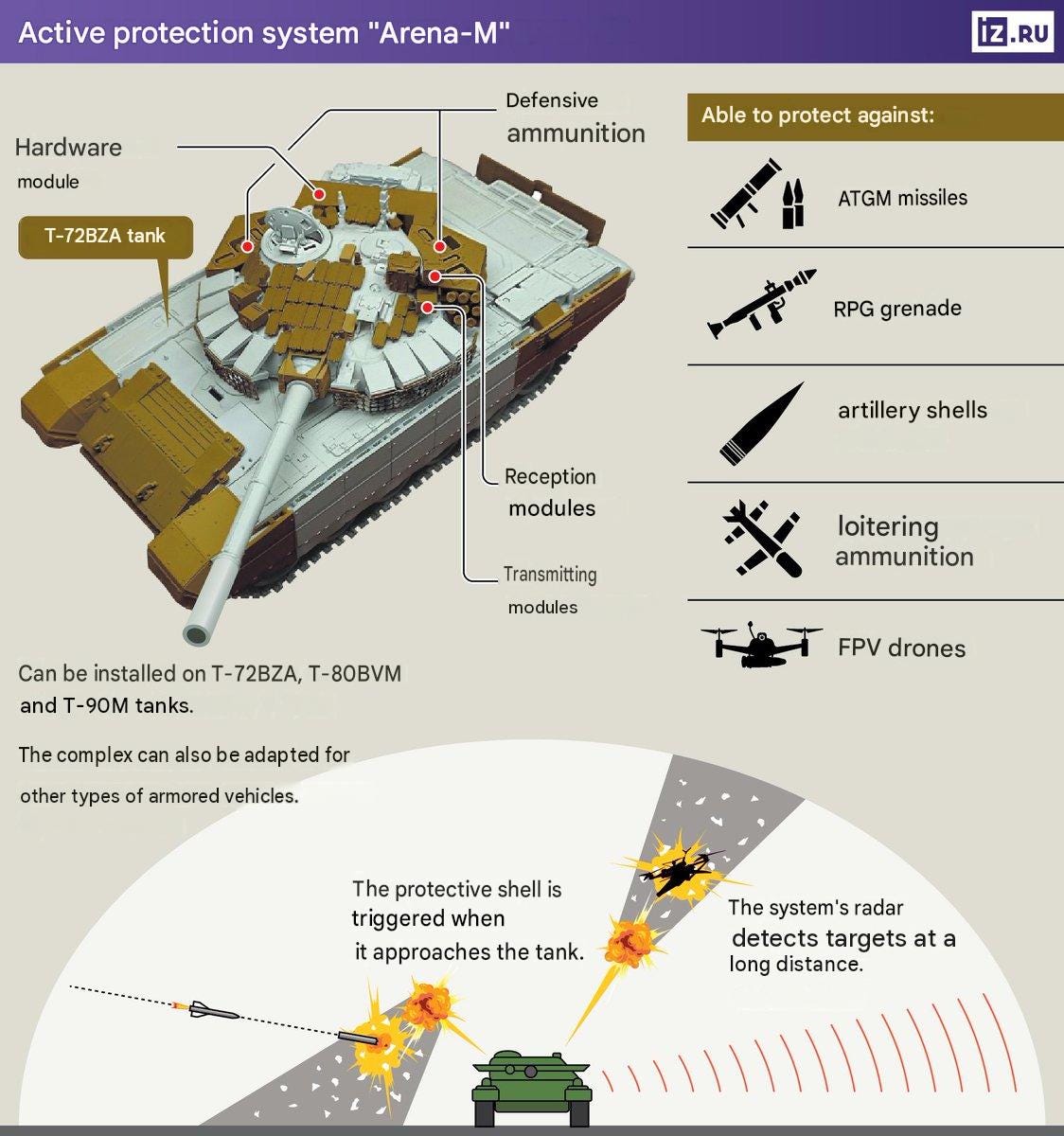
The system works by having a small millimeter-wave doppler radar which detects incoming projectiles and then launches a hard-kill countermeasure that is timed and fused to explode near the tank which showers the incoming projectile with shrapnel.
Now, in a recent assault in the Dobropillya direction out of Shakhove, near Pokrovsk, Russian forces reportedly used tanks with these Arena-M systems for the first time. Footage released by the Azov Corp which defends the area showed one possible shoot down of an FPV drone by the Arena system:
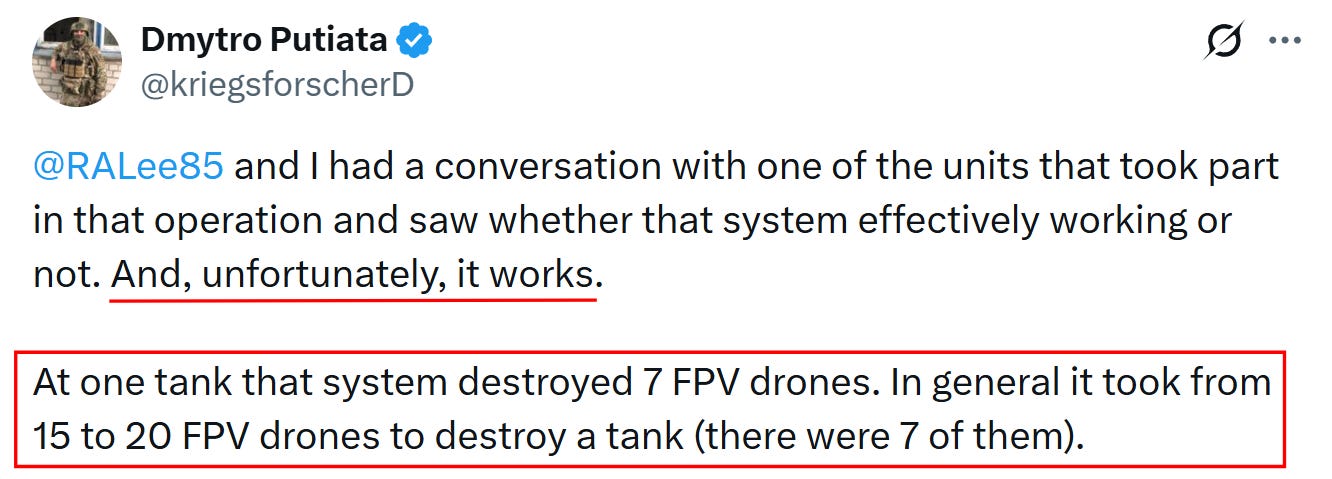
But the shocker was that major pro-Ukrainian figures which included American analyst Rob Lee and a Ukrainian Special Operations veteran Dmytro Putiata spoke to the Azov units involved in the attack and learned that the Arena-M system actually worked remarkably well:
 Etienne de la Boetie2
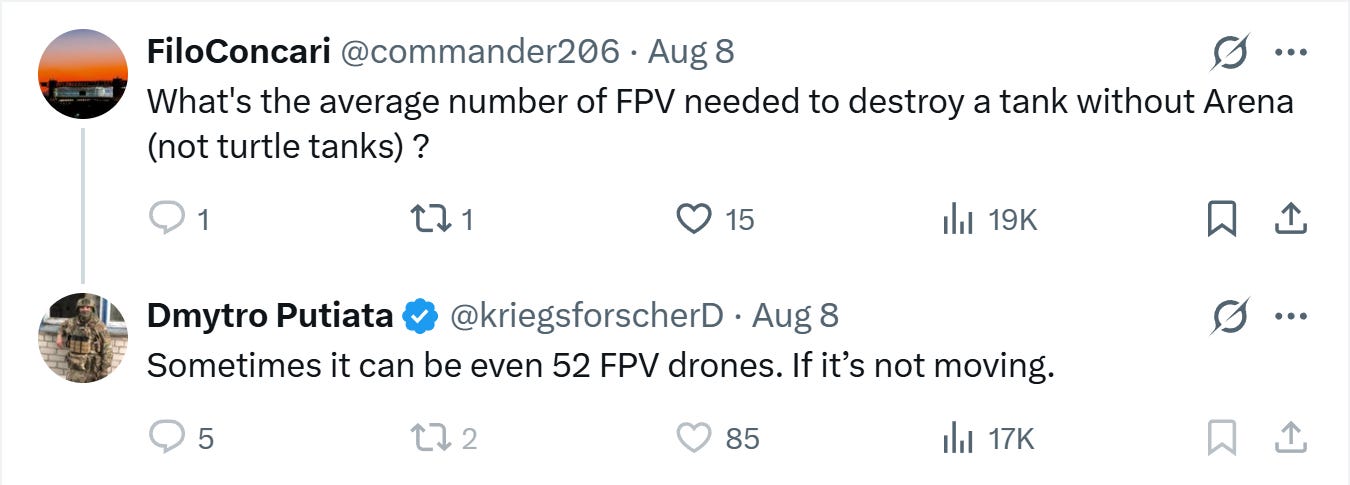
Putiata confirmed the units told him that one Arena system destroyed 7 FPVs and that on average it took up to 20 FPV drones to destroy a tank.
Their original thread was in response to a thread by another Ukrainian tank expert who confirmed that the only reason the tanks were hit was due to the total expenditure of the Arena-M canister ammunition:
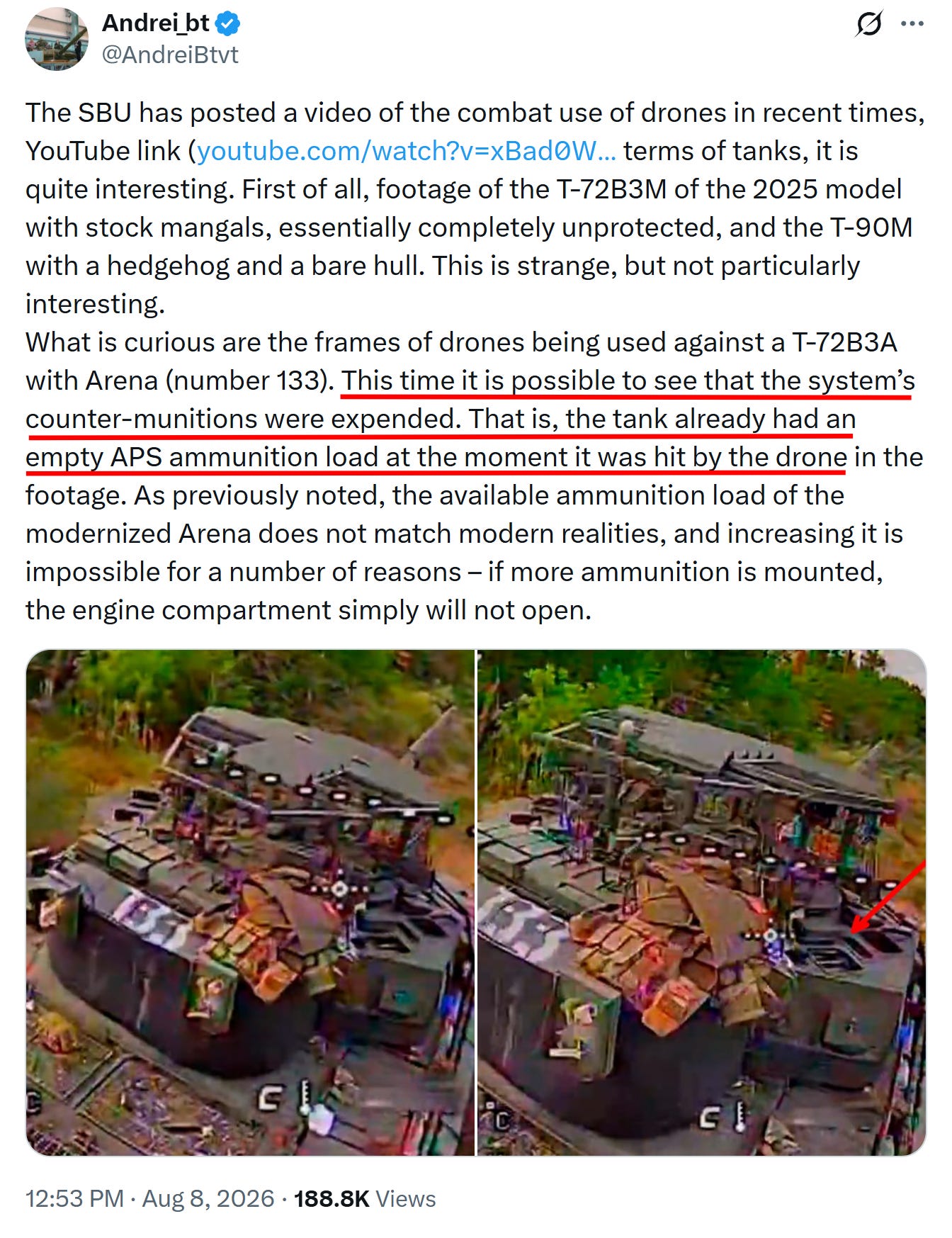
In short, it sounds like the Arena system essentially shot down everything in sight and only after running out of ammo were the tanks able to be hit.
Here is the section of the video posted by the Azov Corps of the Russian attack for reference:
How do we know the canister modules were empty? Because when they have not been shot or dispensed, they are sealed closed like so:
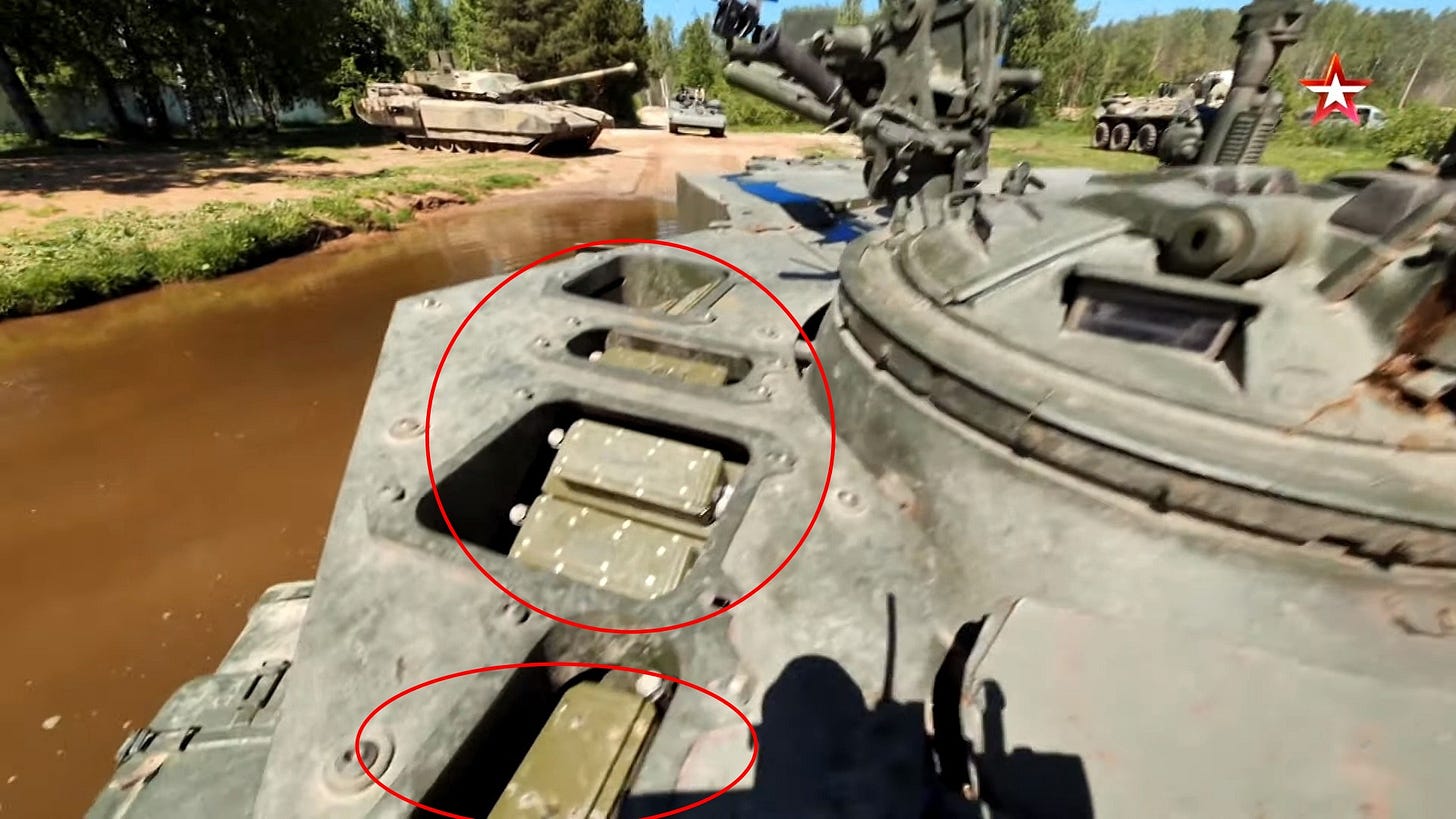
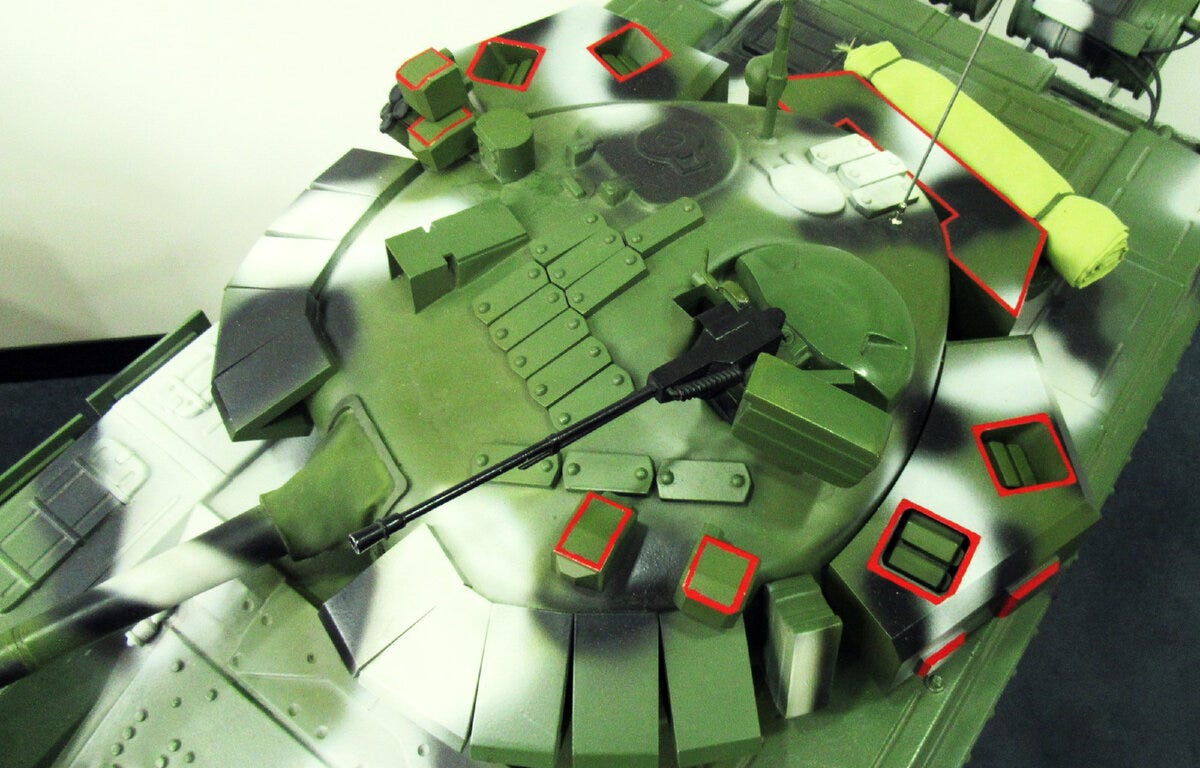
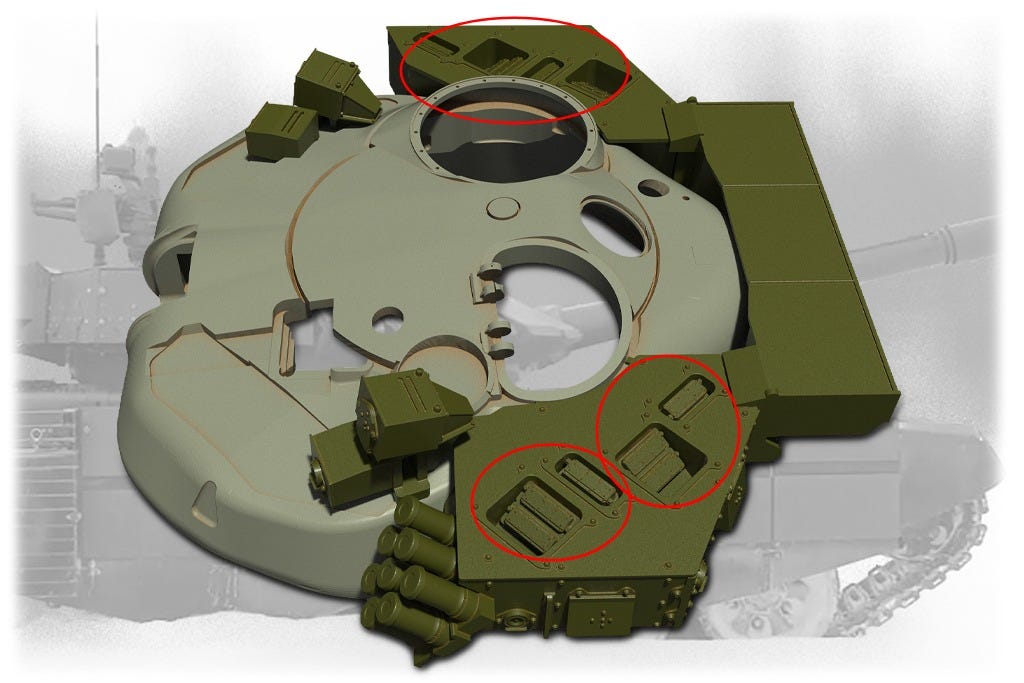
Now look at the screenshot of the video, you can see the modules on both sides are open and empty, because they have been expended:
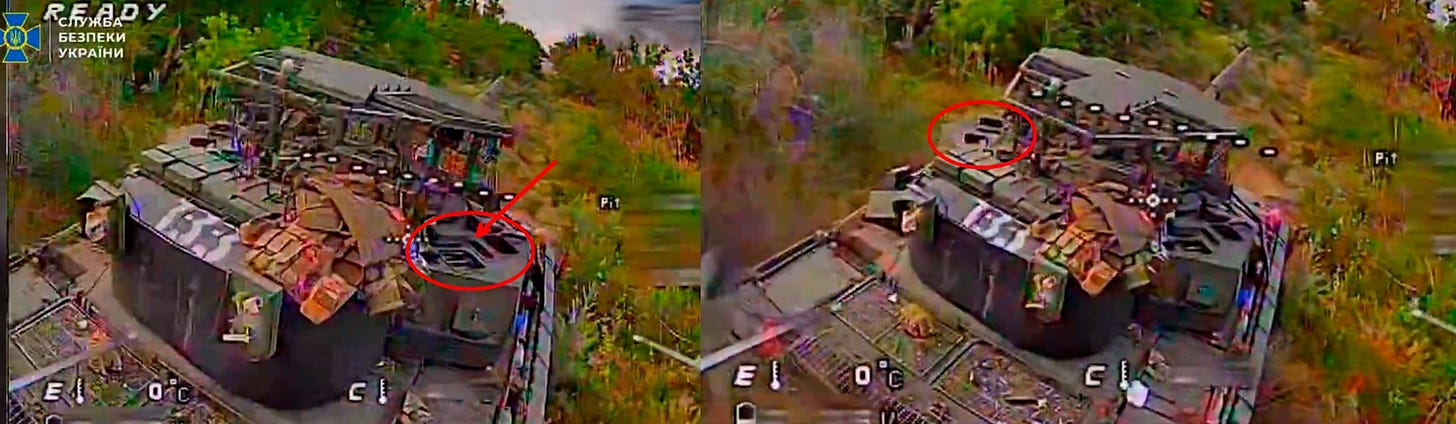
The above Ukrainian tank expert Andrei Tarasenko believes the limited ammunition will not allow the Arena to be useful in modern conditions wherein drone saturation is simply too high. But one can never guess the ingenuity of Russian engineers in figuring out solutions to put more ammo or more launchers themselves on the tank.
Just listen to Zaluzhny’s opening talk, wherein he credits Russian ingenuity in figuring out countermeasures to all of the West’s top systems. The interesting thing about the Arena-M’s now-confirmed success is that the hard kill mechanism is able to do what even the best EW cannot: kill fiber-optic or even autonomous AI-guided drones.
The canister charges cannot be expensive to make themselves, which means theoretically such a system with massive amounts of rounds should be feasible to take out drone after drone from every possible direction. Now imagine several such tanks and perhaps even a dedicated Arena-M vehicle mounted with nothing but these systems traveling in a tighter formation that forms a kind of phalanx “wall” of countermeasures. Nothing would ever be 100% foolproof but it could cause enemy drone expenditures to go through the roof exponentially on each assault.
Russia’s innovations continue to roll out. Multiple Ukrainian outlets reported earlier today that Russia’s native “Starlink” system, known as the Rassvet constellation, has been deploying much faster than expected, as per a top Ukrainian intelligence chief:
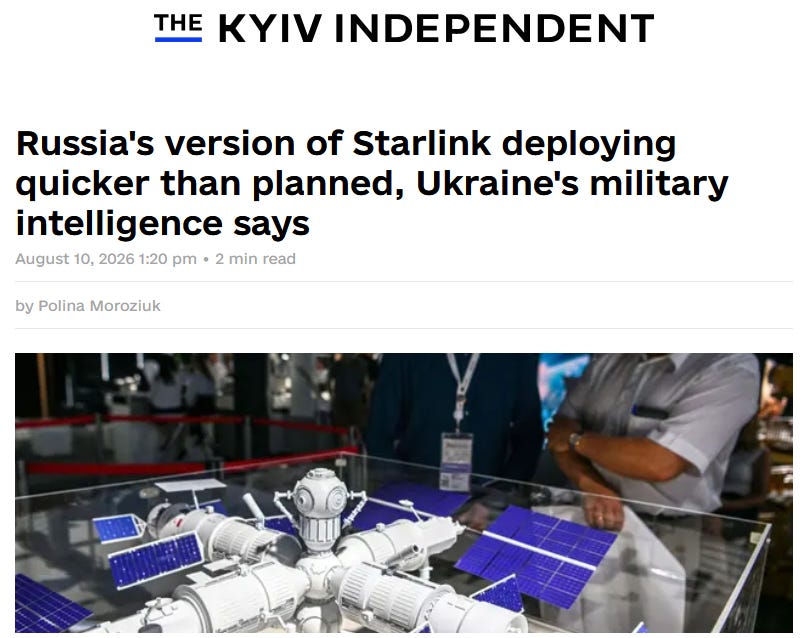
Russia is accelerating the deployment of its Rassvet satellite communications system, a domestic equivalent of Starlink, faster than previously planned, Ukraine’s military intelligence deputy chief, Major General Vadym Skibitskyi, said on Aug. 10.
“Moscow is implementing Rassvet, effectively a Russian analogue of the Starlink system. And they have begun launching it significantly faster than was envisaged in their plans,” Skibitskyi said in an interview with RBC-Ukraine.
As we had concluded in an earlier analysis a week or two ago, intel chief Skibitskyi notes that Russia is now expected to boost the constellation to 292 by next year, which is even more than the ~250 cited earlier as the baseline for allowing Russia to have total 24/7 signal coverage over Ukraine:
Skibitskyi added that Russia plans to build a constellation of 292 satellites by 2027 and expand it to 924 satellites by 2035.
This development has the Ukrainians quite worried:
In an interview with AP published Aug. 10, Commander of the Unmanned Systems Forces Robert “Madyar” Brovdi described the development as a “risk for the entire planet.”
“Because a dictatorship will gain access to information across the whole globe,” he added.
These are certainly interesting developments. In particular the advent and tested success of the Arena-M system could potentially pave the way for a new phase of the war, where the armored assault returns to some form of prominence.
But share your thoughts, will it reinvigorate armored assaults in future offensives, or die out as more of a novelty and test platform due to the simple intractability of the drone swarm issue?


