

The Great Taking Documentary on YouTube, Rumble, Bitchute, and The Liberator (MP4 Download Here)
Get The Book - The Great Taking by David Rogers Webb
Print Copies - you may order paperback or hardcover versions
Download the English version for free in PDF from: The Liberator (PDF download Here)
Official Website: Official English PDF Free Download Here.
Translations: Spanish, Portuguese, Russian, Italian, Turkish, Polish, German and French
I finished David Rogers Webb’s book The Great Taking over the Christmas break. I am embarrassed to admit that while we first reported on The Great Taking in October of 2023, and multiple times since in the Daily News from the Art of Liberty Foundation, it took me this long to really grasp the absolute true importance until I read the whole book. I had assumed I understood what was going on based on interviews I had seen with the author, boil downs, and discussions with others especially Matt White, an Art of Liberty Foundation Advisory Board Member, who has been in the middle of the fight to bring this to prominence and organize resistance. It wasn’t until I finally read the book and watched the documentary last month that it really clicked.
The Great Taking is, quite literally, a 44 Magnum pointed at the face of humanity. There is a hollow point in the chamber and the hammer is cocked and the guy holding the trigger has killed before…
Executive Summary of the Executive Summary
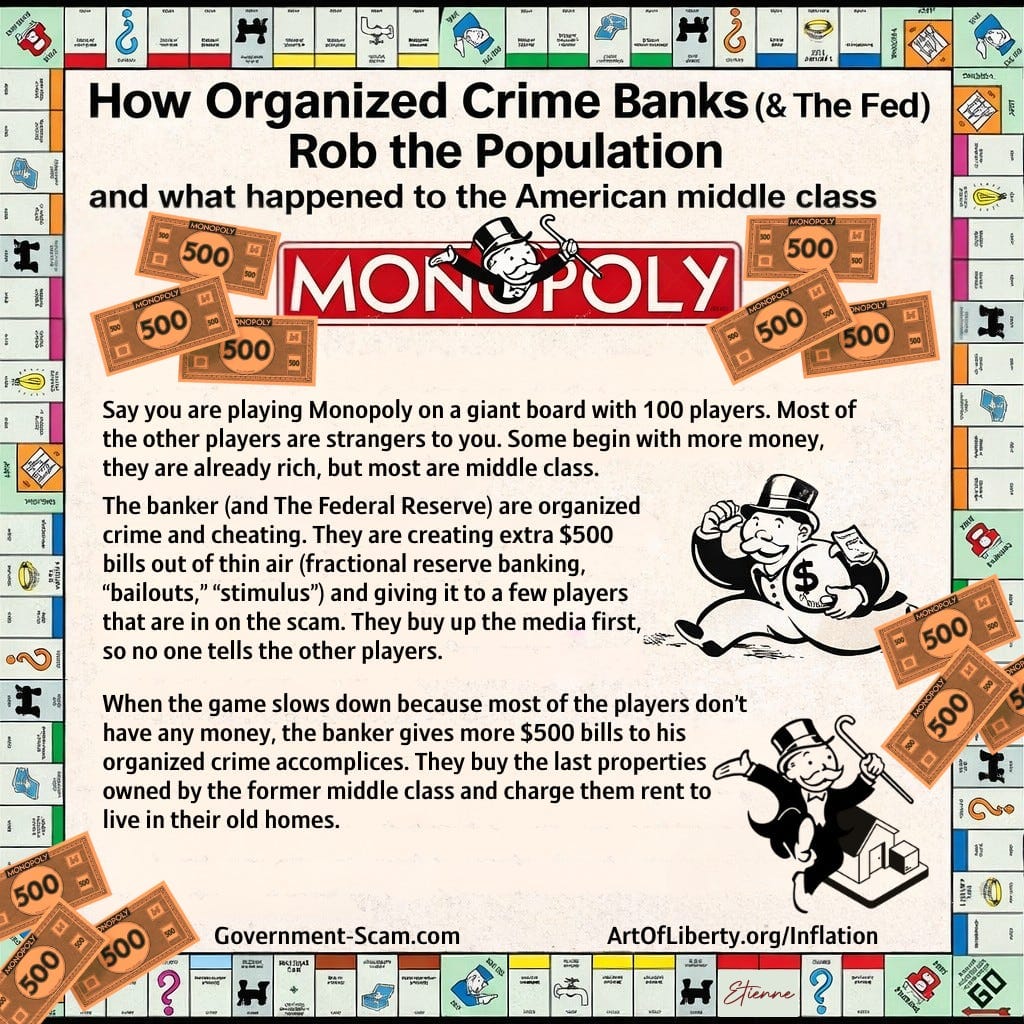
The exact same money center banks and central banks that we are exposing at the Art of Liberty Foundation behind the theft of Trillions through fractional reserve banking, “bailouts,” “stimulus,” and other scams have been working quietly behind the scenes for decades to change the UCC in all 50 States AND engineer the “Dematerialization” of stock ownership from physical stock certificates and a status of private property to electronic ownership and a new legal definition of a “Security Entitlement.”
To quote David Rogers Webb from the book:
“There are now no property rights to securities held in book-entry form in any jurisdiction, globally. In the grand scheme to confiscate all collateral, dematerialization of securities was the essential first step. The planning and efforts began over half a century ago. That there was some great strategic purpose behind dematerialization is evidenced by the fact that the CIA was assigned the mission.
The project leader was William (Bill) Dentzer, Jr., a career CIA operative… even though he had no background in any aspect of banking or finance, he was appointed New York State Superintendent of Banks by Nelson Rockefeller. This came after his nomination to the newly-formed New York State Council of Economic Advisors by its Chairman, former head of the World Bank, Eugene Black. [Etienne Note: In intelligence agency parlance this is called: Creating the Legend]
Interestingly, Black’s father had been Chairman of the Federal Reserve in 1933 [Etienne Note: 1933 was the last “Great Taking,” see below] Within two years of assuming his position as New York State Bank Superintendent, Dentzer was named Chairman and CEO of the newly formed Depository Trust Corporation (DTC), a post he held for the next twenty-two years i.e., through the entire process of dematerialization.
In the case of a financial crisis (or what appears to be the banks setting up an engineered financial crisis for this specific purpose) that would bankrupt fiduciaries such as stock brokers, pension funds, and broker-dealers… then the banks would assume the role of secured creditors and the specific stocks that you currently believe you own in your brokerage account are actually being held in a unsegregated “pool” where they can be electronically swept up through institutions like the Depository Trust in the US and Euroclear in Europe. You “might” eventually get a token settlement in depreciated dollars OR a new Central Bank Digital Currency in a dollar collapse or massive devaluation BUT the ownership of the assets will be taken from you and 98% of other market participants.
The absolute priority claim of secured creditors to pooled client securities has already been upheld by the courts.
The Last “Great Taking” was in 1933
( The Guy Holding the Trigger has Killed Before)
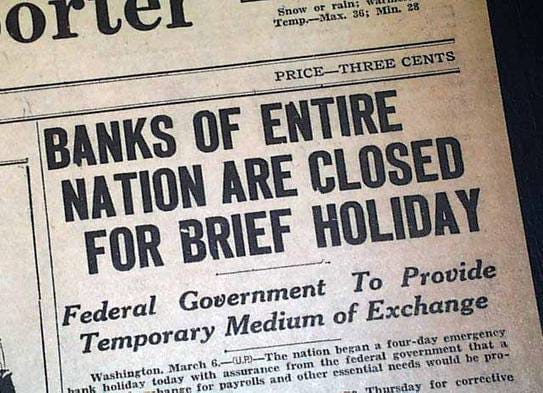
There is also a historical precedent where bankers engineered a financial crisis to steal real assets using “government” and “legislation” during the great depression.
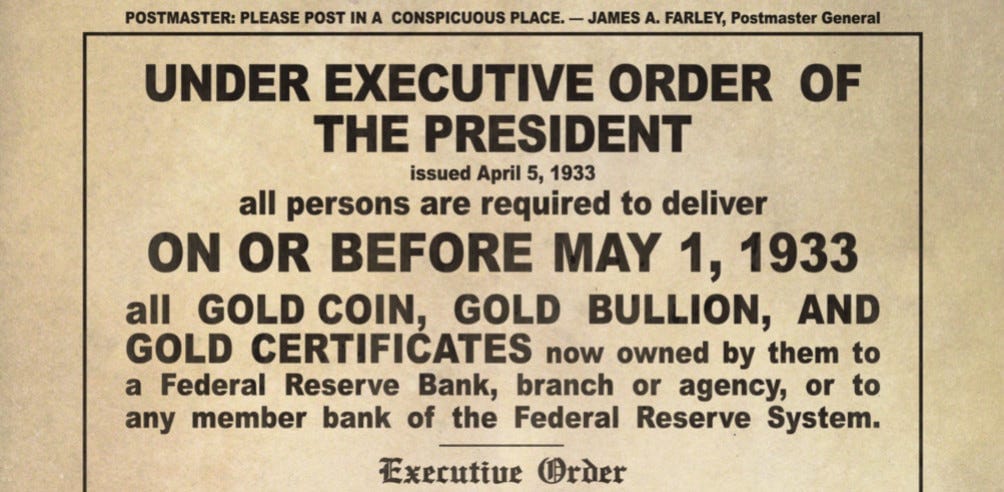
In 1933, the organized crime “government” confiscated the American people’s gold coin and bullion through Executive Order 6102 in a move that opened up the organized crime “banks” to be able to create unlimited fiat paper tickets and digital dollars through fractional reserve banking even though the process is inflationary and steals the value out of everyone else’s money.
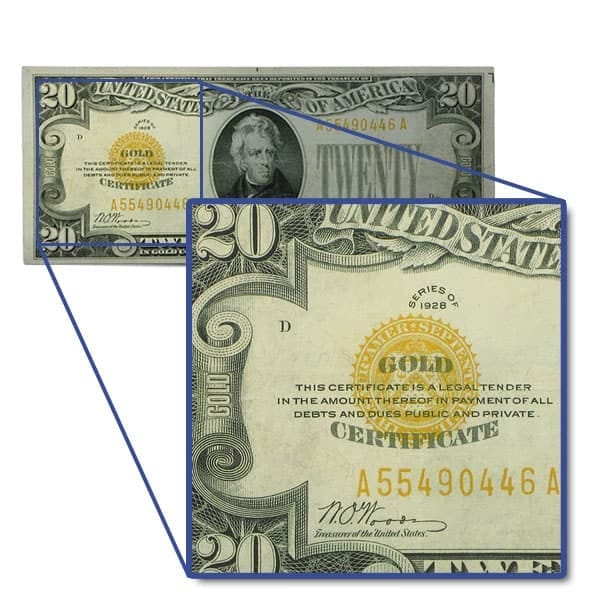
Prior to 1933, US dollars functioned as “warehouse receipts” for gold coin that was held at banks so you wouldn’t have to haul around the actual heavy gold. A US twenty dollar gold certificate was redeemable for a $20 one-ounce St. Gaduins Coin
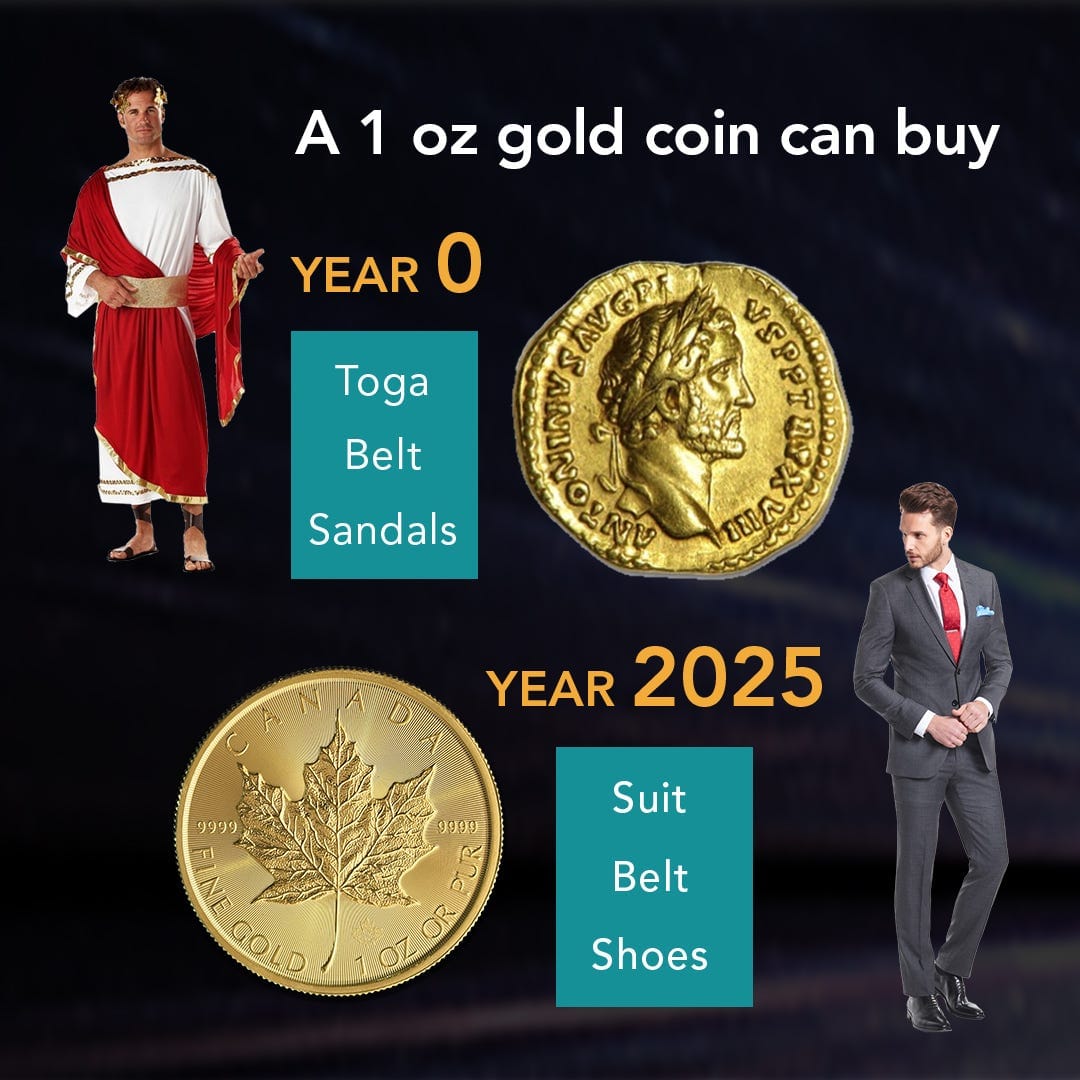
The Roman 8 gram Aureus pictured above would buy a finely tailored toga, belt and sandals. In 1933 the 30 gram St. Gaduins Double Eagle gold piece (or its $20 gold certificate/warehouse receipt) would buy a finely tailored man’s suit, belt and shoes. If you had buried the $20 bill and $20 gold piece in the ground in 1933 and dug them up today, a one ounce gold coin (absent its numismatic value) is worth $4,965 dollars which will still get you a finely tailored man’s suit, belt, and shoes. The $20 bill won’t buy crap. The difference is what has been stolen through fractional reserve banking, “quantitative easing”, and US Treasury unbacked printing press & digital dollar creation.
The $20 gold coin wasn’t cable of being printed on a printing press or created digitally so it kept its purchasing power which was good for people who owned, saved, and invested dollars.
BUT the organized crime “government” and banks couldn’t finance their wars, campaign promises, and no-bid contracts with cronies.
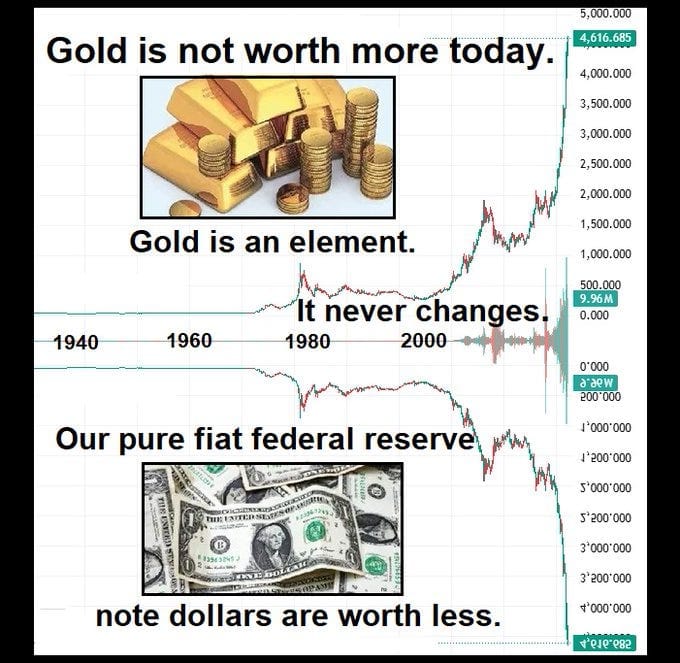
It appears the organized crime banks paid off the organized crime “government” to steal everyone’s gold so they could move to a system where the banks could create unlimited fiat paper tickets that the organized crime “government” mandates for the payment of all debts and taxes.
The organized crime “government” forces you to use the bankers money even though the system is inherently dishonest, stealing the value out of the dollars you earn and save, and dramatically limiting the prosperity that honest money would provide.
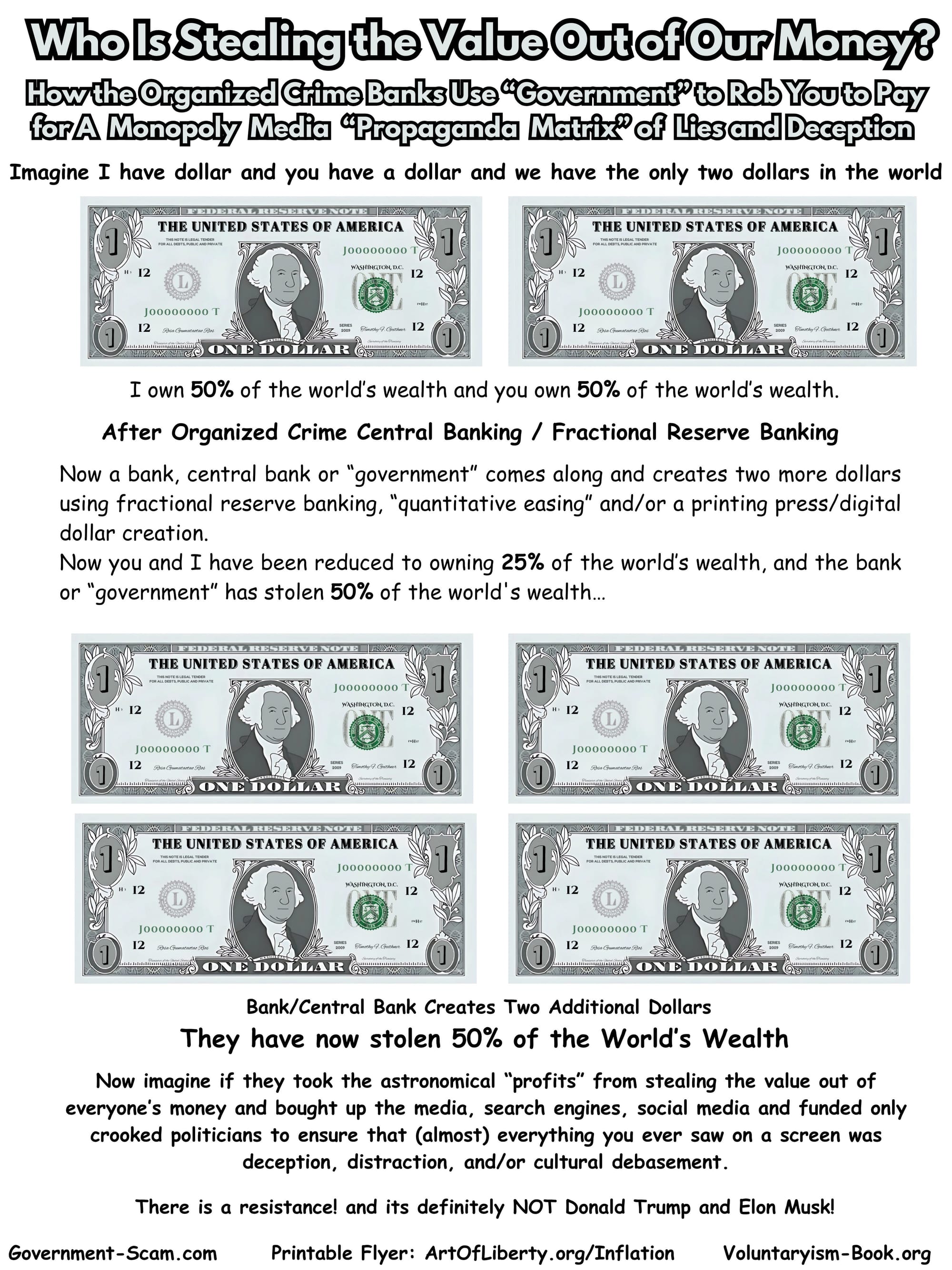
You Can Download and Print Copies of Our Flyer Explaining the Theft of Fractional Reserve Banking Here: ArtOfLiberty.org/inflation
Ryan McMaken (and John Chamberlin) Break in Down the theft of Gold in in the Mises Institute Article: The Gold at Fort Knox Was Stolen from Americans
“Arguably, it was a default, in the broad sense, when Roosevelt’s regime refused to make good on its obligations to dollar holders under the gold standard. The US also defaulted in a formal and legal sense when it refused to pay its World War I Liberty Bonds in gold as promised. Specifically, in 1934, the United States defaulted on the fourth Liberty Bond. The contracts between debtor and creditor on these bonds was clear. The bonds were to be payable in gold. This presented a big problem for the US, which was facing big debts into the 1930s after the First World War.
As described by John Chamberlain:
By the time Franklin Roosevelt entered office in 1933, the interest payments alone were draining the treasury of gold; and because the treasury had only $4.2 billion in gold it was obvious there would be no way to pay the principal when it became due in 1938, not to mention meet expenses and other debt obligations. These other debt obligations were substantial. Ever since the 1890s the Treasury had been gold short and had financed this deficit by making new bond issues to attract gold for paying the interest of previous issues. The result was that by 1933 the total debt was $22 billion and the amount of gold needed to pay even the interest on it was soon going to be insufficient.
So how did the US government deal with this? Chamberlain notes “Roosevelt decided to default on the whole of the domestically-held debt by refusing to redeem in gold to Americans.” [Etienne Note: Which simultaneously benefited the banks by opening up the ability for them to engage in fractional reserve banking backstopped by the privately owned Federal Reserve which was owned by some of the banks themselves]
In other words, thanks to its profligate deficit spending, the US government was running out of gold by the early 1930s. So, the regime defaulted on the gold bonds. The gold that would have passed into private hands was hoarded by the federal government and declared off limits to the public. Much of that gold remains in the US gold reserves today.
The organized crime banks behind the Federal Reserve System, whose corrupt founding is chronicled in the award-winning book: The Creature from Jekyll Island: A Second Look at the Federal Reserve (PDF from The Liberator: Here) by G. Edward Griffin, benefited from The Emergency Banking Act passed on March 9, 1933 (just 3 days after the “government” shut down all banks with a mandatory Bank Holiday began)
What The Emergency Banking Act did:
Gave the President power to regulate banking during emergencies
Retroactively authorized the bank closures that FDR undertook without any legal justification.
Authorized the RFC (Reconstruction Finance Corporation) to buy preferred stock in banks (essentially bailouts)
Allowed the Federal Reserve to issue emergency currency backed by bank assets
Created a three-tier system for reopening banks:
Class A: Sound banks - reopened immediately
Class B: Banks needing help - could reopen with RFC assistance
Class C: Insolvent banks - remained closed for liquidation or reorganization
The Emergency Banking Act of 1933 and the Bank Holiday associated with it collapsed thousands of banks into insolvency and only Federal Reserve Banks and banks selected by and licensed by the Treasury or state banking commissioners were allowed to reopen. This consolidated banking into a small handful of banks that have been further consolidated into a small handful of, essentially, monopoly institutions today.
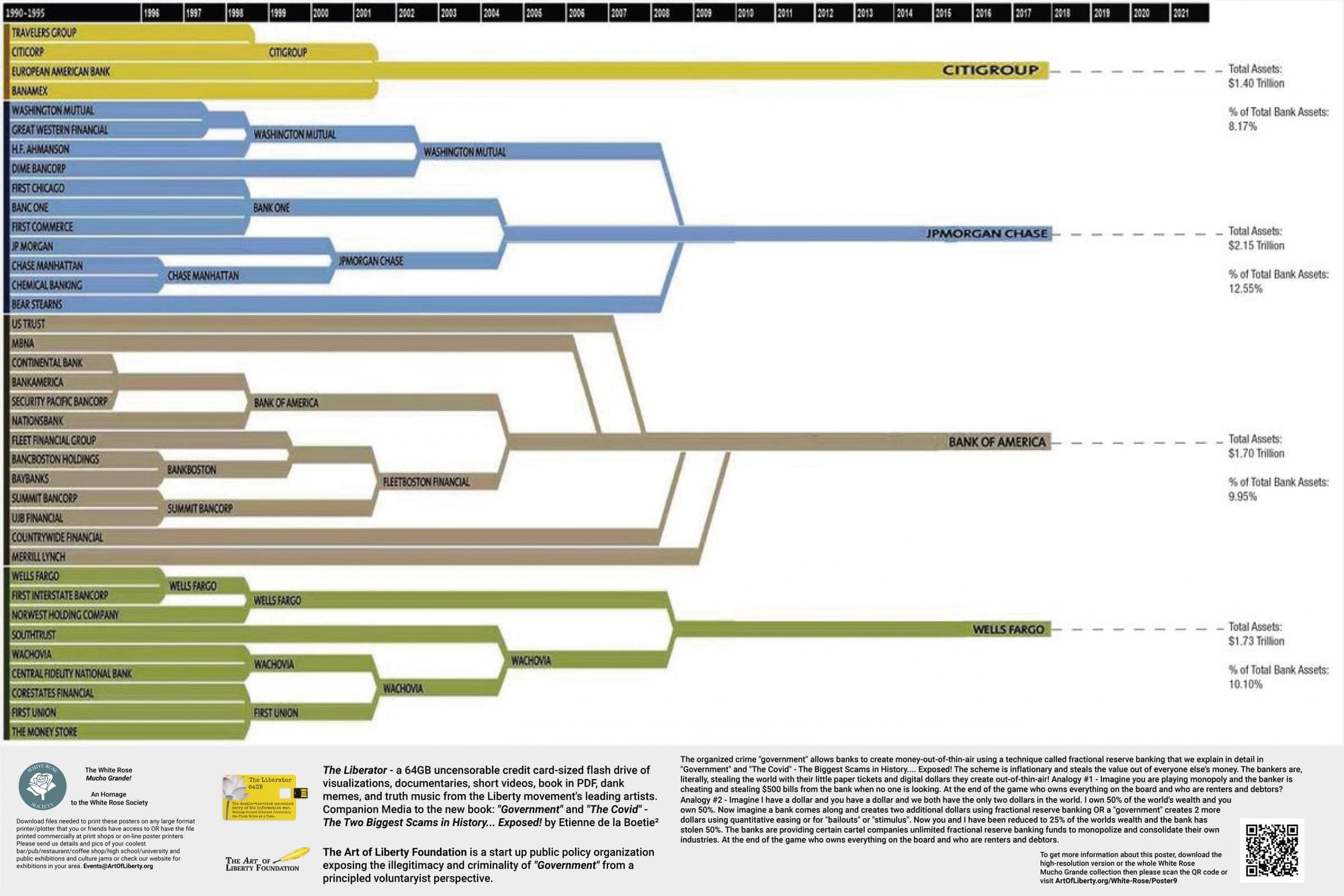
The Monopolization of the Financial Industry Over Time - From our White Rose MUCHO GRANDE collection - This is Poster #9 which you can download from The Liberator in both High-Res JPG and High-Res PDF
In 1964 The Organized Crime “Government” and Banks Stole Everyone’s Silver
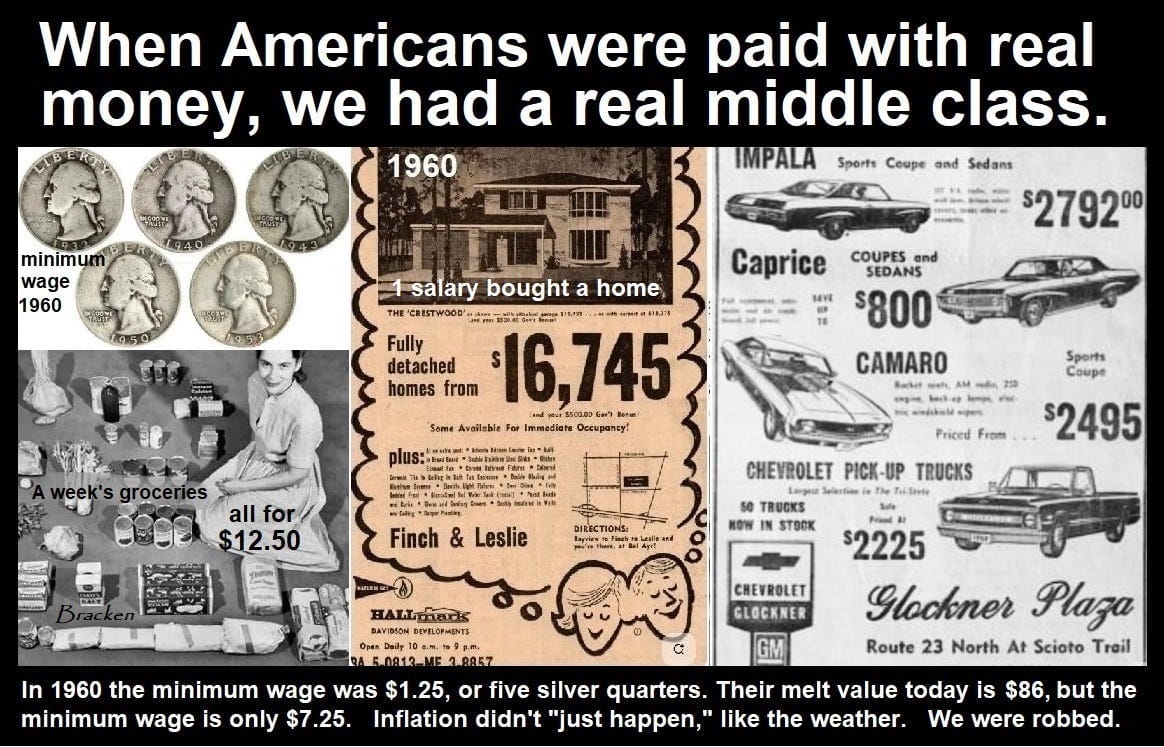
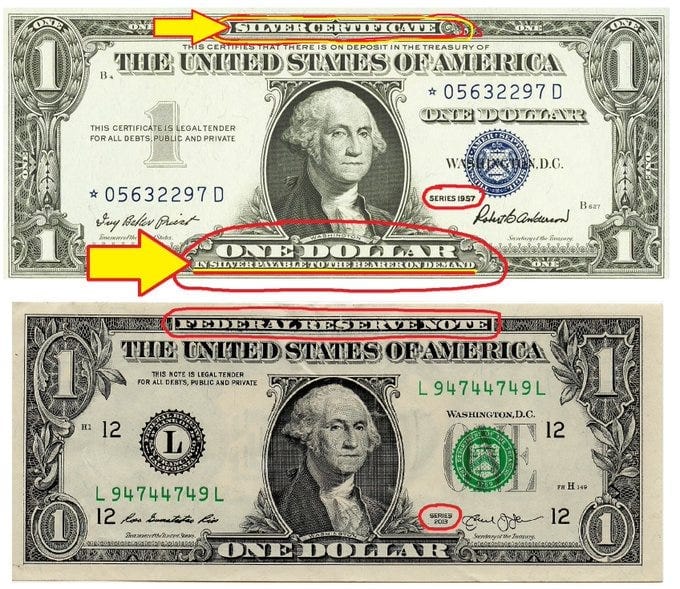
In 1965 there was another “Great Taking” where the organized crime “government” stole the silver out of the American people’s coins further debasing the dollar. The “government” instructed their accomplices in banking to send the silver to the treasury and then replaced the REAL silver coins with the base metal tokens that we use today.
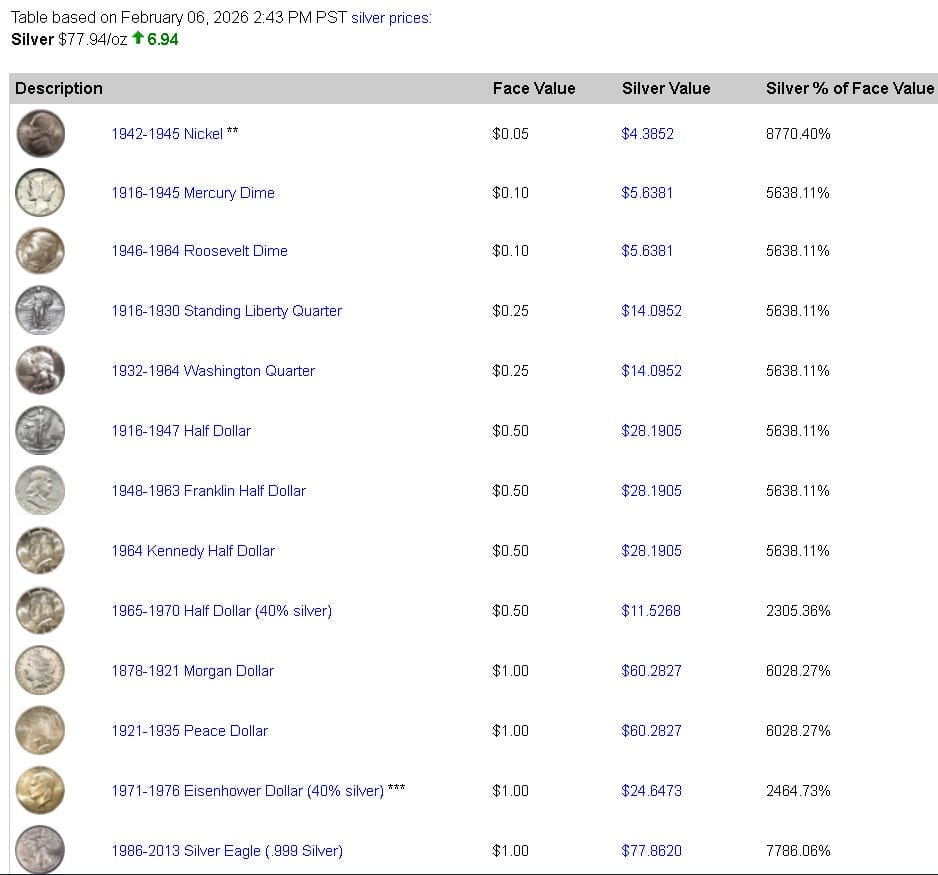
In this chart by the website Coinflation.com, you can see the current price in silver for pre-1965 nickels, dimes, quarters, half-dollars and silver dollars. Today the Nickel is the only US coin actually worth its weight in metal. Every other US “coin” (they are technically “tokens” now) is not worth the face value of the coin in the metal that it is made of.
So… the monopoly organized crime banks and “government,” who have killed multiple times before, appear to be setting up another engineered “Great Taking” and this is the 44 Magnum that is loaded with hollow points, cocked and pointed at the face of humanity.
Why Would the Bankers Collapse Everything?
Two Reasons:
1. They Are Being Exposed - The developing alternative media and honest public policy organizations like the Art of Liberty Foundation are slowly and surely cutting through the Propaganda Matrix of monopoly media (and Mainstream Alternative Media!), controlled opposition, and algorithmic manipulation and exposing the scam of “government” and the theft of trillions through fractional reserve banking, “bailouts,” scams like “The Covid,” and weapons we don’t need to fight foreign wars based on lies and manufactured intelligence,
If the posse has figured out who robbed the bank and is saddling up to ride after the thieves, do the banksters want “the posse” well capitalized OR dead broke living in a militarized police state with programmable digital money, a Chinese-style social credit score system, and the ability to turn off truth tellers ability to publish evidence on the Internet using biometric digital IDs?
2. The System Is/Has Been Inherently Unstable and Destined for Ultimate Collapse – Once the financial system was moved off of hard money to little paper tickets and digital dollars that could be created by private organized crime banking interests, it was, essentially, doomed to eventual collapse. With $846 Trillion of derivatives (Gross Notional Value) according to the Bank for International Settlements / $231 Trillion for US-based banks, and the eventual exposure of what I believe are straw purchases (2014 Belgium Example) (and open purchases!) by the Fed of US Treasury Bonds, Bills, and Notes, the hand is already writing on the wall! I believe this is the banker’s plan to manage the collapse by engineering and initiating the collapse on their terms.
The engineered collapse and The (2nd) Great Taking allows them to scoop up all the independent, private wealth of the world so no one can afford to organize resistance against them. It also gives them the engineered reason to bring in Central Bank Digital Currencies (CBDCs) or another version of programmable digital money that would allow them the ability to turn off dissidents, truth tellers, and the alternative media’s ability to buy and sell and confiscate their savings the same way that Canada did with the truckers protesting the scam of “The Covid.”
What Can Be Done
1. A Complete Investigation into Who was Behind the Engineering of this from the Beginning - Starting with CIA Operative William (Bill) Dentzer Jr., Nelson Rockefeller and CIA Director William Casey) to the specific lawyers and lobbyists opposing honest legislators in states like South Dakota and Tennessee.
Who Is Leading the Fight
TruNorth Public Policy – Organizing grassroots action on a state-by-state basis to change Article 8 in the UCC in each state to restore some property rights for investors. They have worked with legislators in both South Dakota and Tennessee to provide model legislation that would change the UCC code in each state.
The Art of Liberty Foundation – We have been exposing this since 2023, but are planning to crank up our efforts now that I have a better understanding after completely reading the book.
State Sovereignty Groups (e.g., Tennessee Conservative, South Dakota Citizens for Liberty):
Strategy: Ballot initiatives/referendums. TN: “Protect Property Rights from Unsecured Creditors” (2026 ballot push). SD: Similar UCC reform petition. Grassroots door-knocking/email campaigns; lawsuits vs. SOS rejections.
Allies: Local reps (e.g., TN Rep. Monty Fritts sponsoring bills).
The Best “Go Paid” Deal on Substack! You Get REAL Stuff!!
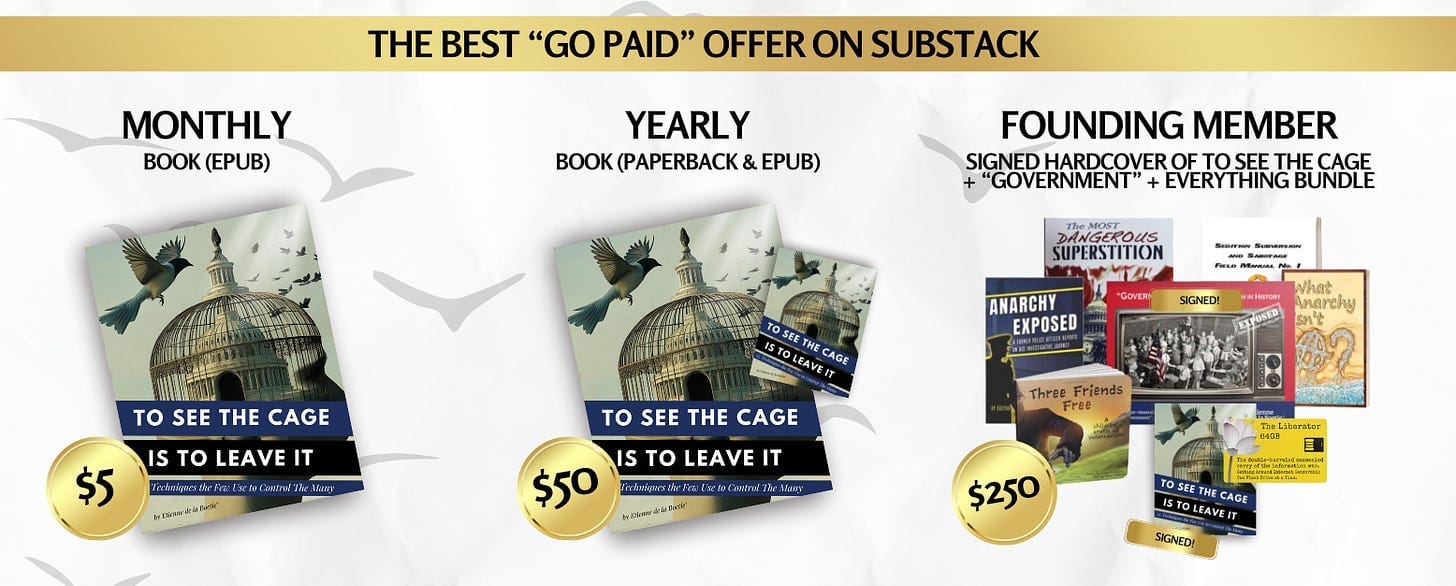
Go paid at the $5 a month level, and we will send you both the PDF and e-Pub versions of Etienne’s new book: To See the Cage Is to Leave It - 25 Techniques the Few Use to Control the Many and a coupon code for 10% off anything in the https://artofliberty.org/store/.
Go paid at the $50 a year level, and we will send you a free paperback edition of Etienne’s new book: To See the Cage Is to Leave It - 25 Techniques the Few Use to Control the Many OR “Government” - The Biggest Scam in History… Exposed! OR a 64GB Liberator flash drive if you live in the US. If you are international, we will give you a $10 credit towards shipping if you agree to pay the remainder.
Support us at the $250 Founding Member Level and get a signed high-resolution hardcover of “Government” - The Biggest Scam in History... Exposed! + Liberator flash drive + a signed high-resolution hardcover of Etienne’s new book: To See the Cage Is to Leave It - 25 Techniques the Few Use to Control the Many + everything else in our “Everything Bundle” of the best in voluntaryist thought delivered domestically. International pays shipping. Our only option for signed copies besides catching Etienne @ an event.
What is Behind the Paywall Today?
The Complete Transcript of The Great Taking Documentary
Complete Transcript from the Documentary: The Great Taking
My name is David Webb. I live in Stockholm, Sweden; I’m on a small farm here. It’s important to understand I am not giving financial advice; the book I’ve done has a greater purpose than that. I am not active in the markets, I’m not short the market, and I am in things like farmland.
I was managing public equities and, ultimately, hedge funds through the aftermath of the Asian financial crisis, the lead up to the dot com bubble and bust. And I noticed that fund flows were very large relative to the size of the U.S. economy, for example, or the global economy. So, I started to look at the scale of money creation by the Federal Reserve, and I developed the insight that the Fed was actually influencing the financial markets, which no one would be surprised at today. But at that time, it was considered conspiracy theory, even by my partners. This was something I could not talk to people about, but I began studying it myself.
And I saw that in individual weeks, the scale of new money created was on the order of 1% of U.S. GDP or more. Now, what that meant—given that the U.S. economy was growing at maybe 3 or 4% in a good year—to have money creation on that scale in a single week, it meant that the money creation was far outstripping any real economic growth. So, the transmission mechanism from money creation into real economic activity was breaking down. This is when I started becoming concerned, and started following this closely, and it actually developed into a way for me to navigate the markets. So, I applied it, and I managed to protect people who I was responsible to as my clients through the dot-com bubble and bust, and did very well through that period, armed with this understanding.
But the bigger understanding was that the velocity of money was collapsing. And I knew at that time—this is over 20 years ago—that we were headed into something like the time that the world experienced through the period of the Great Wars and the Great Depression, because this kind of velocity of money was occurring at that time. So, I went into this deeply and studied everything that was happening leading into the 20th century, saw that this provided the best analogous period for understanding what we were entering then. So, I have followed this very closely. I have applied it in my work, in what I was doing, so I had an effective understanding of it.
The important thing to understand now is that the velocity of money—which is the relationship between economic growth and money, or money creation, money supply—has broken down and is now at a lower level velocity of money than it was at any point during the Great Depression and the World Wars. So, I believe that this is actually the profound underlying reason for the many things that we are seeing geopolitically.
I grew up in a family of medical people and engineers. They were not involved in high finance. As a boy, I went through, basically, the beginning of the industrial collapse of Cleveland. They say that people strive to get control over what has hurt them. And I grew up with a real need to understand what was destroying us, because it deeply affected my family, which had been very happy prior to this—a happy, benevolent family—and it literally destroyed the place where I grew up.
So, I decided to study business and finance. This was something my father did not want me to do; he thought I should be an engineer. And when I was younger, I thought I would have been a medical doctor. But this became the pressing thing for me to understand. So, I studied finance and computer science.
I got a subscription to the Wall Street Journal. I had no one to guide me; I just started looking at the Wall Street Journal and I noticed these tombstones, which announced the big mergers and acquisitions deals or financing, that all these firms were in New York. So, I decided at a young age I needed to go to New York, and I got a job with a computer services firm. I could program; I had studied systems analysis and finance. So, in this first year as a young guy, I went into, perhaps literally, every financial firm in New York City with the sales teams.
So, that helps a person, I think, to begin to understand things on an intuitive level just by seeing things. It’s not so intimidating once you’ve been into these places. Things are intimidating if you’ve never encountered them. So, that all happened in my first year. And then, one of my clients, which was a mergers and acquisitions group, their two analysts were leaving. One was going to Harvard Business School, the other was going to the London office, and the sales guy that I worked with on that account came back and told me that they needed someone with a background in finance and computers. And I realized at that time that was going to be me.
So, I talked with my wife about it. I showed up at this office so early the next day, nobody was there. I had to wait about an hour for people to start coming in. And they were shocked that I thought that I had any business suggesting that I could work there. They proceeded to put me through a shocking, stressful morning. I was ushered into one of the senior vice presidents, who listened to what I had to say, and then he said, “well, you better be sure you want to do this, because if you fuck up, you’re gone.” By the time I left, I thought, maybe this wasn’t such a good idea; I probably shouldn’t have bothered. You know, sure enough, they called back. They needed me because I knew how to do things.
So, I worked in M&A, mergers and acquisitions, for five years in this firm. It was working literally around the clock, sometimes for days with no sleep, or maybe just lying on the office floor for half an hour to get up and continue. So, I learned to deal with a lot of stress with little sleep through this period of time. And then, I managed to move to what was then the biggest private equity firm in the world by an order of magnitude. I chose to go there rather than stay. I had another offer from a mergers and acquisitions group at L.F. Rothschild that would have been for about twice the compensation. But I sensed that there was going to be a crash of some kind. And a month later was Black Monday, October of ‘87, and LF Rothschild was wiped out—lost all of its capital.
I really went to this private equity firm because, when you’re doing M&A, it’s basically being a glorified salesman. You’re an agent. When you’re in the shoes of the private equity investment firm, you are the principal. It’s a different kind of due diligence and analysis. And I was there for three years, but it was a very intensive three years. And shortly after I had started with the firm, I ended up running the acquisition of this long distance telephone company. I handled all of it because the partner on the deal had difficulty with stress, and he literally went home and stayed in bed for six months. I handled all the due diligence, which was very complicated, and the financing. And it ended up being the largest capital gain in the history of the firm. But it was very stressful for my family because, once again, I was working around the clock. I would get up to negotiations on Saturday morning, late into three in the morning Saturday night, sleep for a few hours, start again on Sunday morning.
This went on for nine months. When it was over—it took a few months—but my wife eventually said to me, “you know, if I knew our life was going to be like this, I wouldn’t have signed up for it.” And that just crushed me. I got out a road atlas of the U.S.; we went through it page by page and just thought about where could we go, where could we be happy. I couldn’t stay in that. There was a possibility I would go to their London office, but I knew that would even be more intense—it would just be more of the same. Once I’ve done something, I don’t need to keep doing it; I learn what I have to learn from it.
I think I am different than other people in this financial world because I actually don’t care about the money. That is not why I’m doing it; that should just kind of fall out of what you’re doing. And you don’t need a lot of it—there’s no reason that you need more and more and more. I was always driven by understanding things, and that actually gave me an advantage: I understood things that other people didn’t.
So, ultimately, we just decided to go back to Cleveland, where I grew up. And we bought a house that was within the sound of the church bells where my grandfather’s house was. My memory from Sunday is when my dad would take us to grandpa’s house. So, it was really going home to try to make things sane, but the intensity returned. Again, as I got into managing in the public markets, I had this insight that the public markets were even less efficient than the private markets, because you had these big fund flows that were pushing things way up beyond where a negotiated deal would never be done, and driving prices down below where it would be done. So, you got better opportunities to both buy and sell things.
I ended up ultimately running this hedge fund strategy that I created. So, I designed the trading desk, I trained the people, and developed this team trading strategy. Through the dot-com bubble and the bust, we were typically in three to 400 positions at the same time. I had developed a strategy to be short the market using hundreds of positions so that, with all these crazy dot-com stocks, no one position could kill us. But with all of these positions, we had a kind of visibility into the market, the fund flows, and what was happening. We were doing exceptionally well. People couldn’t figure out how we were doing so well.
So, we had these consultants coming from literally all over the world, flying into Cleveland, coming to the office. The macro thing I was looking at was this rate of money growth; it’s always growing, whether it was accelerating or decelerating. And I knew we had maybe a day or two lead time, once I saw the figures, to get positioned ahead of the market rolling over or the market accelerating upwards. And other people didn’t understand this. Even if I explained it to them, they didn’t want to hear about it; they didn’t know how to apply it. It was like that.
In addition to that, I’ve always operated with a mental model of what is happening in the world. And I suppose I’m different than other people in that the things I pay attention to is what does not fit my model. That is what can kill you. So, I pay attention to what does not make sense to me, what does not fit. You have to drop everything. Imagine you’re in a highly leveraged position with hundreds of positions—when something comes up that does not fit, you pay attention to that immediately. So, the trading room was a newsroom, a research operation; so we paid attention to things second by second, and we would dig into things that did not make sense.
So, through this period of time, I also started changing, I think, as a person, because I was seeing things that were not in the narrative—the news narrative—that people were accepting about what was happening. So, I knew that economic data series were being changed. This is after September 11th, as well as all the disconnects around September 11th itself. So, it was the beginnings of my becoming a kind of activist, although I didn’t know it. I wrote quarterly letters to my clients, so I assembled things on my desk. They would accumulate, and I eventually had something like a thick telephone book of just the things that I knew and had documented that did not conform with the accepted narrative that people were being shown through the media. And I then thinned this down to a thinner telephone book and literally started going door to door to my neighbors. And what I was doing was I was seeing how I could get through to people. How could I explain this? And it’s damn difficult.
Basically, it doesn’t work. I decided that maybe my neighbors were too well off to be able to hear about this. So, I actually went out to a poor area and a guy was sitting on his front porch and he was interested in what I was doing because I was still in a business suit. I explained it to him and he just said, “good luck man,” in this voice of someone who really knew already and had a kind of resignation that there wasn’t much you could do about it.
So, it’s been a long journey for me trying to expose things. I was expecting that there were going to be large-scale insolvencies after the housing bubble. I was aware of what happened during the housing bubble and how that was engineered. In 2003, I met with George Soros. I showed him a chart of the growth in asset-backed securities, and I told him that this would be the basis of the next bubble and collapse. And he said to me, “you’re crazy.” So, he either did not know that or he did not want to acknowledge it at that time in 2003.
So, what was happening was tremendous growth in the derivatives complex. So, I started becoming concerned about derivatives in the very early 2000s, in the aftermath of the dot-com bubble. At that time, the derivatives complex was about twice global GDP. By 2007, it was 10 times global GDP—that growth in maybe five or six years. So, the financialization was outstripping any real thing on earth already at that point.
And this growth in asset-backed securities, what was happening was that the process of doing any credit underwriting, the moorings had been slipped. And this was done by design. Prior to this, banks would do credit underwriting, meaning they would want to get repaid for money they had loaned. So, they would do some analysis of whether the borrower could repay it. But during this period of time, the banking industry went to securitization of loans. So, it became a business of originating loans without any concern as to whether they could be repaid.
The loans were all packaged up, whether they were AAA loans or subprime loans, boat loans, car loans, anything. These pools were stratified. Now, if you think of it, you had a top 20%, the next 20%, and so on down to the bottom. And the idea was that any defaults would hit the bottom rated tranche first. So, for the defaults in that pool to reach the top of the pool, the top 20%, you’d have to blow through 80% of all the capital in the pool. So, the top was rated AAA; just structurally, they could do that.
The problem was no one wanted to buy the lower rated tranches. So, they then used an aspect of the derivatives market—the credit default obligation, CDO—to buy the default protection for the lower rated tranches. Then they could sell the entire pool as AAA. So, this was done through, as Greenspan called it, the miracles of modern finance. And he said, presumably, the risk will be borne by those best able to bear that risk at the time.
So, because it could all be sold as AAA and the yields were better than treasuries, and the Fed was creating so much liquidity, these pools were then sold 10 times over on a modeled synthetic basis, also in the derivatives market. And so, while the banks knew that they did not want to eat their own cooking, the stuff that they had originated, they were buying the assets. This is the nature of a bubble: the people that know it’s a fraud are still consuming the stuff that is being created through the same process. So, the asset side of the balance sheets of banks were these securities that were being created through the same process; it reached a point where credit default obligations alone were about 10% of the derivatives complex.
By the time the Great Financial Crisis kicked off in 2008–2009, it was 10%. So, credit default obligations alone were the size of the global economy. Now, I wondered: who is signing up to take that default risk? In the early stages, people were saying, “well, the problem here is maybe in the hundreds of billions.” They were off by an order of magnitude; it was in the tens of trillions.
So, as the Fed was injecting all of this created money into the banks, it eventually became clear that the default risk had been taken by hedge fund subsidiaries within the banks themselves. So, they enabled this whole thing by creating the entities within the banks that would take the other side of the default risk. And then, when the collapse occurred, they were given the money to paper over that loss.
The Fed has murky powers that people don’t know about until they decide to make it visible. One of their powers is to create entities out of nothing. You just create a limited liability company, and then the Fed can loan money, create money, and put it into that entity. It’s completely off-balance sheet; it doesn’t have to be disclosed anywhere. But in this case, they did. They created something called Maiden Lane, which is a street I sometimes walk down in the Southern District of Manhattan, in the Financial District. So, Maiden Lane was extended this created money to buy these problematic positions out of the banks—to take them off the hands of the banks. And there was so much of this problematic stuff that they then created a Maiden Lane 2 and a Maiden Lane 3. And who knows what else was created that we were not told about.
So, in 2008, I noticed the first failure of a broker-dealer. I was expecting there to be a lot of insolvencies and I was paying attention. And the thing that shocked me was that the client accounts in this broker-dealer were encumbered in the bankruptcy estate of the broker. That never could have happened before. In all of the history of securities, they were personal property. And if the broker failed, you would say, “I’m sorry you’re out of business; here’s where you can transfer my assets.” That did not happen in this case.
So, I started digging into what could possibly have changed. And this was as serious as a heart attack, given that we were going into this meltdown at that time. That’s when I discovered it had been done through changes to the Uniform Commercial Code in the United States. This had been done in all 50 states, so it was something that could be done very quietly over a long period of time and did not have to be done at the federal level; it didn’t draw attention.
What they did was to create a new legal construct of a “security entitlement.” Now, prior to this, as I said, securities for 400 years were personal property. This concept of a security entitlement severed that; that’s its purpose. So, what people then have in institutions and pension funds—even sophisticated investors—all they have is an entitlement. It’s a claim. It’s a contractual claim, which is very weak in the event of insolvency.
So it’s an appearance of ownership. It’s sometimes referred to as “beneficial ownership,” which sounds nice, but what it means is that you receive dividends, you receive a proxy, and you are the owner of title. You can, of course, buy it and sell it; but you can see in documents that I’ve found that the legal owner is actually the entity that controls the security with a secured interest. They are the legal owners of the property; so, now, you have a contractual claim.
Next, all of the securities are held in pooled form, so you have no specific identification. It used to be that with paper certificates, they were numbered—you had a specific numbered bond or stock share certificate. So now they’re fungible: fungible bulk, book entry form, pooled. Further, we know—and it is absolutely irrefutable from the Fed’s own response to a questionnaire from the EU—that even segregated accounts, even people or institutions that have been told that their securities are segregated, are in the same pool and entitled to only a pro rata share in the event of an insolvency of the custodian.
So, again, segregation is just an appearance. People are told that; it’s an absolute subterfuge. And the shocking thing is that even sophisticated institutional investors do not understand this, or they don’t want to know it. Further, even if fraud—outright fraud—is committed by the custodian, that does not obviate the ability of the secured creditors to take the securities from these pools ahead of the people who thought they owned them.
Then there was, in 2005, a change to the bankruptcy law in the United States, creating something called “Safe Harbor.” Again, that sounds nice, but what Safe Harbor means is safe harbor for the secured creditors to take the client assets, and to make that absolutely certain that even in the event of fraud, they will take the client assets. Prior to this change in bankruptcy law, there was something called “fraudulent transfer” or “fraudulent conveyance,” and the trustee—the bankruptcy trustee—had a duty to claw back any assets that had been fraudulently transferred.
So, this change was made in 2005, and then with the failure of Lehman Brothers, this was cemented in case law. And we can see the judgment by the bankruptcy court related to this. What happened there was that J.P. Morgan was both the custodian for the client assets and the security creditor that took the client assets—which, prior to 2005, everything that happened there would have been constructively fraudulent. But the bankruptcy judge—this is the Southern District of New York, which is Manhattan—found in favor of J.P. Morgan, that J.P. Morgan absolutely was entitled to take the client assets.
The only question was whether J.P. Morgan was an “entitled person,” basically, to take the client assets. This is an important point because it’s not all secured creditors that have this power to take the client assets; it is only the very biggest banks that are entitled to take the client assets. So, they don’t want anyone else elbowing in there to take anything—only they will take them. And in this judgment, the judge asked the question: “Is J.P. Morgan a member of the protected class?” Used explicitly those words and said, quite obviously, as one of the biggest banks in the world, the biggest financial institutions, J.P. Morgan is quite obviously a member of the protected class.
To see this in a bankruptcy case law from the court, I think that’s pretty strong stuff. It’s like that document directly from the Fed provided to the Legal Certainty Group. This is hard to refute. A custodian has the records of who owns what; it’s in their books and records. But that’s all it is: it is the records.
The system has been changed so that the property itself is then transferred up to a higher level and held in pooled form. So, you deal with your broker to execute a trade to buy or sell something, and you get a representation of an account that shows you what you have in it; but the assets are not held even at what you think is your custodian. It’s transferred to a higher level.
In the U.S., that is the Depository Trust Corp., which holds all securities in the United States in pooled form. So, the brokers themselves are low down in the food chain. In Europe, there are central security depositories at the national level that give an appearance of a registry of ownership at the national level. But by law—under something called the Central Security Depository Regulation, CSDR, which was imposed in 2014—by law, these securities are transferred by a mandatory link to an international central securities depository. So, they want cross-border mobility of the collateral to occur.
So in Sweden, for example, you have a local registry, but then the securities go up to Euroclear Belgium. So they are subject to Belgian law, not Swedish law at that level. And then the collateral is transported to underpin the derivatives complex, which is housed at the central clearing counterparties. The acronym is the CCPs. So this is the purpose: to take the collateral up to this central clearing counterparty level.
And we know from a BIS document that is now over 10 years old that the systems are in place for the movement of this collateral on a global basis. Nearly instantaneously—especially in a crisis—to be swept to meet the collateral demands of the system, the secured creditors.
Also associated with this, we have to understand derivatives used to be bilateral. You knew when you entered into a contract who your counterparty was, and you look to the credit quality of that counterparty; they were on the other side. In the name of reducing risk, they actually increased risk. They created a monolithic risk because they forced central clearing so that the CCP is the counterparty on all derivatives contracts. The central clearing parties are the counterparties.
Now, what does that mean if the central clearing party itself fails? That means there is no counterparty there to honor the derivative contracts for all manner of things, but especially for people that think that they have hedged their downside risk in the collapse. There’s no counterparty.
And the central clearing parties have been deliberately undercapitalized. So, in Europe and the U.S., there are discussions by the participants themselves about the possibility of the central clearing parties failing. In the last few years, there have been discussions of this. And if you look at DTC itself—which houses all the securities in the U.S. securities complex and is the central clearing party for most derivatives—they have discussion of how they will start over again when the central clearing party collapses. And explicitly, they will not put more capital behind it; but they have pre-funded the startup of a new central clearing party when one of the existing ones fails. So, it’s essentially planned.
The entire capital base of depository trusts—so essentially the entire U.S. securities complex—is housed there in all derivatives. The entire capital is $3.5 billion. Individual banks have derivative positions the size of the global GDP. So, something will happen to trigger this collapse implosion. I would say the cake is already baked at this time. It’s been made to happen because to take interest rates after having kept them at zero for 15 years—which was insane to begin with and did not have to happen—is made to happen. And then, in essentially a year, to take that back to over 5%.
And if you’re noticing, they’re not stopping; the rates are continuing up. I’ll go through what that means for the global financial system. When interest rates were at 5%, if a bond paid $5—to simplify this, let’s say it’s a perpetuity, which means you don’t have to take into account a maturity date—if it pays $5, it’s worth $100. You would pay $100 for that because interest rates are 5%.
Now, if interest rates are driven down by the central bank to 1% and the bond still pays $5, now 5 is 1% of $500. So, the value of the bond goes up fivefold by dropping interest rates like that. And it was even further because they took it to zero. So, this is the source of the bubble: the financial bubble that we’ve experienced, the “everything bubble,” as some people call it. And the entire financial system is basically a perpetuity; so, everything is based on discounting cash flows. All real estate, the entire stock market, is based on discounting back theoretical future cash flows from companies as well as bonds.
Now, if you do a round trip on this and you take interest rates back from 1% back to over 5%—which is something like what has happened here—you reverse the entire thing and you have an 80% fall in value of everything. Everything. All commercial real estate, the stock market, everything.
Now imagine what happens to you if you own these things on leverage—if you borrowed to own these things. That’s the problem. So, the entire run-up, the entire bubble was artificial; and the decline will be something like a decimation, where indexes will go to maybe 10% of the peak because a lot of things will just go out of business.
This is what happened with the whole dot-com sector when that bubble collapsed. This is what happened in the 1930s. This is what happened to the Nikkei with Japan—all bubbles end this way. And when you step back and look at them, it’s like a very sharp mountain peak that goes into like a needle blow-off. And you get a first break and then a second run for the top that fails. And that’s where we are now.
If you step back and you look at something like the NASDAQ index, the second top is failing now, which is understandable given that bond yields are continuing straight up. So, when this begins imploding, the insolvencies will increase due to the level of debt, and there will be an automatic call for more collateral that will be transferred into the derivatives complex in the central clearing counterparties.
But the central clearing counterparties are themselves likely exposed to the collapse. Because I say to people that you may think that you’ve hedged your exposure to a decline here, but you’ve done it through the derivatives complex. So the risk is in the derivatives complex; it doesn’t disappear. It doesn’t go away; it’s all there. This pain will accumulate in the central clearing counterparties, and then they will fail. And they’re basically telling us they will fail.
And when that happens, the people that thought that they had hedged their exposure—including the most sophisticated institutions and the pension funds—will have no protection. And the secured creditors will take all of the underlying stocks and bonds, which then gives them control of all public corporations. And once you control the capitalization structure, you then control all of the underlying real things.
So, this is something like what happened in the 1930s when there was distress globally, everywhere, due to debt levels. And you would think that there were no winners, but there were; because the banks that were controlled by the Federal Reserve, for example, in the U.S., were slated to survive. 9,000 banks in the United States were forced into failure. The people who had money in those banks lost all their cash, but their debts were not canceled. Their debts were then consolidated into the Federal Reserve System and enforced.
So, people that were in debt were in trouble. Even wealthy people lost everything. The difference this time around is they’re not going after just property that is encumbered by debt. They’ve engineered this so they can take things—all securities as collateral—from people and entities that have no borrowings against them. They own them clear and outright. Now, let me give you an example as an analogy to explain the horror of this. So, you have bought a car and you paid cash for it. You think you’re being very conservative.
You have no debt against the car. But unbeknownst to you, the dealer continues to control your car as collateral. You’re not told this. The dealer uses your car and all the other cars sold by the dealer as collateral for his borrowing in his business. Now, the dealer goes bust, and only certain secured creditors are empowered to immediately take your car and all the cars ever sold by the dealer without any judicial review—immediately.
When I describe this to people, they get worried about their cars. This is not about your car. This is an analogy for what has been done. It’s much worse than this being about your car because it is literally about the entire securities complex globally. So, it is not about your insolvency that causes the loss of your assets; it’s the insolvency of the people that secretly used your collateral as their property without telling you that or disclosing it.
How could this happen legally? It’s a good question. And perhaps there is some hope for humanity in avoiding this, in challenging this whole construct—because it is a construct. None of this is real. There are real things in the world; this is not a real thing. But they will try to convince us that, “well, I’m sorry, you’ve lost everything.” It’s an elaborate story. So yes, they have changed the law. Can that be challenged? That’s what has to happen.
So, this was the process: they changed it in the Uniform Commercial Code. This was beginning in 1994. The efforts to affect this actually go back further than that, into the 1960s, when they began the process of dematerialization of securities to hold them all electronically—which some people were suspicious about then, and they were right to be suspicious. It is clear that that beginning process was literally run by the CIA. And this is not conspiracy theory; the man who was charged with forming the Depository Trust Corp to do this, in his own memoir and in interviews, discloses that he was a career CIA operative from the time he was a young man.
So, there was a grand strategic purpose behind this. They’ve been able to do it because it has been run from the highest levels of the U.S. government. So, the involvement of the CIA... then, when this construct of the “securities entitlement” was put into the Uniform Commercial Code, that was pushed through all 50 states, done quietly. That change was made in 1994, so it took maybe 10 years to get it done in all the states.
Then, they changed the bankruptcy law in 2005, and then it was ready to go with the testing of the Lehman Brothers case in 2008. So, there’s a plan that’s executed over decades to do this. Then they began a process of “harmonization,” which was to force this model in law globally. And they did this through the EU. The first discussion in documents in the EU is in 2002. So, that’s when the process was beginning then, in the aftermath of the dot-com bust.
And the EU created something they called the Legal Certainty Group. And again, that sounds like a good thing. But what they mean is legal certainty that the secured creditors will take the client assets. And they worked at this for years, figuring out how to subvert local law. When you think about it, rights to property is kind of a sacred thing. It’s something that all people should care about. And oddly enough, even the people participating in making this happen should care about this in a big way. So, therein lies the hope of addressing this. We can come back to that.
But the Legal Certainty Group identified the problematic local law. And then it took maybe another 10 years to come up with this CSDR regulation—Central Securities Depository Regulation—in 2014, that mandated the transport of the collateral from the local or the national level Central Securities Depository (where people think they own their things outright, their record of ownership is there). And the securities are transferred up to this international central securities depository level and then on to the central clearing counterparties.
So, it has been done in law. It’s been done legally. It must be attacked legally; it must be dismantled legally. The power behind all of this is the private control of the central banks. And when you look around the world, they are all privately controlled. You are not allowed to know, actually, who controls the Federal Reserve and how it is controlled. We know that it is controlled somehow by a set of banks. So, there is some kind of an ownership structure that extends through the banks that own and control the Fed. But something like this is done in all central banks around the world. If you notice, any country that has attempted to have a national bank is literally attacked and destroyed. They’re not allowed to exist.
So it is linked with the war machine, this private control of money. The intelligence agencies and the militaries globally would not be able to function as they are if they weren’t linked with this money creation power. We now know that when we were kids, perhaps we thought that the money you borrowed from the bank is someone else’s savings that they’re giving you—a zero-sum game. I think we now know, with the scale of the money created during the COVID period, that that is not the case.
The scale outstrips any real-world activity and it’s just created out of thin air. So, this is the power that controls everything: they control all political parties, all governments, all the major corporations, and the media. And this was the case leading into the 20th century, in this period when the velocity of money was collapsing. That is basically a collapse of their control system. Money is a very sophisticated control system because it requires almost no energy input—people are directed by chasing money incentives.
But this power, through chronic overuse, when it reaches this point where no matter how much money is created it’s not translating into actual economic growth, then it goes into a financial bubble and you get the major collapse of the whole system. Then they must have a plan to stay in control through that collapse, which will require physical control over people through the reset because the money control system has broken down. So, this is why you have a period of terrible instability.
As we were entering the 20th century, velocity of money was collapsing; then the Qing dynasty collapsed. It’s a global phenomenon that ended dynastic rule in China. Then in the period 1914 to 1918, the Turk-Ottoman Empire collapsed, the Austro-Hungarian Empire, the Russian Empire, Germany was destroyed, and the British Empire had passed its zenith and was really collapsing at that point. So, it’s a global collapse. And the people that controlled the banking power through that managed to stay in control. And they did it by subjugating populations.
It’s not about taking their money; it’s not about taking their stuff, which they don’t need. It’s about suppression and subjugation. And that’s the lesson when you look at this period in the 1930s; and that is what they have planned for this kind of a cycle again, and they’ve set up for it. So, this plan to take all collateral globally and to collapse the system in a kind of controlled demolition where they end up controlling everything—this design was set in motion over 50 years ago. It may have had a longer planning horizon than that, but we can see actual concrete steps beginning in the 1960s with the dematerialization.
So, when this is unfolding—this wave of insolvencies—and it creates an urgency to take the collateral, people will be terrified, they will be panicked, and we know that fear shuts down critical thinking. So, people will be in panic mode. I’ve always been interested in what happened in the 30s because of talking about these things with my father, who lived through that, and what I saw happening in Cleveland when I was a boy. I’d try to talk with anyone who had lived through that time, and I asked my aunt what had happened in the 30s, and she said, “well, suddenly no one had any money.” And I said, “what do you mean? How could that be?” And she said, “well, no one had any money, and even wealthy families didn’t have any money.”
And she knew families in which their daughters had been going to private schools and they couldn’t afford to go back to school. When you really look at what happened there, if you close all the banks—which is what FDR did, he suddenly, literally, closed all the banks—and then only certain banks were allowed to reopen, which were the ones controlled by the Fed, well, then suddenly no one had any money. It’s not hard to imagine when it’s all just shut down suddenly. And then you have the problem that there was a drop in price level, a drop in activity, and they kept the economic activity very suppressed.
our years, and I know that from family history through the 30s. My grandfather’s engineering business—I know from a family letter by 1936, which was three years after the banks had reopened—there was still no business. Three years later, they managed to get through this, both sides of my family, because they had no debt. People were more conservative then, but it was very difficult.
Now, the other thing that happened was the Federal Reserve was set up with a kind of inevitable logic that they would have to take the gold from the public, which was, of course, the monetary asset backing everything. So, the gold of the public was confiscated under the complaint that the public was “hoarding” the gold. But then, what did the Fed do with it? The Fed hoarded the gold and did not use it to expand credit; they kept the conditions tight.
So, what do we have this time around? Gold is not the underlying collateral in this system; it’s all securities globally. So, they will be taken under the argument that, “well, we have to save these systemically vital institutions so that we can restart the economy again. How could we restart the economy if they are not protected?” So, that will be the reason given.
And it’s like a game of Monopoly where all of the pieces and all of the money on the board are pulled back to the bank and then they say, “let’s start a new game. And we’ll start over from the basis that we have everything and you don’t. So, would you like to borrow something?” And this is what the CBDC—the Central Bank Digital Currency—will be. It will be very difficult for people to refuse to use it because they literally won’t be able to eat. They will have an app they can download. This will be the “help”; this will be the cavalry riding to the rescue. Just download this app, and you can load your phone with some currency to allow you to go buy milk. But every time you use that, you’re actually borrowing money from them. They have you.
Again, it will happen very fast. This will unfold in a very frightening, crisis-kind of environment, and people will have difficulty refusing. And that’s why it’s so important to spread this awareness of this beforehand so that people understand what is happening and so that people can become engaged in this all the way to the top of the system. It has the potential to activate very capable people all the way to the top of the system; it has the potential to unify people against this.
What I tried to do with this book was to stick with things I absolutely know and to make it a kind of whole, in terms of allowing one to see irrefutably the whole thing, with the aim of pulling it out on the table so that everyone can have a good look at it—including the participants, including the people that are making it happen. I have the premise that this is largely being done unconsciously, that the end result of this has not really been fully understood by the participants, and that perhaps even the people at the very top of this do not understand what is about to happen and that they will be destroyed by their own hand if they do this.
So, it’s the result of a kind of inevitable logic that they have—that they have to control everything—that has now been taken to the ultimate degree where one can see that, while it’s an intelligent design, it is literally insane to actually do this because no one wants this. And that the people that have inherited this ownership layer at the very top, they did not design this. They did not put it in motion. They have allowed the juggernaut to continue. There has been no pruning in the garden. There’s been no oversight. It’s literally never been looked at, never been checked. It is basically run out of control unconsciously. So, we have to make it conscious all the way to the top of the system.
Now, another way I think about this is they study us. We have to try to imagine who we’re dealing with here. So, I’m getting into conjecture about this. I have known people pretty high in the system. I have this idea that people are intimidating if you have not met them; but once you’ve met them, you see that they are just people. And I think we have to understand these are just people. They are not lizards eating babies like potato chips; that is not helpful to think of it that way. So, they are actually not particularly capable people.
So, there is a head of the snake, but it can’t do anything alone. It is reliant on the muscle beneath the head of the snake to do everything for it. And that part of the purpose of this is to push this awareness up to that muscle. Now, what would that look like? It might look like people that control corporations that are doing all the work to implement this, that would realize when they see this that they didn’t know anything about this—which means they do not actually have a place at the table. How might that affect their thinking? Could they have some interesting conversations with someone when they’re asked to do something? Could they perhaps decide to withdraw participation? That kind of thing, we need to happen.
So, we have to reach people at high levels in this system. Another principle is that there’s not just one head of the snake; it’s like a hydra. There are lots of heads. And if you cut one off, another one grows back. So, you have to be able to show the entirety of this because they only understand one piece of it. So, this is like a mirror to be able to see concisely the whole of where this is going so that you can address the many-headed hydra.
You know, people consider that the CIA and all the intelligence organizations are much like that. As I said, the garden has not been pruned. There’s been no oversight here, so they’re all running within their missions, essentially out of control. Those people also need to be aware of where this is going. Now, there are people that are actual criminals, that are killers in this, but they are not the people running things. Actually, if the money is just cut off to these entities, it stops.
I think that we’re very close to this collapse being triggered. What are the indications for that? Well, most profoundly, what has been done to interest rates and where they are now and the scale of the insolvencies that are out there. They’re not being discussed; they’re being covered up. The only way that the financial system has not collapsed is that there is a big hidden hand injecting lots of created money directly into the financial markets, holding them up right now, as well as allowing institutions to believe they have downside risk by buying protection in the derivatives market—the combination of those things.
So, this support, the “hidden hand” as I call it, can be withdrawn at the time of their choosing. But we’re getting late in this process, given what’s already happened to the interest rates. The other indication of timing is the bank resolution, the documents of the Bank Resolution Authority in Europe. Their planning cycle documents were mandating all of the globally systemically important banks to be ready for solvent wind-down at the end of last year, 2022.
Now, what they mean by solvent wind-down is not wind-down of the entire bank on a solvent basis; it will be parts of the bank that will remain solvent. But they’ve literally mandated that they have to be ready—the biggest banks—to go flat on all of their derivatives positions in a controlled way suddenly. So, they’ve prepared for that. That is operational as of the end of last year.
Now, in this year’s planning cycle document, they are saying that they are on track to have completed all their work by the end of this year, 2023. So, these are indications to give you another idea of the seriousness of this. They’ve been running these trilateral exercises with Britain and the EU and the U.S. for six of the seven past years. I think they may have missed a year during COVID. But in these exercises, from the U.S. side, the participants are the U.S. Treasury Secretary, the chairman of the Federal Reserve, the chairman of the FDIC, the heads of all these entities in this exercise—which I’ve never seen before with anything.
So, they’re very, very serious about this. And these exercises are about assuring the cross-border transfer of the collateral when the banks are put into wind-down. So, you’ve noticed in the news that there have been some failures of banks in the last year. And that is due to this increase, this backup in interest rates. And the idea that this is a bank-specific problem is not the case. These are the canaries in the coal mine. This is absolutely systemic.
Again, looking back at the 1930s for guidance here, the first big bank failure was in 1930. It was allowed to happen and there was a kind of trickle of bank failures. So, the bank holiday when they closed everything was not until 1933. So, it was an unfolding banking crisis for three years. So, it’s not unusual that you would have an opening stage here of a number of banks that have failed, but it doesn’t all let loose immediately. It unfolds over months and perhaps a couple of years before you hit the point where everything’s a free fall.
SPEAKER_00:
How could things be better here? How could this go well? We have to imagine that. It seems to be overwhelming, but the first step is to get this awareness up to the highest levels so that people realize we don’t want this to happen. It’s been taken to an insane extreme, and it’s not going to go well for anyone.
Then people are left with this idea that, well, everything will just collapse; and I don’t believe that at all. There is a real world with real economic activity that goes on despite this system—a system that extracts resources from people and places enormous stress on them, and that funds psychological operations that are, of course, public-facing. They’re used against the population so that the resources of the public are extracted. Tremendous burdens are placed on people; stresses. It’s a system that subjugates people. And if that simply stops, everything gets better immediately.
Now, how could things be different? Central banking should be a public utility. The very idea that it should be controlled by private interests—that is the source of all the problems for humanity. That must stop. As a public utility, you know, of course, banking is a useful thing to have. We have to realize we don’t have to go back to sticks and stones. We don’t want everything burned to the ground. We have to take back control of our society, which has largely been created by good people—all the innovations—and usurped. So, we don’t owe them anything. We have good things that have been created; we just have to not allow them to control these things any longer.
So, public banking would be like a utility. Any profits would be returned to the public or used to support government. We have to have government. We have to have some way to operate society and have roads and do things that work for society. So, anarchy and chaos—we can’t have that. This has to be done peacefully. It has to be done legally.
Another concept—and these are not my ideas, I’m borrowing these things in terms of public banking—but also something like the tax system, which is really a way of harassing and, again, subjugating people. We know with the scale of money creation, things are not being funded from our tax dollars. But if we had a stable system, some kind of share of economic resources are needed to operate the government. A very simple way to do that is to place a simple fee on every electronic money transfer. It wouldn’t be needed for paper currency, just every electronic money transfer.
We know today that the major corporations don’t pay any taxes. They aren’t supporting anything. So, if money flows, it could be a fraction of a percent. Especially if you end all of the wars, if you wind down the military bases, if you stop all the covert actions which are criminal, the scale of government can be right-sized to what is actually beneficial to humanity. As I say, we’re being governed by constructs. They aren’t even real. And if they don’t serve humanity, they must be stopped. And if we’re going to have artificial constructs, they must serve humanity.
Imagine how people would feel if they were told: “you don’t have to file taxes anymore; that’s all going to be handled. Just pay a tenth of a percent on whatever electronic transfer you’re doing.” But the people that run this system don’t want those kinds of solutions because it would eliminate their control.
So, my purpose with this book is to create something that will show the entirety of what this is and where it’s going, to do it with an economy of information and just hard, irrefutable information, and to put this in something that can travel. And that is happening. I know already that it has reached billionaires. It’s reached people all over the world. It’s reached people that manage a lot of money and have responsibility for that—people in Buenos Aires, Vancouver, New Zealand, Monaco, and London.
So, it is happening. That’s what we have to have happen. And we need people at the top of the system—that are not six degrees of separation from the head of the snake, but are more like one or two degrees from the head of the snake—to become aware of this and start to say something about it and start to do something about it, because they realize that they are not going to be protected. As I say toward the end of the book: wealthy people think they’re special. You are special—they’re saving you for dessert. And you let that sink in.
So, everybody has to get busy with this, including people who believe that they are powerful and they can make a difference. And it needs to be done legally. It needs to be opposed through legal means. I mean, imagine what would happen if judges in important positions become aware of this—prosecutors. This has never really been examined in terms of how it can be dismantled, and there will be ways to do this because it is just a construct.
So, in terms of advice to people—and again, I can’t give you financial advice, I don’t know your personal situation—I would start by saying that your happiness is important and the happiness of your family. You should not let financial considerations cause you to do something that will drive your family into despair. You have to be able to get through these years, but if there are things you can do that might actually give you a relief of stress, you should consider doing those things. And one of those might be to eliminate all debt.
So, you have to get over this notion that you should use borrowed money to control more stuff. They want you to do that because, when the price level falls, you won’t be able to service that debt. So, you take advantage of this time remaining to sell things to pay off your debts. It doesn’t make sense to have money in the financial markets when you also have debt. There are people I know who have sold their homes—which is a tough decision to make—and are simply renting to make sure that they’re not in debt at all. So, you have to ask yourself: how does that feel for you to do that? These are personal decisions.
Another principle is to “get real,” so to speak: to invest in real things, avoid constructs and intermediaries. You want to hold things directly and have good title to them—things that you can hold like that, such as land and buildings. And you want to think about—if this goes into a difficult period of years, and this can be a positive thing—having an ability to produce food.
In the 30s, for both sides of my family, they weren’t farmers; but they had to have recourse to family that had farms in order to supplement their food. It was important. So, again, that can be done in a positive way. You put money into building a greenhouse, have a big garden, an orchard, or choose to live in a more rural area. Talking with people who went through the Depression, there was one friend of mine much older than me. I knew he had lived through the Depression and I asked him about it and he said, “well, you know, both my parents were killed in an automobile accident, so I was on my grandfather’s farm and I was not aware that there was a Depression.” So, he was on this farm with his cousins. That tells you something. As a child, they were just fine.
The book I’ve written is called The Great Taking, and you can find it on a landing page at thegreattaking.com. There is a free PDF you can download. I’ve done it this way because it will make it close to zero friction, so it can spread globally, and that is really happening. Some people would say, “well, surely you must be paid something for this.” And I know that if I had been paid anything, I would just use it to spread the book. So why do that? Make it zero friction. This is the most important thing I can do right now.
There are hard copy books you can get through Lulu, and those cost something because it costs something to produce them, and they can be delivered globally. There is some small profit in that, but I am directing that to another person who is a scientist and has done very important work.
The Best “Go Paid” Deal on Substack! You Get REAL Stuff!!
Go paid at the $5 a month level, and we will send you both the PDF and e-Pub versions of Etienne’s new book: To See the Cage Is to Leave It - 25 Techniques the Few Use to Control the Many and a coupon code for 10% off anything in the https://artofliberty.org/store/.
Go paid at the $50 a year level, and we will send you a free paperback edition of Etienne’s new book: To See the Cage Is to Leave It - 25 Techniques the Few Use to Control the Many OR “Government” - The Biggest Scam in History… Exposed! OR a 64GB Liberator flash drive if you live in the US. If you are international, we will give you a $10 credit towards shipping if you agree to pay the remainder.
Support us at the $250 Founding Member Level and get a signed high-resolution hardcover of “Government” - The Biggest Scam in History... Exposed! + Liberator flash drive + a signed high-resolution hardcover of Etienne’s new book: To See the Cage Is to Leave It - 25 Techniques the Few Use to Control the Many + everything else in our “Everything Bundle” of the best in voluntaryist thought delivered domestically. International pays shipping. Our only option for signed copies besides catching Etienne @ an event.


