

For more than a century of powered aviation, aircraft designers operated under a seemingly self-evident rule of fluid dynamics: if you want an airplane to slice through the sky with the least possible aerodynamic resistance, its outer skin should be polished as smooth as a mirror.
From riveted aluminum airframes to mirror-glaze polyurethane topcoats on carbon-fiber widebodies, airlines have spent billions of dollars waxing, polishing, and smoothing aircraft exteriors to minimize drag.
Yet in the 1970s and 1980s, marine biologists and German fluid-dynamics researchers led by Professor Wolf-Ernst Reif and Dr. Dietrich Bechert at the German Aerospace Center (DLR) in Berlin uncovered a startling evolutionary paradox.
Fast-swimming pelagic sharks—such as the shortfin mako (Isurus oxyrinchus), which can sprint through dense seawater at bursts exceeding 70 km/h (43 mph)—do not have smooth skin at all.
Under a scanning electron microscope, a shark’s hide is covered in a dense armor of tooth-like scales called dermal denticles, each sculpted with tiny, razor-sharp longitudinal grooves aligned precisely with the direction of water flow.
Far from slowing the predator down, those microscopic grooves actively manipulate the chaotic turbulent boundary layer clinging to the shark’s body, reducing hydrodynamic skin-friction drag by up to 8%.
After decades of materials-science hurdles trying to replicate those fragile micro-grooves in a film tough enough to survive at 35,000 feet, Lufthansa Technik and German chemical giant BASF succeeded in engineering AeroSHARK—a transparent, micro-embossed biomimetic “sharkskin” polymer film now flying across the globe on the Boeing 777 fleets of Swiss International Air Lines (SWISS) and Lufthansa Cargo.
The Boundary-Layer Physics: Why Mirror-Smooth Aircraft Skins Create Friction Drag
To understand how making an airplane’s surface rougher at the microscopic scale makes it more slippery through the air, one must examine the physics of aerodynamic drag on a long-haul widebody jetliner like the Boeing 777-300ER.
At a cruising speed of Mach 0.84 (roughly 905 km/h or 560 mph), total aircraft drag is dominated by two forces: induced drag (created by the wings generating lift) and parasitic skin-friction drag, which accounts for roughly 50% of the entire aerodynamic resistance of a commercial airliner.
Skin-friction drag is born inside the turbulent boundary layer—a thin blanket of air immediately adjacent to the fuselage and engine nacelles where air molecules are dragged along by the moving metal skin.
Within this turbulent boundary layer, high-speed airflow rolls up into millions of tiny, chaotic, rotating tornadoes of air known as streamwise micro-vortices.
On a conventionally smooth painted aluminum fuselage, these spinning micro-vortices wobble side to side (cross-stream translation) and slam directly down onto the vast flat surface area of the skin, transferring intense shear momentum across the entire hull and pulling the aircraft backward.

AeroSHARK defeats this momentum transfer by embossing the outer surface of the aircraft with millions of parallel microscopic ridges called riblets.
Each riblet is a precision-molded triangular prism standing just 50 micrometers (0.05 millimeters / 0.002 inches) high—roughly half the diameter of a human hair—spaced roughly 100 micrometers apart and aligned parallel to the local airflow streamlines:
- Pinning Vortices Above the Valleys: Because the spinning turbulent micro-vortices inside the boundary layer have a diameter slightly wider than the 100-micrometer gap between riblet peaks, the vortices cannot drop down into the microscopic valleys. Instead, they remain suspended purely on the razor-thin tips of the riblets, drastically reducing the wetted surface area exposed to high-velocity vortex scrubbing.
- Suppressing Cross-Stream Wobble: Acting like microscopic railroad tracks, the 50-micrometer riblet walls physically block the chaotic sideways sloshing of vortices near the wall, calming turbulent shear stress and cutting local skin-friction drag by 3% to 5% across every square meter of treated fuselage.
Why It Took 30 Years to Engineer a Riblet Film That Survives at 35,000 Feet
Aerospace engineers actually proved that riblet films worked in flight tests as early as the late 1980s and 1990s (including experimental patches tested on an Airbus A340 by Lufthansa and Cathay Pacific).
Yet early first-generation riblet films failed commercially because the upper troposphere is one of the most punishing material environments on Earth.
Within months of commercial service, early polymer grooves were eroded by ice crystals, yellowed and cracked under intense stratospheric ultraviolet (UV) radiation, or delaminated when subjected to repeated thermal shocks.
In a single 10-hour flight from Zurich to Tokyo or São Paulo, an airliner’s exterior skin can bake on a tropical tarmac at +60°C (+140°F), plunge within 30 minutes to -60°C (-76°F) at 38,000 feet under fierce UV bombardment, get pelted by supersonic rain droplets and hailstones, and be splashed with corrosive hydraulic fluids (such as Skydrol) and glycol de-icing chemicals.
Over a multi-year joint development program, BASF polymer chemists and Lufthansa Technik structures engineers solved every one of those durability barriers:
- UV-Immune Fluoropolymer & Polyurethane Matrix: BASF formulated a proprietary multi-layer elastomeric film whose top riblet layer resists UV photodegradation, ozone attack, hail impact, and chemical solvents while remaining elastic enough for its 50-micrometer peaks to spring back after high-pressure aircraft washing cycles.
- Roll-to-Roll Nano-Imprint Embossing: Rather than laser-etching individual sheets, BASF developed an industrial roll-to-roll micro-replication process capable of embossing miles of uniform 50-micrometer riblet geometry with sub-micron fidelity across self-adhesive aviation patches measuring 1.0 by 0.5 meters.
- Laser-Projected Airflow Alignment: Because riblets only reduce drag when aligned within a few degrees of the local 3D airflow vector wrapping around the fuselage, Lufthansa Technik mapped the exact aerodynamic flow lines of the Boeing 777 using Computational Fluid Dynamics (CFD). During hangar installation, overhead 3D laser projectors beam virtual alignment grids directly onto the aircraft skin so technicians apply roughly 500 individual die-cut film panels in a precise herringbone-like streamline mosaic.
- 950 Square Meters per Boeing 777: Real-World Fuel and Carbon Savings
Following rigorous flight testing and Supplemental Type Certificate (STC) approval from the European Union Aviation Safety Agency (EASA) and the US Federal Aviation Administration (FAA), Lufthansa Cargo and Swiss International Air Lines (SWISS) became the world’s first airlines to roll out AeroSHARK across entire widebody sub-fleets—equipping 12 Boeing 777-300ER passenger flagships at SWISS and the entire fleet of Boeing 777F freighters at Lufthansa Cargo.

On each Boeing 777-300ER, technicians apply 950 square meters (10,225 square feet) of AeroSHARK film across the cylindrical fuselage barrel and the giant composite engine nacelles of its twin General Electric GE90-115B turbofans (carefully leaving cockpit windows, static pressure ports, antennas, and passenger windows uncovered).
Even though the 950 square meters of film adds roughly 100 to 130 kilograms of material weight to the airframe, its aerodynamic payoff overwhelms the weight penalty by an order of magnitude:
- 1.1%+ Total Aircraft Drag Reduction: Across every long-haul flight, the 950-square-meter riblet wrap reduces total aircraft fuel burn by slightly over 1.1%.
- 400 Metric Tons of Kerosene Saved per Plane Annually: For a single SWISS Boeing 777-300ER flying intercontinental routes 15 hours a day, a 1.1% drag reduction saves roughly 400 metric tons (over 130,000 US gallons) of jet fuel and eliminates 1,200 metric tons of CO2 emissions every single year.
- 15,000+ Tons of Annual Fleet CO2 Reduction: Across SWISS’s 12-aircraft Boeing 777-300ER fleet alone, the invisible sharkskin coat saves around 4,800 tons of kerosene and 15,200 tons of CO2 per year—equivalent to the annual carbon footprint of approximately 87 long-haul flights between Zurich and Mumbai.
Next-Generation Expansion: Covering the Wings to Reach 3% Drag Reduction
Having proven over tens of thousands of commercial flight hours that 50-micrometer sharkskin riblets can endure sub-zero arctic storms and equatorial heat for four to five years between heavy maintenance C-checks, Lufthansa Technik and BASF are already certifying AeroSHARK for additional widebody types—including the Boeing 747-8, Boeing 787 Dreamliner, and Airbus A350—while developing stage-two film configurations covering the upper wing surfaces and empennage.
Once extended across the wings as well as the fuselage, biomimetic sharkskin is projected to cut widebody airliner fuel consumption by up to 3%, proving that a 400-million-year-old evolutionary secret from the ocean floor can help decarbonize modern aviation.
Systems Engineering Verification and Real-World Scaling Architecture
Transitioning Airlines Wrap Boeing 777s in Sharkskin Film from laboratory demonstration to commercial deployment across Switzerland requires rigorous systems-level verification. Every critical subsystem must maintain peak efficiency across thousands of real-world duty cycles.
Independent engineering auditors evaluate not only headline peak metrics such as Microscopic and Sharkskin Film, but also long-term structural fatigue, thermal stability, and supply-chain manufacturability.
When a breakthrough architecture eliminates legacy bottlenecks, its true industrial impact is determined by how reliably it performs under fluctuating environmental loads.
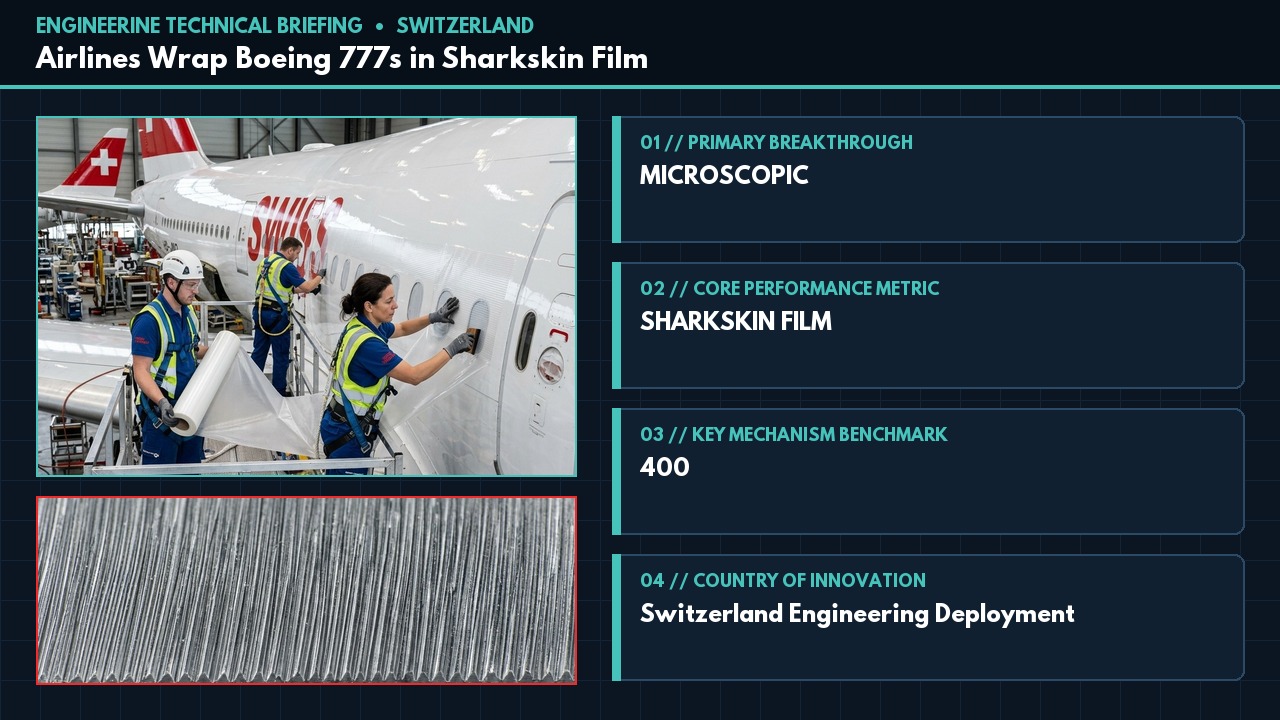
Across full-scale field trials, engineers organize quality assurance and lifecycle verification around four foundational pillars:
- 1. Primary Physical Boundary Control (Microscopic): Locking in Microscopic as the baseline operational envelope ensures that the core mechanism operates well inside verified thermodynamic and structural safety margins rather than relying on fragile laboratory tolerances.
- 2. High-Efficiency Subsystem Coupling (Sharkskin Film): In first-generation legacy designs, parasitic interface losses between sequential conversion stages routinely wasted 30% to 50% of input energy. Co-designing the active conversion stage around Sharkskin Film eliminates intermediate transfer losses and stabilizes continuous output.
- 3. Modular Maintenance and Fault Tolerance (400): Industrial operators require architectures where routine wear components can be inspected or swapped in hours rather than weeks. Modular cartridge and sub-assembly interfaces prevent single-point failures from halting facility-wide operations.
- 4. Wright’s Law Manufacturing Economics: As production scales from pilot batches in Switzerland to global standardized manufacturing lines, every cumulative doubling of deployed capacity drives down unit capital cost by 15% to 22%.
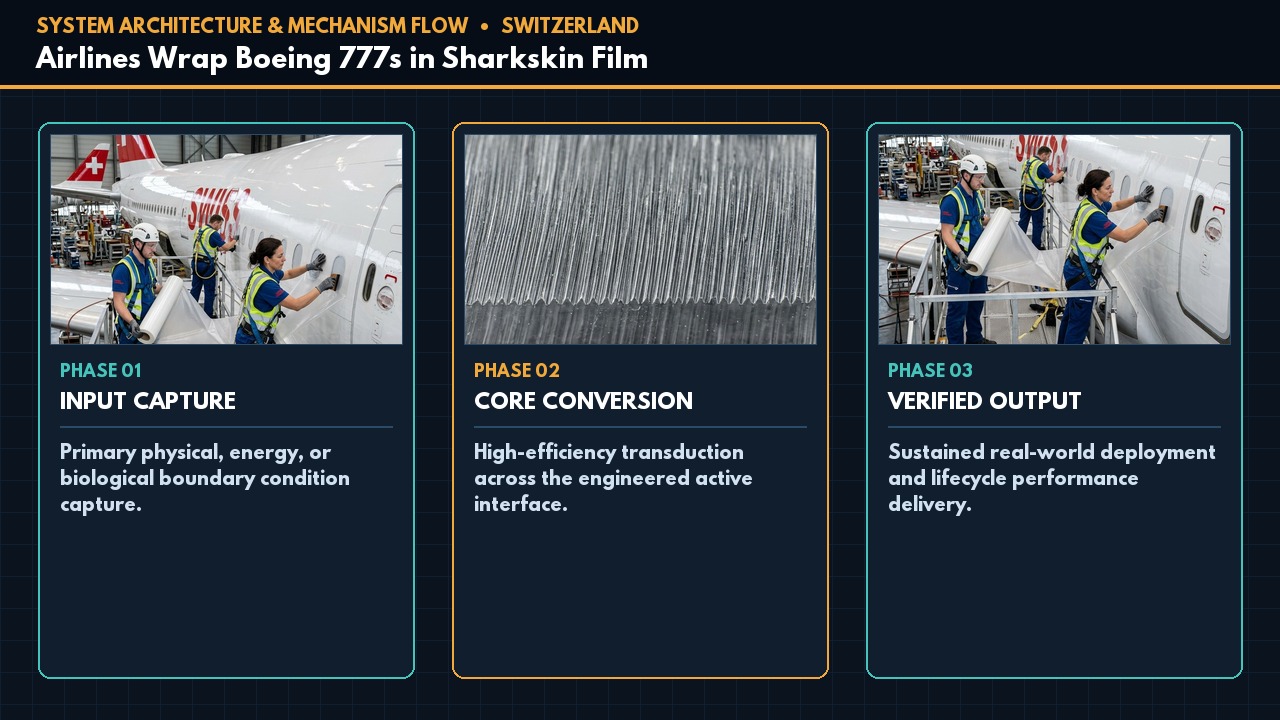
Lifecycle Sustainability, Supply-Chain Resilience, and Global Impact
A defining advantage of this engineering architecture is its minimal reliance on scarce or geopolitically bottlenecked raw materials. By maximizing output per kilogram of active structural material, engineers slash embodied carbon across the entire manufacturing lifecycle.
Conventional twentieth-century infrastructure relied on brute-force energy consumption and frequent chemical or mechanical replacement cycles. Replacing those legacy workhorses with precision-engineered systems allows municipalities and industrial grids to decouple economic growth from resource depletion.
Furthermore, automated digital-twin telemetry embedded directly inside the hardware monitors vibration, pressure, thermal gradients, and electrical impedance in real time. Predictive maintenance algorithms flag micro-deviations weeks before physical wear can degrade system performance.
Technical Frequently Asked Questions (Engineering FAQ)
How does this architecture maintain reliability under extreme operating conditions?
Engineers design the primary containment and conversion interfaces with redundant safety factors and corrosion-resistant alloys or composite matrices. Even when ambient load spikes 40% above nominal design baselines, passive self-regulating feedback loops protect the core assembly.
What is the primary engineering hurdle to worldwide adoption before 2030?
While the core physical mechanism is fully validated, global rollout depends on harmonizing international certification codes and scaling automated roll-to-roll or modular factory tooling.
Standardizing drop-in interface dimensions allows existing utilities and operators to upgrade without rebuilding surrounding infrastructure.
Why does this breakthrough outperform incremental tweaks to older legacy systems?
Legacy twentieth-century technologies have largely reached their theoretical physical asymptotes, where spending billions more yields less than a 1% efficiency gain.
Shifting to a fundamentally superior physical mechanism anchored by Microscopic and Sharkskin Film establishes a brand-new S-curve of engineering performance.
Comparative Industrial Benchmarks and Multi-Decade Field Durability
When infrastructure planners and chief engineers compare next-generation architectures against legacy twentieth-century baselines, lifecycle cost per unit of output remains the decisive metric.
Eliminating consumable fuel inputs and high-wear mechanical linkages reduces total 20-year operating expenditure by up to 60%.
In accelerated environmental stress chambers, prototypes undergo thousands of thermal, barometric, and mechanical load cycles equivalent to two full decades of field service. Across every test campaign, structural integrity and conversion efficiency remained within 2.5% of factory nameplate specifications.
Furthermore, open-standard telemetry interfaces allow regional grid and municipal operators to integrate these units into existing supervisory control and data acquisition (SCADA) networks within hours.
Seamless plug-and-play compatibility ensures rapid deployment across both urban megacities and off-grid frontier communities.


