

Hyundai, Ford and Stellantis are planning to introduce larger EVs with gas generators to solve range anxiety
By Christopher Otts, The wall Street Journal
The auto industry has a new solution to Americans’ fear that electric vehicles will run out of juice: a gasoline engine.
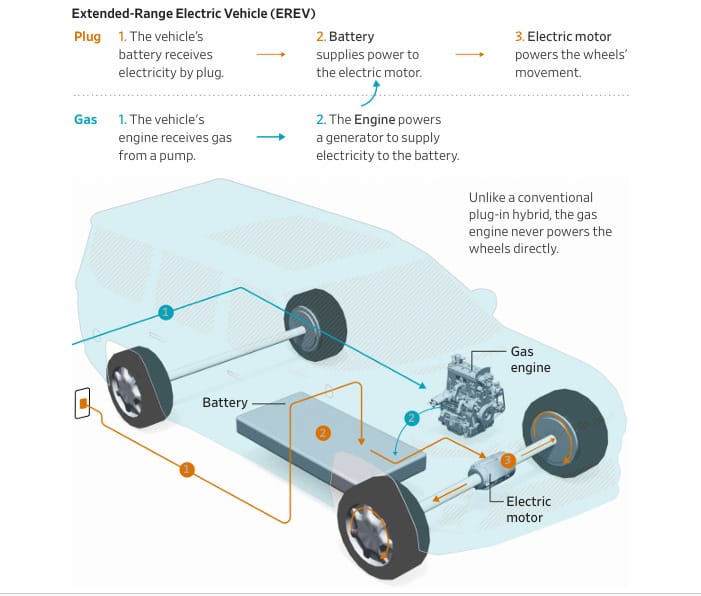
Hyundai, Ford Motor F 1.46%increase; up pointing triangle and Jeep parent Stellantis STLA 1.28%increase; up pointing triangle are among the first U.S.-market automakers planning to roll out a new kind of plug-in vehicle called an extended-range EV. It is a fully electric car with the security blanket of a gas-powered generator to charge the battery, if needed—ensuring you won’t end up stranded as long as a gas station is nearby.
“It is simply a good answer,” said Micky Bly, head of propulsion systems at Stellantis, which aims to kick off the “EREV” trend in the U.S. later this year or early next with its Jeep Grand Wagoneer SUV. A second range-extended vehicle, a pickup truck called the Ram 1500 REV, will follow it. The truck couples a large EV battery with a gas V-6 to recharge it, promising up to 690 miles of driving—more than twice the typical EV in the U.S.
In late August, Korean giant Hyundai announced that its next Santa Fe SUV will offer an EREV version in 2027. Hyundai has said it would provide about 600 miles of driving. Its luxury brand Genesis will offer a similar vehicle. And after canceling its money-losing electric F-150 Lightning truck last December, Ford says it will resurrect that truck as an EREV.
Whether customers will embrace a new and complicated middle-ground technology is a separate question. EV newcomers often struggle with the complexities of charging, and previous attempts to marry plug-in and gas vehicles haven’t found much commercial success in the U.S.
“Now we’re throwing in another layer of complexity and oddity,” said Ivan Drury, director of insights at car-shopping site Edmunds. “There’s going to be a major level of education required.”
Nick Phucas, a mechanical engineer in Virginia, recently swapped a Rivian EV truck for a Ram gas pickup. Phucas said the EREV concept is intriguing, but wonders whether the truck’s performance will be compromised when relying on the gas generator. Other unknowns remain, he said.
“If I get to the end of my (EV) range and I refill with gas, what will my range be?” he said.
The new approach comes as the industry is navigating a painful retrenchment from seeking a mostly electric market by the 2030s, with billions of dollars in stranded investments as customers failed to make the switch at levels once projected.
EV sales remain depressed since the Trump administration removed a $7,500 incentive last year and rolled back regulations driving a more electric market.


