

Inside China’s Humanoid Robot Boom: What BofA Analysts Saw On The Ground In Beijing
China put its humanoid robotics industry on full display last week with a series of technological, commercial, and capital-markets milestones. Beijing first hosted the 2026 World Robot Conference, followed by the five-day World Humanoid Robot Games, while Unitree capped the week with a blockbuster IPO.
Bank of America analyst Ming Hsun Lee attended last week’s 2026 World Robot Conference and provided feedback to clients, noting that China’s humanoid-robot industry has shifted from research demonstrations to commercial deployment, with logistics emerging as the first real-world use case.
Welcome to China, and welcome to the future!
Maybe we will soon witness humanoid robot formation in China’s military parade.@WHRGFUN ©️@boosterobotics pic.twitter.com/dVqkVRGghu
— Shen Shiwei 沈诗伟 (@shen_shiwei)August 23, 2026
Lee said the WRC featured more than 300 exhibitors spanning humanoid robots, AI models, and critical components. Unlike last year’s conference, which focused mainly on research and industrial applications, this year’s conference focused on real-world uses for these robots, including logistics, retail, services, and household tasks.
He pointed to one example in which humanoids far exceed human capabilities.
X Square Robot demonstrated a dual-arm system capable of sorting more than 1,800 parcels per hour, far faster than the 1,200 to 1,400 parcels typically handled by a human worker. He also noted that Galaxea AI reported a success rate above 95% for its retail sorting and delivery system.
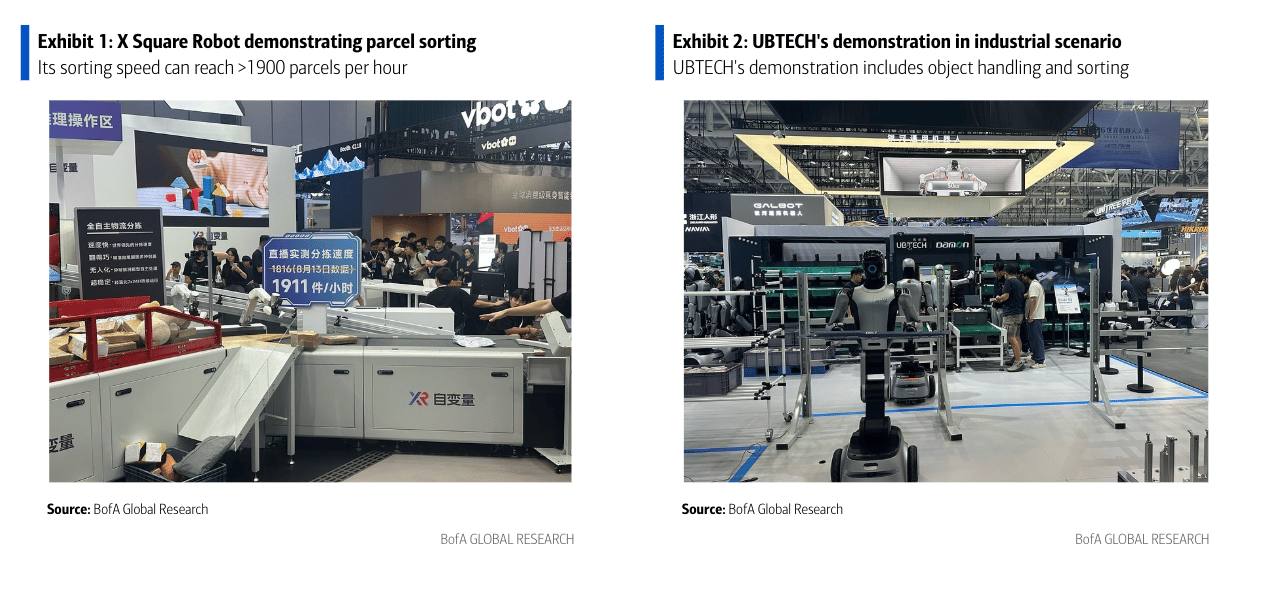
Other robotics startups featured at the event included Unitree, Galbot, and Spirit AI, which demonstrated robots folding clothes, preparing meals, sorting household objects, and assembling supermarket orders.
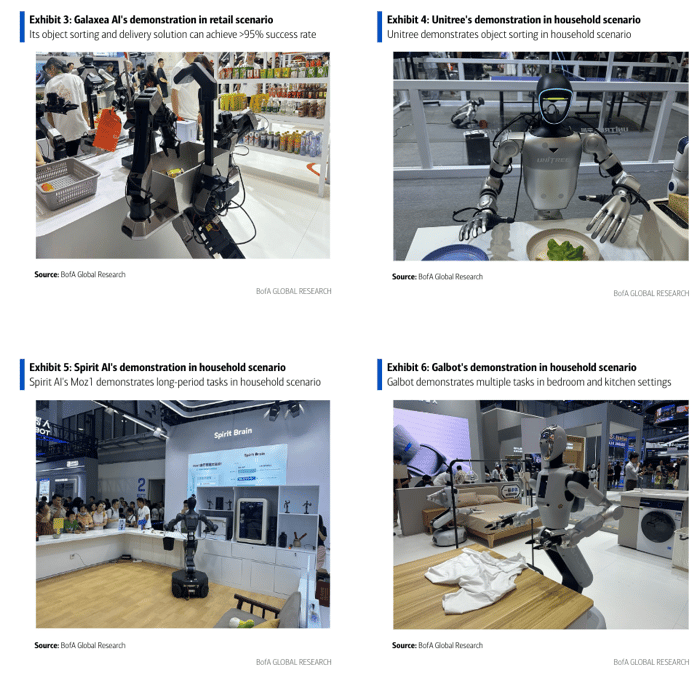
Dexterous hands displayed at the conference offered between 6 and 37 degrees of freedom, with these components having completed approximately 1 million operating cycles.
“Tactile sensors have become a must-have for dexterous hands, which account for 20-25% of the BOM cost of a dexterous hand. On the cost front, 6D force & torque sensor/tactile sensor/planetary roller screw are among the key components with fastest cost reduction over the past year, thanks to scale effect and improved manufacturing process. This could support a 45% cost reduction of humanoid robots in 2026-30E, according to our forecast,” the analyst said.
Here’s what Lee told clients:
Wider application scenario for embodied AI
We attended the 2026 WRC, held in Beijing from 19-23 August. The conference featured more than 300 exhibitors spanning humanoid robots and key component manufacturers. Compared with WRC 2025, where applications were primarily in R&D/industrial settings, WRC 2026 showcased a broader range of embodied AI use cases, extending into logistics, retail, services, and household scenarios. Among these, logistics emerged as one of the fastest-commercializing applications. Notably, X Square Robot demonstrated a parcel-sorting capacity of >1,800 parcels per hour using dual robotic arms, higher than the speed of human beings (1,200-1,400 parcels per hour). Many robotics companies (such as Galbot, Galaxea AI, Spirit AI, X Square Robot etc.) also demonstrated long-duration tasks in retail and household scenarios, such as folding clothes, preparing meals, and picking supermarket orders.
Real-world data crucial to model capability
World action models (WAM) are increasingly adopted by embodied AI companies, which enables higher generalization capability and performs well in long-period tasks. Leading robotics companies are seeking to develop a unified base model that can control different body forms (wheeled, bipedal etc.). On the data front, the importance of high-quality real-world data has become a consensus among embodied AI developers. Egocentric data is increasingly used in pre-training, thanks to its cheaper cost and larger scale, while high-quality real-world robot data (teleoperation/ failure-recovery trajectory) are used in post-training. Currently, data availability remains the key bottleneck for embodied AI developers. We estimate a general-purpose embodied AI model with high generalization capability would require 10mn-100mn hours of real-world data. Leading robotics companies now target to collect >1mn hours of real-world data by end-2026. Third-party data service providers (e.g. Lightwheel) also emerge to provide Egocentric/UMI data and simulation platform for model training.
Component: fast cost reduction continues
Dexterous hand companies in WRC demonstrated products with DoF ranging from 6 to 37. In general, high-DoF dexterous hands are preferred for R&D and high-precision manipulation tasks, while 6-DoF hands and grippers are widely used in manufacturing scenarios. Technology routes for dexterous hand haven’t yet converged, with tendon-driven/bar linkage/direct drive solutions co-existing in the market. Leading dexterous hand companies can now achieve a life span of nearly 1mn cycles. Tactile sensors have become a must-have for dexterous hands, which account for 20-25% of a dexterous hand’s BOM cost. On the cost front, 6D force & torque sensor/tactile sensor/planetary roller screw are among the key components with fastest cost reduction over the past year, thanks to scale effect and improved manufacturing process. This could support a 45% cost reduction of humanoid robots in 2026-30E, according to our forecast.
The bigger picture is that China appears to hold an early lead over the US in the humanoid robotics race, supported by control over both critical materials and downstream manufacturing. Beijing dominates rare-earth supply chains and much of the production capacity for critical components, including permanent magnets, motors, actuators, and sensors. That vertically integrated advantage could allow Chinese manufacturers to reduce costs and scale humanoid production faster than any US company.
What JPMorgan Saw Inside Tesla’s Fremont Factory As Humanoid Production Nears
Retail flows across Asia remained heavily concentrated in newly listed, high-beta names, most notably Chinese robotics maker Unitree following its blockbuster Shanghai debut. The retail craze surrounding physical AI merely shows Beijing’s accelerating push to dominate the humanoid market.
To close out the week, we pivot across the Pacific for a peek inside the US humanoid-robotics supply chain, where Tesla’s Fremont buildout provides a timely indicator of how quickly physical AI is advancing.
Rajat Gupta, a JPMorgan analyst who covers Tesla, recently toured Tesla’s Fremont factory and reported to clients this week that the facility, once the birthplace of the company’s electric vehicles, is now pivoting toward producing robotaxis and humanoid robots.
Gupta and his colleagues toured the roughly 5-million-square-foot facility and found that the discontinued Model S and Model X production lines are being replaced by manufacturing equipment for Tesla’s Optimus humanoid.
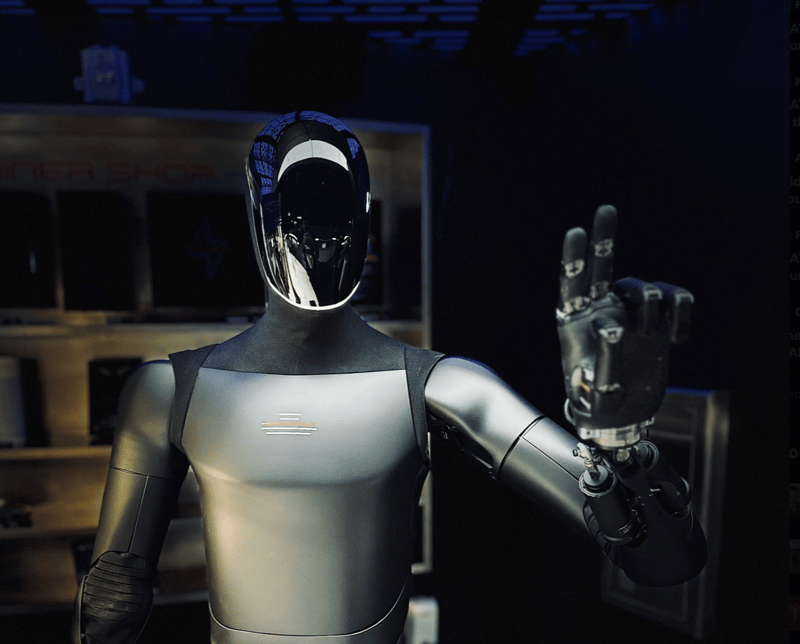
“On Optimus, production lines are being installed at Fremont (the area was tarped off at the time of our visit), and TSLA remains largely on schedule for the targeted four-month transition following the end of S/X production in May, with initial humanoid deployments in 2H26 expected to focus on Optimus Academy for training and data collection, followed by internal factory use and external sales as early as 2H27,” the analyst said.
He said that Optimus robots are not currently working inside the Fremont plant. Initial deployments in the second half of 2026 will instead take place at the “Optimus Academy,” where the robots will collect real-world training data before being deployed in factories.
“Overall, we came away from the factory tour with greater conviction in the robotaxi fleet ramp through late 2026 and early 2027, as well as an Optimus SoP that remains largely aligned with previously communicated timelines, both of which are central to the long-term thesis, while near-term commentary on demand drivers and FSD uptake remains constructive,” the analyst said.
Here are Gupta’s top takeaways from walking the Fremont factory floor:
Facility details. TSLA’s Fremont facility serves as the company’s primary test bed for innovation, supporting the launch of both new vehicles and humanoids across its expansive roughly 5-million-square-foot footprint. The plant manufactures premium Model Y variants and performance and premium Model 3 variants, while the recently decommissioned S/X lines, retired in early May, are being replaced by Optimus production lines. The factory showcases the breadth of TSLA’s automation capabilities, featuring numerous custom-built robots and proprietary software designed to enhance manufacturing speed and precision. Production continues under several modernized tents, originally erected during the Model 3 “production hell” days, which remain integral to the facility’s operations. During our visit, we observed gigapress machines, stamping operations and general assembly lines and participated in FSD demonstrations involving the Model Y L variant and the Cybertruck.
Giga casting and stamping. TSLA’s innovative giga-casting process, first introduced with the Model Y, consolidates 70 underbody components that would otherwise require welding, significantly streamlining production. This approach reduces the number of robots needed on the welding line. The Model Y utilizes roughly 300 robots, compared with approximately 1,000 for the Model 3. TSLA also attributes this advancement to its materials-science expertise, including the development of a custom aluminum alloy, a capability enhanced through its collaboration with SpaceX. For stamping, TSLA employs Schuler presses with six progressive, interchangeable dies. TSLA stamps roughly 10 visible vehicle components in-house, while hundreds of remaining stamped parts are sourced from suppliers.
Unboxed manufacturing. TSLA emphasized that Cybercab production leverages an unboxed manufacturing process in which large subassemblies are built independently and in parallel, then joined together during the final stage. This approach allows open access from all angles, enabling simultaneous installation and streamlining the overall assembly process.
FSD demos. We participated in FSD demonstrations involving the Model Y L and Cybertruck, with the team walking us through the various modes, ranging from Sloth to Mad Max. The vehicles demonstrated notable driving accuracy, including navigating through a construction zone without manual intervention. The Autopark function worked seamlessly as well.
The Cybercab ramp-up is closely tied to the FSD v15 rollout. Management expressed optimism about the trajectory and pace of the Cybercab production ramp, highlighting that technology validation and production through unboxed manufacturing are advancing in parallel. The fleet deployment timeline will be largely dictated by the upcoming FSD v15 launch later this year. TSLA indicated that it is intentionally holding back on adding Model Y units to the robotaxi fleet, reflecting confidence in its ability to scale the Cybercab fleet in the near term. TSLA views FSD v15 as a step change in performance, comparable to the leap from v13 to v14, which produced a significant increase in parameter count, a larger context window and a roughly 20% reduction in latency. The v15 upgrade encompasses seven core technologies, approximately 40% of which are currently being tested in the robotaxi fleet, where initial feedback has been encouraging. TSLA continues to focus on minimizing regression in core driving functions as it introduces new capabilities, and FSD v15 is viewed as the primary gateway to scaling unsupervised FSD. While the current AI/HW4 stack can run v15 and support unsupervised FSD, TSLA’s AI4.5 compute system is designed to accommodate rising compute and memory demands as robotaxi models scale and context windows expand. The system offers roughly 10% more FLOPS and twice the memory.
Robotaxi unit economics remain compelling with the Model 3 and Model Y, although Cybercab is designed to broaden the TAM beyond traditional ridesharing. TSLA highlighted that current robotaxi economics are attractive, with the Model Y and Model 3 carrying total ownership costs of roughly $0.60 to $0.70 per mile at average personal-vehicle utilization rates. Those costs fall to approximately $0.50 to $0.60 per mile at utilization rates four to five times higher, as is typical for robotaxis. That remains well below the roughly $2.50 to $3 per mile charged by incumbent rideshare operators. However, TSLA’s vision for robotaxis extends beyond the traditional rideshare segment, which represents only a low-single-digit percentage of the overall mobility market, and calls for a purpose-built robotaxi platform capable of driving total ownership costs down to approximately $0.30 per mile. Management also reiterated that Cybercab is only the initial form factor, with additional vehicle types expected to follow as the platform evolves, citing the Robovan demonstration from the October 10 event as an example.
Optimus is on track for SoP in the coming months, with commercial sales expected as early as 2H27. While we did not have the opportunity to view the Optimus production lines currently being installed following the S/X decommissioning, TSLA indicated that it remains largely on schedule with its roughly four-month transition target after S/X production ended in May 2026. No Optimus robots have been deployed at the Fremont factory yet, although management highlighted that stamping and body-in-white operations are likely to benefit most in the near term, given the repetitive and hazardous nature of those tasks. In contrast, the general assembly line still requires human dexterity and is expected to be a longer-dated application for humanoids. The initial rollout plan calls for Optimus robots to be deployed at the Optimus Academy in 2H26, where the humanoids will learn by interacting with real-world environments, accelerating TSLA’s data-collection flywheel. Following this phase, humanoids will be deployed internally at TSLA factories for further data collection and to minimize third-party data complexities, with commercial sales to external customers anticipated as early as 2H27. TSLA is aligning humanoid data collection with its FSD methodology and is committed to retaining data ownership internally, rather than relying on third-party datasets, to preserve its long-term differentiation. Separately, TSLA noted that compute capacity increased roughly twofold year over year in 1H26. The finalization of the design, although aesthetics remain a work in progress, represents a key milestone for Optimus and signals the company’s commitment to scaling volumes over the longer term. TSLA is targeting roughly 1 million units at Fremont, with a longer-term goal of approximately 10 million units at Giga Texas. The Gen 3 unveiling will be timed closer to SoP to protect the company’s competitive advantage, while the scope of Gen 4, including its capabilities, cost and scalability, will be informed by Gen 3’s field experience.
The demand rebound is attributed to FSD and model-lineup refreshes. Excluding any potential uplift in EV demand from higher gasoline prices tied to the Middle East conflict, which management teams at publicly traded franchised dealers indicated has not materially affected BEV demand, TSLA attributes the recent acceleration in unit volumes to progress on FSD and a refreshed model lineup. Second-quarter 2026 unit sales increased 25% year over year and 34% sequentially, marking the largest quarter-over-quarter increase since 2019. The introduction of new base variants, alongside the Model Y L and updated performance models, has broadened TSLA’s offering, enabling the company to address a wider range of use cases and price points. TSLA has made FSD the centerpiece of its product portfolio, leveraging improved functionality to generate additional customer interest. Management noted a growing trend of customers visiting showrooms specifically to learn about FSD. This sales momentum is also evident internationally, with markets such as Australia and South Korea, as well as early results from Europe, showing a step change in demand following the FSD rollout.
Europe FSD approval update. TSLA is pursuing a dual-track strategy for FSD approval in Europe, engaging directly with the EU, where the approval timeline has been repeatedly delayed and is now expected in October, while simultaneously working with individual countries such as the Netherlands, whose regulatory frameworks can be adopted by other EU member states. Early driving data from Europe show promising safety metrics, including roughly five times fewer collisions across approximately 65 million kilometers of FSD driving, which management believes is gradually increasing regulatory momentum. Once approved, activation in European markets is expected to occur relatively quickly, measured in weeks rather than months or quarters.
FSD pricing remains iterative over the near to medium term, although it represents a significant long-term opportunity. TSLA explained that the transition from upfront FSD purchases to a subscription-only model is designed to maintain flexibility and capture the increasing value of continued improvements in functionality. In the near term, management is prioritizing vehicle activations and FSD usage, especially because roughly 50% of TSLA owners historically have not tried FSD and a substantial cohort of customers who previously accessed older versions have not activated new subscriptions. TSLA continues to see strong customer retention once drivers experience the technology, supporting its one-month free trial for all new customers and the decision to maintain pricing at approximately $99 per month.
Automotive gross margins. TSLA noted that it has made targeted pricing adjustments to certain Model Y variants and a broader group of Model 3 variants globally to offset commodity-cost headwinds. Changes to interest-rate subsidies should also alleviate some pressure on gross margins. Management noted that first- and second-quarter 2026 gross margins were modestly affected by the shift toward subscription-based FSD monetization, as upfront FSD purchases ended in the US and Canada in February 2026 and will be phased out elsewhere by August 2026. The ramp-up of cathode and anode production, which began in January 2026, is expected to contribute gradually to cost-of-goods-sold efficiencies. It typically takes 18 months for a plant to reach an appropriate level of scale and utilization, although the magnitude of the savings may be difficult to isolate given several other moving parts. More broadly, TSLA emphasized that its operating philosophy remains focused on expanding the top line and leveraging significant production capacity, with a target of up to 3 million units compared with JPMorgan’s estimate of approximately 1.8 million deliveries in 2026.
Tesla’s humanoid pivot is not an immediate commercial story, but it could become one in the second half of 2027 as series production scales and external sales begin. The emerging robotics race between the West and China is increasingly centered on Tesla and Unitree, with both companies preparing to ramp factory output and commercial deliveries over the next year.
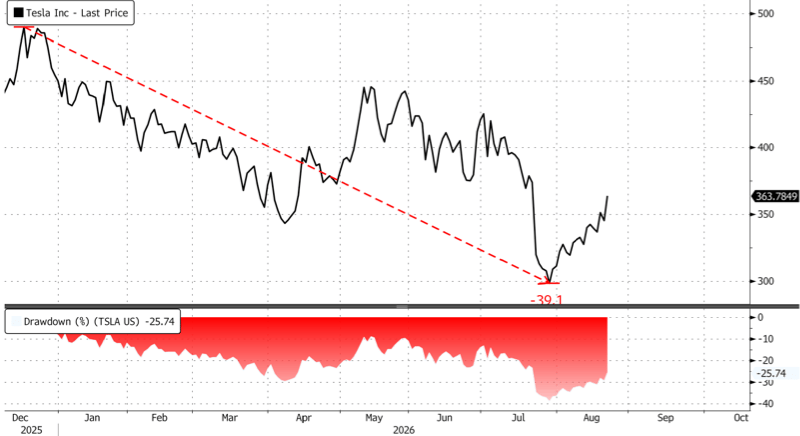
Tesla shares still locked in a bear market.
The West does, however, have a supply-chain problem. China controls significant portions of the supply chains for components required to manufacture humanoids, including rare-earth materials, permanent magnets, actuators, electric motors and optics. Tesla may lead the Western commercialization effort, but without secure domestic or allied sources for these critical components, the US risks building its humanoid-robotics industry on a supply chain that Beijing can restrict, as currently seen across critical materials ranging from tungsten to germanium (read the report here).


![The KILL SWITCHES Have Arrived [Flock Part 10]](/content/images/size/w960/format/webp/2026/10/Captura-de-pantalla-2026-10-22-153542.png)