

By Cade Metz Photographs and Video by David B. Torch and Loren Elliott.
On a recent morning, I knocked on the front door of a handsome two-story home in Redwood City, Calif. Within seconds, the door was opened by a faceless robot dressed in a beige bodysuit that clung tight to its trim waist and long legs.
This svelte humanoid greeted me with what seemed to be a Scandinavian accent, and I offered to shake hands. As our palms met, it said: “I have a firm grip.”
When the home’s owner, a Norwegian engineer named Bernt Børnich, asked for some bottled water, the robot turned, walked into the kitchen and opened the refrigerator with one hand.
Artificial intelligence is already driving cars, writing essays and even writing computer code. Now, humanoids, machines built to look like humans and powered by A.I., are poised to move into our homes so they can help with the daily chores. Mr. Børnich is chief executive and founder of a start-up called 1X. Before the end of the year, his company hopes to put his robot, Neo, into more than 100 homes in Silicon Valley and elsewhere.
His start-up is among the dozens of companies planning to sell humanoids and get them into both homes and businesses. Investors have poured $7.2 billion into more than 50 start-ups since 2015, according to PitchBook, a research firm that tracks the tech industry. The humanoid frenzy reached a new peak last year, when investments topped $1.6 billion. And that did not include the billions that Elon Musk and Tesla, his electric car company, are pumping into Optimus, a humanoid they began building in 2021.
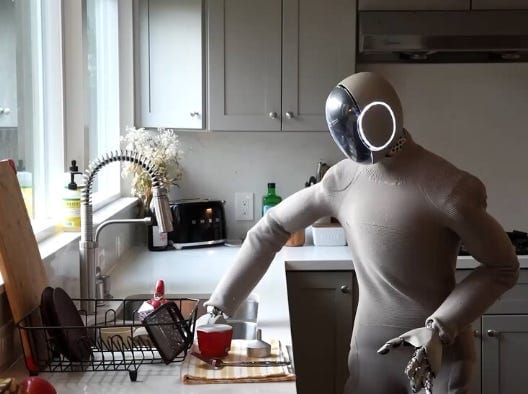
Entrepreneurs like Mr. Børnich and Mr. Musk believe humanoids will one day do much of the physical work that is now handled by people, including household chores like wiping counters and emptying dishwashers, warehouse jobs like sorting packages and factory labor like building cars on an assembly line.
Simpler robots — small robotic arms and autonomous carts, for instance — have long shared the workload inside warehouses and factories. Now, companies are betting that machines can tackle a wider range of tasks by mimicking the ways that people walk, bend, twist, reach, grip and generally get things done.
Because homes, offices and warehouses are already built for humans, these companies argue, humanoids are better equipped to navigate the world than any other robot.
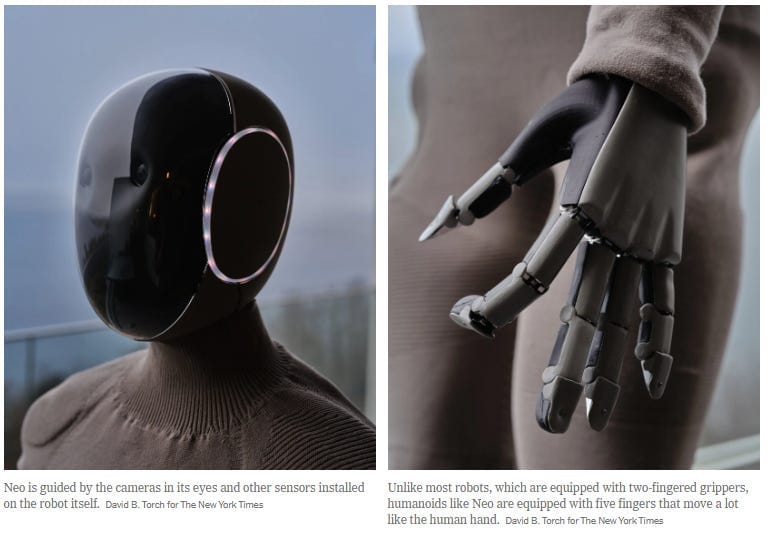
The push toward humanoid labor has been building for years, fueled by advances in both robotic hardware and A.I. technologies that allow robots to rapidly learn new skills. But these humanoids are still a bit of a mirage.
Internet videos have circulated for years showing the remarkable dexterity of these machines, but very often, they are remotely guided by humans. And simple tasks like loading the dishwasher are anything but simple for them.
“There are many videos out there that give a false impression of these robots,” said Ken Goldberg, a robotics professor at the University of California, Berkeley. “Though they look like humans, they aren’t always behaving like humans.”
Neo said “Hello” with a Scandinavian accent because it was operated by a Norwegian technician in the basement of Mr. Børnich’s home. (Ultimately, the company wants to build call centers where perhaps dozens of technicians would support robots.)
The robot walked through the dining room and kitchen on its own. But the technician spoke for Neo and remotely guided its hands via a virtual reality headset and two wireless joysticks. Robots are still learning to navigate the world on their own. And they need a lot of help doing it. At least, for now.
‘I saw a level of hardware that I did not think was possible.’
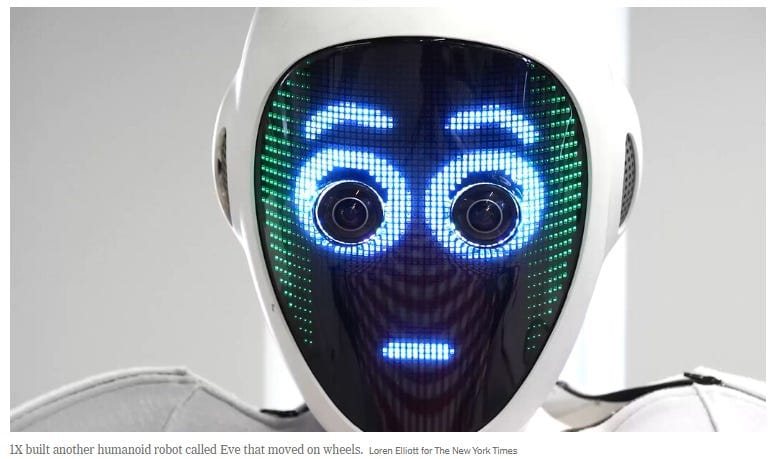
I first visited 1X’s offices in Silicon Valley nearly a year ago. When a robot named Eve entered the room, opening and closing the door, I could not shake the feeling that this wide-eyed robot was really a person in costume.
Eve moved on wheels, not legs. And yet, it still felt human. I thought of “Sleeper,” the 1973 Woody Allen sci-fi comedy filled with robotic butlers.
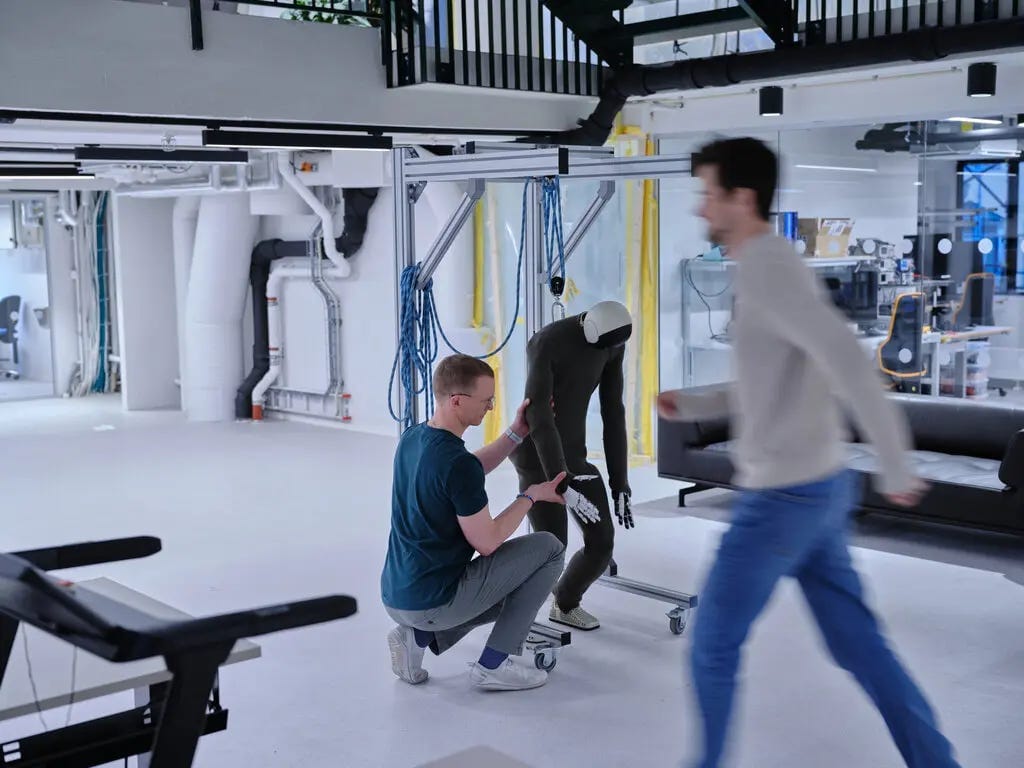
The company’s engineers had already built Neo, but it hadn’t learned to walk. An early version hung on the wall of the company’s lab.

Go paid at the $5 a month level, and we will send you both the PDF and e-Pub versions of “Government” - The Biggest Scam in History… Exposed! and a coupon code for 10% off anything in the Government-Scam.com/Store.
Go paid at the $50 a year level, and we will send you a free paperback edition of Etienne’s book “Government” - The Biggest Scam in History… Exposed! OR a 64GB Liberator flash drive if you live in the US. If you are international, we will give you a $10 credit towards shipping if you agree to pay the remainder.
Support us at the $250 Founding Member Level and get a signed high-resolution hardcover of “Government” + Liberator flash drive + Larken Rose’s The Most Dangerous Superstition + Art of Liberty Foundation Stickers delivered anywhere in the world. Our only option for signed copies besides catching Etienne @ an event.


