

Future of Freedom Foundation) In today’s society, there are incessant debates over how much the minimum wage should be. I sometimes wonder how many Americans realize that there was once a time when Americans lived without minimum-wage laws. Indeed, how many people realize that the U.S. Supreme Court once held that minimum-wage laws violated the U.S. Constitution, the document that called the federal government into existence?
In 1918, Congress approved a bill that created a board to investigate wage conditions in the District of Columbia and to establish a minimum wage for women and minors working within the district. President Woodrow Wilson signed the bill into law.
The D.C. minimum-wage law was a good example of the interventionist/regulatory philosophy that was gaining ground in the United States. For more than 100 years, the United States had existed without minimum-wage laws or, for that matter, most other governmental regulations. That’s because the American people had adopted what was known as a “free enterprise” economic system, one in which economic enterprise was largely free of government control, management, and regulation.
In fact, it is impossible to overstate the highly unusual nature of the economic system of our American ancestors. Setting aside the obvious exception of slavery, the American people were, by and large, free to engage in any economic enterprise without governmental permission or interference. They were also free to accumulate unlimited amounts of money and decide for themselves what to do with it.

Consider, for example, the period 1880 to 1910, which is my favorite time in American history when it comes to freedom. Imagine: no income tax, IRS, Social Security, Medicare, Medicaid, welfare, farm subsidies, education grants, minimum-wage laws, licensing laws, drug laws, Federal Reserve, paper money, Pentagon, CIA, NSA, foreign aid, foreign military bases, foreign wars in Europe and Asia, and gun control. Additionally, there were very few economic regulations, minimal immigration controls, and almost no public (i.e., governmental) school systems.
Needless to say, that American society shocked the world. Nobody had ever seen or heard of that type of society. It was one-of-a-kind and the first time in history that such a society had existed.
The results of this unusual society also shocked the world. It caused the greatest outburst of economic prosperity that mankind had ever seen — despite the fact (or, actually, partly because of the fact) that thousands of penniless immigrants, many of whom could not speak English, were flooding American shores every day. In fact, many of the poor were becoming wealthy — after one, two, or three generations — something the world had never experienced. With their strange economic system, Americans had, in fact, discovered the way to end or drastically alleviate poverty, which had afflicted mankind since the dawn of civilization.
That’s not all. Americans also created the most charitable society in history. When people were free to accumulate unlimited amounts of wealth, many of them used it to help out others on a purely voluntary basis. This was how the hospitals, museums, opera houses, libraries, soup kitchens, and other charitable activities came into existence. One man — John D. Rockefeller, who statists have long reviled as a “robber baron” — actually gave away half-a-billion dollars — and not to get an income-tax deduction because there was no income tax.
The progressive movement
During that same period of time, however, a small number of Americans began agitating for a different type of economic system, one in which government, at both the federal and state levels, would wield the power to regulate, manage, and control economic activity, which had been the typical way societies had operated throughout history.
Moreover, these “progressive” Americans wanted an economic system in which people could be forced through the power of taxation to care for others, whether they wanted to or not. That’s what the “welfare-state” way life they favored was all about. Moreover, some of them were not satisfied with the limited-government republic that the Constitution had created, which included a relatively small military force. They wanted a vast empire of overseas possessions and an enormous, permanent military establishment to govern it.
Thus, in the late 1800s, the battle lines were being drawn between those who favored a genuine free-enterprise, limited-government system — one in which economic activity was free of governmental control, regulation, and management and people were free to accumulate the fruits of their earnings and decide for themselves what to do with them — and those, on the other hand, who favored a system in which economic activity was controlled, managed, and regulated by governmental officials and in which people would be forced to care for others through a tax-and-welfare system.
The statists — those who looked to the state to provide “safety” and “security” to people — had an uphill battle. After all, they were facing more than 100 years of a system that had succeeded in bringing unbelievable increases in people’s standard of living and in voluntary charitable activity, while protecting the freedom of people to live their lives the way they wanted. Why would anyone want to give up that way of life in return for one in which the state was in charge of controlling, managing, and regulating people’s lives and resources?
Yet, the statists began making inroads. For example, there was the Sherman Antitrust Act of 1890. There were state commissions setting rates for railroads. There was the start of Jim Crow laws. There was the Chinese Exclusion Act, a brutal and racist piece of legislation that was the nation’s first immigration-control law. There was the Spanish American War.
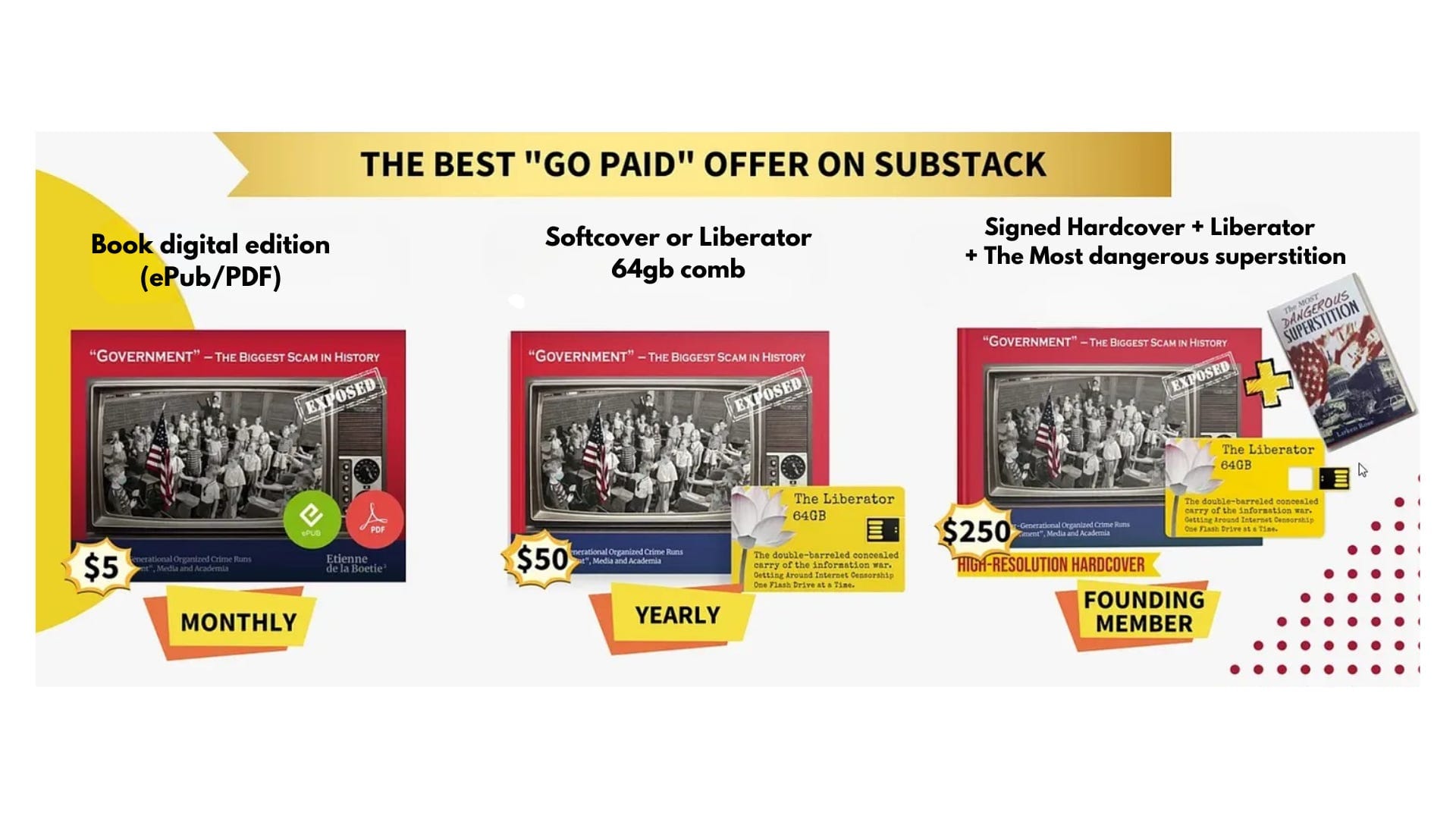
Go paid at the $5 a month level, and we will send you both the PDF and e-Pub versions of “Government” - The Biggest Scam in History… Exposed! and a coupon code for 10% off anything in the Government-Scam.com/Store.
Go paid at the $50 a year level, and we will send you a free paperback edition of Etienne’s book “Government” - The Biggest Scam in History… Exposed! OR a 64GB Liberator flash drive if you live in the US. If you are international, we will give you a $10 credit towards shipping if you agree to pay the remainder.
Support us at the $250 Founding Member Level and get a signed high-resolution hardcover of “Government” + Liberator flash drive + Larken Rose’s The Most Dangerous Superstition + Art of Liberty Foundation Stickers delivered anywhere in the world. Our only option for signed copies besides catching Etienne @ an event.


