

Executive summary
Now available on Zenodo McCullough Foundation Report: Determinants of Autism Spectrum Disorder
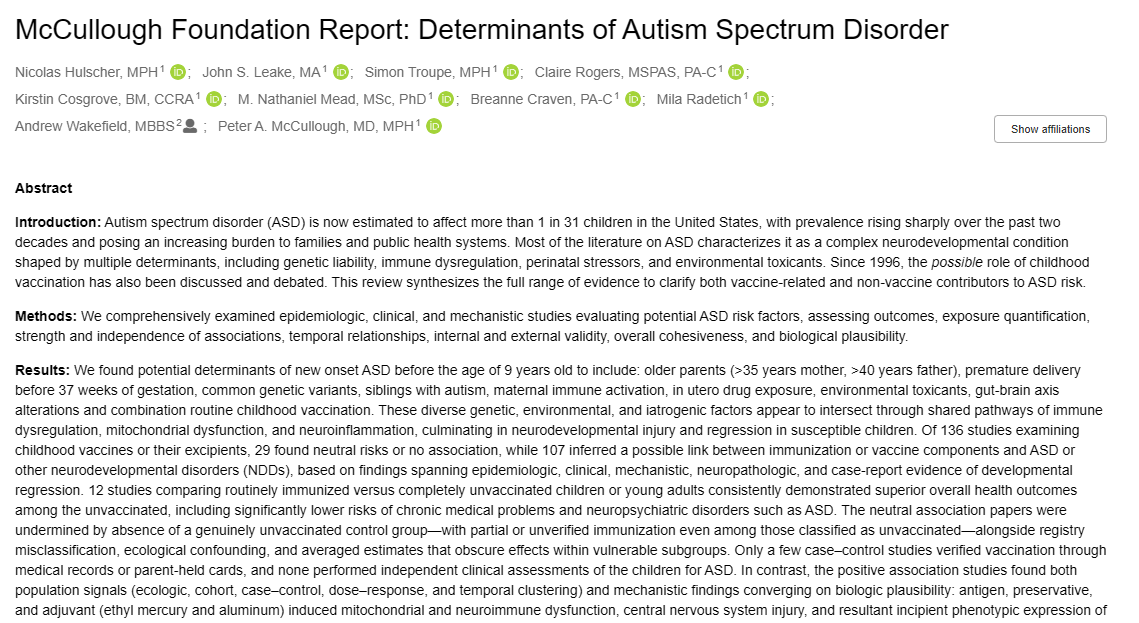
Conclusion: Combination and early-timed routine childhood vaccination constitutes the most significant modifiable risk factor for ASD, supported by convergent mechanistic, clinical, and epidemiologic findings, and characterized by intensified use, the clustering of multiple doses during critical neurodevelopmental windows, and the lack of research on the cumulative safety of the full pediatric schedule.
In short, it’s the vaccines.
About the report
The report is essentially a large‑scale literature syntheses, not new population data collections. They don’t include any new cohort recruitment or lab work; they pull from existing epidemiologic, clinical, mechanistic, and toxicologic papers available through PubMed, Scopus, Web of Science, registries, and gray literature.
“We conducted database searches across PubMed, Scopus, Web of Science, Google Scholar, and gray literature … Inclusion: peer‑reviewed epidemiologic cohort, case‑control, mechanistic, animal and systematic reviews …”
They gathered roughly 100 – 150 citations on non‑vaccine factors (e.g., prenatal infection, maternal age, pollution) and another ≈ 130 papers on vaccination or excipients, then merged them into thematic tables. It’s a meta‑collation.
Alternative reports use the same evidence space, but come to different conclusions!
That’s the right comparison to make — because the McCullough Foundation review and its Supplemental Material operate in basically the same evidence space as:
Lancet Commission on the Future of Care and Clinical Research in Autism (2021)
and the
NIH Autism Centers of Excellence (ACE)
network, but they reach very different conclusions.
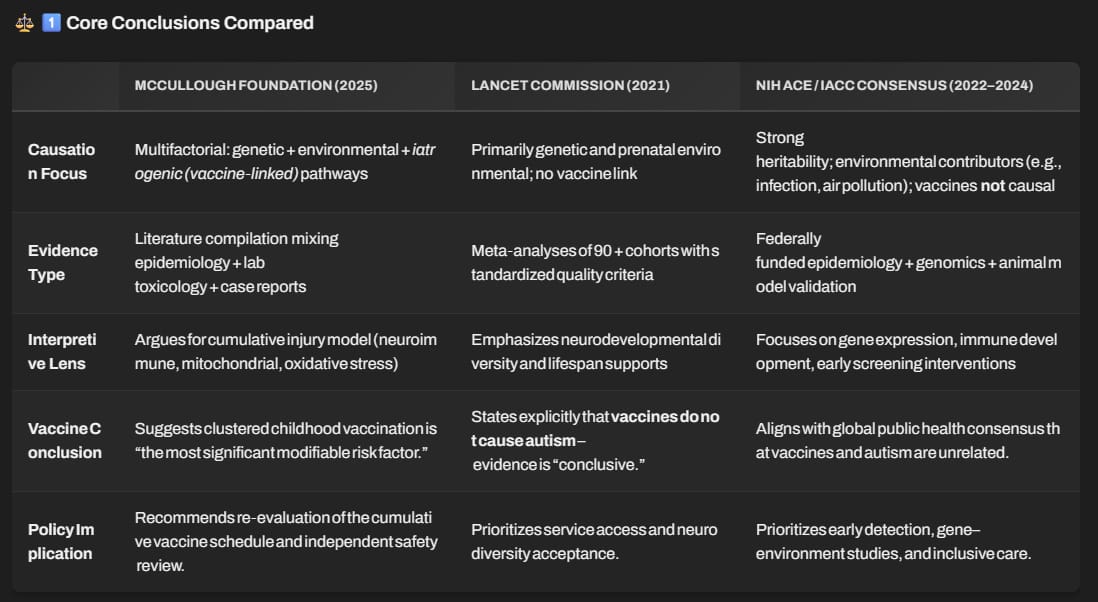
The divergence arises from both methodology and interpretive framework.
a. Different Inclusion Rules
Lancet / NIH ACE use Cochrane‑style systematic filters: randomized or large registry studies with double‑blinded outcome assessment.
→ Low‑power or non‑replicated mechanistic papers, uncontrolled case‑series, and ecologic correlations are excluded.McCullough review includes broad evidence — mechanistic animal work, cell data, case reports, and re‑analyses of disputed datasets — giving heavy weight to biological plausibility even when statistical demonstration is weak.
Hence: different evidence hierarchies → different conclusions.
b. Interpretive Approach
- Lancet/NIH treat correlation ≠ causation; they require population‑level replication before causal language.
- McCullough interprets overlapping mechanistic signals (immune activation, metal toxicity, mitochondrial deficit) as causal chains even without direct cohort confirmation.
c. Selection Bias & Data Weighting
The McCullough group weights:
in‑vitro data showing neuronal toxicity of ethyl‑Hg or Al;
ecological trends (autism incidence vs. vaccine dose counts);
clinical case series of “regressive autism after vaccination.”
Mainstream commissions discount those sources as uncontrolled and biologically non‑comparable to real pediatric exposure levels.
d. Motivating Questions
- Lancet/NIH ask: “How do we improve outcomes for neurodivergent people?”
- McCullough asks: “What is driving the incidence curve rise since the 1980s?”
The first frames autism as neurodevelopmental variation with multiple influences;
the second frames it as an acquired injury needing hazard identification.
They agree on
Both camps agree on advanced parental age, premature birth, maternal infection, and high inflammation markers as consistent ASD risk factors.
Both accept a role for mitochondrial and redox biology in some subgroups.
They differ solely on iatrogenic exposures
Mainstream bodies see no epidemiologic signal once bias is controlled.
The McCullough report emphasizes uncontrolled subpopulation findings.
The difference arises from how each group defines valid evidence and how strictly they apply epidemiologic causal criteria.
The million dollar question: Which is more likely to be correct?
It depends on which evidence bases you value more.
When you go to an AutismOne Conference, and the speaker asks the parents, “How many of you believe your child’s autism was linked to vaccines?” and nearly every hand in the room goes up, that’s a little hard to explain.
But for me, it’s the statistics for pediatric clinic that don’t vaccinate: zero autism cases in 25 years.
Or Pediatrician Doug Hulstedt’s clinic in Monterey California. 44 cases of overnight autism. Amazingly, all 44 happened within 1 week after a vaccine appointment. 0 within 1 week before the appointment.
The McDowell triplets. The only time in human history all three kids get autism at the same time and it happened 2 hours after they got their vaccine shot.
Those 3 case histories are simply impossible if vaccines aren’t the primary driver of autism.
The Best “Go Paid” Deal on Substack! You Get REAL Stuff!!

Go paid at the $5 a month level, and we will send you both the PDF and e-Pub versions of Etienne’s new book: To See the Cage Is to Leave It - 25 Techniques the Few Use to Control the Many and a coupon code for 10% off anything in the https://artofliberty.org/store/.
Go paid at the $50 a year level, and we will send you a free paperback edition of Etienne’s new book: To See the Cage Is to Leave It - 25 Techniques the Few Use to Control the Many OR “Government” - The Biggest Scam in History… Exposed! OR a 64GB Liberator flash drive if you live in the US. If you are international, we will give you a $10 credit towards shipping if you agree to pay the remainder.
Support us at the $250 Founding Member Level and get a signed high-resolution hardcover of “Government” - The Biggest Scam in History... Exposed! + Liberator flash drive + a signed high-resolution hardcover of Etienne’s new book: To See the Cage Is to Leave It - 25 Techniques the Few Use to Control the Many + everything else in our “Everything Bundle” of the best in voluntaryist thought delivered domestically. International pays shipping. Our only option for signed copies besides catching Etienne @ an event.


