

Dispatch: Kindness, compassion, community, homelessness
It was on an unremarkable, early-autumn mornings when the sun hesitates behind pale clouds, and the air carries a bracing promise of winter’s approach, when I first noticed it, a long, soft coat, newly feathered and waterproofed, cosseted inside an old blue rucksack and left, almost reverently, on the slats of a park bench. It was not the usual park bench, either; this one curved like a parent’s arm beneath the grand, gnarled reach of an old oak. At first, I thought that maybe someone had forgotten it, perhaps in a moment of distraction, a jogger pausing after dawn or a student heading hurriedly to class. But as I passed, I saw the shape was too deliberate, the items too carefully arranged for mere accident. The next day, the same bench played host to a new arrival, this time, a thick wool blanket, rich as a sheep’s winter coat, and a matched set of hat, scarf, and gloves in a red so vivid it seemed even the grey sky could not quite extinguish its heat. The woollens, folded so precisely they looked untouched by hands, were anchored to the wood by a slip of scrap paper, the edges softened by dew. It read, in a looping, uncertain hand: “If you are cold, take me. No need to return.”
The words pricked at me, tart and insistent. It seemed, at first, a local quirk, a solitary impulse of generosity flaring up and fading in a city whose days often turned on the impersonal axis of work, home, repeat. But over the following weeks, I began to notice these quiet offerings everywhere, tucked into the crooks of bike racks, tied gently to fence posts, even, in one case, pinned like a medal to the bronze lapel of a statue whose face was always streaked with rain.
I was curious, as anyone would be. Curiosity, in my experience, is often the child of repetition. Once a pattern emerges, it demands explanation the way a wound demands a bandage. So I began to pay closer attention, not just to the gifts but to the invisible hands that left them. Some mornings, in the slant of dawn light, I spied an old woman in a battered parka, her hair silver as coins, pausing to knot a scarf around a lamppost. Another time, I glimpsed a man, face hidden by a mask, leaving a pair of new boots beneath a bus shelter. I never saw them linger, never saw anyone claim the items in the glare of day, but somehow, by the time I returned from work, the benches and rails were bare again, awaiting their nightly renewal.
Months passed. The city wheeled through sleet and sun, through a spring so brief it might have been a rumour. Still, the anonymous gifts endured, even multiplied, as if to quietly defy the season’s indifference. I started, in odd moments, to trace the phenomenon, asking neighbours, librarians, the barista whose gloves always seemed to match her apron. Some shrugged, they didn’t seem to care, some smiled, one or two dropped their gaze as if the question itself were too intimate. It was only after a chance encounter with Mrs. Kociemba, a retired music teacher and, as it turned out, the unofficial archivist of the neighbourhood’s oddities, that I discovered the custom’s true provenance.
She told me, over tea that smelled of citrus and old books, that the tradition was far older than our city or even our country. “It’s a far quieter old tradition, and it’s not charity,” she insisted, “but memory. And respect.” In her hushed, deliberate voice, Mrs. Kociemba described how, in the mountain villages of Eastern Europe, winters could arrive in a single night, swallowing roads, silencing even the church bells. In those small, isolated towns, one did not wait for official help; there was none to be had. Instead, the villagers wove their own safety nets, sometimes literally by secreting extra clothes, food, or firewood in agreed-upon places, where any neighbour in trouble might find them without having to ask. “No one wanted to confess need,” she said, “but everyone, at some time, would need.”
The custom, she explained, was rooted in a kind of stubborn dignity, with the belief that to give anonymously was to preserve the pride of both giver and receiver. The act was simple, but the etiquette strict. No labels, no lectures, no need to be seen to be giving, or receiving, just the item and, occasionally, a note; “If you are cold, take me.” Or, “For tonight, may you be warm.” Some families even kept a “giving box” at their door, restocked with whatever surplus they could spare. In times of famine or political unrest, it was not uncommon for an entire community to survive on the quiet exchange of these gifts.
Mrs. Kociemba’s stories, coloured as they were by the romance of exile and memory, led me to wonder how such a practice had survived translation into the glass-and-steel corridors of a modern city. I began to search online, expecting to find only the barest trace, but instead discovered a virtual tapestry of similar acts, threaded through cities and suburbs the world over.
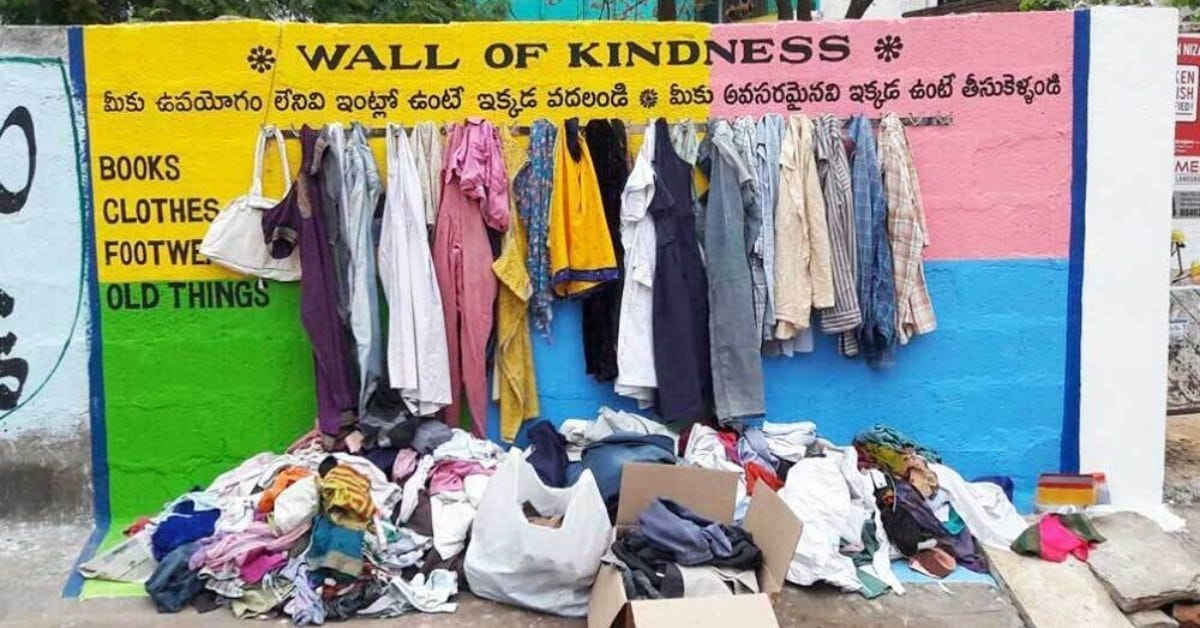
In Helsinki, volunteers hung coats from the arms of statues, their pockets stuffed with candy and metro tickets. Budapest, Tehran, Berlin, Madrid, and even parts of Southern Asia have had literal “kindness walls,” where racks or hooks are mounted for anyone to leave or take clothes, food, or essentials.
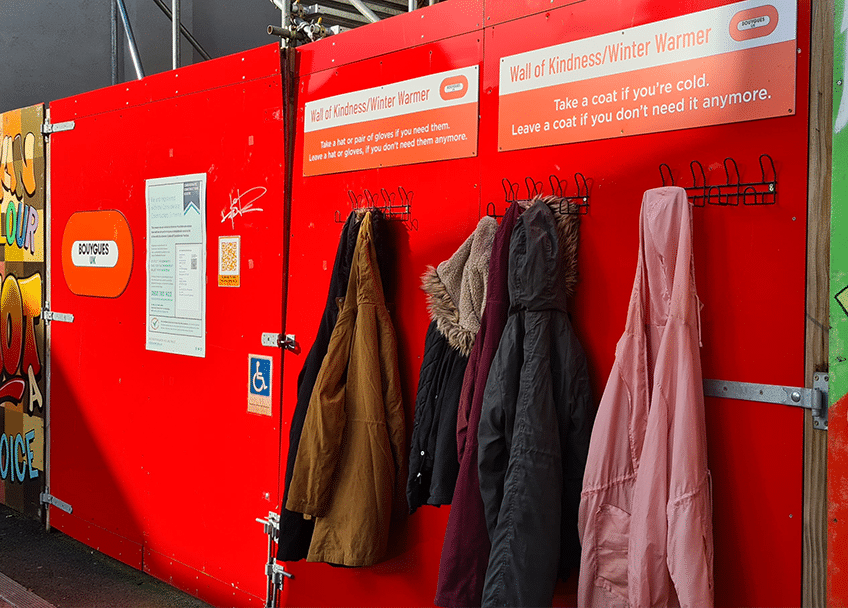
In South Korea, there have been grassroots mutual-aid practices, especially in student housing areas, where food supplies are left in stairwells or on community shelves. In Seoul, landlords left rice and instant soup in stairwells for students too embarrassed to beg. In New York, the “kindness closet” movement had turned unused office spaces and old phone booths into tiny shrines of abundance, where anyone might take a clean shirt or a box of tampons without explanation or thanks.
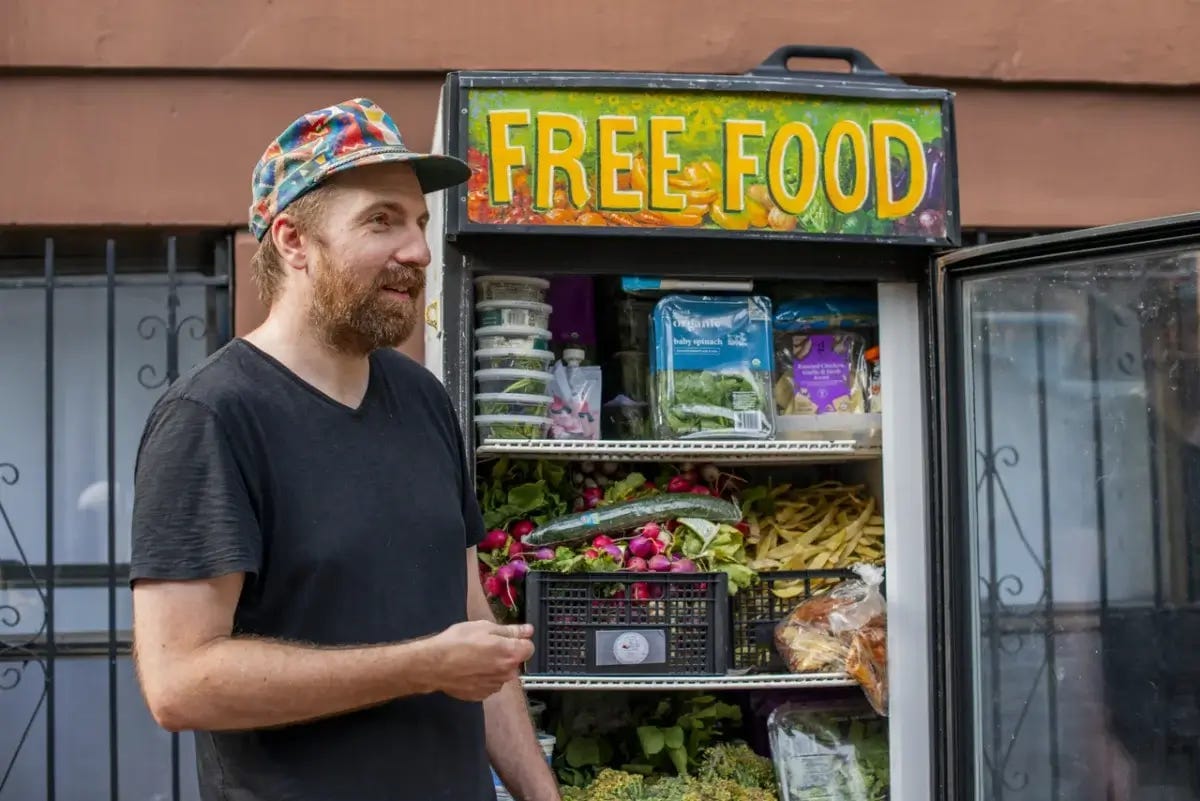
Thadeaus Umpster with the fridge he set up in his Brooklyn neighborhood. by Emma Kazaryan. Source: Modern Farmer
Some neighbourhoods and schools have “free closets” or “free fridges”, stocked by the community, taken by whoever needs. In NYC, free fridges became widespread during Covid thanks to Thadeaus Umpster, For thirty years, Thadeas has waged his quiet war against waste in the concrete labyrinth of Brooklyn, he is a man wounded by the sight of perfectly good tomatoes and day-old bread consigned to dumpsters, while children go to bed with empty stomachs. Hunger was once his own fierce companion during past advocacy work with the homeless.
When the pandemic hit New York City, Umpster responded with a single refrigerator outside his Bed-Stuy building, an unremarkable act that, like a seed dropped in fertile soil, sprouted into something magnificent. He started with humble Craigslist announcements of bagels and greens that rapidly metamorphosed into a revolution that spread through Crown Heights, Flatbush, and even across the waters to the Bronx. Through the anarchistic fellowship of In Our Hearts NYC, fridges multiplied across the boroughs like stars in dark times, each one independent but forming a quiet network in the grand constellation of human kindness. —Modern Farmer
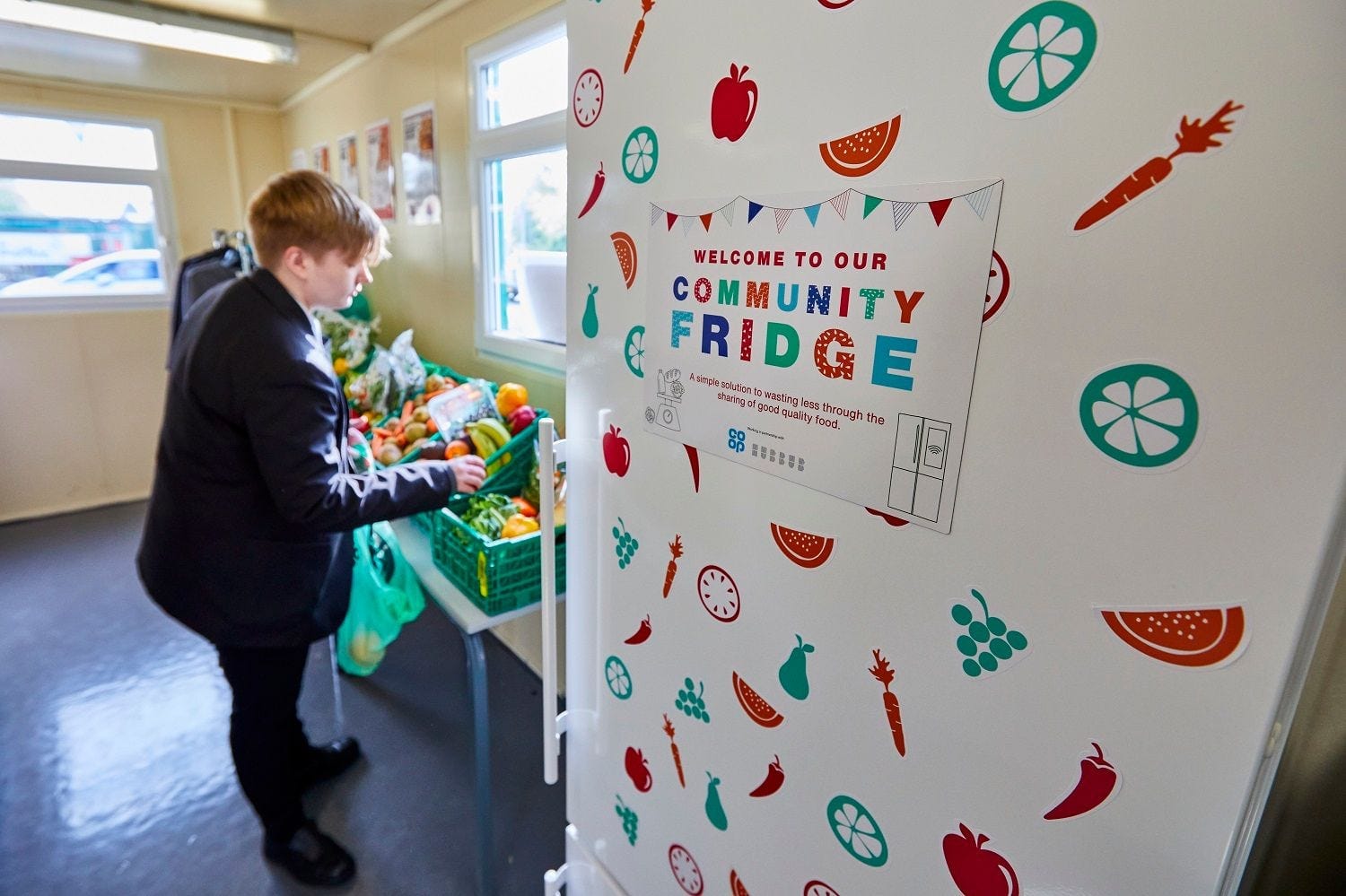
British Community Fridge UK Source: In Your Area
The Community Fridge Network has evolved in the UK emerged during the Covid years, orchestrated by the Hubbub charity like a benevolent conductor, and sprouted over 700 locations across the rain-washed British Isles. These fridges, standing support systems in schools, community centres, and shops where people gather to discuss the weather, offer sanctuary for excess supermarket shelf produce that would otherwise meet an ignominious end in landfills.
Would-be fridge founders receive not just guidance but a peculiar kind of fellowship from Hubbub's enthusiasts, who dispense health and safety wisdom with the gravity of village elders. In 2024 alone, these humble appliances rescued 10,438 tonnes of food—enough to feed several small armies or one very large one, while drawing 3 million visits from 787,000+ people in these communities, where neighbours had previously passed each other with English reserve. The next funding round arrives with the autumn on September 1st, 2025.
These stories, form a kind of silent chorus. What struck me most, reading through the testimonials and news clippings, was that the authors not only spoke of gratitude, but also of relief, the relief of not having to ask, of not being seen to beg, of feeling, if only for a moment, that one’s need was not a flaw, not judged but a fact, an essential part of life. It made me think of my old friend Jean Fromage, a wise old French artist, who used to say, “We are all poor, at something,” as he pressed some grapes into my hands after Sunday dinner. I later understood how these stories were quiet examples of how to level the ledger of human dignity in a way even the grandest charity could not.
I began to participate in the tradition out of a sense of compulsion, or perhaps guilt, but over time it became a kind of ritual. Each Friday, as I left work, I would detour to the discount store, buy a sandwich or a thermal mug filled with soup, and leave it in one of the city’s unofficial “giving spots”, the park bench, the old fountain near the school, the ledge outside the community centre. Sometimes I left a note, sometimes not. I never saw anyone take the items, but I didn’t need to. The act itself satisfied something quiet in me.
Today, the tradition has roamed far beyond its birthplace. There has been a real phenomenon in Canada, the US, hats, and coats are tied to lampposts or trees with notes like “I am not lost. If you need me, I am yours.” Along American avenues, discarded blankets lie in tidy stacks by bus stops. In parts of Latin America, the night air carries the hush of secret dinners, bags of rice and beans left at doorsteps, so a hungry family might wake to a meal without embarrassment.
Beyond Charity & The Dignity of Anonymous Giving
There is a tender magic in such silent generosity. Unlike formal charities that sometimes weigh the giver and the receiver on unequal scales, these offerings dissolve any sense of hierarchy and preserve human dignity for the receiver. No one must explain their plight; no one is compelled to blush at their need. Meanwhile, the giver, isn’t giving to post for admiration on social media or to massage their own goodwill vanity, or they might genuinely be quite shy or simply want their anonymity. A woollen wrap slung over a branch also carries the message of community support “You are not alone.” Which is so needed in the contemporary world where there is little sense of community.
What if every park and corner of our towns bore such discreet tokens, such as blankets folded on benches, tinned food tucked into wooden boxes, baskets of fruit, a pair of good shoes leaning against a wall? What if compassion for others were restored quietly again, an undercover army of secret angels, woven into the very fabric of our streets, so seamlessly that we barely noticed its threads, yet we felt its strength and warmth in every breath?
In an age when cold walls of indifference seem higher than ever and competing voices of discord ring louder than those of kinship and compassion, these simple traditions remind us that our humanity endures in the softest gestures. For sometimes, a single blanket laid on a cold night can carry the warmth of an entire community.
The Best “Go Paid” Deal on Substack! You Get REAL Stuff!!

Go paid at the $5 a month level, and we will send you both the PDF and e-Pub versions of Etienne's new book: To See the Cage Is to Leave It - 25 Techniques the Few Use to Control the Many and a coupon code for 10% off anything in the https://artofliberty.org/store/.
Go paid at the $50 a year level, and we will send you a free paperback edition of Etienne’s new book: To See the Cage Is to Leave It - 25 Techniques the Few Use to Control the Many OR “Government” - The Biggest Scam in History… Exposed! OR a 64GB Liberator flash drive if you live in the US. If you are international, we will give you a $10 credit towards shipping if you agree to pay the remainder.
Support us at the $250 Founding Member Level and get a signed high-resolution hardcover of “Government” - The Biggest Scam in History... Exposed! + Liberator flash drive + a signed high-resolution hardcover of Etienne's new book: To See the Cage Is to Leave It - 25 Techniques the Few Use to Control the Many + everything else in our "Everything Bundle" of the best in voluntaryist thought delivered domestically. International pays shipping. Our only option for signed copies besides catching Etienne @ an event.


