

"The human body is no longer just a biological entity - it’s becoming a networked platform, where cells, neurons, and even DNA can be interfaced with digital systems, raising profound questions about who controls the essence of our existence." - Ian F. Akyildiz
Imagine discovering that your neurons - the very cells that make you you - could be transformed into networked data points, each one monitored and potentially controlled by microscopic machines. At the same time, your genetic code - your biological blueprint - is being bought, sold, and potentially auctioned to the highest bidder in bankruptcy proceedings. This isn't science fiction. Research papers published in mainstream scientific journals are already mapping out how to connect human brains directly to the cloud using injectable ‘neuralnanorobots,’ while in late 2024, 23andMe - once a $6 billion biotech darling - filed for bankruptcy, leaving 15 million DNA samples in limbo as potential assets for creditors.
Though I don't claim deep technical expertise in nanotechnology or neuroscience, my deep dive into these fields - analyzing technical documentation, consulting with researchers, and tracking academic developments - has revealed an alarming landscape of converging technologies. The fundamental question isn't whether this technology will be developed - it's already underway. The real issue at stake is whether we'll maintain autonomy over our own biology as these technologies emerge.
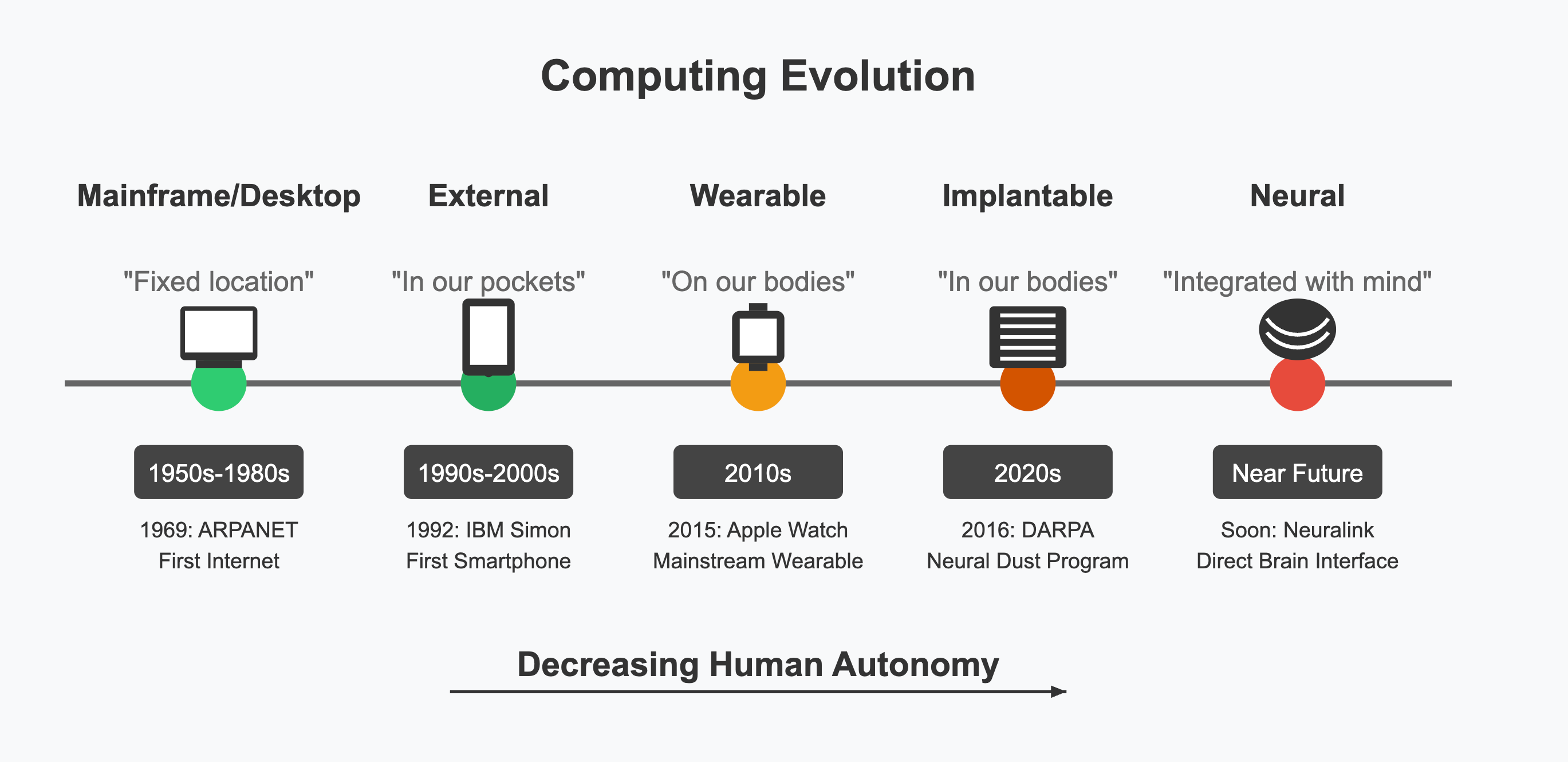
Consider the trajectory: First, we carried computers in our pockets. Then we wore them on our bodies. Now, researchers are developing ways to put them inside our brains while companies collect our DNA through consumer services marketed as harmless genealogical exploration. But unlike a smartphone you can turn off or remove, or even a password you can change after a data breach, your biological data is permanent and uniquely yours. This becomes especially concerning when we consider technologies designed to interface directly with our genetic machinery. Moderna CEO Stéphane Bancel has described mRNA technology in revealing terms: 'Since mRNA is an information-based platform, it works similar to a computer's operating system, letting researchers insert new genetic code from a virus - like adding an app - to create a new vaccine quickly.'
What's particularly noteworthy is how this platform was positioned as an urgent priority shortly before its global deployment. At the Milken Institute's Future of Health Summit on October 29, 2019 - just months before COVID-19 emerged - Dr. Anthony Fauci discussed the need for a 'completely disruptive' approach to vaccine development that wouldn't be 'beholden to bureaucratic strings and processes.' He described a scenario that now feels eerily prophetic: 'It is not too crazy to think that an outbreak of a novel avian virus could occur in China somewhere. We could get the RNA sequence from that, beam it to a number of regional centers... and print those vaccines.' The hair-raising accuracy of this forecast, delivered just weeks before it became reality, makes one wonder: Was this remarkable foresight? Or was there a deeper agenda behind accelerating a technology that Fauci himself admitted would normally 'take a decade' to properly test?
As bionetwork pioneer Ian Akyildiz candidly described: 'These mRNAs are nothing than small scale, nanoscale machines right? They're programmed, and they're injected.' Such technologies could represent the perfect bridge between digital code and biological function—potentially serving as a programmable interface to human biology.
What we're witnessing isn't just technological innovation - it's what I've come to see as biometric colonization, where bodily data is extracted and controlled in ways that echo the resource extraction of colonial empires. This isn't just about privacy or data security - though those concerns are serious enough. This is about the fundamental sovereignty of your own biology. When your neurons can be monitored in real-time, when your brain activity can be networked to the cloud, when your DNA is stored in corporate databases that can be sold or hacked, who truly owns the essence of your existence? Your DNA isn't just information - it's you: your genetic identity, your health predispositions, characteristics tied to your family lineage. You can't change it like a password or cancel it like a credit card. It's permanent, revealing secrets about you that you might not even know yourself.
As technology analyst Shoshana Zuboff observes in her work on surveillance capitalism: "You're not just a user anymore. You're the infrastructure." This fundamental shift transforms the relationship between humans and technology. We're no longer simply using tools - we're becoming the substrate through which those tools operate.
This transformation was predicted decades ago and aligns with patterns I've documented in patterns The Technocratic Blueprint. Microsoft even won a patent to "exploit network potential of skin" (U.S. Patent No. 6,754,472). As The Guardian reported in the early 2000s, Microsoft envisaged "using the human skin's conductive properties to link a host of electronic devices around the body," treating the human body itself as a networking medium.
The recent experience with global medical interventions has taught many of us the importance of informed consent and bodily autonomy. Yet the technologies being developed would make current debates about medical freedom look quaint by comparison.
Scientists are already detailing systems that would monitor all ~86 billion neurons in your brain, transmitting that data to the cloud at speeds of over 5 quadrillion bits per second. Researchers are even modeling nanonetworks on the nervous system's own signals, aiming to treat brain disorders - or potentially monitor them in real time. The theoretical benefits of such technology are often touted, but we need to confront what truly matters: at what cost to human agency? To bodily self-determination? To the very essence of what makes us human?

Go paid at the $5 a month level, and we will send you both the PDF and e-Pub versions of “Government” - The Biggest Scam in History… Exposed! and a coupon code for 10% off anything in the Government-Scam.com/Store.
Go paid at the $50 a year level, and we will send you a free paperback edition of Etienne’s book “Government” - The Biggest Scam in History… Exposed! OR a 64GB Liberator flash drive if you live in the US. If you are international, we will give you a $10 credit towards shipping if you agree to pay the remainder.
Support us at the $250 Founding Member Level and get a signed high-resolution hardcover of “Government” + Liberator flash drive + Larken Rose’s The Most Dangerous Superstition + Art of Liberty Foundation Stickers delivered anywhere in the world. Our only option for signed copies besides catching Etienne @ an event.


