

EXEC Summary
SpaceX’s $17 billion acquisition of EchoStar’s AWS-4 and H-block spectrum enables broadband DTC (direct to cellphone) with 20x throughput over prior low-band spectrum from T-mobile.
This mid-band S-spectrum offers excellent propagation characteristics but phones will need new chips to work with the spectrum band.
The phones will have new chips to support the specific bands, antenna changes and better power management.
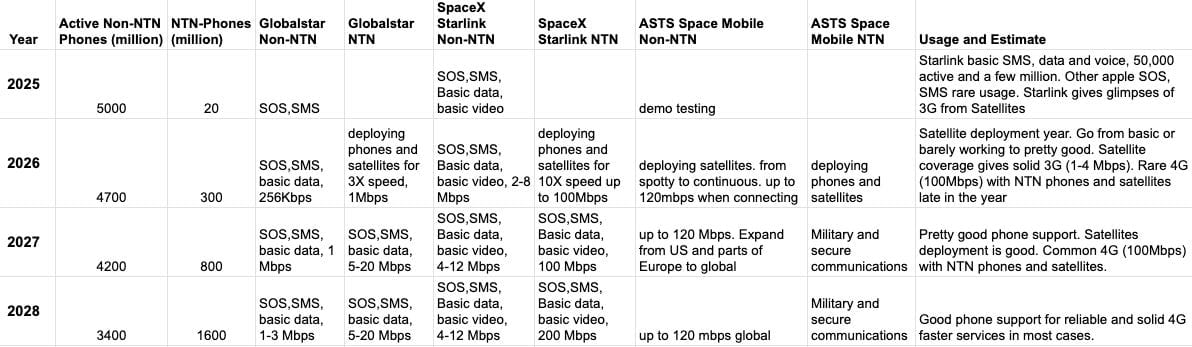
DTC is an emerging service and we are going from it barely works in 2025 to a mature mostly 4G service in 2028. In 2025, SpaceX Starlink is the only continuous coverage service with basic texting, voice and low speed data service. All providers will build out coverage and reliability in 2026. I am projecting the DTC transition to 4G speed and services as satellites and satellite optimized phones are deployed in 2026-2028.
2027 is when higher speed direct to satellite services and phones to support them will be good for early adopters of 3G-4G. 2028 is when this will be reliable and fast with the full 15,000 Starlink satellite constellation and lots of bandwidth will have been acquired.
Regular Phones Work Unreliably for Satellite but New Phones Will Be Reliable and Faster
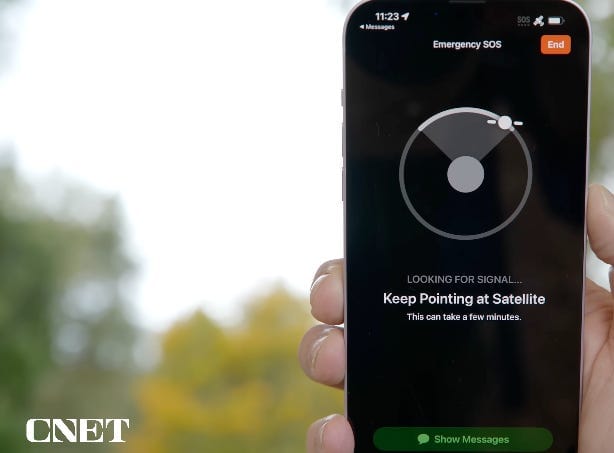
Phones with early Non-Terrestrial Network (NTN) chips are more reliable. NTN chip makers are designing phone to have 2-5x better connection success in cars and when partially obstructed. AI beam management reduces dropouts by 30-50%. There are online reviews that Apple unmodified phones can take 15-120 seconds to connect and are prone to 15-30% failure in tests due to no native handover. Online reviews of Starlink show faster connections to satellites and handovers every two minutes or so for texting, voice and data.
In 2025, SpaceX Starlink and partners like T-mobile have the only significant satellite network with reliable and consistent coverage for text, voice and basic data with up to 2-8 mbps for 3G speeds. NTN phones are rare and just make satellite services more reliable and a bit faster. Apple and Globalstar satellite service is mainly SOS and basic texting with minutes to connect and drops in service.
In late 2026, Globalstar’s third-generation, C-3, satellites are projected to support at least 1 Mbps downlink for DTC to unmodified phones. The C-3 system features higher gain antennas, increased beam power, dynamic beamforming, and robust signal strength, enabling 2-3x throughput improvements over older satellites. First launches, 9 satellites, are slated for Q1 2026 via SpaceX, with full operational deployment ,up to 50 satellites, by end of 2026.
What Phones Improvements Are Needed
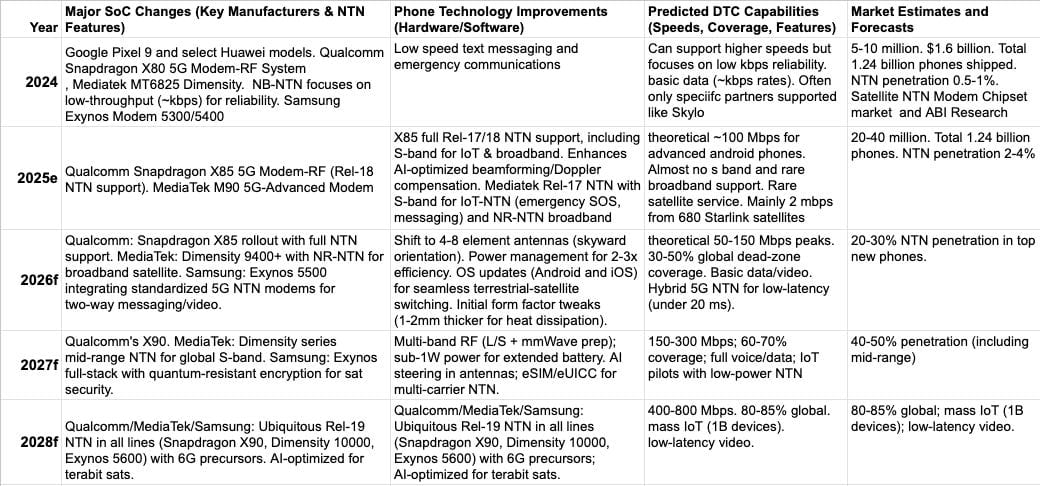
Current smartphones are optimized for terrestrial networks. Smartphones and chips with Non-Terrestrial Network (NTN) compliant modems began entering the mainstream market in 2024 and saw accelerated introductions through 2025. The leading chipset vendors—Qualcomm, MediaTek, Samsung all are selling and developing chips able to better handle DTC (direct from satellite to cellphone).
The main processor chip in phones (called a system-on-chip) handles all the signal receiving, processing, and transmitting in one efficient package, keeping things fast and battery-friendly. New chips must include built-in modems that support satellite-based 5G in the specific bands bought from EchoStar.
Optimized phones with NTN chips will help SpaceX Starlink the most because the Echostar bandwidth needs more support and has a bigger performance leap from not working to working for those bandwidth. Globalstar (Apple) and ASTS Spacemobile have bandwidth that needs the NTN chips for reliability but less of a speed and service jump.
Onboard tools are needed for DTC phones to pre-adjust for motion-induced signal shifts, plus error-checking features that temporarily store and resend data during frequent satellite handovers. Today’s phones are built for ground-based cell towers, not satellites. But starting in 2024 and ramping up in 2025-2026, phones with satellite-ready modems hit the market big-time. Top chip makers like Qualcomm, MediaTek, and Samsung now offering versions that handle direct satellite links better. However, current NTN chips are still at an early stage and with less DTC feature support. No deals have been announced with SpaceX Starlink and the main cellphone chipmakers but they will need to cooperate to get the needed modifications built.
Qualcomm holds 26-30% of the market and is adding satellite support to their modems for Android and iOS phones. They use AI to predict when to switch satellites (based on orbit paths), plus special radio chips for these frequencies that reduce noise, boost signal strength, and filter precisely.
MediaTek has 28-32% market share, targeting affordable mid-range phones.
In 2026, there will be a buildout of DTC satellites. SpaceX Starlink and AST Space Mobile will need until about 2028 for 15000 V3 Starlink and 240 AST Space Mobile satellites. The AST Space Mobile buildout to 60 or more will be substantial by early 2027 for continuous service in the USA and will get better for Europe in 2027.
SpaceX V3 buildout could be impacted by the need to complete full orbital capability and fully reliable performance. SpaceX has demand for Starships for the NASA HLS and for an unmanned Mars mission in 2026 and 2027.
Power Management Requirements
NTN uplinks require 2-4x power of regular terrestrial phones (1-2 watt instead of 0.5 Watts). This is caused by higher path loss. The chips will use adaptive voltage scaling to limit battery drain.
It will still be better for DTC optimized phones to have larger batteries.
Antenna Requirements
Change from side-mounted dipoles to skyward facing arrays. These will have over 5 dBi gain, and circular polarization to mitigate Faraday rotation in the ionosphere. There will be AI steering for beam tracking.
Unmodified phones will generally be stuck at about 2-8 Mbps but the chip, power and antenna modifications and V3 satellites will enable 100+ Mbps communications for SpaceX Starlink by 2026-2027.
Satellite Modifications: 15000 Starlink V3 DTC
Starlink V3 next-gen DTC satellites will launch from 2026 onwards. The number of launches will depend upon when the Starship goes fully orbital and is reliable. SpaceX can start launching V3 satellites even if they are not reusing the upper stage. The booster should be reliable and going to orbit needs to be reliable. Orbital movement and engines in orbit needs to be reliable. SpaceX will have a lot of Starship launches and refueling missions that will take up Starship capacity for moon and Mars missions.
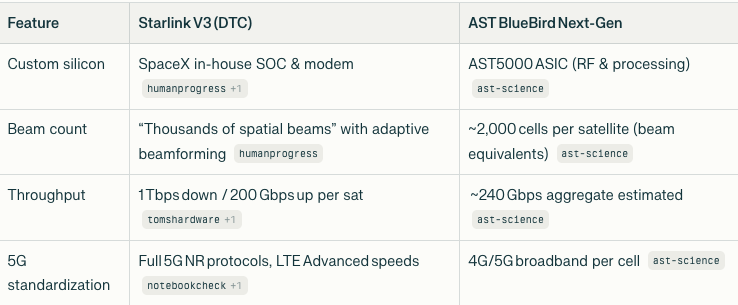
Custom SpaceX chips and modems in the V3 satellites will be tuned for 5G and will support thousands of beams. They will have larger solar arrays scaled to roughly 3x power of the V2 mini. There will need to be more fuel and stronger ion drives to maintain the lower altitude.

RF/Beamforming will use phased arrays that are tuned to S-band. This enables 20x throughput. Adaptive beam shaping for handset tracking with narrower beams. Narrower beams allow frequency reuse across adjacent beams which can boost overall throughput in dense urban zones.
Future of Satellite of Direct to Cellphone
SpaceX’s $17 billion acquisition of EchoStar’s AWS-4 and H-block spectrum enables broadband DTC (direct to cellphone) with 20x throughput over prior low-band spectrum from T-mobile.
This mid-band S-spectrum offers excellent propagation characteristics but phones will need new chips to work with the spectrum band.
DTC is an emerging service and we are going from it barely works in 2025 to a mature mostly 4G service in 2028. In 2025, SpaceX Starlink is the only continuous coverage service with basic texting, voice and low speed data service. All providers will build out coverage and reliability in 2026. I am projecting the DTC transition to 4G speed and services as satellites and satellite optimized phones are deployed in 2026-2028.
2027 is when higher speed direct to satellite services and phones to support them will be good for early adopters of 3G-4G. 2028 is when this will be reliable and fast with the full 15,000 Starlink satellite constellation and lots of bandwidth will have been acquired.
The rollout of satellites and phones is explained in the Nextbigfuture.substack.com article.
The Best “Go Paid” Deal on Substack! You Get REAL Stuff!!

Go paid at the $5 a month level, and we will send you both the PDF and e-Pub versions of Etienne’s new book: To See the Cage Is to Leave It - 25 Techniques the Few Use to Control the Many and a coupon code for 10% off anything in the https://artofliberty.org/store/.
Go paid at the $50 a year level, and we will send you a free paperback edition of Etienne’s new book: To See the Cage Is to Leave It - 25 Techniques the Few Use to Control the Many OR “Government” - The Biggest Scam in History… Exposed! OR a 64GB Liberator flash drive if you live in the US. If you are international, we will give you a $10 credit towards shipping if you agree to pay the remainder.
Support us at the $250 Founding Member Level and get a signed high-resolution hardcover of “Government” - The Biggest Scam in History... Exposed! + Liberator flash drive + a signed high-resolution hardcover of Etienne’s new book: To See the Cage Is to Leave It - 25 Techniques the Few Use to Control the Many + everything else in our “Everything Bundle” of the best in voluntaryist thought delivered domestically. International pays shipping. Our only option for signed copies besides catching Etienne @ an event.


