

In A Nutshell
- Grateful people reported better health across two surveys of 148,000-plus people.
- Feeling supported tracked with health in both surveys; giving help did so in one.
- Gratitude was less tied to helping in more collectivist countries.
- These are links, not proof that gratitude improves health.
Feeling thankful tends to go hand in hand with better health, but the reason may have less to do with being generous than with feeling looked after. A study of more than 148,000 people in 57 countries found that grateful people did help others more often, yet feeling supported was the steadier link to better health.
Researchers drew on two large surveys: one fielded during the COVID-19 pandemic and another from the Global Flourishing Study, which checked in with the same people a year apart. In both, people who reported more gratitude also reported better physical health and well-being, matching earlier research. What had been unclear was why, and whether the pattern holds in every country, since earlier cultural comparisons mostly pitted European Americans against East Asians or Asian Americans. The results appear in the Journal of Happiness Studies.
Culture changed part of the picture. In countries rated as more collectivist, meaning places that put a high value on group harmony and community obligations, gratitude was less likely to go along with helping others. That does not mean people in those countries help less overall. The researchers called it plausible that cultural norms there already push people toward giving support, leaving grateful feelings with less extra work to do.
Feeling Supported Showed the Steadier Link Between Gratitude and Health
Originally run to study emotions during the pandemic, the first survey included 24,221 people across 51 countries, about a third of them men, with an average age of 37. Participants rated how much gratitude they felt over the past week and how much support they received from others. They also counted how many helpful acts they had done that week, out of six possibilities that included donating to a pandemic-related charity, and rated how physically and mentally healthy they felt at that moment. The researchers adjusted for age, gender, and self-rated social standing.
More grateful people reported getting more support and doing more helping. Only the support, though, tracked with health. Those who reported receiving more support rated their physical and mental health higher, while the number of helpful acts showed no clear relationship to either. The health boost routed through support was small but measurable. In everyday terms, someone grateful for a neighbor’s help may gain more from the help received than from returning the favor.
Results varied by country: gratitude was strongly linked to helping in Vietnam but showed no clear link in Greece.
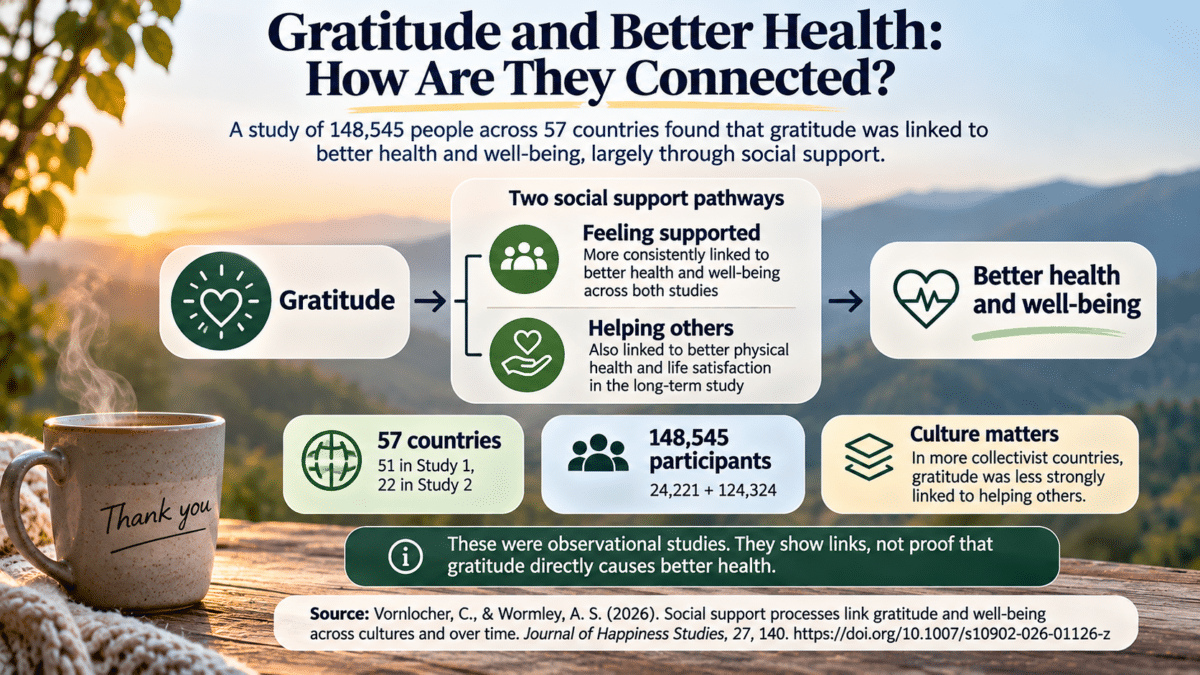
Gratitude and Health Links Held Up a Year Later in 22 Countries
Because a single snapshot cannot show which factor comes first, a second analysis turned to the Global Flourishing Study, an ongoing five-year project that surveys people about the factors behind a good life. It covered 124,324 people in 22 countries who completed surveys in both 2023 and 2024. Nearly half were men, and the average age was about 50.
Gratitude was gauged by agreement with a statement: “If I had to list everything that I felt grateful for, it would be a very long list.” Participants also rated how often they could count on friends or relatives when in trouble, how often they showed people in their lives that they love or care for them, their physical health, and their satisfaction with life, all on 0 to 10 scales.
People who reported more gratitude in 2023 also reported more confidence in others’ help and more caring behavior in 2024, even after factoring in how each person had rated these things the year before. This time, both kinds of support went along with better physical health and higher life satisfaction. Giving was measured as showing love or care rather than as concrete helping, a difference that may help explain why it mattered here but not in the first survey. Effects were modest, and with no one assigned gratitude exercises, even this year-apart design cannot prove that gratitude causes better health.
Country differences echoed the first survey. Gratitude’s link to feeling supported varied more across countries than any other link tested, barely detectable in Turkey but strong in the United States, the United Kingdom, and Japan.
Gratitude Was Less Tied to Helping in More Collectivist Countries
Countries were scored with the Global Collectivism Index, a measure of how strongly each nation emphasizes group ties. The weaker gratitude-to-helping link was the only cultural result that showed up in both surveys. The larger second survey added a twist: gratitude was also less tied to feeling supported in more collectivist countries, yet giving and receiving support were more strongly tied to physical health there, perhaps because support signals belonging to the group, a possibility the authors raised.
Researchers also noted that support explains only part of gratitude’s health link. Positive mood, lower stress, and stronger feelings of connection are other possible routes, though none was tested here.
Gratitude’s tie to health appears to run at least as much through helping people notice who already has their back as through making them generous, so exercises built only around repaying kindness may be missing half the picture.


