

by Ashley Armstrong, articles.mercola.com
Story at-a-glance
Chronic disease rates in America have increased dramatically, from 7.5% of the population in the 1930s to 60% today, representing a 700% surge, while obesity now affects 40% of Americans
Four companies (Bayer, Syngenta, BASF, and Corteva) dominate the agricultural market, with Bayer controlling 18.2% of global agrochemicals and, together with Corteva, over half of U.S. retail seed sales for major crops
The concentration ratio (CR4) in U.S. agriculture has reached extreme levels — 85% in beef packing, 70% in pork packing, and 95% control of corn intellectual property by just four companies
In 2024, pharmaceutical companies spent $294 million on lobbying, while agribusinesses spent $32.7 million, with Bayer alone spending $6.46 million in the U.S.
Modern industrial agriculture mimics pharmaceutical business models by creating dependency cycles. Farmers must repeatedly purchase synthetic inputs while patients require ongoing medication rather than cure-focused treatments
America is facing a health crisis. In the 1930s, just 7.5% of Americans suffered from chronic diseases.1 Today, that figure has surged by over 700%, with 60% of Americans now living with one or more chronic conditions.2 We are also fatter than ever — obesity rates have reached 40% and continue to climb.3
Even more alarming, the U.S. is the only developed nation where both healthy life expectancy and total life expectancy are in decline4 — a trend that began before COVID-19. In other words, we’re not living as long as our grandparents did, despite all of our technological advancements.
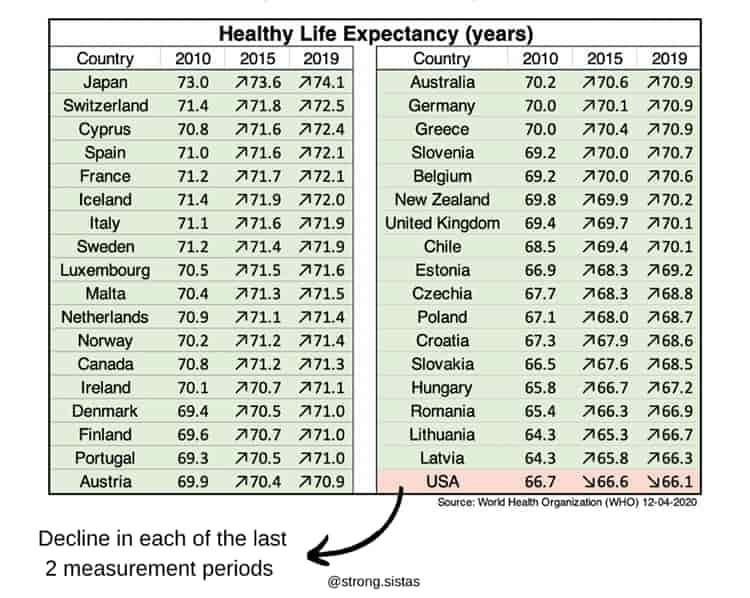
How did we get here? One answer lies in the disturbing parallels between Big Pharma and Big Ag — two industries that wield enormous power over our health. The relationship between our food systems and our healthcare systems is no coincidence. Food is being produced in ways that undermine our health and keep us dependent on pharmaceuticals.
The business models of both the pharmaceutical and agriculture industries thrive on treating symptoms rather than addressing root causes, ensuring a continuous cycle of dependency.
Pharmaceutical companies profit immensely by focusing on symptom management instead of curing underlying conditions. Chronic diseases like diabetes or hypertension, for example, have become lucrative markets, as patients often require lifelong medication rather than one-time treatments.
Big Ag mirrors this approach. Farmers are locked into systems reliant on synthetic fertilizers, pesticides, herbicides, and genetically modified crops — inputs they must repurchase every season. Rather than restoring soil health or embracing regenerative farming, these practices perpetuate chemical dependency. (And fail to provide truly nutritious, health-promoting food).
Both industries promise solutions but often create new problems. In agriculture, pests develop resistance, leading to the need for even stronger chemicals. In healthcare, one medication’s side effects often require another drug to manage.
This cycle of dependency benefits corporations but leaves the rest of us sick, overmedicated, and struggling. The unfortunate reality is that the power over our health is concentrated in the hands of a few corporations.
Understanding this connection between Big Ag and Big Pharma is the first step toward change. By supporting alternative systems — whether regenerative agriculture or holistic health practices — we can begin to reclaim our well-being.
Bayer — Bridging Big Pharma and Big Ag
When exploring the overlap between Big Pharma and Big Ag, Bayer stands out as a stark example. As of December 2023, Bayer comprised 340 consolidated companies operating in 80 countries.5,6 Its vast reach ensures its influence spans nearly every aspect of health and agriculture, blurring the lines between industries that should prioritize health over profit.
Before Bayer acquired Monsanto in 2018, the two companies operated in separate realms. Monsanto was a powerhouse in agriculture, dominating the seed and agrochemical markets, while Bayer focused primarily on pharmaceuticals and consumer health products. The $63 billion merger merged these sectors, creating a global behemoth that exerts significant influence over both food production and health care.
This acquisition solidified Bayer’s dominance in agriculture. By 2018, Bayer controlled 18.2% of the global agrochemical market.7 Between 2018 and 2020, Bayer and Corteva collectively accounted for more than half of U.S. retail seed sales for corn, soybeans, and cotton. Globally, Bayer, Syngenta, BASF, and Corteva dominate the agricultural market, controlling a substantial share.8
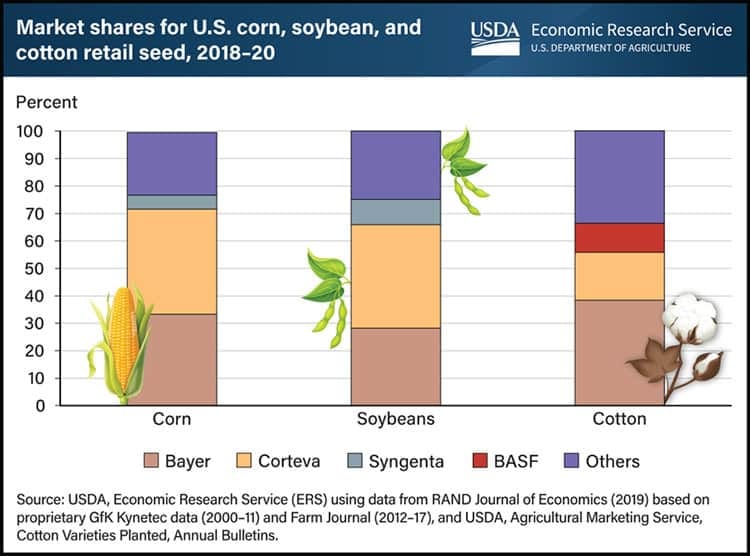
This German multinational now operates across pharmaceuticals, consumer health, and agriculture — a structure that raises serious concerns. Bayer’s pharmaceutical division spans several therapeutic areas:
Cardiology — Medications like Xarelto (rivaroxaban) treat blood clots, hypertension, and cardiovascular issues.
Oncology — Cancer treatments such as Stivarga (regorafenib) and Nexavar (sorafenib) address colorectal, liver, and kidney cancers.
Women’s health — Products include hormonal contraceptives and treatments for menopause-related conditions.
Ophthalmology — Drugs like Eylea (aflibercept) combat macular degeneration.
Bayer’s consumer health division includes household names, reinforcing Bayer’s influence in everyday health decisions:
Allergy and cold remedies — Claritin and Alka-Seltzer.
Digestive health — MiraLAX and Rennie.
Skin and wound care — Bepanthen and Canesten.
Bayer’s agricultural division, bolstered by Monsanto’s expertise, focuses on “crop science” and food production. While this may seem to serve public health by addressing food security, the reality is more complicated. Bayer’s focus on genetically modified seeds, synthetic fertilizers, and pesticides promotes systems of dependency that harm soil health and perpetuate chemical use.
Bayer’s dual role in pharmaceuticals and agriculture exemplifies how intertwined these sectors have become. The consolidation of power across both industries raises pressing questions about the health of people and the planet. Is it truly possible for one corporation to champion health while contributing to agricultural practices that undermine it?
Consolidation of Power and CR4 — A Rigged System
The centralization of power in both Big Ag and Big Pharma has created systems that prioritize corporate profits over the health of people, farmers, and the environment. By examining the CR4 (Concentration Ratio of 4) — a metric that measures the market share of the four largest firms in an industry — we can see just how concentrated these industries have become. The CR4 provides a clear picture of market competitiveness:
When the CR4 > 50%, the top four firms control more than half the market, suggesting significant concentration.
A CR4 > 80% indicates a highly concentrated, oligopolistic market.
A CR4 < 40% reflects a relatively competitive industry.
High CR4 values signify reduced competition, giving dominant firms significant power over pricing, policies, and market access, often at the expense of consumers and smaller players. In the U.S. agricultural sector, CR4 values are alarmingly high, showcasing how a handful of corporations dominate key markets:
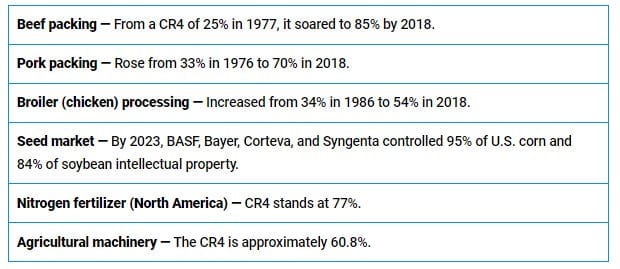
Farmers are forced into a system where they have little choice over inputs, crops, livestock, or markets, and a system that encourages a “go big or go home” mindset to make the numbers work. This industrialized and concentrated setup marginalizes small farmers and alienates consumers from the family farms that grow their food. Meanwhile, biodiversity, rural communities, and soil health suffer as corporations push monocultures and chemical dependency.
While the pharmaceutical industry is slightly more fragmented, certain sectors exhibit high CR4 values:
Vaccines — Pfizer, GSK, Sanofi, and Merck control nearly 80% of the global market.
Diabetes drugs — Dominated by Novo Nordisk, Eli Lilly, and Sanofi, with a CR4 of about 70%.
Oncology — The top four companies (Roche, Merck, BMS, and Novartis) control 45% to 50% of the market.
High CR4 values highlight a troubling reality: concentrated power creates a system ripe for market abuse. Whether it’s Big Ag controlling what farmers plant or Big Pharma deciding what treatments are available, these industries hold disproportionate power over our food and health systems.
The result? Consumers pay more, farmers earn less, and the broader systems we depend on — our health and our environment — continue to erode.
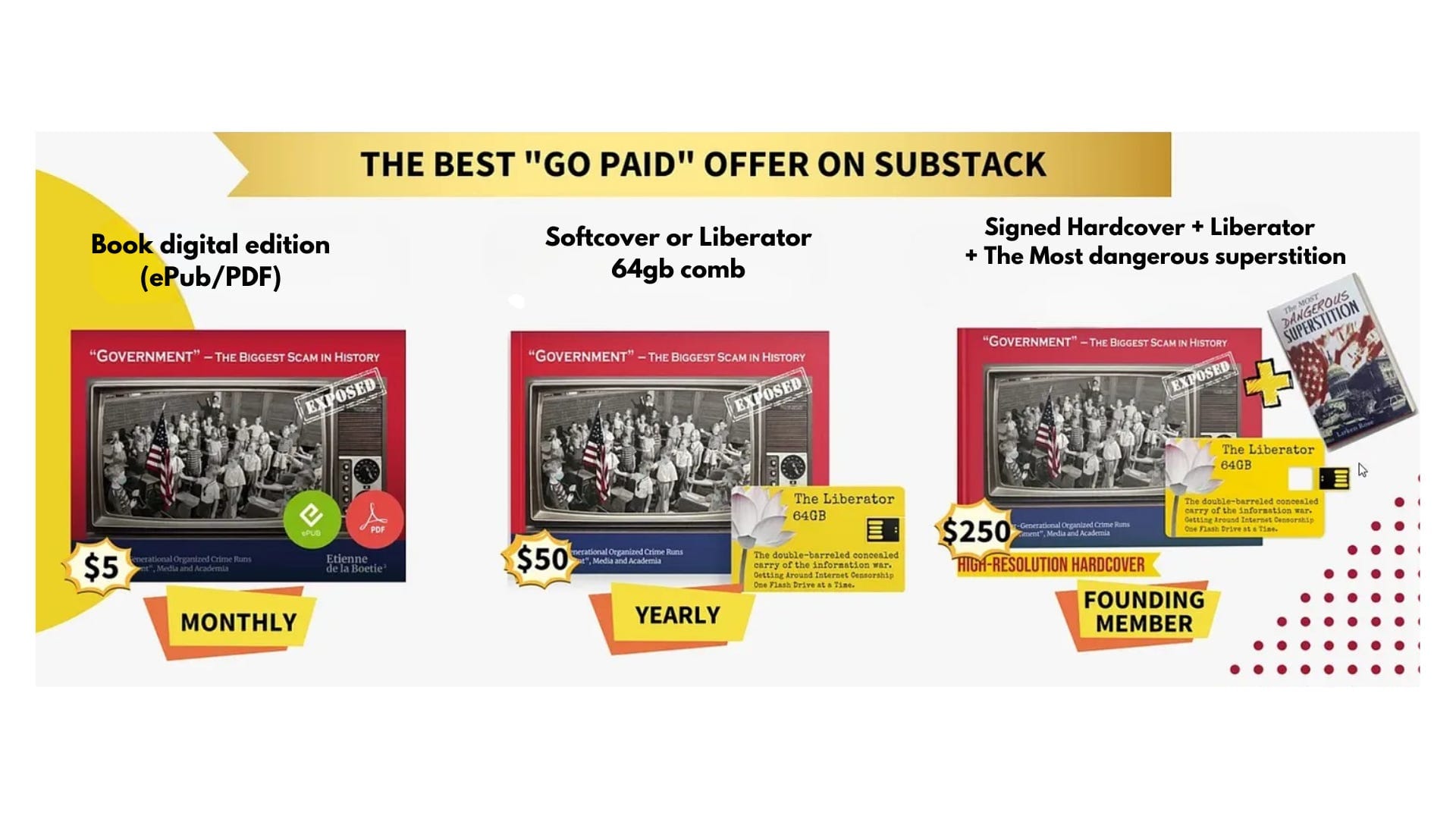
Go paid at the $5 a month level, and we will send you both the PDF and e-Pub versions of “Government” - The Biggest Scam in History… Exposed! and a coupon code for 10% off anything in the Government-Scam.com/Store.
Go paid at the $50 a year level, and we will send you a free paperback edition of Etienne’s book “Government” - The Biggest Scam in History… Exposed! OR a 64GB Liberator flash drive if you live in the US. If you are international, we will give you a $10 credit towards shipping if you agree to pay the remainder.
Support us at the $250 Founding Member Level and get a signed high-resolution hardcover of “Government” + Liberator flash drive + Larken Rose’s The Most Dangerous Superstition + Art of Liberty Foundation Stickers delivered anywhere in the world. Our only option for signed copies besides catching Etienne @ an event.


