

Etienne Note: This article also appears in “Government”, Media and Academia Criminality Exposed, A digest of HUNDREDS and HUNDREDS of articles exposing and suggesting inter-generational organized crime’s control of the “Government,” Media and Academia by the Art of Liberty Foundation. You can view the other articles or subscribe on Telegram: https://t.me/Government_Scams
Executives at Anduril and Palantir, crypto industry advocates, and investors giving through AIPAC helped fund the Democratic leader preparing to become speaker.
With the Democrats’ sweeping midterm victory, Hakeem Jeffries is preparing to lead House Democrats’ promised investigations of the Trump administration. A review of his 2025-26 fundraising shows he’ll do so with financial backing from executives at Anduril and Palantir, cryptocurrency industry interests, and major Wall Street investors—business interests with a stake in how aggressively the new majority pursues corporate beneficiaries of Trump’s presidency.
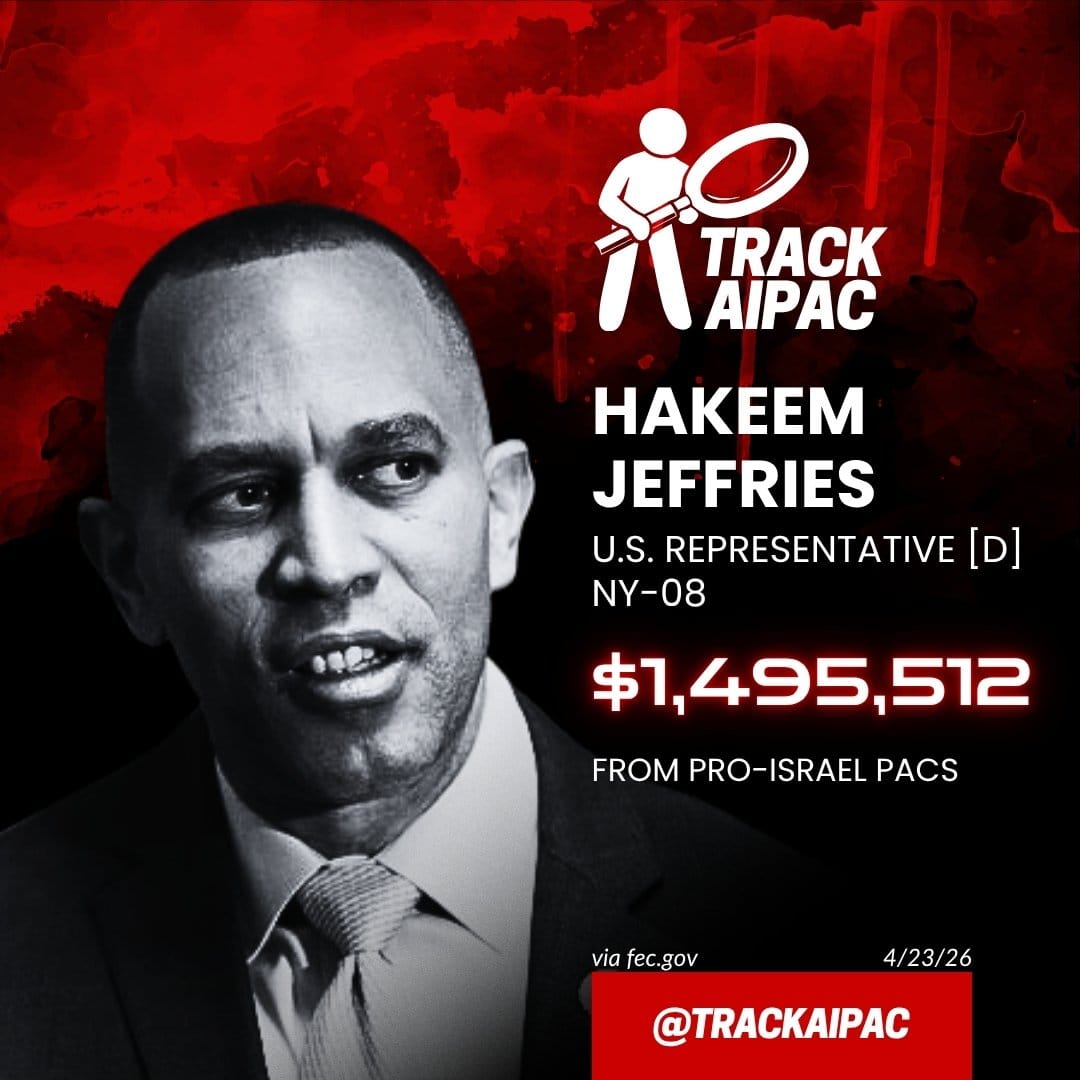
Federal Election Commission filings show that Anduril’s CEO and chief operating officer gave $144,300 to Jeffries’ fundraising committees, while a manager at Palantir contributed another $44,300. His donors also include the head of a cryptocurrency advocacy group and investment executives at Bain Capital, D.E. Shaw, and Renaissance Technologies. AIPAC’s political action committee routed more than $427,000 in donor contributions to his campaign and fundraising committees this cycle.
The Democrats’ midterm victory puts Jeffries in position to become the first Black speaker when the new Congress convenes in January. He has promised investigations of the Trump administration and an agenda focused on lowering living costs. The majority will give Democrats control of House committees, with the power to subpoena records, question corporate executives, and scrutinize administration practices.
Some of the industries Democrats could investigate have helped finance Jeffries’ political operation over the past two years, with executives contributing large sums as their companies seek federal contracts, favorable regulations, and tax breaks.
The contributions were given to a range of committees associated with the Democratic leader, including Jeffries Victory Fund, Jeffries Majority Fund, Jeffries Battleground Protection Fund. which are joint fundraising committees that split up the proceeds with other candidates. The analysis also looks at contributions to Jeffries’ campaign committee.
Jeffries’ office did not respond to a request for comment on the contributions and whether they will affect the Democrats’ legislating and oversight in the next Congress.
Defense and Surveillance Contractors
Anduril CEO Brian Schimpf gave $100,000 to Jeffries Battleground Protection Fund on April 9. Fellow co-founder Matthew Grimm, the company’s chief operating officer, gave $44,300 to Jeffries Victory Fund on Aug. 16.
Anduril sells weapons and autonomous surveillance systems to the federal government. In June, it announced a $363 million Customs and Border Protection contract for more than 200 additional surveillance towers along the southwest border. The company says the 80-foot towers can detect, classify, and track people more than five miles away. It already has more than 350 standard-range towers operating for CBP. The Army also announced a 10-year Anduril contract in March with a maximum potential value of $20 billion.
Anduril’s co-founder Palmer Luckey has donated $5.9 million to Republicans since 2017, The Guardian reported in August. His fundraising has included hosting Trump at his Newport Beach estate in 2020 and 2024, where tickets reached $150,000 per couple for a place on the roundtable host committee. Schimpf and Grimm, on the other hand, have directed substantial contributions to Democrats, a pattern that LAist recently covered.
Palantir, which supplies surveillance software to Immigration and Customs Enforcement (ICE), also appears in Jeffries’ fundraising records. Mehdi Allhassani, who leads internal operations at the company, gave $44,300 to Jeffries Victory Fund on Feb. 28, 2025.
ICE paid Palantir $30 million in 2025 to develop ImmigrationOS, a system intended to help the agency track immigrants and carry out deportations.
Palantir has also hired lobbyists with close ties to Jeffries. As Sludge previously reported, its lobbyist at the firm Avoq includes Cedric Grant, Jeffries’ former chief of staff, and Steve Elmendorf, a major bundler for congressional Democrats.
Major defense contractors also contributed through their PACs. Jeffries’ campaign received $10,000 apiece from the PACs of Lockheed Martin, Northrop Grumman, Raytheon Technologies, Boeing, General Dynamics, and L3Harris during the cycle. Smaller contributions came from the PACs of BAE Systems, Huntington Ingalls, Leidos, and Textron.
Crypto Lobbying
Jeffries Victory Fund received $50,000 on May 28 from Adrian Wall, a managing director and lobbyist at the Digital Sovereignty Alliance. The nonprofit advocates on cryptocurrency legislation. Its January 2025 launch announcement indicated the coalition was led by TRON DAO as its supporters and included an endorsement from TRON founder Justin Sun, who invested in the Trump family’s World Liberty Financial venture before suing it this year over the freezing of his tokens.
The Digital Sovereignty Alliance has promoted the Clarity Act, legislation that would overhaul federal oversight of cryptocurrency markets and put many projects under a less rigorous regulatory regime. The Congressional Progressive Caucus opposed the bill, arguing that it would weaken investor protections and that it failed to address Trump’s financial conflicts of interest. Jeffries voted against the CLARITY Act when it passed the House in July 2025.
Coinbase CEO Brian Armstrong gave Jeffries’ campaign $7,000 on April 28. The campaign also received $3,500 each in March from Jesse Pollak, a Coinbase vice president of engineering, and Alden Knowlton, listed as its political director. Knowlton currently works as a senior director at lobbying firm Invariant, a major DCCC bundler, focused on technology policy. Dennis Porter, CEO of Satoshi Action Fund, gave Jeffries Victory Fund $5,000 in June.
AIPAC and Wall Street
AIPAC PAC transmitted $427,550 in earmarked contributions to three Jeffries committees through September: $250,000 to the Victory Fund, $149,300 to the Battleground Protection Fund, and $28,250 to his campaign.
The money came from donors using AIPAC as an intermediary, rather than from the PAC’s own funds. The total covers payments greater than $200 in AIPAC PAC disbursement records reviewed by Sludge.
The entire $250,000 to Victory Fund was transmitted on Feb. 27, 2025, in 20 earmarks. Donors included Tony Davis of Linden Capital Partners, Andrew Rubinstein of Oberland Capital, and Philip Darivoff of Vibrant Capital Partners, along with Alan Leifer of Leifer Capital Advisers, each at $15,000.
Another $149,300 came from investor Daniel Och in two earmarked payments AIPAC transmitted to Battleground Protection Fund on May 20. Sludge previously reported those payments in July, which at the time were AIPAC PAC’s largest earmarks ever. Och’s contributions to the Protection Fund and Victory Fund totaled $205,600 in the 2025-26 cycle.
Jeffries opposed a July amendment to cut off U.S. aid to Israel, arguing that it was too broad and would also restrict humanitarian aid and other programs, though he did not instruct Democratic colleagues to vote against it.
His continued support from AIPAC’s donor network comes as Democratic voters’ views of Israel have grown more negative. A Pew Research Center poll conducted in March found that 80% of Democrats and Democratic-leaning independents viewed Israel unfavorably, a rise from 53% in 2022.
Investment executives also supplied large contributions outside the AIPAC earmarks. Matthew Hulsizer of PEAK6 Industries, whose businesses span options trading and financial technology, gave the Battleground Protection Fund $485,100. Geoffrey Raynor of Q Investments, a Texas firm investing in hedge funds and private equity, contributed $428,800 across Victory Fund and Battleground Protection Fund. Henry Laufer of Renaissance Technologies, which uses mathematical models to trade financial markets, gave Victory Fund $300,700, while Edward Fishman of D.E. Shaw, a global investment firm known for its use of quantitative trading strategies, gave $259,300.
Bain Capital’s Ryan Cotton and Jonathan Lavine each gave Victory Fund $100,000. So did David Golub of Golub Capital, Constantine Dakolias of Fortress Investment Group, Steven Rattner of Willett Advisors, and Roger Altman of Evercore. Bain Capital belongs to major trade associations the American Investment Council (AIC) and Managed Funds Association (MFA), among others, that supported the Trump administration’s push to open up 401(k) retirement accounts to alternative assets. AIC also campaigned against proposed changes to the “carried interest” tax loophole in negotiations over the Republican reconciliation budget bill.
Corporate PACs also contributed to Jeffries’ campaign, which reported $10,000 each from the PACs of JPMorgan Chase, Bank of America, Citigroup, Wells Fargo, and Morgan Stanley. PACs associated with seven major health insurers and their parent companies—UnitedHealth, Cigna, CVS, Humana, Elevance, Centene, and Molina—also each gave $10,000.


