

Etienne Note: The CIA realized the importance of books! This quote is from a 1961 CIA memo, made public in the 1975–76 Church Committee investigation. Attributed to the CIA’s Covert Operations (Clandestine Services) chief: “Books differ from all other propaganda media, primarily because one single book can significantly change the reader’s attitude and action to an extent unmatched by the impact of any other single medium... this is, of course, not true of all books at all times and with all readers — but it is true significantly often enough to make books the most important weapon of strategic (long-range) propaganda.” This is why we make bulk copies of “Government” – The Biggest Scam in History... Exposed! and To See the Cage is to Leave It – 25 Techniques the Few Use to Control the Many available in low-cost “Friends Bundles” to give to your friends, family and colleagues. Physical books are impossible to delete, impossible to algorithmically censor, and have a permanence in someone’s life until they decide to read it. We use a variety of different techniques that I explained in detail in my interview with James Corbett, to both capture the reader’s attention and bring them to the “moment of insight.” Fun Fact: Over 10% of the books we sell are “Friends Bundles” as people realize how powerful the books are in “waking up” their friends, family and colleagues! We already have an order for 200 copies of my upcoming book The Greatest Theft in History! From a supporter of the Foundation is about to drop the (Knowledge) BOMB on her community!
By Diamond-Michael Scott - Great Books + Great Minds
The art of reading is dying. Yet something else is being reborn. I believe that both are happening simultaneously, in the same cultural moment, but many of us are aware of only one of these trends.
The numbers on reading’s decline are not subtle. Two in five Americans did not read a single book in 2025. Daily reading for pleasure has fallen roughly 40% over the past two decades.
A Gallup poll found that Americans read an average of 12.6 books per year, the lowest figure since tracking began in 1990. College graduates, the demographic we once counted on to keep the flame alive, now read six fewer books annually than they did just a decade ago.
Among U.S. 12th graders, those reading no books for pleasure nearly tripled between 1976 and 2016. And across the Atlantic, a UK survey of 114,000 young people found that only 32.7% enjoy reading in their free time, a 36% drop since 2005.
Let’s sit with these trends and feel the weight of them, not as an abstract social trend but as our own personal mission.
The Attention Economy Has Won. Or Has It?
I believe that clarity is the beginning of any intelligent response to this. First, it is important to note that social media and other elements of the digital economy are not merely competing with books. They’re architecturally engineered to dismantle the very conditions that make reading possible: stillness, patience, sustained focus, and the willingness to sit with complexity that does not resolve itself in seconds.
Short-form video delivers dopamine in bursts that books were never designed to match. TikTok, Instagram Reels, YouTube Shorts are platforms used as precision instruments for capturing and fragmenting attention.
Teenagers now average nearly five hours of social media daily. Researcher Maryanne Wolf’s landmark work on neurological rewiring and critical thinking surfaces something even more unsettling, namely, that screen reading structurally favors skimming, and the neural pathways built through sustained immersive reading are now less frequently exercised.
Deep reading has not just become less entertaining for many young people. It has become cognitively harder. The brain, shaped by what we repeatedly ask it to do, is drifting away from depth.
And then there is AI, which is accelerating the whole thing. A Forbes/Gallup study found that 43% of Gen Z rarely or never read books for pleasure, and when AI can summarize a book in thirty seconds or answer any question on demand, the functional motivation to read begins to evaporate. We are living in the age of the instant answer. Why wrestle with a 400-page argument when the algorithm will flatten it for you?
I navigate this tension every day as a writer, a reader, and a curator of conversations. I have watched it reshape the people around me. And I have come to believe that the intelligent response is neither panic nor nostalgia. It is clarity about what is actually at stake.
The Paradox That Futurists Cannot Agree On
Forecasters are genuinely divided, and their disagreement is worth sitting with. Pessimists like technologist Peter Wang envision books replaced entirely by AI-powered interactive fragments, dynamic nuggets of thought that respond to the reader in real time. Some analyses suggest that books as a conduit for mainstream knowledge medium could be effectively dead within 25 to 30 years, as younger generations skip cover-to-cover reading in favor of AI-mediated summaries and curated highlights.
Some futurists foresee AI-adaptive storytelling and augmented reality books, narratives that shift with your emotional state along with characters appearing as holograms. The book survives, they argue, but evolves into something more immersive and personalized than anything we can currently imagine.
Then there is the camp I find most compelling, because it is the one grounded not in prediction but in what people are actually doing with their hunger. Call them the counterculturalists. There is growing, documented evidence of a deliberate long-form revival among a committed minority. Book clubs, slow-reading rituals, curated newsletters, and physical books as identity objects are creating what one analyst calls a ‘high-intensity demand cluster.’
And here is the data point that should stop you cold: while reading time per capita is falling, book market revenues in the U.S. and UK recently hit record highs. Fewer people are reading. But those who do are spending more, buying more, going deeper.
The global book publishing market is estimated to reach roughly 100 billion dollars in 2026 and is projected to hit 113 billion by 2030. U.S. industry revenue came in at 14.6 billion in 2025, up 1.1% year over year. The casual reader is gone. The committed reader is very much alive, and she is not slowing down.

The Renaissance Nobody Predicted
Here is the sentence I did not expect to write about this particular cultural moment: independent bookstores are booming.
605 new independent bookstores opened in the United States in 2025 alone, a 19% jump in American Booksellers Association membership. ABA membership now stands at 3,417 stores, nearly triple what it was a decade ago. Roughly 1,500 new indie stores have opened over the past five years, the highest levels since the late 1990s. And 73% of ABA members reported sales increases in 2025. These are not boutique vanity projects. These are businesses thriving in conditions that were supposed to be killing them.
The reason is instructive. Indie bookstores have reinvented themselves as community third spaces. They host events and author readings. They pour wine. They become anchoring institutions in neighborhoods that feel the strain of a politically fractured, digitally saturated culture. As the Los Angeles Times observed, they are serving a resistance function now, becoming gathering places for people who are hungry for something real.
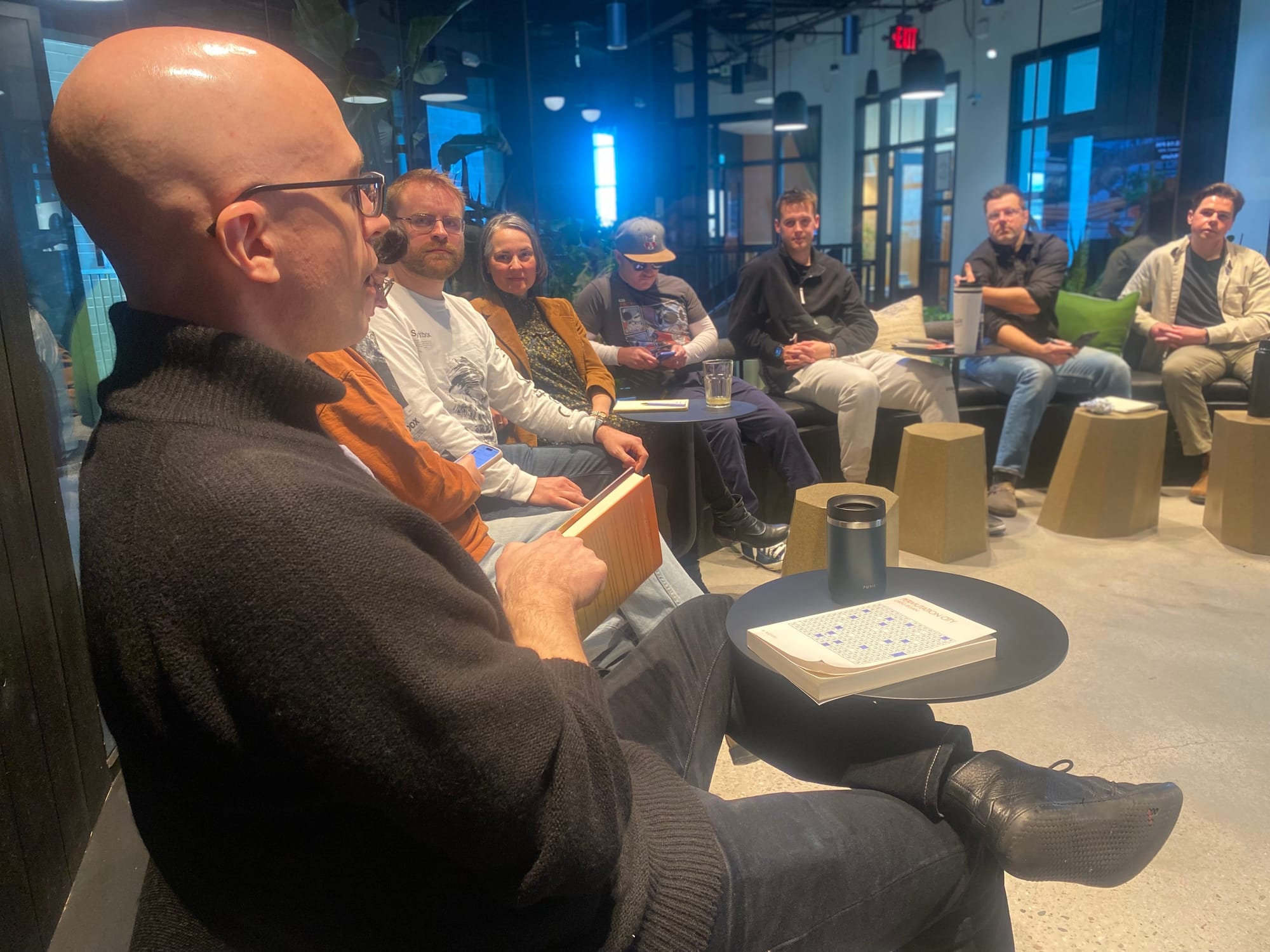
This is the thesis I have carried for years. It is the beating heart of what I am building with Book Chat at Kiln, our monthly gathering in Fort Collins where bestselling author Josh Kaufman and I bring together a community of thinkers around books and ideas. The point was never just the books. It was always what happens between people when reading becomes the catalyst for genuine conversation. Books create the conditions for human connection to go deep. That is the irreplaceable thing.
Books are not dying. They are becoming sacred objects, reserved for the people serious enough to deserve them.
BookTok, Audiobooks, and the Signal-to-Noise Collapse
We cannot talk honestly about reading’s future without talking about BookTok, and we cannot talk about BookTok without holding two contradictory truths at once.
Major publishers now treat it as infrastructure, not marketing. It has turned obscure novels into overnight bestsellers, resurrected forgotten titles, and pushed publishers toward acquiring authors based on social following rather than manuscript quality, a development critics rightly find alarming.
BookTok has concentrated demand around specific micro-genres: romantasy, dark academia, spicy fiction, book-to-screen adaptations. It has made reading feel culturally alive for a generation that was supposed to have given up on it entirely.
But the New York Times has noted the crucial caveat that the BookTok boosters tend to gloss over, namely, that the platform appears to shift which books people buy more than it creates new readers. Its influence on taste is enormous. Its influence on the total reading population remains murky at best.
Audiobooks, meanwhile, are the real growth engine in this ecosystem. Revenue hit 2.22 billion dollars in 2024, up 13%, and audiobooks now account for 34% of adult fiction consumption. AI-assisted narration is going mainstream in 2026, slashing production costs. For publishers, audio is no longer a secondary format. It is a primary revenue line.
And then there is the discovery crisis, which does not get nearly enough attention. 4.2 million new titles appeared in 2025, up 32.5% in a single year, nearly all self-published. More books chasing a readership that is barely growing.
The signal-to-noise ratio has collapsed. This is precisely why curated human community matters more right now, not less. When everything is available and nothing is findable, the trusted voice of a real person in a real room becomes the most valuable discovery engine there is.
Reading as Luxury, Reading as Resistance
NYU Stern professor Alison Taylor has made the observation that being a deep thinker is becoming a luxury good. The ability to sustain attention through a 300-page argument is increasingly a class and cultural differentiator. This is why Warren Buffett and Bill Gates still read voraciously while broad public engagement with books continues to slide. Deep reading is becoming a marker of a certain kind of person in a certain kind of world.
Think about what that means. The capacity for depth, for sustained reflection, for the kind of slow reckoning with ideas that books uniquely demand, is being redistributed by default toward those who can afford the time and cognitive bandwidth to resist distraction. That is not a neutral trend but a fracture line.
I have maintained a daily journaling practice since 1995, sparked by hearing Jim Rohn speak in Chicago. For thirty years, writing and reading have been the twin disciplines of my interior life. I do not read to be entertained. I read to be sharpened, to be challenged, to encounter perspectives I did not already hold. And I build community around books because that kind of transformation is more durable when it happens in the presence of other people.
In a culture organized around speed and frictionlessness, the act of sitting with a book for two hours is a genuinely countercultural act. It is a declaration that some things are worth the difficulty. That depth is not a deficiency. That the questions worth asking do not fit inside a thirty-second video.
One Book at a Time: The Mission Sharpens
Here is what the data tells me, and what it demands of my work going forward.
The casual reader is gone. So, I am not building for the casual reader. I am building for the person who senses that something essential is being lost, who feels the pull toward depth in a world that rewards distraction, who wants to be in a room with other people who are wrestling with the same hunger. That person exists. I’ve met them at our local Book Chat at Kiln here in Fort Collins. I hear from them in the responses to my writing. They are out there, and they are looking for each other.
The indie bookstore renaissance is not a fluke. It is an appetite. People are not just looking for books. They are looking for what books make possible which is real conversation, genuine friction, and the experience of encountering an idea that unsettles them in the company of another human being who takes ideas seriously.
The mission is not to reverse the decline in reading for that battle is bigger than any one person or program. The aim should be to serve the remnant, the dedicated, the restless, the intellectually hungry people who still believe that a great book and a great conversation can change the direction of a life — one book at a time, one conversation at a time, one community at a time.
Help Venezuela get back on its feet
HOW TO HELP NOW?
Donate to the House Project in Venezuela

Etienne Note: We have team and friends in Venezuela and understand there are over 40,000+ missing. Many buried under the rubble. They need heavy equipment to move rubble ASAP. We have evaluated multiple charities that are providing support on the ground and have chosen to support: The House Project which already has multiple projects on-going in Venezuela. We will be featuring them as our Voluntaryist Charity Option in Five Meme Friday. You can donate here: https://thehouse-project.org/es/collections/donate


