

by Joshua Kaplan, Brett Murphy, Justin Elliott and Alex Mierjeski
ProPublica is a nonprofit newsroom that investigates abuses of power. Sign up to receive our biggest stories as soon as they’re published.
Reporting Highlights
“Maximum Pressure”: The State Department conducted a monthslong campaign to push a small African country to help Musk’s satellite internet company, records and interviews show.
“Ram This Through”: Working closely with executives at Starlink, the U.S. government has made a global push to help expand Musk’s business empire in the developing world.
“Crony Capitalism”: Diplomats said the events were an alarming departure from standard practice — because of both the tactics used and the person who would benefit most from them.
These highlights were written by the reporters and editors who worked on this story. Were they helpful?
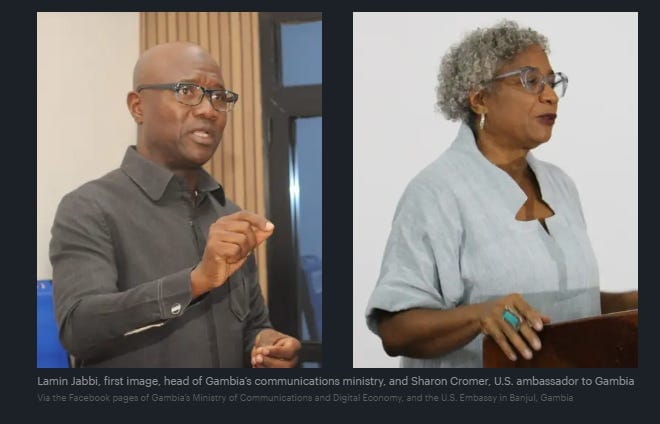
In early February, Sharon Cromer, U.S. ambassador to Gambia, went to visit one of the country’s Cabinet ministers at his agency’s headquarters, above a partially abandoned strip mall off a dirt road. It had been two weeks since President Donald Trump took office, and Cromer had pressing business to discuss. She needed the minister to fall in line to help Elon Musk.
Starlink, Musk’s satellite internet company, had spent months trying to secure regulatory approval to sell internet access in the impoverished West African country. As head of Gambia’s communications ministry, Lamin Jabbi oversees the government’s review of Starlink’s license application. Jabbi had been slow to sign off and the company had grown impatient. Now the top U.S. government official in Gambia was in Jabbi’s office to intervene.
Musk’s Department of Government Efficiency loomed over the conversation. The administration had already begun freezing foreign aid projects, and early in the meeting, Cromer, a Biden appointee, said something that rattled Gambian officials in the room. She listed the ways that the U.S. was supporting the country, according to two people present and contemporaneous notes, noting that key initiatives — like one that funds a $25 million project to improve the electrical system — were currently under review.
Jabbi’s top deputy, Hassan Jallow, told ProPublica he saw Cromer’s message as a veiled threat: If Starlink doesn’t get its license, the U.S. could cut off the desperately needed funds. “The implication was that they were connected,” Jallow said.
In recent months, senior State Department officials in both Washington and Gambia have coordinated with Starlink executives to coax, lobby and browbeat at least seven Gambian government ministers to help Musk, records and interviews show. One of those Cabinet officials told ProPublica his government is under “maximum pressure” to yield.
In mid-March, Cromer escalated the campaign by writing to Gambia’s president with an “important request.” That day, a contentious D.C. meeting between Musk employees and Jabbi had ended in an impasse. She urged the president to circumvent Jabbi and “facilitate the necessary approvals for Starlink to commence operations,” according to a copy of the letter obtained by ProPublica. Jabbi told confidantes he felt the ambassador was trying to get him fired.
The saga in Gambia is the starkest known example of the Trump administration wielding the U.S. government’s foreign policy apparatus to advance the business interests of Musk, a top Trump adviser and the world’s richest man.
Since Trump’s inauguration, the State Department has intervened on behalf of Starlink in Gambia and at least four other developing nations, previously unreported records and interviews show.
As the Trump administration has gutted foreign aid, U.S. diplomats have pressed governments to fast-track licenses for Starlink and arranged conversations between company employees and foreign leaders. In cables, U.S. officials have said that for their foreign counterparts, helping Starlink is a chance to prove their commitment to good relations with the U.S.
In one country last month, the U.S. embassy bragged that Starlink’s license was approved despite concerns it wasn’t abiding by rules that its competitors had to follow.
“If this was done by another country, we absolutely would call this corruption,” said Kristofer Harrison, who served as a high-level State Department official in the George W. Bush administration. “Because it is corruption.”
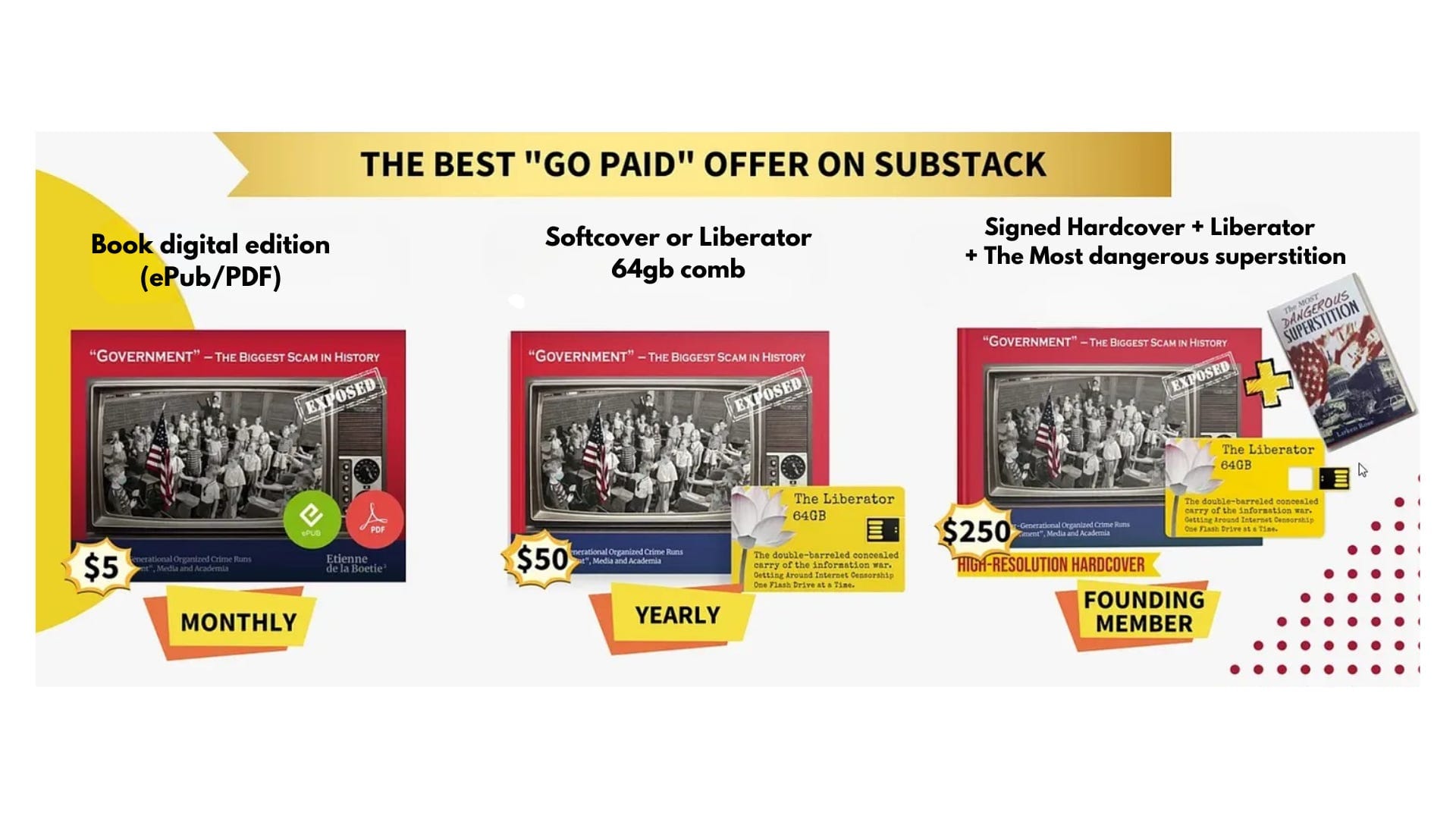
Go paid at the $5 a month level, and we will send you both the PDF and e-Pub versions of “Government” - The Biggest Scam in History… Exposed! and a coupon code for 10% off anything in the Government-Scam.com/Store.
Go paid at the $50 a year level, and we will send you a free paperback edition of Etienne’s book “Government” - The Biggest Scam in History… Exposed! OR a 64GB Liberator flash drive if you live in the US. If you are international, we will give you a $10 credit towards shipping if you agree to pay the remainder.
Support us at the $250 Founding Member Level and get a signed high-resolution hardcover of “Government” + Liberator flash drive + Larken Rose’s The Most Dangerous Superstition + Art of Liberty Foundation Stickers delivered anywhere in the world. Our only option for signed copies besides catching Etienne @ an event.


