

Summary:
Emerging research continues to link ultraprocessed foods (UPFs) to major health risks. Three recent studies found troubling connections. One found that higher UPF consumption is associated with increased fat in thigh muscles linked to knee osteoarthritis. Learn more here. Another found measurable declines in attention and processing speed. Learn more here. And last but not least, a third found a 5% higher risk of stroke, heart attack, or cardiac arrest for each additional daily serving consumed. Learn more here.
Looking for a snack? Grab an organic apple instead of an Oreo.
Experts warn ultra-processed foods linked to reduced muscle health
Reduced muscle health leaves people vulnerable to chronic degenerative joint disease
by Julia Musto, The Independent in New York
Eating a diet dominated by ultraprocessed foods like cookies and fries has long been tied to harms for many areas of human health.
Now, researchers say people who regularly eat a lot of ultraprocessed foods need to worry about another health hazard: poor muscle health.
Eating ultraprocessed foods is linked to a higher amount of fat in the thigh muscles, researchers at the Radiological Society of North America warned in a recent study. And that’s true regardless of how many calories you consume, how much you work out and what your genetic history is.
Higher amounts of this fat also raises the risk for knee osteoarthritis, they say. The common chronic degenerative joint disease can lead to cysts or permanent bone spurs, according to the Cleveland Clinic.
Ultra-Processed Foods Erodes Visual Attention
by Barbara Cardoso FeaturedNeuroscienceVisual Neuroscience
Summary: A new international study identified a direct link between the consumption of ultra-processed foods (UPFs) and a measurable decline in the brain’s ability to focus.
The research followed over 2,100 middle-aged and older adults. The results reveal that even a minor daily increase in UPFs, such as adding a single packet of chips, is enough to significantly lower scores on standardized tests for attention and processing speed, regardless of how “healthy” the rest of the diet is.
Key Facts
The 10% Threshold: For every 10% increase in daily energy from UPFs, researchers observed a distinct drop in visual attention. A 10% increase is roughly equivalent to adding one standard bag of chips or a soft drink to a daily routine.
The Mediterranean Myth: Surprisingly, the negative effects of UPFs occurred even in individuals who otherwise followed a “healthy” Mediterranean diet. This suggests the processing of the food itself is as damaging as the lack of nutrients.
Attention as a Foundation: While the study did not find a direct link to immediate memory loss, it highlighted that attention is the prerequisite for learning and problem-solving. Eroding this foundation increases long-term dementia risk.
Structural Destruction: Ultra-processing often destroys the natural cellular structure of food and introduces artificial additives and industrial chemicals that may trigger cognitive decline through mechanisms like neuroinflammation.
Source: Monash University
New research from Monash University, the University of São Paulo and Deakin University shows a diet high in heavily processed foods can negatively impact the brain’s ability to focus and increases the risk of developing dementia.
The study published in Alzheimer’s & Dementia: Diagnosis, Assessment & Disease Monitoring, a journal of the Alzheimer’s Association, examined the diets and cognitive health of more than 2,100 Australian dementia-free adults middle-aged and older.
Science on the harms of ultraprocessed foods is ‘strong enough to act,’ researcher says
As another study links ultraprocessed foods to heart attacks and strokes, a leading researcher breaks down the evidence and calls for policy action.
by Sasha Chavkin, The Examination
Each daily serving of ultraprocessed foods raises the risk of a stroke, heart attack or cardiac arrest by 5%. That was the stark finding of a study published last month in the Journal of the American College of Cardiology, and it’s the latest research showing an association between industrially-made foods and health problems including diabetes, heart disease and obesity.
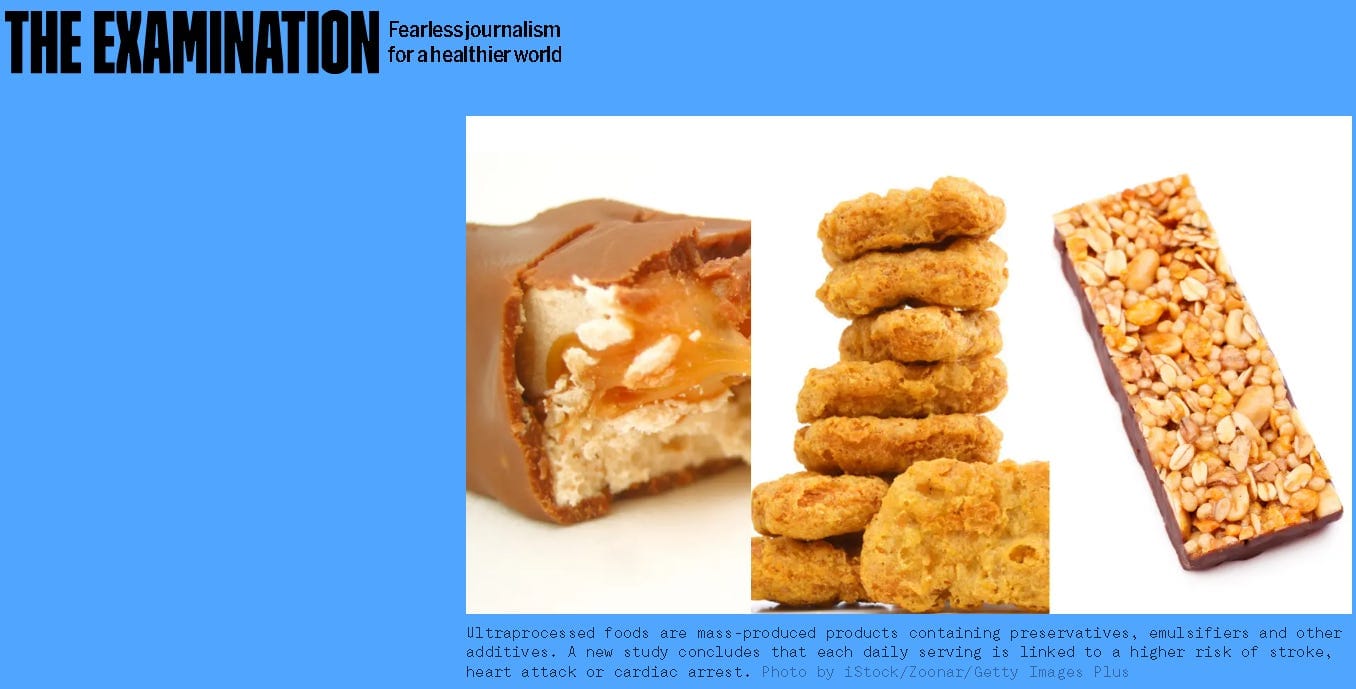
From breakfast cereals to chicken nuggets to candy bars, ultraprocessed foods are mass-produced products that contain ingredients such as preservatives, emulsifiers and other additives that you wouldn’t find in a home kitchen.
Though some countries have policies aimed at reducing consumption of ultraprocessed foods, there is still a scientific debate about the root causes of the global epidemic of diet-related disease.
The food industry and some independent academics have argued that the category of ultraprocessed foods is too broad to be meaningful because it encompasses everything from soda and processed meats, which have well-known health risks, to more nutritious foods like whole-grain breads. Some experts say it’s misguided to focus on foods’ processing levels when other factors, such as density of calories or amount of sugar, salt or fat, are the true culprits. These arguments have often stalled or blocked policies meant to crack down on highly processed foods or promote whole foods.
The Best “Go Paid” Deal on Substack! You Get REAL Stuff!!

Go paid at the $5 a month level, and we will send you both the PDF and e-Pub versions of Etienne’s new book: To See the Cage Is to Leave It - 25 Techniques the Few Use to Control the Many and a coupon code for 10% off anything in the https://artofliberty.org/store/.
Go paid at the $50 a year level, and we will send you a free paperback edition of Etienne’s new book: To See the Cage Is to Leave It - 25 Techniques the Few Use to Control the Many OR “Government” - The Biggest Scam in History… Exposed! OR a 64GB Liberator flash drive if you live in the US. If you are international, we will give you a $10 credit towards shipping if you agree to pay the remainder.
Support us at the $250 Founding Member Level and get a signed high-resolution hardcover of “Government” - The Biggest Scam in History... Exposed! + Liberator flash drive + a signed high-resolution hardcover of Etienne’s new book: To See the Cage Is to Leave It - 25 Techniques the Few Use to Control the Many + everything else in our “Everything Bundle” of the best in voluntaryist thought delivered domestically. International pays shipping. Our only option for signed copies besides catching Etienne @ an event.


