

You've seen a ton of videos of humanoid robots – but this one feels different. It's Sanctuary's Phoenix bot, with "the world's best robot hands," working totally autonomously at near-human speeds – much faster than Tesla's or Figure's robots.
Canadian company Sanctuary AI has been accelerating its own progress toward general-purpose humanoids, using teleoperation to show Phoenix how to do things, and letting it go away and figure out more in simulation.
Phoenix is an odd duck in this space, in that the Sanctuary team hasn't got it up and walking yet, deciding to let others figure that bit out so its team can focus on the nitty gritty of work behaviors. Thus, it sits on a decidedly unsexy wheeled platform, but it has some of the most finely-tuned and human-like hands out of anything we've ever seen.
And it's also starting to move in a way that's much faster, more fluid and natural-looking than anything else in the space. Take a look – and remember, this is fully autonomous. Phoenix has been trained by human operators, but now it's doing this task all by itself.
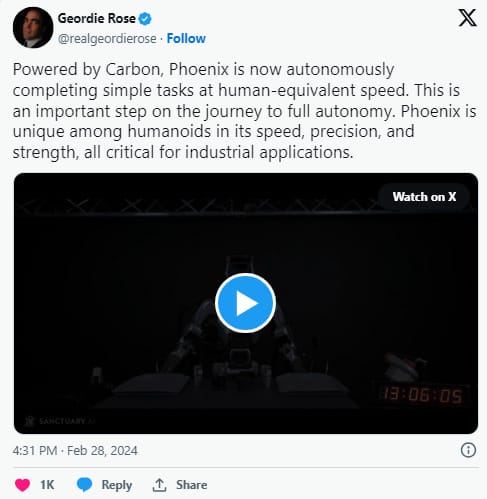
That kind of motion feels like a marked step change in the humanoid field. It's pretty dang impressive. But how has Phoenix accelerated past the pack here?
We spoke to Sanctuary co-founder and CTO Suzanne Gildert in an extensive interview last week, and look forward to bringing you that whole chat shortly – but one thing we discussed was the unique approach Sanctuary is taking to the challenge of teaching Phoenix how to do... Well, pretty much anything we can do.
Phoenix's hands, Gildert told us, are hydraulically actuated as opposed to the electric motors in others like Optimus and the Figure 01. "We moved over to hydraulics," she said, "and there's disadvantages there, they leak and they're very expensive to do R&D on. But it's the only technology that gives us a combination of three factors that are very important: obviously precision, but there's also speed and strength."
"If you see a robot doing something really dexterous," she continued, "like threading a needle, or doing a button or something, you have to ask yourself, could that hand also lift a 50-pound suitcase? And could it also move fast enough to, say, type on a keyboard? Usually people only show one of these three factors, but the ultimate hand needs to have all three. Currently, the hydraulic technology's the only one that can get you all three of those."
"The one we've built, I think is the ultimate," she grinned. "The world's best robot hand. But there's probably plenty of research you can do on a simpler hand as well."

Go paid at the $5 a month level, and we will send you both the PDF and e-Pub versions of “Government” - The Biggest Scam in History… Exposed! and a coupon code for 10% off anything in the Government-Scam.com/Store.
Go paid at the $50 a year level, and we will send you a free paperback edition of Etienne’s book “Government” - The Biggest Scam in History… Exposed! AND a 64GB Liberator flash drive if you live in the US. If you are international, we will give you a $10 credit towards shipping if you agree to pay the remainder.
Support us at the $250 Founding Member Level and get a signed high-resolution hardcover of “Government” + Liberator flash drive + Larken Rose’s The Most Dangerous Superstition + Art of Liberty Foundation Stickers delivered anywhere in the world. Our only option for signed copies besides catching Etienne @ an event.


