
By Nick Giambruno, Doug Casey's International Man
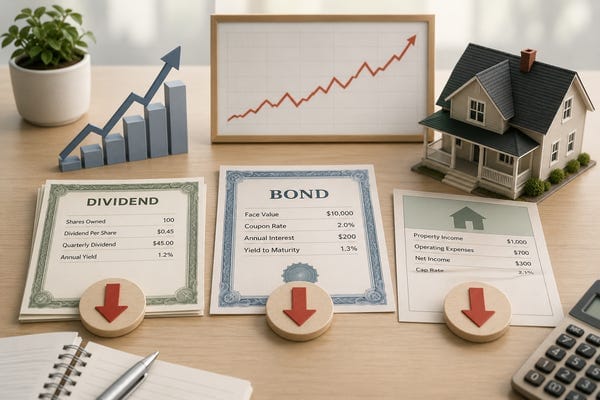
Ideally, a portfolio of high-quality dividend-paying stocks grows large enough to provide meaningful investment income.
The ultimate goal is to generate enough after-tax dividend income to cover your monthly living expenses, keep pace with—or exceed—inflation, and continue growing over time.
For planning purposes, use 6.8% as the inflation hurdle rate, reflecting the long-term average growth of the money supply.
In practical terms, your after-tax dividend income should grow by at least 6.8% per year just to preserve purchasing power and offset average currency debasement.
That said, 6.8% is only a long-term average. In periods of aggressive monetary expansion—such as early 2021 during the Covid mass psychosis, when money supply growth exceeded 26%—currency debasement can be much higher.
So keep in mind that currency debasement can—and likely will—be worse than the long-term average in some years in the future.
As it pertains to high-quality dividend-paying stocks, this quote is especially relevant. Warren Buffett once wrote (emphasis mine): “When we own portions of outstanding businesses with outstanding managements, our favorite holding period is forever.”
He was highlighting the importance of investing in great businesses and holding them for the long run, rather than frequently trading stocks based on short-term market movements. His philosophy is rooted in the belief that long-term ownership of high-quality companies leads to superior returns, especially when those businesses possess durable competitive advantages—what he refers to as an “economic moat.”
In short, the key to building lasting wealth has been the same for centuries: owning enduring, high-quality businesses. Think Standard Oil, US Steel, McDonald’s, Disney, Starbucks, Nestlé, or Coca-Cola. That is not going to change.
The easiest and fastest way to identify the highest-quality, most elite businesses is to look at the Dividend Aristocrats—a company that’s increased its dividend for at least 25 consecutive years. These are some of the safest, strongest, and most durable companies in the world.
However, the current investment landscape presents challenges.
Finding high-quality businesses at reasonable valuations is becoming increasingly difficult, if not impossible.
The S&P 500’s Price-to-Earnings (P/E) and CAPE (Cyclically Adjusted P/E) ratios are near historical highs.
Meanwhile, Market Cap to GDP (the Buffett Indicator) sits at a record high. It measures the total value of the US stock market relative to US GDP. Today, that ratio stands at roughly 214% — far exceeding prior peaks of 139% at the height of the dot-com bubble in 2000 and 106% at the peak of the housing bubble in 2007.
Rampant money printing by central banks has distorted financial markets like never before, rendering traditional fundamental analysis far less effective.
It’s like using a measuring stick where the length of a centimeter keeps changing.
That’s why I believe dividends are the most reliable indicator of true value. Unlike earnings, which can be manipulated through flexible accounting rules, dividends are real cash payments that land directly in your pocket—you can’t fake that.
Unfortunately, dividend yields are generally near record lows, reflecting how overvalued the broader market has become.
On average, Dividend Aristocrats yield a meager 2.5%.
Remember, taxes on dividend income in the US can reach 37% at the federal level alone for high-income taxpayers subject to the top ordinary income tax rate, before factoring in any state or local taxes.
Suppose you wanted to earn $100,000 annually in after-tax dividend income from the average Dividend Aristocrat. Assuming a 37% federal tax rate and ignoring potential state and local taxes, you would need to generate roughly $158,730 in pre-tax dividend income. At the current average 2.5% yield, that would require an investment of roughly $6.4 million.
$6.4 million is an enormous amount of money that most people will never see in their lifetimes, let alone be able to allocate solely to dividend income.
In other words, the nosebleed valuations of most stocks—including Dividend Aristocrats—have compressed dividend yields, and combined with the corrosive effects of inflation, have pushed the key financial goal of earning enough investment income to cover monthly expenses out of reach for the vast majority of people.
What about bonds?
It’s important to understand that bonds are merely contracts denominated in fiat currency—essentially, they are long-dated fiat currency. The issuer promises to repay the bondholder the principal amount at maturity, usually with periodic interest payments along the way.
The fatal flaw with bonds is their denomination in fiat currency, which I expect will be debased to a staggering degree. Debasement is likely the only way the US government can manage its unsustainable debt burden.
I expect the rate of currency debasement to far outpace the meager nominal yields offered by Treasuries and most other bonds.
Remember, the average annual growth in the money supply—a good benchmark for inflation—is 6.8%. But that is just the average. In early 2021, during the Covid mass psychosis, the money supply was growing at over 26%.
All of this makes most bonds little more than worthless promises.
Most bondholders are almost certain to suffer negative real returns over the long term.
For this reason, I do not believe bonds have any place in a sound financial plan.
What about real estate?
Real estate is illiquid and depreciates. It comes with significant carrying costs and is vulnerable to natural disasters. And it is often financed with debt.
Even a single broken pipe can wipe out months of rental income.
So if not bonds…
If not dividend-paying stocks…
And if not real estate…
So what can investors starved for yield do?
The first step is to understand why the old playbook is failing. Low dividend yields, overvalued stocks, debased bonds, and risky real estate are not isolated problems. They are symptoms of a much larger economic crisis now unfolding across the West.
That is why I have prepared a free special report that explains what is really driving this crisis, what it could mean for your money and personal freedom, and the three strategies to consider right now.
The Best “Go Paid” Deal on Substack! You Get REAL Stuff!!

Go paid at the $5 a month level, and we will send you both the PDF and e-Pub versions of Etienne’s new book: To See the Cage Is to Leave It - 25 Techniques the Few Use to Control the Many and a coupon code for 10% off anything in the https://artofliberty.org/store/.
Go paid at the $50 a year level, and we will send you a free paperback edition of Etienne’s new book: To See the Cage Is to Leave It - 25 Techniques the Few Use to Control the Many OR “Government” - The Biggest Scam in History… Exposed! OR a 64GB Liberator flash drive if you live in the US. If you are international, we will give you a $10 credit towards shipping if you agree to pay the remainder.
Support us at the $250 Founding Member Level and get a signed high-resolution hardcover of “Government” - The Biggest Scam in History... Exposed! + Liberator flash drive + a signed high-resolution hardcover of Etienne’s new book: To See the Cage Is to Leave It - 25 Techniques the Few Use to Control the Many + everything else in our “Everything Bundle” of the best in voluntaryist thought delivered domestically. International pays shipping. Our only option for signed copies besides catching Etienne @ an event.


