
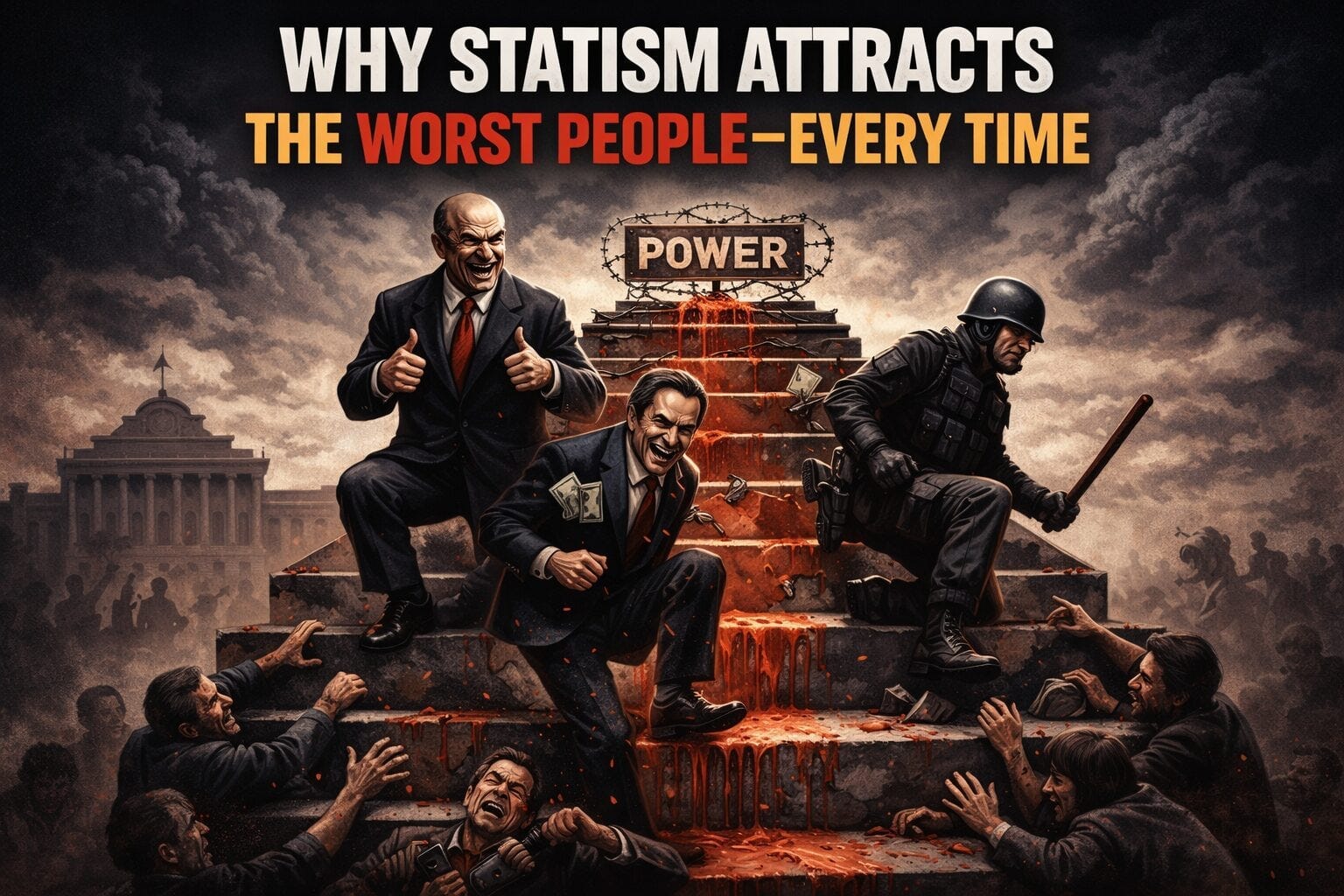
How Coercive Systems Select, Filter, and Transform Human Behavior
Statism does not merely corrupt good people after the fact. More dangerously, it selects for a particular type of person at the outset—and then reshapes everyone who remains inside it. This is not ideological speculation or partisan rhetoric. It is a pattern that repeats across centuries, cultures, flags, and slogans. Different regimes promise different futures, yet the outcomes are strikingly similar.

At its core, statism concentrates coercive power. Any system built on coercion—rather than consent—inevitably attracts those who are comfortable using force, distance, and enforcement as organizing principles. Once coercion becomes the foundation of legitimacy, persuasion no longer matters. Moral character becomes secondary. Compatibility with power replaces conscience as the primary filter.
This is not a story about “evil leaders.” It is a story about design.
What Statism Actually Is
Statism is the belief that society should be organized through centralized authority backed by force. Rules are imposed without consent. Obedience is enforced through punishment. Compliance is treated as legitimacy.
Under statism, power does not flow upward from the people through persuasion and trust. It flows downward through enforcement. And once enforcement becomes the organizing principle, personality stops being the main variable. The system itself begins to choose who rises and who falls.
Who Is Drawn to Statist Power
Most people do not desire authority over strangers. They want autonomy, stability, and responsibility over their own lives and families. Statist systems, however, require something else entirely: individuals willing to command people they will never meet, enforce rules they did not design, and cause harm indirectly—while calling it governance.
History makes this unmistakably clear.
In the Roman Empire, advancement favored those willing to enforce imperial decrees across vast territories regardless of local consequences.
In Imperial China, bureaucrats rose not through wisdom or judgment, but through strict obedience to centralized authority.
In both cases, those most comfortable enforcing power from a distance advanced the fastest.
This is the first selection effect: statism attracts people compatible with coercion.
The Funnel Effect: How the System Filters Itself
Statist systems operate like funnels. Many enter with mixed motives—idealism, ambition, duty, or necessity. Very few rise. Even fewer remain intact.
Advancement requires:
Obedience upward
Enforcement downward
Silence when rules conflict with conscience
In the Soviet Union, loyalty mattered more than competence. Officials who questioned directives were labeled unreliable; those who enforced them efficiently were promoted. In Maoist China, harsh quota enforcement was rewarded, while hesitation led to removal.
This did not happen because leaders were uniquely cruel. It happened because the system rewarded these traits. The state does not promote the wisest—it promotes the most compatible.
Why Good People Leave
Highly conscientious individuals often exit statist systems voluntarily—not because they are weak, but because they experience constant moral friction.
They struggle with:
Enforcing rules they didn’t design
Punishing behavior they understand
Benefiting from privileges denied to others
This explains the recurring pattern of whistleblowers, quiet resignations, and moral burnout. These people rarely rise to the top. They leave before they are reshaped.
The system does not collapse when they go. It becomes more uniform.
Statism Doesn’t Need Bad People
This is the most common misunderstanding. Defenders of statism often argue that abuse requires evil individuals. It does not. Statism only requires obedient ones.
Consider East Germany’s border guards. Most did not wake up wanting to imprison their neighbors. They followed procedures. They enforced orders. The harm was not personal—it was institutional.
Statist power rewards:
Loyalty over honesty
Procedure over judgment
Compliance over conscience
You are not asked to believe in the harm. You are only asked to carry it out.
The Transformation Effect
Over time, something changes in those who remain inside statist systems.
Distance from consequences grows. Human effects become abstract. Responsibility diffuses. Language shifts:
“I was following policy.”
“That decision came from above.”
“That’s just how the system works.”
People stop seeing individuals. They see categories, violations, and case numbers. This is how ordinary people become functionaries—not through cruelty, but through normalization.
Why This Pattern Repeats Everywhere
This is why changing leaders does not fix statism. The system itself rewards:
Efficient enforcers
Reliable rule-followers
Emotional distance
Those who perform best are promoted. Those who hesitate are removed. Statism does not merely attract the worst people—it turns normal people into instruments, then elevates the most obedient among them.
This is the structural trap. People keep hoping statism can be made safe with better leaders, better rules, or better intentions. But centralized coercion always produces the same filters.
The Core Insight
Statism is not a failure of morality.
It is a failure of design.
It selects for comfort with force.
It filters out conscience.
It reshapes whoever remains.
Statism doesn’t need monsters—though it often attracts them.
It can manufacture them all on its own.
Final Reflection
When power is built on coercion rather than consent, the outcome is not an accident. It is inevitable. Liberty requires moral responsibility distributed among free people. Statism requires obedience concentrated in institutions.
History has already shown us which one selects for human dignity—and which one selects against it.
Statism Through the Lens of Kohlberg’s Moral Stages
Why Coercive Systems Stall Moral Development
Lawrence Kohlberg’s theory of moral development helps explain why statism repeatedly produces the same outcomes across history. His framework shows that moral reasoning develops in stages, and—crucially—that systems can lock entire societies into lower stages.
Statism does exactly that.
A Brief Overview of Kohlberg’s Stages (Condensed)
Kohlberg identified three broad levels, each containing two stages:
Pre-Conventional Morality (Stages 1–2)
Stage 1: Obedience & punishment (“I obey to avoid pain.”)
Stage 2: Self-interest (“What’s in it for me?”)
Conventional Morality (Stages 3–4)
Stage 3: Social approval (“I want to be seen as good.”)
Stage 4: Law-and-order (“Rules must be followed.”)
Post-Conventional Morality (Stages 5–6)
Stage 5: Social contract (“Laws exist to serve human dignity.”)
Stage 6: Universal principles (“Justice transcends law.”)
Here’s the key insight:
Statism is structurally dependent on Stage 4 morality—and hostile to Stage 5 and 6.
Why Statism Thrives at Stage 4 (Law-and-Order)
Stage 4 morality values:
Authority
Rule compliance
Institutional legitimacy
Stability over justice
This is not evil—it’s limited. And it is precisely the mindset statism requires.
Statist systems reward people who believe:
“The law is the law.”
“Order must be maintained.”
“If everyone just follows the rules, society works.”
This is why bureaucracies, empires, and centralized governments instinctively elevate Stage 4 thinkers. They are predictable, obedient, and enforceable.
But Stage 4 morality confuses legality with morality.
Why Post-Conventional Thinkers Become a Threat
Stage 5 and Stage 6 thinkers ask dangerous questions:
“Is this law just?”
“Does this policy violate human dignity?”
“Should conscience override authority?”
Statism cannot tolerate these questions at scale.
As a result:
Stage 5 individuals become whistleblowers
Stage 6 individuals become dissidents
Both are labeled “troublemakers,” “radicals,” or “extremists”
They do not rise. They exit—or are removed.
This explains why:
The most ethical people rarely lead large coercive systems
Moral courage is punished while procedural obedience is rewarded
Statism does not collapse when higher-stage thinkers leave.
It becomes more morally uniform.
The Selection Effect, Explained Morally
Recall the article’s core claim:
Statism does not promote the wisest—it promotes the most compatible.
Kohlberg explains why.
Statist systems:
Select for Stage 4 compliance
Filter out Stage 5 conscience
Crush or expel Stage 6 principle
Over time, the institution becomes morally stagnant—even while appearing orderly and “civilized.”
This is why advanced societies can carry out extraordinary harm while believing themselves enlightened.
“I Was Just Following Orders” Is Stage 4 Language
Every historical atrocity powered by bureaucracy shares the same moral vocabulary:
“I followed policy.”
“That decision came from above.”
“I didn’t make the rules.”
These are not the words of monsters.
They are the words of arrested moral development.
Statism does not require cruelty.
It requires moral outsourcing.
Why Changing Leaders Doesn’t Fix the Problem
People often believe the solution is:
Better leaders
Better laws
Better intentions
But Kohlberg shows us the flaw:
A system that structurally blocks moral development cannot be fixed by personalities.
As long as coercion replaces consent, the system will:
Reward lower-stage morality
Punish higher-stage conscience
Repeat the same pattern under new flags
This is why revolutions so often reproduce the tyranny they overthrow.
Liberty as a Moral Accelerator
Unlike statism, liberty requires post-conventional morality.
A free society depends on:
Internal restraint instead of external force
Conscience instead of compliance
Responsibility instead of obedience
Liberty is risky—not because people are bad, but because it assumes moral adulthood.
Statism infantilizes.
Liberty matures.
Final Synthesis
Statism is not just a political failure.
It is a moral bottleneck.
It locks societies into Stage 4 thinking while pretending that law equals justice and order equals virtue. It does not attract the worst people—it prevents the best moral reasoning from governing at all.
And that is why, across history, the most advanced civilizations still fall for mass delusion, bureaucratic cruelty, and institutional evil—while believing themselves righteous.
The Best “Go Paid” Deal on Substack! You Get REAL Stuff!!

Go paid at the $5 a month level, and we will send you both the PDF and e-Pub versions of Etienne’s new book: To See the Cage Is to Leave It - 25 Techniques the Few Use to Control the Many and a coupon code for 10% off anything in the https://artofliberty.org/store/.
Go paid at the $50 a year level, and we will send you a free paperback edition of Etienne’s new book: To See the Cage Is to Leave It - 25 Techniques the Few Use to Control the Many OR “Government” - The Biggest Scam in History… Exposed! OR a 64GB Liberator flash drive if you live in the US. If you are international, we will give you a $10 credit towards shipping if you agree to pay the remainder.
Support us at the $250 Founding Member Level and get a signed high-resolution hardcover of “Government” - The Biggest Scam in History... Exposed! + Liberator flash drive + a signed high-resolution hardcover of Etienne’s new book: To See the Cage Is to Leave It - 25 Techniques the Few Use to Control the Many + everything else in our “Everything Bundle” of the best in voluntaryist thought delivered domestically. International pays shipping. Our only option for signed copies besides catching Etienne @ an event.


