

Etienne Note: The #1 thing you can do for your spine is Bikram Yoga, which is a 90-minute hot yoga practice done in a 105-degree room. It includes 26 postures and 2 breathing exercises, with a variety targeting the spine specifically.
By StudyFinds Analysis, Reviewed by Patrisha Antonaros
Bones and brains may seem unrelated, yet a new study finds they may age on the same clock. Adults with weaker bones in their upper spine lost thinking skills faster over the next several years, and researchers caught the warning sign in an unlikely spot: ordinary chest CT scans taken for a lung and heart study, with nothing to do with the brain.
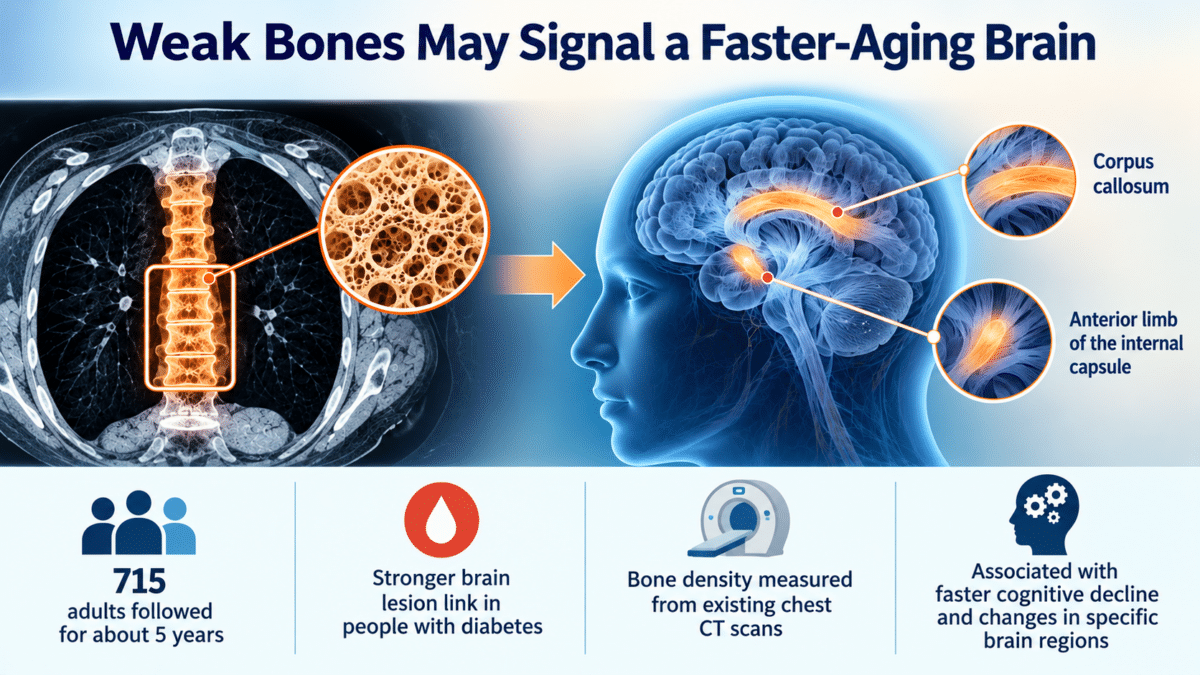
Published in the journal Radiology, the study followed 715 adults over about five years, with roughly 400 undergoing repeat brain MRIs and larger groups completing cognitive tests. People with lower bone density at baseline showed faster declines in global thinking and memory scores, along with quicker damage to specific brain wiring tracts, even after accounting for age, education, smoking, and heart health.
Among people with diabetes, weaker bones were also tied to a faster buildup of one type of brain damage, a connection that was absent in those without the condition. Because the bone reading comes free from chest CT scans already sitting in medical records, researchers say it could offer a low-cost way to help flag people at higher risk of faster brain aging.
How Scientists Linked Bone Density to Brain Decline
Scientists drew on data from the Multi-Ethnic Study of Atherosclerosis, a long-running health study that has followed adults across the country since 2000. This analysis included 715 participants with a median age of 69, none of whom had a history of dementia or stroke at the start of the study period. The group had slightly more men than women.
Between roughly 2016 and 2024, participants underwent chest CT scans, detailed brain MRI scans, and cognitive testing at two time points, spaced about five years apart on average. A deep-learning computer program, a type of artificial intelligence trained to spot patterns in medical images, measured bone density in the upper spine directly from the chest CT images. Earlier research validated that same AI tool for this purpose.
On the brain side, researchers measured two things. First, they looked at white matter hyperintensities: bright spots on brain scans that reflect small areas of damage often linked to aging blood vessels. Second, they measured fractional anisotropy, a way of checking how well organized and healthy the brain’s white matter tracts are. Healthy white matter acts like efficient internal wiring for the brain. When that wiring breaks down, signals move less smoothly, and thinking often suffers.
Cognitive testing rounded out the picture. Participants took the widely used Cognitive Abilities Screening Instrument, along with tests measuring processing speed and working memory. Researchers combined several of these into a single global cognitive score to track overall mental sharpness over time.
What the Bone Density and Brain Decline Data Showed
People with lower bone density at the start of the study tended to show a faster overall decline in the brain’s white matter organization, though that result didn’t hold up once researchers adjusted for the number of statistical comparisons they ran. Still, when they zoomed into specific brain regions, clearer patterns emerged.
In one bundle of nerve fibers deep in the brain, known as the anterior limb of the internal capsule and involved in connecting the parts of the brain tied to movement and thinking, lower bone density was linked to a clearly faster decline in white matter health, a result that held up under strict statistical checks. Lower bone density was also tied to a faster buildup of those bright, damage-related spots in the corpus callosum, the thick band of tissue that connects the brain’s left and right hemispheres.
On the cognitive side, the connection was more consistent. Lower bone density predicted faster decline in the global cognitive score and, specifically, on the Cognitive Abilities Screening Instrument, even after researchers adjusted for age, education, smoking, physical activity, cholesterol, blood pressure, and other factors known to affect both bone and brain health. The link appeared in overall cognitive decline but not in narrower tests like digit span, which measures short-term attention and number memory.
One factor stood out as further increasing risk: diabetes. Among participants with diabetes, weaker bones were tied to a noticeably faster buildup of white matter damage. Among those without diabetes, that link mostly disappeared. Researchers also noted a possible difference between men and women in how bone density related to white matter decline, though they described this pattern as suggestive rather than conclusive.
Researchers noted a twist in the starting lineup: people with the weakest bones had some advantages, including higher education levels and better results on certain metabolic measures, such as lower rates of diabetes and higher “good” cholesterol. Those baseline differences could easily muddy a simple bone-brain comparison, so the statistical models adjusted heavily for them before drawing conclusions.
Why Bone Density and Brain Health Might Be Linked
Researchers pointed to a few possible explanations for why skeletal health and brain health seem to move together as people age. Bone tissue releases substances into the bloodstream, including osteocalcin, that can reach the brain and may influence how nerve cells communicate. Aging bone marrow has also been tied to processes that promote harmful protein buildup, a phenomenon that shares some biological features with brain aging.
Another possibility is less about direct cause and effect and more about bone density serving as a general marker of how well a person’s body has weathered years of inflammation, poor metabolism, or inactivity. Under this view, weak bones would not directly cause brain damage. Instead, both would reflect the same underlying wear and tear building up in the body over decades.
Diabetes’ role in strengthening the bone-brain link fits with what is already known about the condition. Diabetes is associated with damage to blood vessels and chronic inflammation, both of which can make brain tissue more vulnerable to injury. Weak bones may be an easier red flag for brain risk in people whose bodies are already under this added metabolic stress.
None of this proves that bone density directly wears down the brain, at least not on this evidence alone. It shows that a measurement already in millions of chest CT scans, one nobody currently uses for brain assessment, may carry a real signal about who is aging faster upstairs as well as in the skeleton. For a health system looking for cheaper, earlier ways to flag cognitive risk, that is worth attention, especially for patients managing diabetes, who may benefit most from close monitoring.
Disclaimer: This article describes an observational study, which can reveal associations but cannot prove that low bone density causes brain aging or cognitive decline. The findings reflect group-level patterns and are not a diagnostic tool for any individual. Anyone concerned about their bone or brain health should consult a qualified healthcare provider.


