

In 1781, the captain of the British slave ship Zong, Luke Collingwood, deliberately ordered that over 130 enslaved Africans be thrown overboard because the ship was running low on water. Under the rules of marine insurance at the time, the loss of enslaved people due to illness during the voyage could not be claimed. But if the enslaved were “jettisoned” to save the ship, they could be written off as an insurable loss. So the ship’s owners could file a claim and be reimbursed for the value of the lost “cargo.”
The Zong case highlights the chilling logic of actuarial assessment applied to human lives under slavery. Collingwood made calculations about the economic value of killing them that did not include their worth as humans. Instead, he reduced real people to financial risk units.
Something similar can be said about American interventionism.
Consider this from the formidable Tim Clancy:
Rarely in US history has so little been spent to gain so much in degrading the military power of a strategic competitor as supporting Ukraine vs. Russia has.
This isn’t to discount the sacrifices Ukraine has had to bear, but from a US perspective, this has got to be one of the most effective interventions of all time in a cost vs. benefit analysis.
Clancy is no doubt a brilliant military and counterterrorism analyst. The following chart supports his thesis, which, to be fair, is just a social media post.
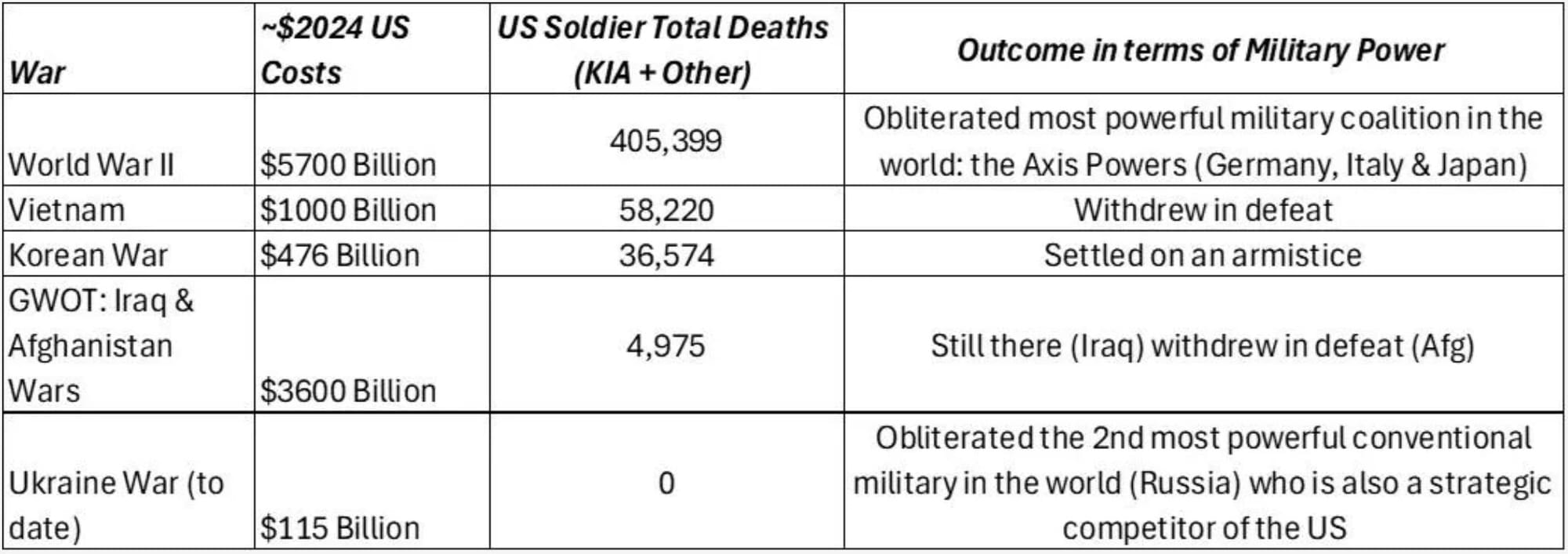
Let’s pass over the absence of all the destabilizing Obama-era interventions that created woeful externalities for the Middle East and Europe. The analysis isn’t exactly wrong. It’s just narrowly construed. Indeed, I believe Clancy when he writes that he doesn’t want to “discount the sacrifices Ukraine has had to bear,” though the chart makes no mention of Ukrainian dead, Russian dead, or the up-ratcheting of existential risk. I worry such analyses are emblematic of US foreign policy rationales in the wake of the costly Afghanistan and Iraq quagmires.
As of this writing, the Ukraine war is one of attrition. It is also not yet over. But even if you think our proxy war in Ukraine is a bargain by standards that assume the US is and should remain the global hegemon, this type of analysis suffers from a series of problems when considered more holistically.
It lends superficial support to the idea that the United States should remain the global hegemon indefinitely.
It implies that distant interventions worldwide are justified so long as narrow cost-benefit analyses are a bargain.
It glosses over the human costs of war.
It fails to include existential risks into the analysis.
It assumes there were no better alternatives to degrading Russia’s capabilities as a military competitor, even if doing so has been a relative bargain.
It doesn’t account for the United Statess’ deepening fiscal problems and the electorate’s desire to retire America as world police.
Before we continue, I mentioned Clancy’s post not because he’s wrong. By the standards of the military-industrial complex and those of us compelled to fund it, the Ukraine proxy war is probably a bargain.
But such analyses reveal one of the myriad ways The Glob justifies its existence, not to mention its spurious actions. So, I am not so much arguing against Clancy’s original post as I am jumping off from it to question more broadly the role of the US hegemon in the world.
Do bargain interventions justify the US remaining the global hegemon?
This is not an easy question. The idealist in me says that the whole damn apparatus is unjust and illegitimate on numerous grounds, including the fact that war pimps are constantly reaching into our pockets to fund conflicts that make no sense—but profit them. I don’t like that “war is the health of the state” (and generally not the people) and that conflict is hell for those who must endure it.
Still, there is redneck wisdom something my dad once told me. He said, “If you ever find yourself in prison, go up to the biggest, baddest, meanest MF and call him darlin’.” In other words, the hegemon might mistreat you a little, but at least it’s on your side. Pragmatically speaking, terrorism is still a threat to Americans. It’s difficult to say whether the full GWOT was worth the candle, but we need protection. We must also admit that the CCP remains a significant threat. There’s no zipping to a future free of bellicose military adversaries. So, as much as we might imagine a more idealistic future, we have to stay grounded in the here and now.
Still, many US adversaries are bellicose due to American interventionism, not peace through strength. Such includes Russia. The bear has indeed meddled by proxy in the US’s Middle East adventures, just as the US has interfered in Russia’s affairs. It’s ongoing tit for tat. But why? Since the Soviet collapse, America has proven ungracious and untrustworthy in victory. After all, a diplomatic and generous declaration of the war’s end might imply that certain multilateral institutions had outlived their usefulness. Remember Shirky’s law: “Institutions will try to preserve the problem to which they are the solution.” That includes NATO.
Note: the Europeans have been reluctant free-riders, but free-riders nevertheless.
The US electorate has become war-weary and immune to emotional blackmail. While our cupboards go bare, our military has become bloated, ennervated, unprincipled, PC, and corrupt—and is running low on both recruits and munitions. One can argue at least that US authorities must begin to constrain their interventionism by picking their battles. Get lean. Stay focused. Don’t overextend. That means authorities must restrain their militaristic impulses and invest far more heavily in consistent diplomatic relations, not vague references to continuing the post-war international order with imperialist tentacles.
Even if helping Ukraine kill a bunch of Russians and take out tanks was done relatively on the cheap, by whose lights is it worth it? Worth what? A reboot of the Cold War with a nuclear-armed power? We have to accept that the US’s continuous expanding NATO since 1991, placing Aegis missiles in Romania and Poland, shredding IBM treaties, and orchestrating coups right next door to Russia means that Russia’s invasion of Ukraine was terrible, but not exactly *unprovoked.*
Russia’s 2014 annexation of Crimea occurred after the US-led coup against Ukrainian president Yanukovych—and was undoubtedly a response to it. From the bird’s-eye POV of strategic realism, imagine being a country surrounded by nations who keep joining an organization whose mission has always been to threaten you—and whose membership has doubled since the end of the Cold War. In Putin, I don’t see so much an imperialist as a cornered animal.
Putin’s Russia has been untrustworthy, but so has the American Hegemon. If we can take a moment to be unblinkered by jingoism, we must acknowledge that both powers have routinely broken the bases of trust.
Is narrow cost-benefit analysis enough?
As I suggest above, we must do a much better job accounting for the human costs of war. It’s not entirely clear how many young men—Russian and Ukrainian—have been conscripted and died in that war. More than a million? How many families were destroyed? How many husbands, sons, fathers, and brothers perished? How many wives, daughters, mothers, and sisters have grieved?
The clinical detachment of cost-benefit analysis doesn’t just omit crucial historical context. It frames matters in a way that causes us to regard reluctant soldiers as faraway, cold, and disposable chess pieces. Call it the convenient Othering of Distance. When you combine the Othering of Distance with a modern David and Goliath narrative, you get a rhetorical combination that is reductionist and morally specious—though effective, at least for a time.
But Ukrainians and Russians are people, too. People who work in The Glob argue such considerations are far too weepy and not relevant to the hard work of foreign policy, which is a disgusting anarchy. They suggest we all look away while they do their jobs because we “can’t handle the truth.” But the cold, calculus of globalized sociopathy inflames passions abroad—minting new enemies. This, of course, is fine by the war profiteers. But it should not be acceptable to us.
But Russia invaded poor sovereign Ukraine!, says the peanut gallery, as if Putin’s motivations had been mere blood-thirst and imperial ambition—and nothing at all to do with the US-led NATO trying to keep its mission creepin’ and its bread buttered after 1991.
Notwithstanding the death toll, those who support these interventions insist that any such analysis can be proved by appealing to the Chamberlain Cliche. In other words, we must topple dictators because *Hitler*!
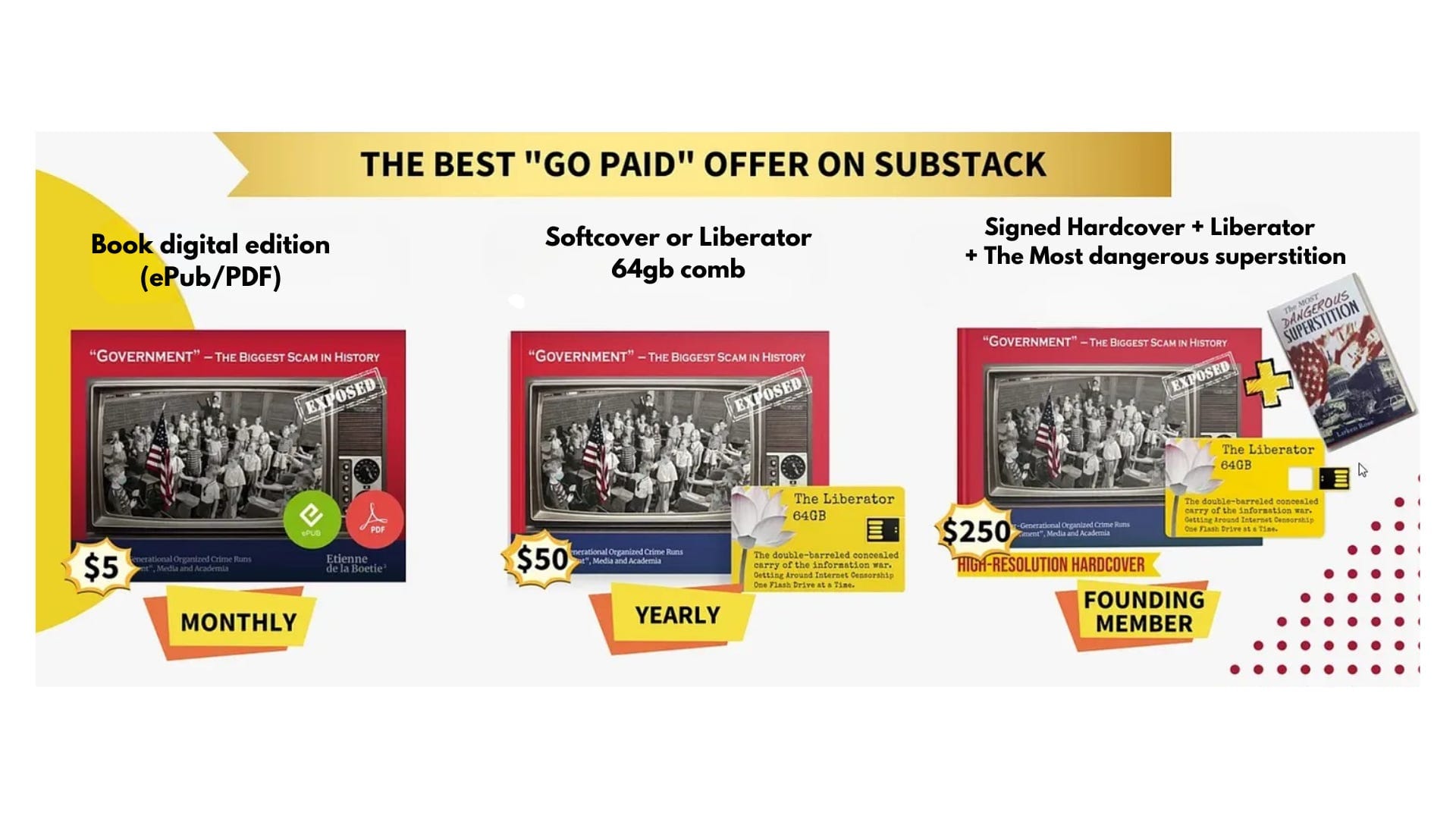
Go paid at the $5 a month level, and we will send you both the PDF and e-Pub versions of “Government” - The Biggest Scam in History… Exposed! and a coupon code for 10% off anything in the Government-Scam.com/Store.
Go paid at the $50 a year level, and we will send you a free paperback edition of Etienne’s book “Government” - The Biggest Scam in History… Exposed! OR a 64GB Liberator flash drive if you live in the US. If you are international, we will give you a $10 credit towards shipping if you agree to pay the remainder.
Support us at the $250 Founding Member Level and get a signed high-resolution hardcover of “Government” + Liberator flash drive + Larken Rose’s The Most Dangerous Superstition + Art of Liberty Foundation Stickers delivered anywhere in the world. Our only option for signed copies besides catching Etienne @ an event.


