

Last night Russia hit Kiev’s North Bridge with an Iskander missile. Only one strike has been fully visually confirmed, but there were again rumored to be several that potentially hit.
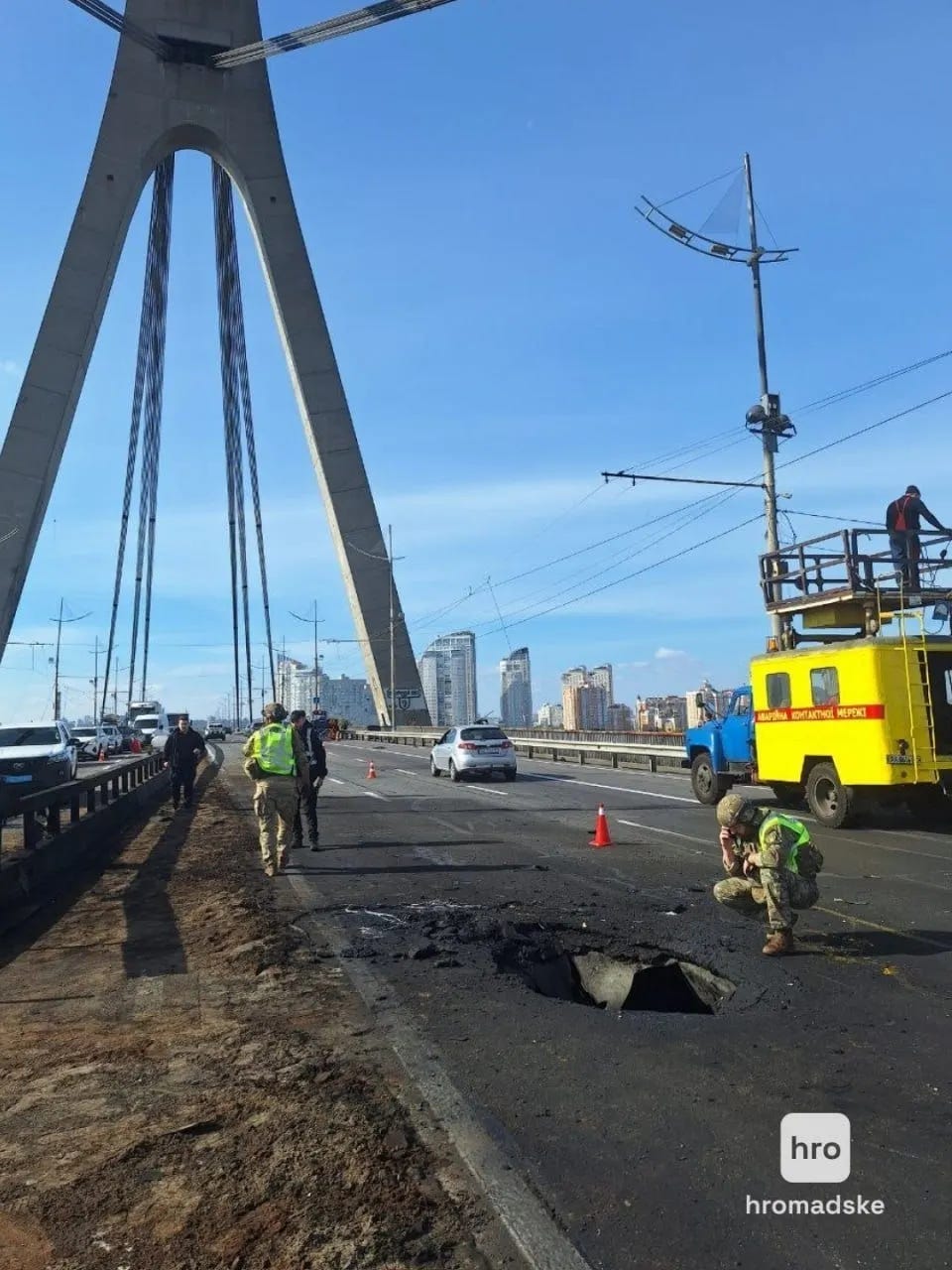
If you’ll recall, the North Bridge was first hit in an experimental fashion with some form of Geran drone on October 3, which caused the following damage:
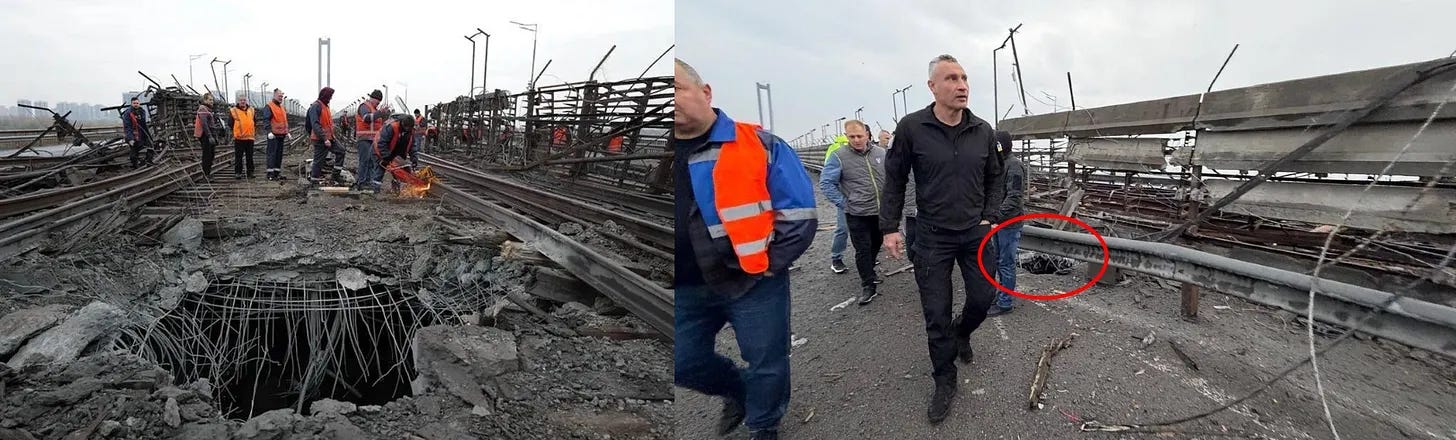
Then, after hitting the South Bridge cable stays with a “wire-cutter” drone, Russia proceeded to hit it again with an Iskander last week, creating a major crater in the middle of it:
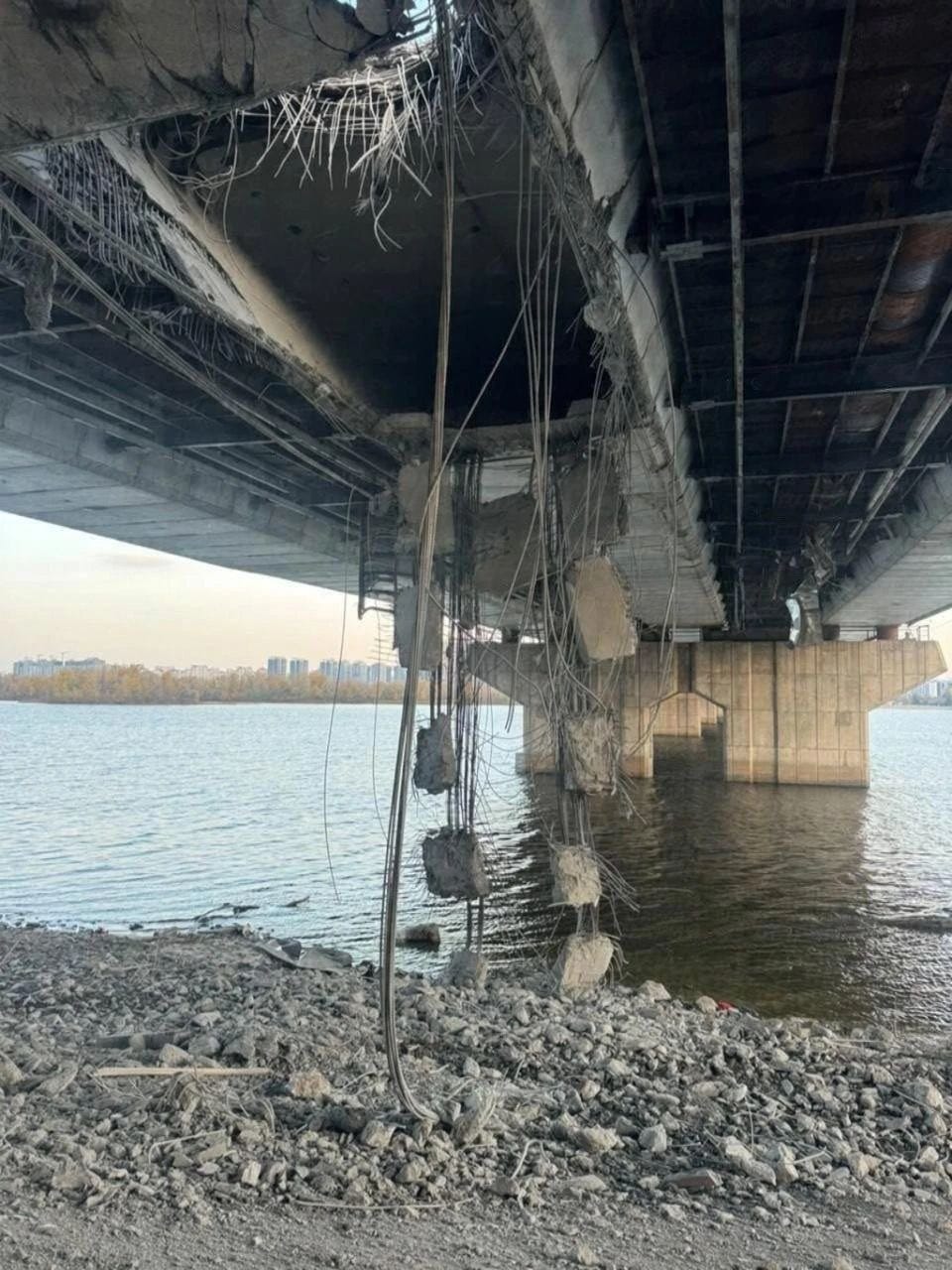
Incidentally, we’ve also now obtained a new photo of the damage from this attack, seen from below the South Bridge:
Now, Iskanders have targeted the key North Bridge, which is Kiev’s most important and highest-trafficked of its six major road bridges. The damage can be seen in the report below:
Watch a 1:06 video by clicking HERE
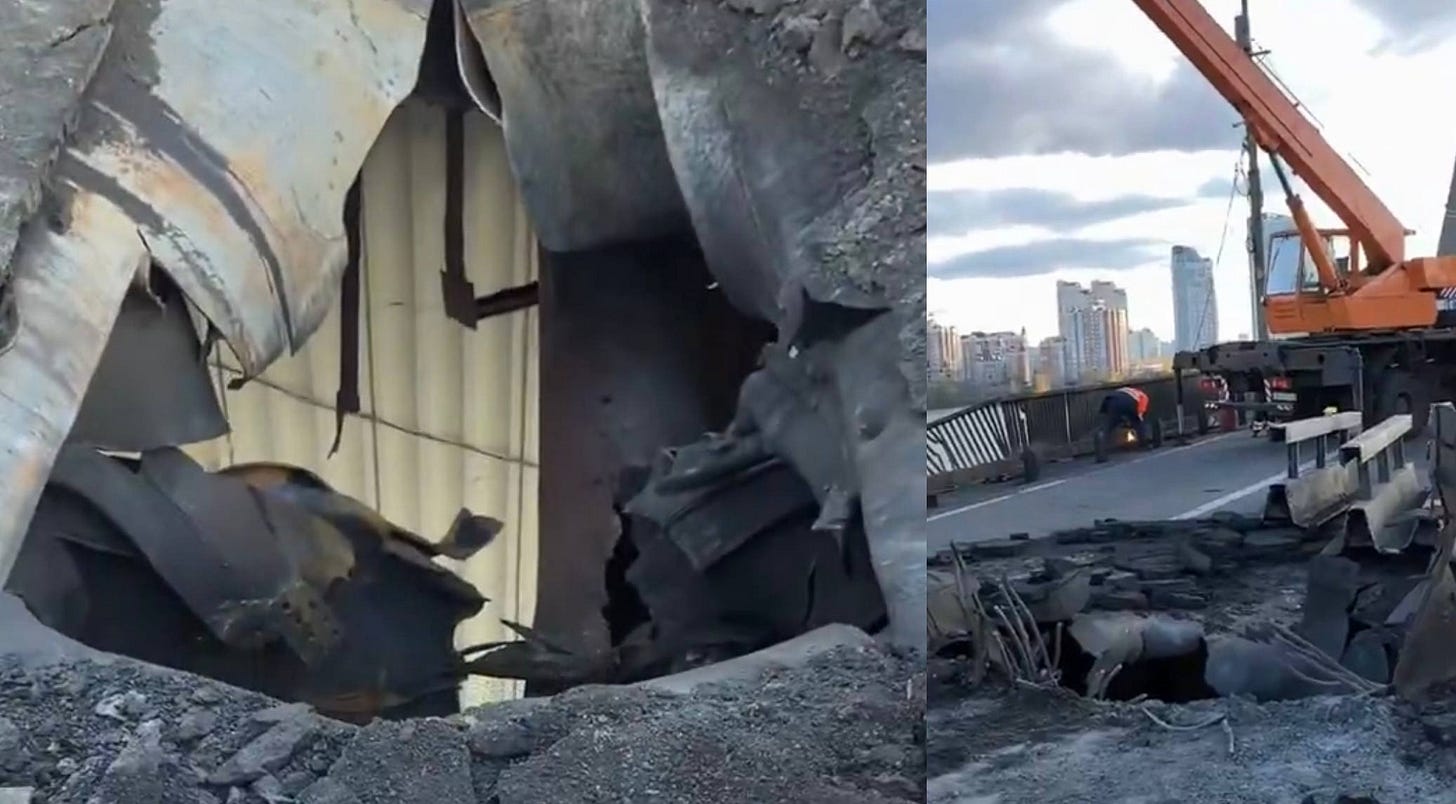
The accuracy was once more pinpoint.
One theory suggested that Russia was attempting to target the anchor point of the giant cable stays:
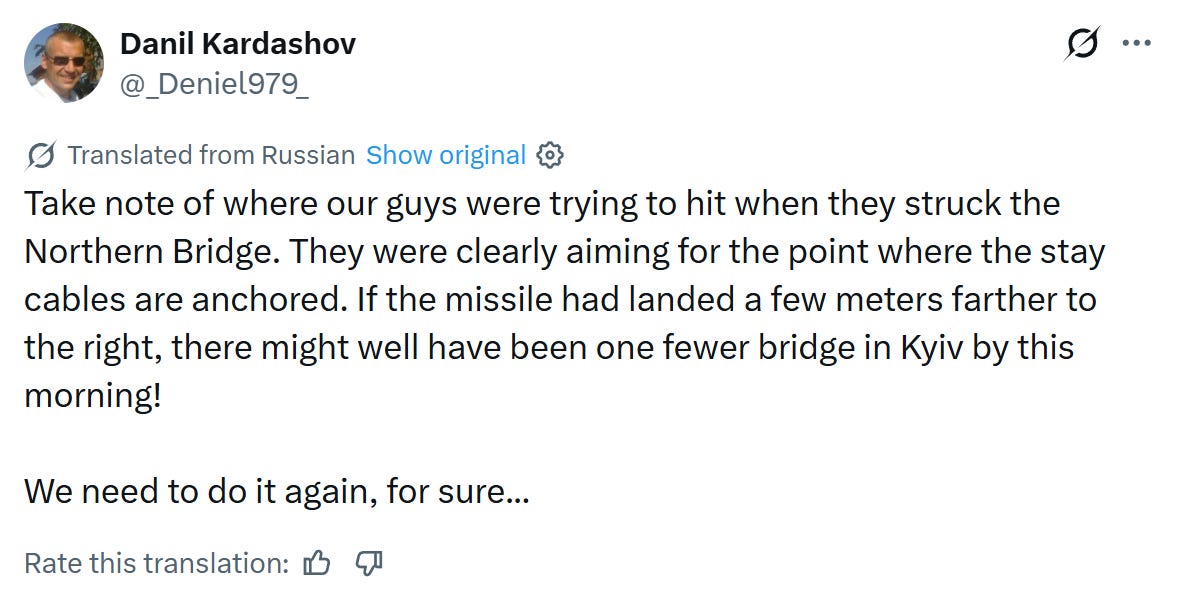
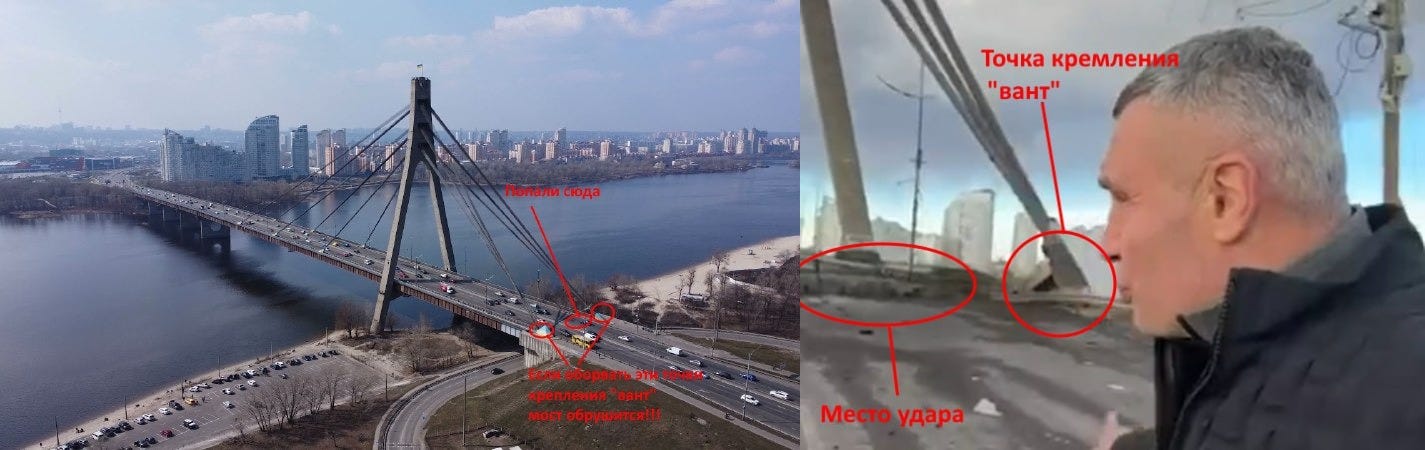
It would make sense, given Russia’s previous attempts to hit the South Bridge’s cables via the new specialized “wire-cutter” drones earlier last month.
Top Ukrainian expert Serhiy “Flash” Beskrestnov writes of the Iskander’s accuracy:
Unfortunately, the enemy is very accurately targeting bridges. How is this possible?
Under conditions of complete navigation suppression across the entire country during air raid alerts, it is difficult for the "Iskander" missile to hit a target with meter-level accuracy. An inertial system alone cannot provide that level of precision.
However, our enemy wants to hit its targets. Therefore, "Iskander" missiles use optical guidance heads (9Э436, 9Б918) or expensive radar-guided heads (9Б918).
During the descent of the warhead, a radar scan of the area takes place over a few seconds, and a correction is entered into the missile's guidance system.
He provided interesting links to two recovered components of the Russian Iskander, showing a radar homing head, and an optical “matching” unit, presumably akin to a DSMAC (Digital Scene Matching Area Correlator) system:

The DSMAC would compare the visual of the target with images of the same target stored in its memory in order to much more precisely hit the exact area that’s needed to be hit, rather than relying simply on GPS/Glonass, which can be degraded via spoofing and jamming.
This could explain why some Iskanders have at times appeared inaccurate. Russia may use the cheaper variants without these homing heads when needing to hit something large or not particularly important. Other times when absolute accuracy is necessary, it can use the variants loaded with the above more expensive and advanced homing units.
What we can conclude for now is that Russia’s debridgification campaign is certainly proceeding in a more systematic fashion than ever before. But the Russian leadership does not appear in a particular hurry to try and disable the bridge entirely and all at once.
It’s clear that the Iskander’s accuracy is allowing it to hit fairly the bridge roadway accurately without major misses, and so it’s conceivable that Russia could easily smash the bridge with a barrage of simultaneous Iskanders. But for now it appears Russia is happy to peck at it incrementally. One of the only logical explanation is one we gave last time: Russia could be deliberately aiming to tie up as much of Ukraine’s civil resources as possible, dragging out the repair work to strain the state to the breaking point.
It’s conceivable that Russia may even not seek to bring the bridge down entirely, but rather simply make it unusable for now. This would be the case if the MOD envisions capturing Kiev later and needing the bridges to be in a semi-restorable state.
There’s also a non-zero chance that the Russian MOD is just shooting from the hip with no real plan, merely hitting things probingly on a whim and hoping for “something” to happen. After all, one could easily come to such a conclusion after seeing the repeated strikes carried out against the Zatoka bridge in Odessa, amongst others.
The campaign comes amid rumors that Putin has privately relayed to Ukraine he intends to destroy all Ukraine’s infrastructure by next year if Ukraine refuses to capitulate:
❗️ According to the FT, sources have relayed Putin’s position as follows: Russia will destroy Ukraine’s infrastructure until Kyiv agrees to terms, and by next year there will be “no bridges, no ports, no railways, no power plants.”
— MAKS 26 🇺🇦👀 (@Maks_NAFO_FELLA) November 6, 2026
This appears to be a response to the summer…
The FT article in question writes:
The Russian president views his air strikes as retaliation for Ukraine’s drone attacks on refineries and commercial warehouses in Russia this summer and blames Kyiv for the collapse of previous ceasefires, according to another person.
“I will destroy all your infrastructure until you agree,” the second person said, relaying Putin’s position. “By next year Ukraine won’t have any infrastructure left. All the bridges, ports, railways, energy infrastructure, power stations . . . will have been destroyed.”
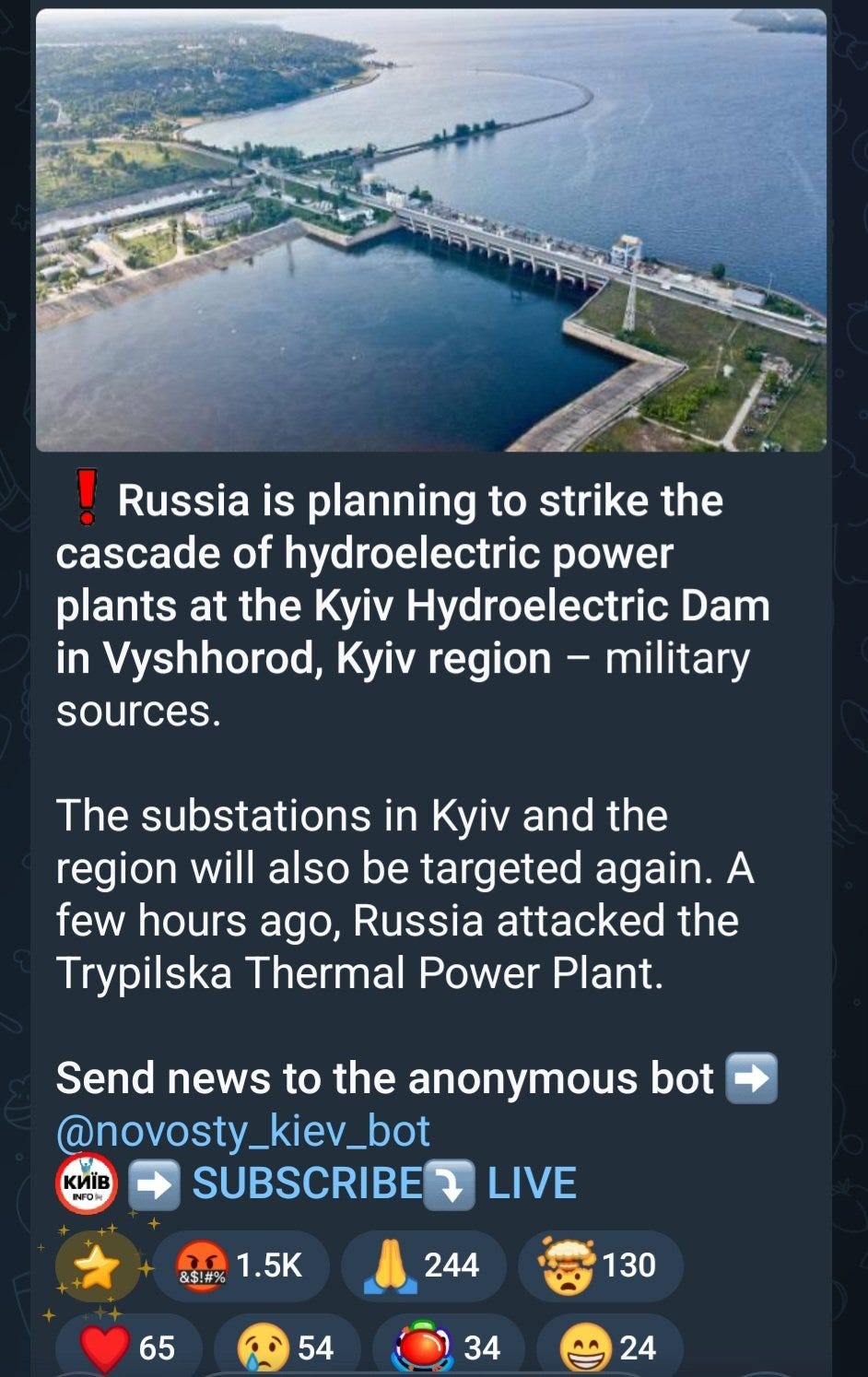
Zelensky himself appeared to indirectly corroborate it by announcing that Russia is preparing even more large infrastructure strikes:
We now have intel that another strike is being prepared – targeting our energy sector, bridges across the Dnipro, and civilian infrastructure. The Air Force and the Armed Forces of Ukraine overall are preparing to protect us. We need interceptor missiles for our Patriots. Every… pic.twitter.com/6D0i2TsO6S
— Volodymyr Zelenskyy / Володимир Зеленський (@ZelenskyyUa) November 6, 2026
Though we are of course to be suspicious of any MSM “leaks” of this sort, the truth is that:
- Previous such leaks turned out to be true. We reported several months ago rumors that Russia was getting ready to disable Kiev’s bridges. This appeared to prove exceedingly accurate.
- It would positively explain why Europe and the US have gone absolutely hysterical with ceasefire attempts, showing urgency to end the war like never before. We can only assume this has to do with the fact that they know they are unable to save Ukraine from what is “coming soon”.
All this past week, Russia has been striking Ukrainian power plants, here the Dniprovska Thermal Power Plant in Dnipropetrovsk seen being hit by cruise missiles on November 3rd:
Watch a 0:29 video by clicking HERE
The strikes were extensive:
The Russian army continues to systematically disable Ukraine’s energy and infrastructure.
▪️Last night, Russian troops launched a massive strike with high-precision weapons and attack drones against Ukraine’s energy and port infrastructure.
➖Ladzhyinskaya Thermal Power Plant - 1800 MW.
➖Kryvorozhskaya Thermal Power Plant - 2800 MW.
➖Prydneprovskaya Thermal Power Plant - 1765 MW.
➖Kharkov Thermal Power Plant - 86 MW.
➖”Zmiivska” substation - 330 kV.
➖”Losevo” substation - 330 kV.
▪️In the Odesa region, the port infrastructure in the port of Kiliya, used in the interests of the Ukrainian Armed Forces, was hit. In the port of Yuzhny and the Black Sea, two dry cargo ships carrying military equipment and dual-use cargo for the Ukrainian Armed Forces were hit.
▪️The targets of the strikes were facilities that ensure the energy supply to the Ukrainian military industry and the Ukrainian Armed Forces, as well as military logistics through the Black Sea ports.
The attacks reportedly triggered the “most severe water outage” of the war for Kiev:
“The mass Russian strikes on Ukraine’s energy system on Nov. 3 triggered Kyiv’s most severe water outage during the full-scale invasion, three people with knowledge of the matter, including a government advisor, told the Kyiv Independent.
— Rob Lee (@RALee85) November 5, 2026
Residents throughout Kyiv were left… pic.twitter.com/8gi8fJIzlV

Welcome to Kyiv, where electricity has officially become a luxury, and planning your day around power outages is a full-time job.
— Tonya Levchuk 🇺🇦🇺🇸 (@TonyaLevchuk) November 8, 2026
Today’s schedule: 3.5 hours with electricity. The remaining 20.5 hours? Good luck.
You have to somehow manage to shower, do laundry, cook, charge… pic.twitter.com/p1XHMzfKZQ
A Ukrainian energy expert says that the grid will never return to its previous levels:
Watch a 2:41 video by clicking HERE
Ukraine’s energy system will not return to its previous capacity.
▪️ Ukrainian energy expert Yuriy Korolchuk stated that it will no longer be possible to restore the country’s energy system to its previous level.
▪️ According to him, the third power distribution scheme created since the beginning of the conflict has been destroyed by strikes. The previous ones were developed in 2022 and 2024, and the latest one in 2026.
▪️ Korolchuk emphasized that damage to energy facilities in Kyiv, Kharkiv, Dnipro, and Odesa is affecting even the western regions of Ukraine, as the entire country is connected by a single energy system.
Here the Director for the Center of Ukraine’s Energy Research Alexander Kharchenko states that all three of Kiev’s main power plants are effectively destroyed:
Watch a 2:56 video by clicking HERE
Director for the center of Ukraine's energy research, Alexander Kharchenko, reports that the 3 main Power Plants in the city of Kyiv have been completely destroyed.
CHP-4, CHP-5, CHP-6, have lost basically all of there energy generation capacity. He states that less than 15% of equipment at these facilities can be repaired.
He also warned that outages in Kyiv may last for up to 36 hours at a time.
—
Now the latest developments continue to revolve around the issue of Starlink and its Russian analogue over Ukraine.
Firstly, Ukrainian expert Serhiy Flash reports that Russians are jamming Ukraine’s own Starlinks with increasing effectiveness. They are doing this by both multiplying the number of new “Volna Kupol Garant” jammers, as well as making them more compact in size. He claims Russia has covered almost all of Crimea with these systems already, which could explain the lack of Starlink-drone attacks on Crimea in recent months. Now it is beginning to fill the battlefield with them:
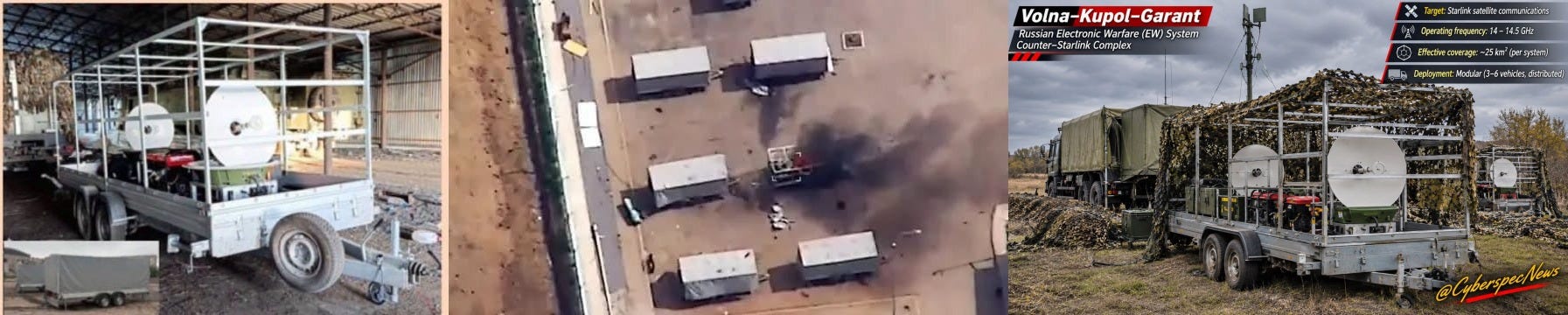
Our adversary continues to increase the number of satellite electronic warfare (EW) systems that interfere with the operation of Starlink. The system operates on the principle of area coverage, protecting an area of approximately 25 square kilometers. The Russians have deployed this type of EW system to protect almost all important facilities in Crimea and are increasingly using it along the front line.
The days when this EW complex looked like 6 trailers parked next to each other in a single location are long gone. Now, the enemy is trying to camouflage it. The core of the complex consists of satellite direct-focus antennas with a diameter of approximately one meter. Regardless of the camouflage used, they must have a clear line of sight (without obstructions) in the zenith, which limits the possibilities for camouflage.
My colleagues from aerial reconnaissance constantly ask me where to look and what to look for.
Pay attention to truck parking areas – these are ideal places for camouflaging the complex. Out of dozens of trucks, 3-6 may have the system installed. Also, pay attention to small trailers attached to cars. The enemy has devised a method of installing one antenna (instead of two) in small trailers that are parked close together but spread out across the area.
Camouflage netting in the rear is likely to attract attention, so its use is unlikely. The EW system can operate under a polycarbonate awning or under a plastic sheet. Pay attention to opaque greenhouses.
Many people write about the enormous power consumption and the need to install the complex near power substations. This is not the case. The complex can even operate on generators.
The EW system operates in the frequency range of 14.0–14.5 GHz.
At the same time, Russia has accelerated development of its own Rassvet (“Dawn”) analogue, and mainstream medias are growing concerned:
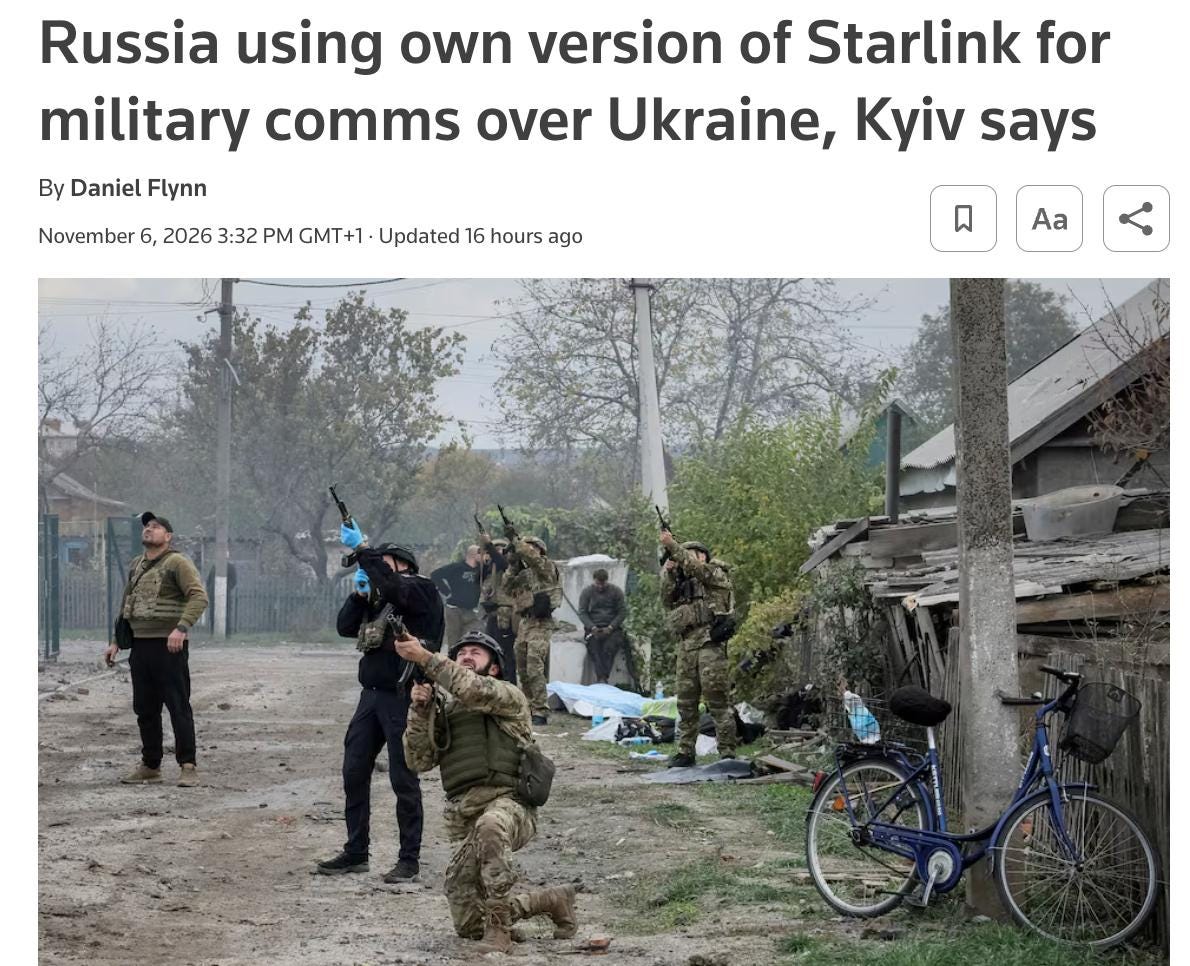
Reuters reports that Russia is planning to send up more of them by the end of 2026, and that Ukraine’s GUR confirms Russia is already actively using the satellites for military purposes over Ukraine:
Moscow plans further Rassvet launches by the end of 2026 to increase the network’s geographic coverage, bringing it gradually closer to a full low-orbit satellite communications system, GUR said in a written statement.
“Russia is using the ‘Rassvet’ satellite system over the territory of Ukraine for military purposes,” GUR spokesman Andrii Yusov said in the statement.
This comes amid reports that Russia has already begun registering the newest, most advanced variant called the Rassvet-4, which appeared in the registry on October 29th:

Applications for the registration of the Rassvet-4 satellite network, which involves the deployment of 374 spacecraft, have appeared in the International Telecommunication Union’s database.
This is evidenced by documents from the International Telecommunication Union (ITU).
According to the published data, the applications were entered into the registry on October 29, 2026.
The proposed constellation is to consist of 374 satellites placed at an altitude of approximately 800 km. They are planned to be distributed across 17 orbital planes—22 satellites in each.
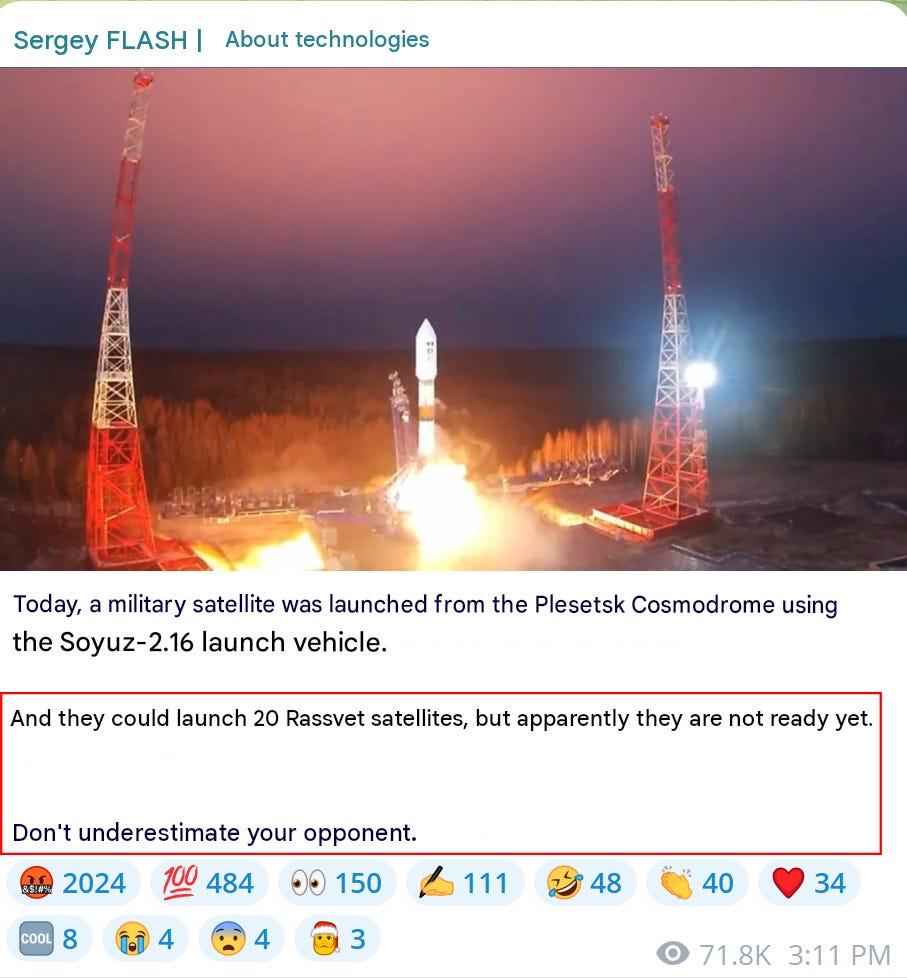
Just as those reports hit the airwaves, Russia made another successful launch of the Soyuz-2.1b carrying some unknown military cargo which some suspect to have been Rassvet satellites, perhaps even of the new Rassvet-4 variety:
Video of today's Soyuz-2.1b launch from Plesetsk Cosmodrome, which carried a GLONASS satellite.
— afec7032 🇷🇺 (@afec7032) November 7, 2026
Payload deployment was reported by MoD as successful. https://t.co/W6YRKFL1ST pic.twitter.com/o3gdbTYkbd
Serhiy Flash himself urged that up to 20 Rassvet satellites could have been amongst the cargo:
As we have written here many times, next year bodes extremely badly for Ukraine given the confluence of factors:
- Ukraine’s own Starlink is being increasingly jammed and made ineffective
- Russia’s Starlink analogue is becoming increasingly operational, while Ukraine will never have the capability to jam it the way Russia jams Ukraine’s Starlink
- Russia is slowly covering all of its refineries with large defensive structures, from layered metal grid-works to nets
The third point above alone will eventually take away Ukraine’s only trump card, leaving Zelensky with little leverage. At the same time, Russia’s own growing Rassvet trump card will come to impose increasingly severe costs on the Ukrainian state, as Russia will be able to target everything in the “rear” that was hitherto relatively safe.
2027 will likely be an extremely incoherent year, at least for those not tuned in to the truly fine details of the conflict. The frontline may continue to appear regressed while Russia will build an unprecedentedly widening disparity in capabilities which will leave observers confused as to “who is winning”. But it will be akin to watching two opponents in a knife fight, one of which has severe internal bleeding that is not visible to the naked eye. To many, the fight will appear “even” for a while—until it doesn’t.
That said, the war may go on for quite a while longer given Russia’s increasingly comfortable position, which will likely grow even more comfortable after the refineries are made safe from drone attacks. Once the Rassvet system is fully operational and integrated, and the Ukrainian state is even more economically and politically depleted, Russia could choose to tighten the noose and launch far larger ground operations as a final deathblow phase.


