

But they learned a lot and predict it will be enacted next legislative session.
Etienne Note: This article is being syndicated as part of our coverage of The Free State Project (New Hampshire). The liberty movement in New Hampshire just came within 3 percentage points of overriding the Governor's Veto... We are growing stronger each day in New Hampshire!
Published August 16, 2026 3:18pm EDT
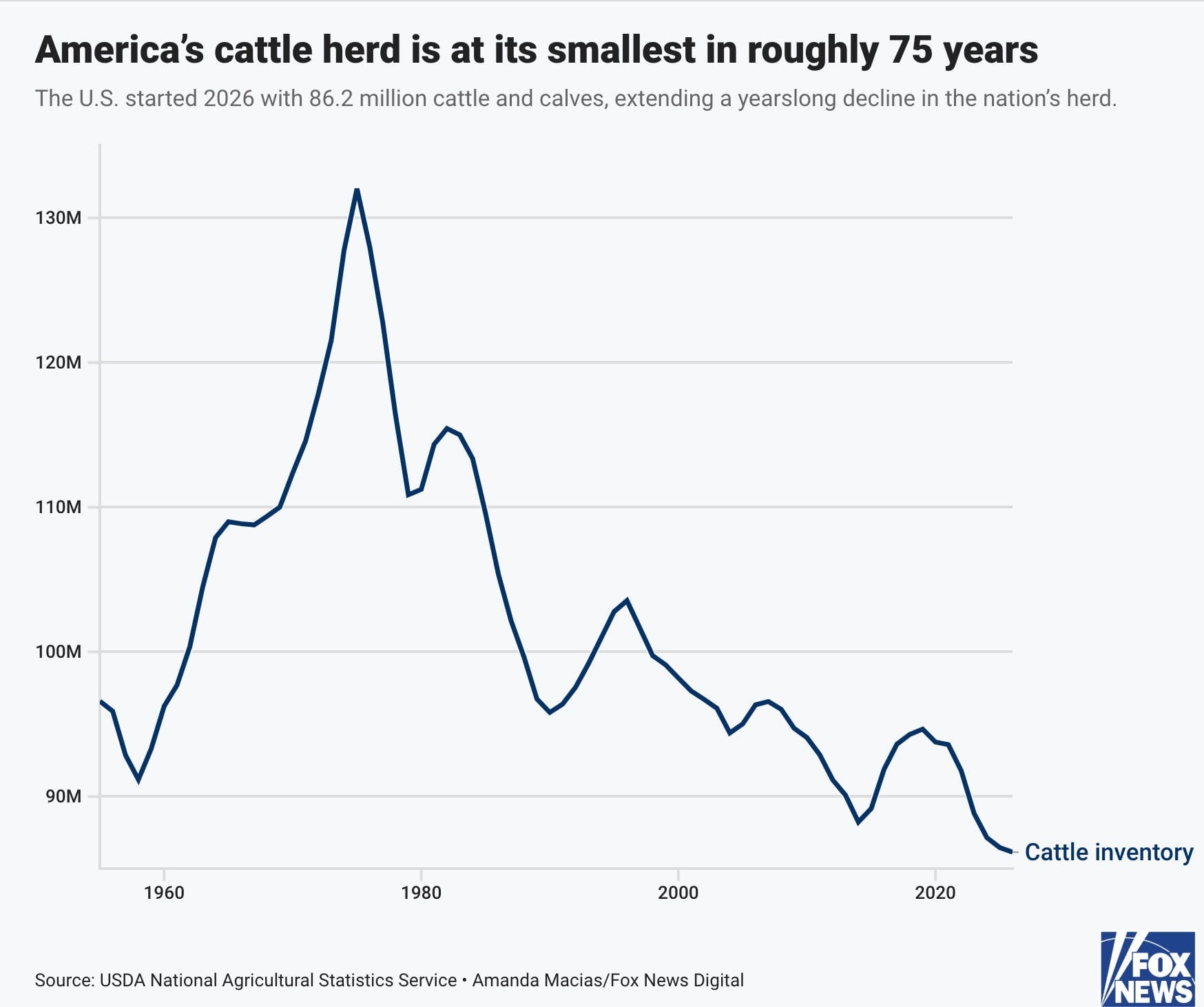
A historic shortage is squeezing an American dinner staple and relief could be years away
USDA data shows the nation entered 2026 with just 86.2 million cattle, down more than 8 million from 2019
According to USDA data, the retail value of Choice beef rose from about $8.51 per pound in August 2024 to $10.49 per pound in July 2026, an increase of roughly 23%.
We lost the override of the Governor’s veto of HB396 in New Hampshire yesterday.
We needed a 2/3 vote of those present in each House for a successful override.
We believed we had that 2/3 support needed in the 24 person Senate, but we did not know if we had it in the 400 person House.
The House vote was 204 to 116 in favor of the override. About 40 people were excused from the vote because of other commitments, or because they had moved away from their districts and were no longer eligible to serve. Another 40 or so people abstained from voting.
So, 63.75% of those present voted to override and we needed two thirds. Therefore, the Senate never got to vote on the override because it had not passed the House, where the bill originated.
We were up against strong headwinds. The Department of Agriculture and its Commissioner were against us and sent out 3 separate memos to members encouraging them to sustain the veto during the few days before the vote.
Originally, we had been told the vote for an override would take place after the midterms in November. Then, 15 days before yesterday’s vote we learned it had been moved up to August 19, and we only had 2 weeks to mount our campaign.
Given that, we did the best that we could. Postcards were sent to all the members. We generated over 4400 emails to members asking them to vote to override.
Jeffrey Tucker wrote a fabulous piece in the Epoch Times. Joel Salatin wrote a great blog post about it. Both were circulated widely within (especially) the NH farming community.
I wrote an Op-Ed in the Concord Monitor. I agreed to a profile piece in that paper, which should come out today or tomorrow. We met with news staff of other outlets that did not run stories and developed some relationships with them for the future.
I studied the Ag Commissioner’s memos and the bill language and found he was right about some of the language in the bill that could be improved. I also showed where he was wrong. I shared my thoughts with the key legislative sponsors, who were grateful, and with whom we will continue to work.
We created a wonderful handout and reached 200 or more members with it as they arrived to vote yesterday.
This was a huge learning experience, and for that we are grateful. We are convinced we will be successful next year, and that we are in a better position to help other states get their bills over the finish line.
It seems that the vote yesterday was very close to the original vote in the House that passed the bill, but we lacked sufficient votes for an override. So, with all that effort, did we change anyone’s mind? (We will be looking at exactly that question since we have tallies of the original and yesterday’s roll call votes.)
Lessons learned:
1. Our barrage of postcards, electronic messages, social media, op-eds and other written materials did not appear to have a great effect.
2. The vote did not fully split on party lines. Roughly 20% of R’s voted against, and roughly 20% of D’s voted for an override. But there was a clear party preference for one side or the other: R’s in favor, D’s against. We had not made the case successfully that this was a nonpartisan bill that helped everyone but the meatpackers, and in normal times would have been a favorite of the D’s.
3. There were problems that remained in the bill language that should be fixed before the bill is presented next session.
4. Members will need to be approached one on one by knowledgeable constituents, in order for us to get carefully thought-out votes in the House. On-farm slaughter is a complicated issue, and few seemed to grasp the nuances, as best we could tell. We never spoke about the fact that illegal on-farm slaughter is already ongoing but is not being prosecuted because the practice is too widespread, and the money involved too small for the USDA and state attorneys to get involved. And USDA might get a black eye if it was seen to come down hard against this practice. We need to point out that what we seek to legalize is already a widespread practice.
5. Attaching our bill to a must-pass bill next session would be another way to get it done. We have plans to pursue this, as it would be a veto-proof method to get the bill enacted.
6. We need to approach the Department of Agriculture and work with them on the standards and training that will be needed so they can be on board, and a fiscal note to compensate the department for this work needs to be added.
All in all, our team learned a lot over the past two weeks.
The positives are important. We have cemented some great relationships with legislators and with media. We know how the bill needs to be amended. We know how to work with the Ag. Dept. We know a lot of the stumbling blocks.
We know what a model bill should look like for other states, as well as for New Hampshire, and we will be building a website with lots of assets for other states that wish to field similar legislation. We will be working with other states to help them offer similar bills and get them over the finish line in the 2027 sessions.
This issue is hugely important and we will win it next time.
We thank you for your support!! We need readers to get to know their elected officials to work with them on important issues, and being proactive so the US can feed its population, especially given this season’s excess heat, drought and floods, lowering crop yields in the US and much of the world--well, this issue is about as important as it gets.
I have warned for several years about an impending food crisis and we should expect it by next year.
Get educated, get engaged, and become a food freedom activist so we can start to make small farming profitable again and help farmers become able to feed our local communities with healthier local food.
Let me know if you want more gardening information, or if you want me to post simple, healthy delicious recipes. We keep posting to SOFAF, and we will post more info on the SOFAF.org website--tell us what you want to see, tell us what you need.
This effort is for everybody. Everybody who eats.


