

Etienne Note: Become a $5-a-month subscriber to our new (and rebranded!) censorship-resistant publishing platform: Voluntaryist.News and get access to ePub versions of ALL my books in the membership area. Become a $50 yearly member and get a paperback copy of our new book: The Greatest Theft in Human History – How the Banks and “Government” Will Steal at Least $1.40 MILLION from the Typical Worker… “Legally”
Six Minutes of Reading May Cut Stress by 68%, Research Review Says
People reach for a book to calm down more often than they reach for a glass of wine or a hot bath, according to a new editorial pulling together decades of research on reading and mental health. One 2015 survey found that just six minutes of reading was tied to a 68 percent drop in stress levels.
Published in the journal Psychological Medicine, the editorial comes from researchers at the University of Cambridge and The Queen’s Reading Room. Rather than running a new experiment, the authors combined survey findings, brain scans, and long-term health studies to argue that reading for pleasure may be more than a hobby, and could function as a low-cost habit that supports well-being.
Their conclusion goes beyond stress relief. People who read regularly for enjoyment tend to report more empathy and less loneliness, and older adults who keep reading appear to face a lower risk of memory decline. Some of these patterns held up regardless of income or education level, though the authors are careful to note that most of this evidence shows associations rather than proof that reading directly causes the outcomes.
Decades of Surveys and Brain Scans Build the Case for Reading
That case draws on survey data, memory and attention tests, brain scans comparing readers with non-readers, and studies that tracked the same groups of people for years or decades.
One survey of more than 4,000 adults asked about reading habits and well-being. Another followed close to 2,000 people in a shared reading program. Several studies gave cognitive tests to adults over 55, and a few tracked groups for a decade or more to see whether early reading habits predicted health later in life.
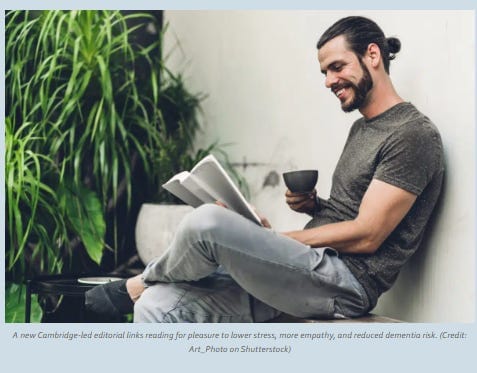
Reading and Mental Health Findings Beat Wine for Stress Relief
In the survey behind the 68 percent figure, reading ranked as the most popular way people said they relax, with 38 percent picking books as their go-to method for unwinding. More people in that survey said they turned to books for comfort (35 percent) than to a glass of wine (31 percent) or a hot bath (10 percent).
Reading also appeared tied to empathy and emotional steadiness. Nearly two-thirds of readers said reading helped them better understand other people’s feelings, compared with fewer than half of non-readers, and half said books made them more open to beliefs different from their own. Loneliness came up too: in a separate reading-group survey, nearly three-quarters of participants said reading helped their overall well-being, and more than 40 percent felt more connected to others.
Reading and Brain Health Improve With Age, Long-Term Studies Show
Several long-term studies followed groups of older adults for years, checking their mental sharpness against how often they read. One study that followed 801 people 65 and older for four and a half years found that engaging in activities such as reading newspapers, magazines, and books was associated with a 33 percent lower risk of Alzheimer’s disease. A separate study of 469 people 75 and older found that reading specifically was linked to a 35 percent lower risk of dementia over about five years.
More recent work suggests reading may also help narrow some of the cognitive differences associated with education. In a study of nearly 2,000 adults over 64 followed across 14 years, frequent reading was linked to a slower rate of decline across all education levels. Picking up a book regularly might help offset some of the disadvantages tied to having less schooling.
Early Reading Habits Shape Kids’ Attention and Well-Being
Using data from more than 10,000 adolescents in a major long-term study, researchers found that just over half had read for pleasure from an early age. Compared with peers who read less, these early readers showed fewer mental health problems, better attention, and improved behavior by early adolescence, along with more sleep and less screen time.
Brain scans backed this up. Kids who read early showed differences in brain regions tied to language, emotional control, and decision-making. Those patterns remained even after researchers accounted for family income, parental education, and several other factors.
Still, the editorial points to a troubling trend: reading among children and teenagers is declining, possibly to its lowest point since records began, with boys 11 to 16 showing an especially steep drop. Kids said they were most likely to pick up a book when it connected to a favorite movie or matched a personal interest, pointing to one possible way to draw young readers back.
Reading for pleasure will not replace medicine or therapy, and most of the evidence here shows links rather than proof of cause and effect. Still, the range of findings, from stress surveys to dementia studies to brain scans of children, points in a consistent direction: something as accessible as opening a book is tied to a calmer mind, a more connected life, and possibly a brain that ages more slowly, a pattern the editorial’s authors say is worth investigating further.
continue reading...

Our new book, The Greatest Theft in Human History – How the Banks and “Government” Will Steal At Least $1.4 MILLION From the Typical American Worker “Legally,” is now shipping!
You can read a summary of the book on ArtOfLiberty.Foundation (Replaces Important News from Art of Liberty Foundation on Substack) that breaks down the basics HERE.
Our first order was for 200 copies; 39 went to sheriff's departments in North Carolina, and two went to Supreme Court justices in North Carolina with whom our supporter had relationships. The books were so well received that she ordered 200 more copies!
You can get a free copy by becoming a Liberty Member on our new publishing platform. Substack was censoring us, so we built our own censorship-resistant publishing platform.
Check it out at Voluntaryist.News, ArtOfLiberty.Foundation, and FiveMemeFri.org and become a Liberty Member at ArtOfLiberty.org/become-liberty-member/
Finally, if you think this is important, can you please forward our press release to your favorite media outlet, podcasters, blogger, vlogger or financial advisor?


