

According to our study of the most widely consumed children’s snacks, 78% of snack products in the United States are ultra-processed.
By Julie Chapon & Gabriela Mourad Vicenssuto, Yuka
This isn’t just about candy and chips: it includes cheddar crackers, toaster pastries, and fruit snacks. Familiar staples of school lunchboxes across the country.
Parents reach for these snacks because they are portable, convenient, and loved by kids. But the fruit, cheese, milk, or protein pictured on the front can hide long lists of industrial ingredients, along with high levels of sugar or sodium. A snack that looks wholesome can therefore be a highly engineered ultra-processed product.
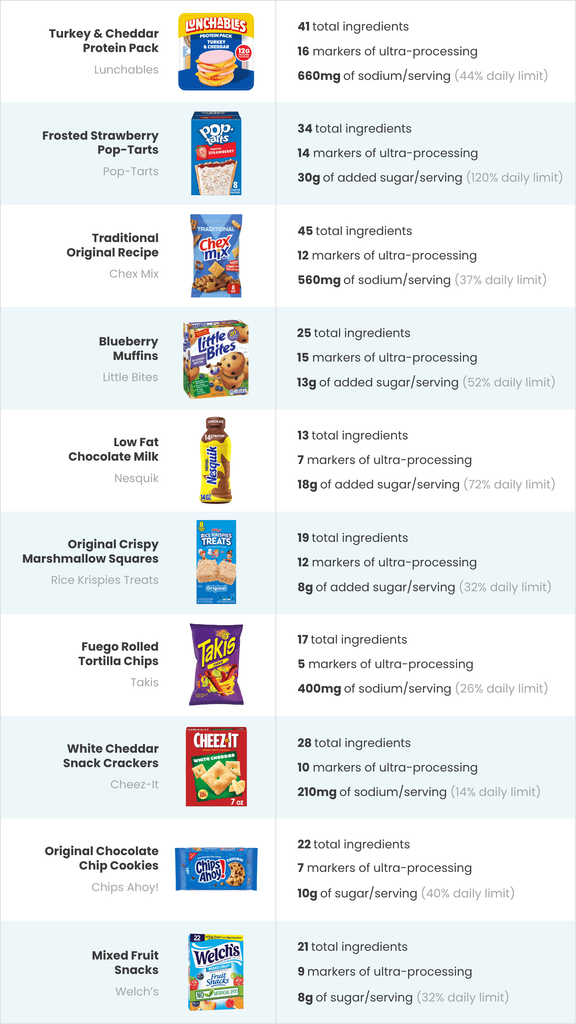
For this back-to-school investigation, we selected 10 popular children’s snacks that combine multiple markers of ultra-processing with high levels of sugar, sodium, or both. Product by product, we show what’s really behind these familiar lunchbox staples.
Ultra-processed foods: a growing concern for children’s health
Ultra-processed foods have quietly become the foundation of children’s diets in the United States. Behind their familiar packaging lies a category of products that science increasingly links to serious health risks.
What are ultra-processed foods?
The concept of ultra-processed foods was introduced in 2009 by Brazilian researcher Carlos Monteiro, who observed that traditional nutritional analysis, focused mainly on sugar, salt, fat, and calories, did not fully explain the rise of obesity and chronic diseases. What was changing was not just the amount of nutrients people consumed, but the nature of the foods themselves: meals prepared from simple ingredients were increasingly being replaced by standardized industrial products. This led to the NOVA classification, which divides foods into four groups, from unprocessed or minimally processed foods in group 1 to ultra-processed foods in group 41,2.
Processing food is not inherently a problem. Freezing vegetables, fermenting yogurt, or baking bread can preserve food and make it easier to consume without fundamentally changing what it is. Ultra-processing goes much further.
An ultra-processed food is not simply a prepared food, but an industrial formulation. Unlike a homemade dish, where whole ingredients are combined, it is built from fragments of other foods. Low-cost raw materials such as corn, wheat, or soy are first broken down into separate components, including powders, oils, and syrups. These components are then assembled with additives, such as emulsifiers, texturizing agents, colorants, and flavorings, to recreate the taste, texture, and appearance of food3.
In practice, ultra-processed foods can be identified through their ingredient list, following the approach proposed by the Food and Agriculture Organization of the United Nations (FAO) in 2019: namely by looking for the presence of industrial ingredients rarely found in a home kitchen (glucose syrup, maltodextrin, modified starches, protein isolates, hydrogenated oils) and/or “cosmetic” additives designed to modify taste, texture, color, or aroma (colorants, sweeteners, emulsifiers, flavor enhancers, flavorings). The result is a product designed to be convenient, highly appealing, and easy to consume4. One such ingredient is enough to place a product in this category, and that is the criterion we applied throughout this investigation.
Documented health risks
A growing body of research associates high consumption of ultra-processed foods with an increased risk of obesity, type 2 diabetes, cardiovascular disease, certain cancers, depressive symptoms, sleep disorders, and even premature death5,6. In large cohort studies, a 10% increase in the share of ultra-processed foods in the diet was associated with a 12% higher risk of overall cancer and a 15% higher risk of type 2 diabetes. These associations follow a dose-response pattern: the larger the share of ultra-processed foods in the diet, the higher the risk.
Several mechanisms may help explain these associations. In ultra-processed products the natural structure of food, known as the food matrix, is broken down. This can make nutrients more rapidly accessible, leading to faster blood sugar spikes. It also reduces the need to chew and creates foods that can be eaten very quickly, before the body has enough time to register fullness7,8.
Many ultra-processed foods are also deliberately engineered to be hyper-palatable. Manufacturers carefully adjust levels of sugar, sodium, and fat to reach the “bliss point,” the precise combination that maximizes pleasure. Combinations of high amounts of both sugar and fat, which are uncommon in whole foods but widespread in ultra-processed snacks, can produce an especially strong reward response and make these products difficult to stop eating9,10. An analysis combining more than 280 studies using the Yale Food Addiction Scale estimated that around 12% of children show signs consistent with food addiction, with ultra-processed foods playing a central role in these behaviors11.
Ultra-processed foods dominate children’s diets
For many children, ultra-processed foods are no longer occasional treats. In the United States and the United Kingdom, they account for more than 60% of the calories consumed by children and adolescents, placing both countries among the highest-consuming nations in the world12,13,14. The share is around 50% in France, Canada, and Australia, and substantially lower in countries such as Italy and Brazil, where it is just over 25%15.
Food marketing plays a central role in driving this consumption. A UNICEF survey conducted in 171 countries found that three in four children had seen advertising for soda, snacks, or fast food in the previous week, and that three in five young people said those ads made them want the products they had just seen. Young children, particularly before about age 7 or 8, do not yet fully understand the persuasive intent of advertising: they cannot distinguish commercials from cartoons. Adolescents also remain vulnerable to marketing, particularly on social media and other digital platforms, where behavioral tracking and algorithms allow highly personalized targeting. Food marketing can shape preferences and eating habits from childhood, sometimes for life, and foster brand loyalty during a formative period16.
Regular exposure to products with very sweet, salty, or fatty tastes, especially from an early age, can make intense flavors feel normal, gradually shaping the idea that food pleasure comes primarily from these products. Brightly colored packaging, mascots, and cartoon characters can further reinforce this attraction by creating an emotional attachment to products and brands before children are fully able to recognize their commercial purpose17,18.
At the same time, claims such as “rich in vitamins” or “no artificial flavors” can create a health halo, leading parents to perceive an ultra-processed product as healthier than it is19,20.
This pattern does not result from individual choices alone. Children grow up in a food environment where ultra-processed foods are omnipresent, heavily promoted, and often designed to appeal specifically to them.
The issue is not one cracker, fruit snack, or toaster pastry eaten occasionally, but a daily pattern in which ultra-processed products dominate a child’s diet during a critical period of development.
The 10 products called out by Yuka
Behind the familiar packaging of these 10 lunchbox staples are long ingredient lists filled with markers of ultra-processing. Half of the selected snacks contain more than ten such markers. Six are also very high in sugar, and four are high in sodium, showing how much can be hidden inside products marketed as everyday choices for children.
Long ingredient lists packed with ultra-processed ingredients
The ingredient list is one of the clearest places to identify ultra-processing. Across the 10 snacks analyzed, the lists range from 13 to 45 ingredients, from Nesquik Low Fat Chocolate Milk to Traditional Chex Mix. Every product contains at least 5 markers of ultra-processing, and some contain as many as 16.
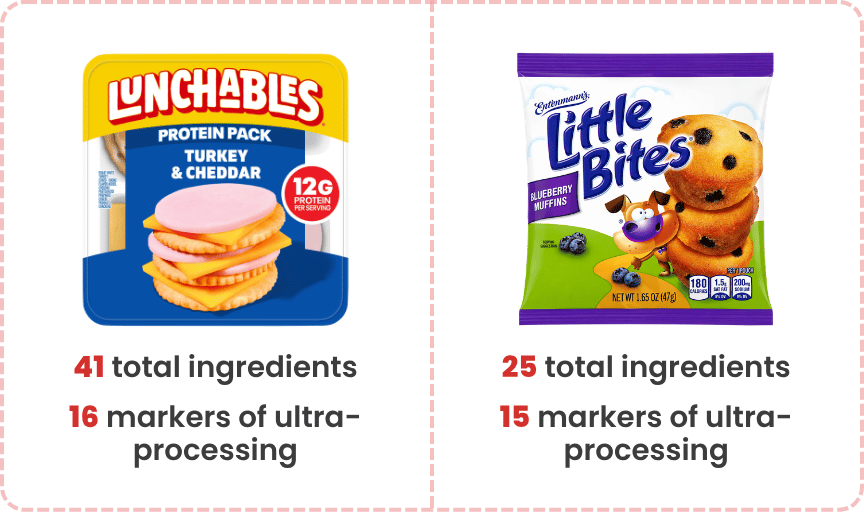
The Turkey & Cheddar Lunchables Protein Pack is one of the most striking examples. A tray of turkey, cheese, and crackers contains 41 ingredients, including 16 markers of ultra-processing, such as modified cornstarch, carrageenan, sodium phosphates, artificial flavor, smoke flavor, sodium nitrite, and lecithins. Little Bites Blueberry Muffins contain 25 ingredients, 15 of which are markers of ultra-processing, meaning these markers account for more than half of the ingredient list. They include modified starch, mono- and diglycerides, polysorbate 60 and several gums.
Among these markers, some are additives that Yuka considers high-risk. The most widespread is phosphate additives. Six of the 10 snacks selected contain them: Pop-Tarts, Chex Mix, Little Bites, Cheez-It, Lunchables, and Chips Ahoy. Phosphate additives can serve several functions, but in these products they are primarily used to modify or maintain texture. While phosphate additives are a source of phosphorus, an essential mineral, they can become problematic when consumed in excess. U.S. dietary data from 2015–2016 show that phosphorus intake already exceeds recommended levels, with Americans consuming approximately 1.5 to 3 times the recommended daily allowance21, depending on age group. Excessive phosphorus intake could interfere with bone mineralization, negatively affect kidney health, and increase cardiovascular risk22-25.
Another concern, particularly for children, is the presence of artificial colors: Pop-Tarts contain Red 40, Yellow 6, and Blue 1. These dyes are suspected of contributing to hyperactivity and attention-related disorders in some children26-29. In Europe, foods containing certain synthetic dyes must carry the warning: “May have an adverse effect on activity and attention in children.”30 While regulatory scrutiny of these dyes is increasing in the United States, Red 40, Yellow 6, and Blue 1 remain federally permitted as of August 2026. The FDA is, however, pursuing a voluntary, non-mandatory phaseout of synthetic dyes by the end of 2026, relying on manufacturers to remove them voluntarily, while several states have adopted stricter legal bans, including California’s ban in public schools starting in 202831,32.
Two of the products analyzed, Lunchables Turkey & Cheddar Protein Pack and Nesquik Low Fat Chocolate Milk, contain carrageenans, a cosmetic additive used for its thickening and gelling properties. Carrageenans have been linked to disruptions of the gut microbiota and intestinal inflammation. Persistent inflammation can weaken the intestinal barrier and may contribute to the development of chronic diseases, including type 2 diabetes, obesity, and certain cancers33-37.
While these are only a few examples, the selected products also contain several other additives of concern, including mono- and diglycerides, sodium nitrite, cellulose gum, monosodium glutamate, polysorbate 60, TBHQ, and BHT.
Too much sugar and sodium in a child-sized snack
Sugar is one of the clearest nutritional concerns across the snacks analyzed: a single serving of several products can account for a large share of a child’s recommended daily limit, and in some cases nearly all of it.
The American Academy of Pediatrics (AAP) recommends that children ages 2 and older consume less than 25 grams, or about 6 teaspoons, of added sugar per day38.
The U.S. context is particularly concerning. National dietary data from 2015–2016 found that children ages 6 to 11 consumed an average of 69.5 grams of added sugar per day, nearly three times the AAP recommendation39. High added-sugar intake during childhood is associated with obesity, tooth decay, hypertension, and other cardiovascular risk factors40.
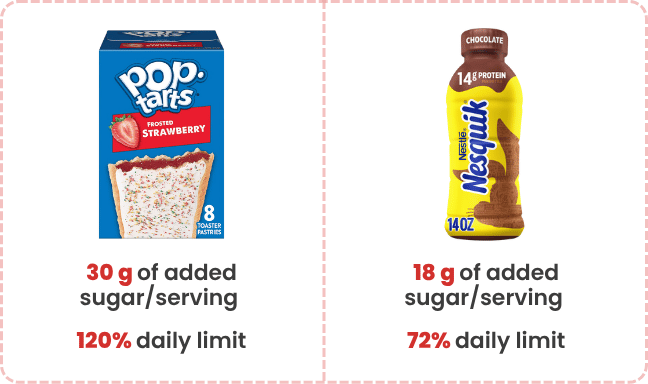
Several snacks in our analysis use up most or all of the recommended daily allowance in a single serving. A labeled serving of Frosted Strawberry Pop-Tarts contains 30 grams of added sugar, representing 120% of the AAP’s recommended daily maximum. A bottle of Nesquik Low Fat Chocolate Milk contains 18 grams of added sugar, representing 72% of the daily maximum.
Sodium is another major concern across several of the snacks analyzed, especially because children need less sodium than adults. The Centers for Disease Control and Prevention (CDC) recommends that children ages 4 to 8 consume less than 1,500 milligrams of sodium per day. It also notes that most sodium comes from processed foods and that highly processed foods high in sodium should be avoided41.
The U.S. context is concerning here too. According to the CDC, about 9 in 10 U.S. children ages 6 to 18 consume too much sodium, and a high-sodium diet can contribute to raised blood pressure during childhood. This matters because high blood pressure is a major risk factor for heart disease and stroke later in life42,43.
Several snacks in our analysis contain a substantial share of a young child’s daily sodium limit in just one serving. The Turkey & Cheddar Lunchables Protein Pack contains 660 milligrams of sodium, which represents 44% of the recommended daily limit for children ages 4 to 8. A serving of Traditional Chex Mix contains 560 milligrams, or 37% of that limit. Even a small 28-gram serving of Takis Fuego Rolled Tortilla Chips contains 400 milligrams, or 26% of the limit.
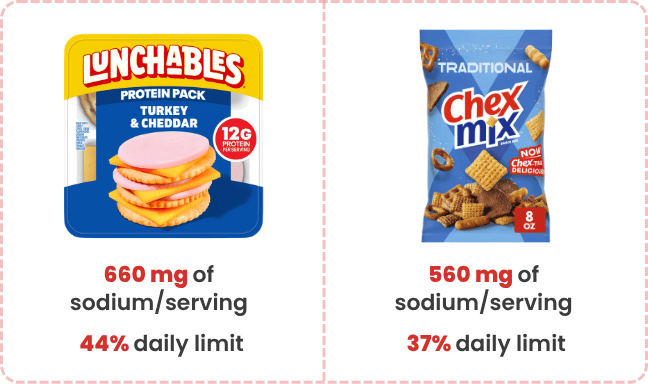
A single serving can therefore use up a substantial share of a child’s daily added-sugar or sodium allowance, and in some cases exceed the recommended limit entirely. Yet these everyday snacks can normalize overly sweet and salty foods from an early age, increasing children’s exposure to the health risks of excess sugar and sodium.
What the manufacturers say
Contacted by Yuka, Kraft was the only manufacturer to respond to our questions. The other brands included in this investigation did not reply to our requests.
Kraft said it is continuing to reformulate its Lunchables portfolio, with a focus on improving the quality and quantity of protein, adding fiber, and simplifying ingredient lists by removing artificial dyes and flavors. According to the company, several updated products are already available, with further changes planned for late summer 2027.
Regarding the Turkey & Cheddar Protein Pack, the company said that it has reduced the sodium content by more than 100 milligrams. Additional reformulation is underway to increase the product’s protein and fiber content, with an updated version expected to reach the market by the end of 2027.
Although the newer recipe contains less sodium and no artificial dyes, it still includes numerous markers of ultra-processing, such as modified cornstarch, dextrose, carrageenan, sodium phosphates, natural and artificial flavors, sodium nitrite, sorbic acid, and lecithins. Under the criteria used in this investigation, the product therefore remains ultra-processed.
Kraft’s response shows that reformulation is possible and that some improvements are already underway, even if there is still a long way to go.
What parents can do
Ultra-processed snacks are not a matter of individual choices alone, and no shopping habit can fix a food environment built to promote them. A few reflexes still make these products easier to spot.
- Read the ingredient list, not the front of the package. Claims such as “made with real fruit,” “good source of calcium,” or “no artificial flavors” say nothing about how a product was made. The ingredient list does, and its length is a first signal: a snack built from 30 or 40 ingredients is rarely a simply processed food.
- Use the kitchen test. Run through the ingredient list and count what you would never keep in your own kitchen: carrageenan, mono- and diglycerides, maltodextrin, phosphates, gums, artificial flavors, modified starch, etc. The more of them a snack stacks up, the further it sits from a recipe you could reproduce.
- Simple swaps hold up in a lunchbox. Plain crackers with a slice of cheese, plain yogurt with fresh fruit, popcorn, or a handful of nuts where school allergy rules allow, are just as easy to pack as a pouch or a tray, at a comparable cost.


