

Story at-a-glance
Current treatments for heart disease fail to address root causes. Stents and bypass surgery only restore blood flow temporarily without tackling underlying endothelial dysfunction and inflammation driving heart disease
Despite their ability to lower cholesterol, statins have limitations. While these drugs lower LDL cholesterol by 25% to 35%, they don’t address oxidative damage or rebuild vessel health, leaving underlying inflammatory processes unchanged
Excess linoleic acid (LA) from vegetable oils fuels heart disease. Modern diets contain 7.2% LA, as opposed to 2.8% a century ago. This creates mitochondrial dysfunction and dangerous oxidized LDL cholesterol formation
Reducing LA intake shows measurable cardiovascular benefits. Limiting LA to under 5 grams daily reduces inflammatory markers like hsCRP by 15% and IL-6 by 10% within weeks
Novel approaches like nanoparticle chelation show promise. Targeted delivery systems can address calcified plaques directly, offering more precise treatment than traditional intravenous methods at lower costs
According to the U.S. Centers for Disease Control and Prevention (CDC), cardiovascular disease is now the leading cause of death among Americans. In fact, it’s so widespread that treatment for it accounted for $417.9 billion in health care costs from 2020 to 2021 alone.1
I recently published a landmark paper in the World Journal of Cardiology. In it, I call for nothing less than a paradigm shift in how we approach heart disease — moving away from patchwork fixes and toward restoring cellular health at its root. The World Journal of Cardiology is an internationally recognized, peer-reviewed journal that publishes cutting-edge cardiovascular research.
My paper challenges the current standard of care and outlines a new framework centered on cellular health, a direction few in mainstream cardiology are taking. This work lays the scientific foundation for practical solutions you can apply today.
Mainstream methods to treat heart disease — such as percutaneous coronary intervention (PCI), which is angioplasty with stenting, and pharmaceutical drugs — are widely used today. But although they are effective, the problem is that they do not address the root causes of heart disease, such as endothelial dysfunction and inflammation.
In the next sections, I’ve summarized the pertinent points of my research. You can also read it in its entirety by simply clicking the below.2
Restoring Blood Flow Isn’t Enough
PCI and coronary artery bypass grafting (CABG) have long been promoted as the cornerstone of treatment for heart disease, especially during emergencies. These procedures are designed to reopen or bypass blocked arteries, restoring blood flow and easing chest pain. But as I detail in my paper, while these interventions save lives in acute situations, they don’t stop the disease itself, leaving you exposed to future heart problems.
•Conventional treatments don’t address the root cause — In one study, patients with stable coronary artery disease (people who had chronic but not immediately life-threatening blockages), stents and bypass surgery did not significantly lower the risk of heart attack or death compared to medical therapy alone.
In fact, the main benefit came down to symptom relief only. As I noted in my paper, “in stable CAD [coronary artery disease], revascularization primarily serves as a symptom-relieving intervention rather than a life-prolonging one, prompting a reevaluation of routine invasive approaches.”
•Stents come with their own complications — Within the first year, around 1% of patients who underwent stent procedures developed a particular thrombosis, a dangerous blood clot forming inside the stent.
In addition, between 5% and 10% of patients face in-stent restenosis, wherein the previously treated artery narrows again, requiring repeat procedures. Even if the stent stays open, the untreated parts of your arteries keep developing new blockages. Furthermore, the literature highlights that 20% to 30% of patients develop new arterial lesions within five years after a stent procedure.
•CABG saves lives, but the trade-offs are serious — This procedure provides more durable blood flow, especially if you have multiple arterial blockages. Statistics show that about 90% of patients who undergo CABG achieve full revascularization, compared to 60% to 70% with PCI.
However, CABG carries a 1% to 2% risk of death during the operation, a 5% risk of wound infections, and a 10% to 20% chance of cognitive decline afterward, particularly for elderly patients. More importantly, vein grafts used in the surgery also wear out — half of saphenous vein grafts fail within 10 years.
•The biology behind these limitations — Both PCI and CABG acutely address blood flow, but fail to tackle the root of atherosclerosis. As noted in my study, atherosclerosis is fueled by an interplay of several factors, particularly endothelial injury, lipid buildup, and inflammation.
In fact, about 30% to 40% of CAD patients show elevated inflammatory biomarkers like interleukin-6 (IL-6) or C-reactive protein (CRP), yet these markers aren’t changed by simply inserting a stent or graft.
•Enhanced external counterpulsation (EECP) — This is a noninvasive therapy that uses inflatable cuffs wrapped around your legs, which helps improve blood flow to the heart. The devices are carefully timed to inflate when your heart relaxes and deflate when the heart contracts. Essentially, the entire process changes how your blood will flow through the vessels by triggering the release of nitric oxide. Published research shows that there’s a 20% to 30% improvement in endothelial function.
While promising, EECP has not yet been proven to reduce the risk of “hard” outcomes like heart attacks, so more research is still needed in this area. Moreover, the mechanics of EECP aren’t fully understood yet, so more testing will be needed to fine-tune its benefits further. That said, early research shows that it may be able to help with conditions like heart failure and peripheral artery disease.
Again, more research will be needed, but the overall sentiment is positive — with enough data, EECP is poised to become a part of cardiovascular management, especially since it is a noninvasive procedure.
Drugs Lower Cholesterol, but Everything Else Stays the Same
Statins are widely considered as a cornerstone of cardiovascular disease management because they lower low-density lipoprotein (LDL) cholesterol, the type often labeled “bad cholesterol.” The thinking has been generally straightforward — reduce LDL cholesterol and you reduce heart attack risk.
In certain patients, particularly those with prior heart disease, statins do lower event rates. But lower cholesterol levels do not automatically mean the root cause of heart disease has been solved.
•A closer look at outcomes shows the limits — Statins reduce the relative risk of major cardiovascular events by about 25% to 35% in high-risk populations. But even with best statin pharmacotherapies available, the literature shows that this method has its own shortcomings.
For example, one study noted that rosuvastatin reduced major adverse cardiovascular events (MACE) by 44% in patients. However, it had the side effect of increasing high-sensitivity CRP (hs-CRP),3 which is associated with significantly increased risks for multiple heart-related conditions, including heart attack, stroke, peripheral arterial disease, and heart failure, even when traditional cardiovascular risk factors are controlled for.
•Statins come with their own problems — Around 10% to 15% of statin users noted that they experienced myalgia (muscle weakness), causing 1% to 2% of them to discontinue the treatment.
Even worse, severe side effects such as rhabdomyolysis, a dangerous breakdown of muscle tissue that can lead to kidney damage, and hepatotoxicity, toxic injury to the liver that impairs its ability to function, have been reported. The risk for Type 2 diabetes also increases over the course of four to five years.
The takeaway for you is straightforward — statins provide a degree of relief, but they don’t resolve the problem. They simply shift your numbers and don’t rebuild your vessel health or address the oxidative damage that sparks new blockages. The underlying processes that inflame and damage your arteries continue at the same pace unless you make other changes to your lifestyle.
Linoleic Acid Contributes to Heart Disease
Going deeper into the root causes, I believe that excess intake of linoleic acid (LA) from vegetable oils is one of the biggest contributing factors to heart disease.
•Modern diets load the body with LA at levels far above what humans historically consumed — Among early civilizations, the daily intake of LA was only around 2.8%, but today this has ballooned to 7.2%. Much of the increase was due to the old belief that the polyunsaturated fats (PUFs) in vegetable oils were healthier compared to saturated fats from animal sources.
•The anatomy of LA — This omega-6 PUF contains two bisallylic double bonds, making it susceptible to bonding with hydrogen. Once it’s inside your system and bonds with the cardiolipin in your mitochondrial membrane, the molecule turns into a substrate for lipid peroxidation. Thus, it produces reactive oxygen species (ROS) that hamper mitochondrial function, which leads to my next point below.
•Mitochondrial disruption quickly changes the chemistry of your arteries — Damaged mitochondria produce excess ROS, which injure the inner lining of your arteries, making them sticky to cholesterol and immune cells. In this environment, arterial plaques not only form — they grow aggressively.
The published literature emphasizes that oxidized LDL (OxLDL) cholesterol, which is directly fueled by LA breakdown products, is far more dangerous than total LDL alone because it drives this sticky, inflammatory process.
•How LA contributes to clogged arteries — LA becomes incorporated into LDL cholesterol, and the more you get it from your diet, the more OxLDL is produced. According to one of the studies I cite in my paper, “replacing saturated fat with LA-rich vegetable oil increased cardiovascular mortality by 62% over five years, despite lowering serum cholesterol by 8 mg/dL.”4
Minimizing Vegetable Oil Intake Attenuates Heart Disease Risk
The risk of high LA intake on your health has long been documented. For example, a 1965 paper I reviewed in my study noted that patients who were given 19 teaspoons of corn oil a day had a significant increase in heart disease risk compared to control groups.5 In light of this information, minimizing LA intake is a viable way of addressing heart disease by way of tackling inflammation.
•Cutting LA intake has measurable cardiovascular benefits — In the table below, I show the results of a 12-week study when participants reduced their LA intake to less than 5 grams per day.
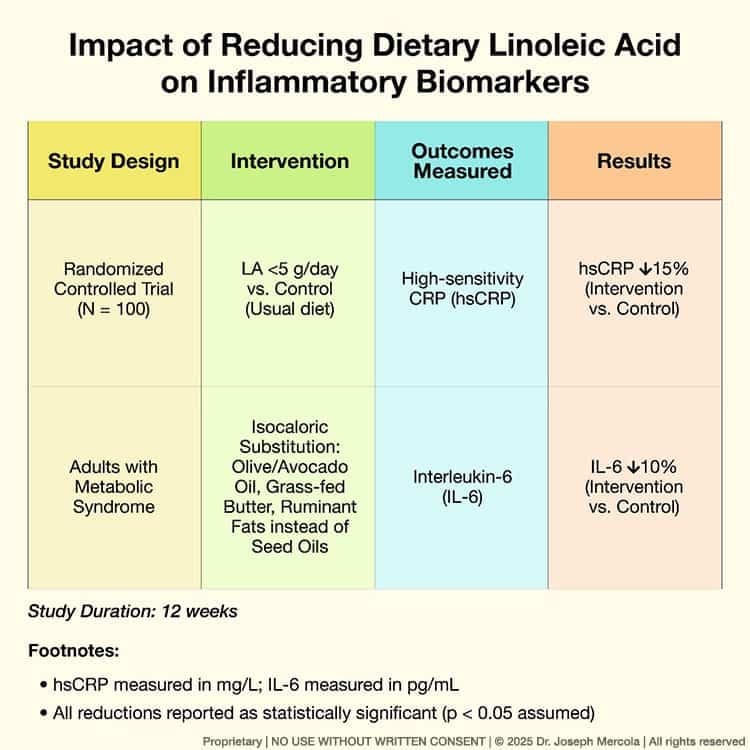
Table 2. Short-term suppression of inflammation after lowering dietary LA to < 5 g/day. A 12-week randomized, isocaloric substitution trial in 100 adults with metabolic syndrome demonstrated that replacing seed-oil LA with monounsaturated- or ruminant-fat sources reduced hsCRP by ≈ 15% and IL-6 by ≈ 10% relative to the control diet, confirming that LA restriction attenuates low-grade vascular inflammation — even in the absence of energy deficit or weight loss.
•The numbers don’t lie — These reductions are statistically significant. In essence, restricting LA intake positively affects low-grade vascular inflammation, even if weight loss or a calorie deficit hasn’t been implemented.
•LA takes years to clear up — LA has a half-life of two years. This means that even if you follow a low-LA diet for an entire year, you’ll only be removing about 30% of prior accumulation. Nonetheless, health benefits can be expected even before other interventions are implemented.
•Sources of LA — The most apparent source of LA is industrialized vegetable oils, such as soybean, corn, and safflower oils. However, less obvious sources include conventionally raised poultry and pork because of their feed, which is high in LA.
The message from the research is clear — lowering LA to less than 5 grams of your daily calories lowers inflammation, resulting in better heart health. This doesn’t require complicated strategies. Just remove vegetable oils from your diet, avoid fried and ultraprocessed foods, and choose grass fed animal fats. Each of these strategies lowers your residual risk of heart disease and helps restore your vascular health.
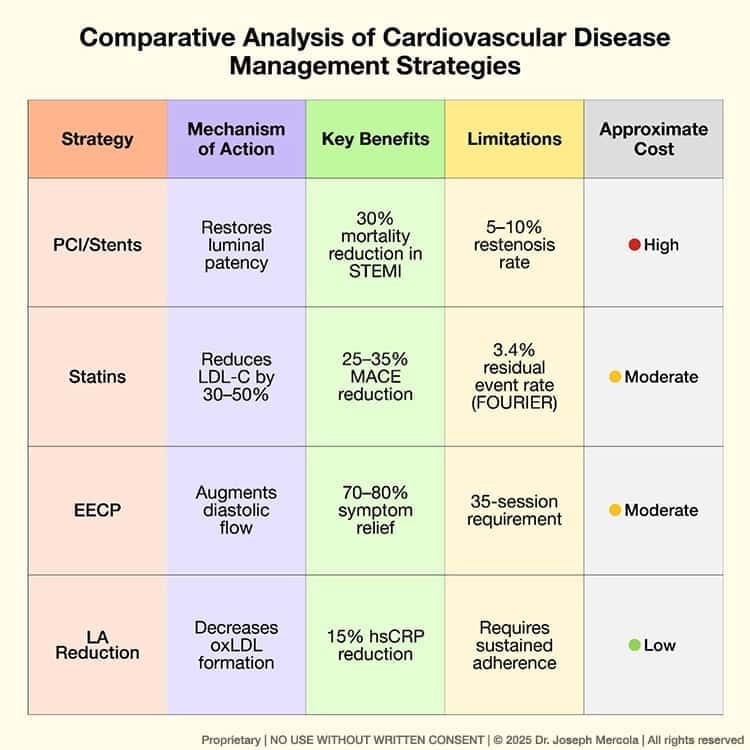
Table 1. Comparative analysis of contemporary CVD management modalities. A side-by-side appraisal shows that PCI and statins yield 30% and 25% to 35% reductions in their respective endpoints but carry high procedural costs or leave a 3.4% annual residual event rate. EECP relieves 70% to 80% of anginal symptoms yet requires 35 outpatient sessions. By contrast, sustained dietary LA reduction lowers oxLDL formation and hsCRP by ~15% at minimal cost, highlighting its favorable risk-benefit and economic profile within an integrative treatment framework.
Exploring Novel Methods That Address Heart Disease
With the issues of PCI and CABG now known to the public, scientists are exploring other approaches like chelation therapy and nanoparticle delivery systems to directly attack hardened, calcified plaques inside the arteries that go beyond symptom relief and reverse structural damage that fuels heart disease. Below, I’ll go over different interventions that I outline in my study:
•Intravenous ethylenediaminetetra-acetic acid (EDTA) chelation — EDTA is a compound that chelates minerals such as calcium, iron, and copper. However, the issue here is that EDTA does its task indiscriminately, making it an impractical choice since your body needs these nutrients to function properly.
Moreover, EDTA takes a long time for its benefits to appear. Prior research showed that it needs to circulate in your system for hours to provide a measurable benefit, and it needs to be repeated many times, too.
•Nanoparticle-facilitated chelation — Instead of sending EDTA through the bloodstream in a scattershot way, research shows that nanoparticles can be used to deliver EDTA (or other chelators) directly to plaque sites. In particular, this approach doesn’t need to be administered intravenously anymore. New formulations making use of liposomal vesicles can be taken orally, making it a convenient way for patients to receive treatment.
•Don’t rely on this new technology alone — While nanoliposomal chelation sounds promising, there are knowledge gaps regarding long-term safety, scalability, and biodegradability. Thus, more research is needed, and it shouldn’t be used as a crutch — a multifaceted approach (such as minimizing LA intake) will still yield the best results.
The Best “Go Paid” Deal on Substack! You Get REAL Stuff!!

Go paid at the $5 a month level, and we will send you both the PDF and e-Pub versions of Etienne’s new book: To See the Cage Is to Leave It - 25 Techniques the Few Use to Control the Many and a coupon code for 10% off anything in the https://artofliberty.org/store/.
Go paid at the $50 a year level, and we will send you a free paperback edition of Etienne’s new book: To See the Cage Is to Leave It - 25 Techniques the Few Use to Control the Many OR “Government” - The Biggest Scam in History… Exposed! OR a 64GB Liberator flash drive if you live in the US. If you are international, we will give you a $10 credit towards shipping if you agree to pay the remainder.
Support us at the $250 Founding Member Level and get a signed high-resolution hardcover of “Government” - The Biggest Scam in History... Exposed! + Liberator flash drive + a signed high-resolution hardcover of Etienne’s new book: To See the Cage Is to Leave It - 25 Techniques the Few Use to Control the Many + everything else in our “Everything Bundle” of the best in voluntaryist thought delivered domestically. International pays shipping. Our only option for signed copies besides catching Etienne @ an event.


