

Today WSJ dropped the “bombshell” report that Nordic leaders and other influential figures in the region have been secretly scrambling behind the scenes to avert a crisis with Russia:
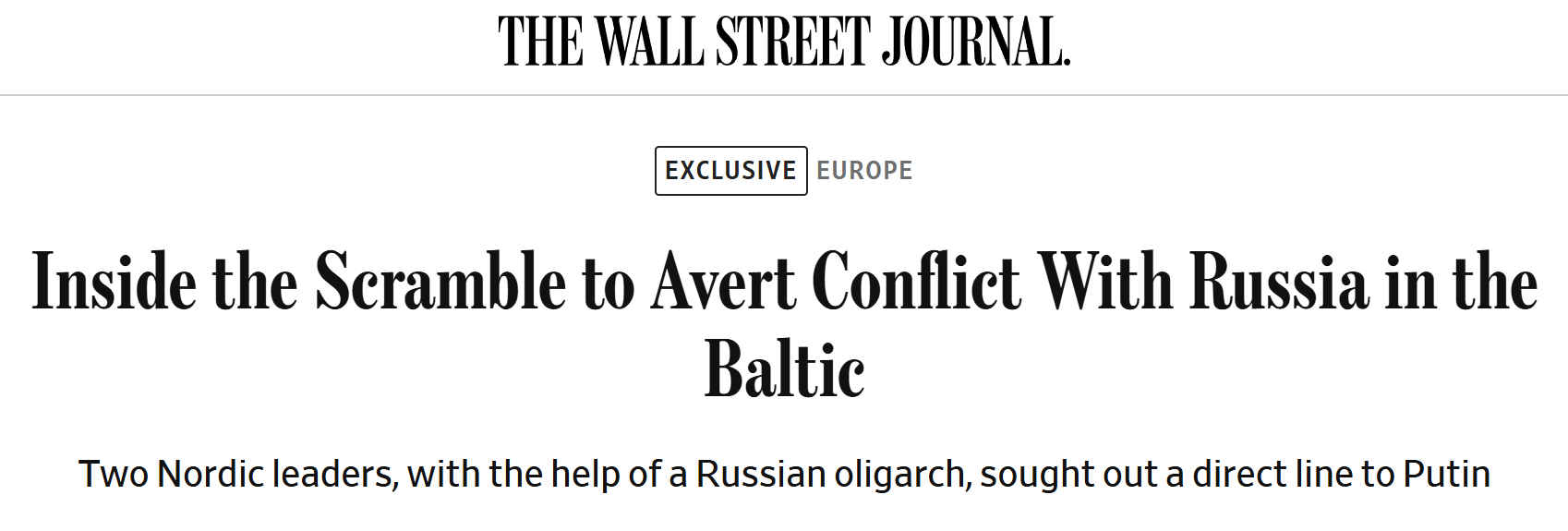
The thing which most alarmed these nations was the new Russian initiative to begin escorting its oil tankers through the Baltic Sea with nuclear missile-carrying warships, after new Russian legislation was signed in May which allowed military force to be used in protecting these vessels:
But in recent months, Western officials say, Moscow took an alarming series of steps that signaled deepening fears in Moscow about a potential blockade.
Russian warships carrying nuclear-capable missiles had been ordered to escort its oil tankers through the Baltic and prevent Western navies and coast guards from boarding them, according to Western officials and statements by Russian officials. In just over a year, the German coast guard registered 260 such escorts in the Baltic and the North Sea.
In May, Russia passed new legislation allowing for military force to be used to protect commercial vessels. Moscow had reinforced its exclave on the sea, Kaliningrad, with drones, powerful radars and electronic-warfare equipment, according to Western intelligence officials.
In August, Putin called European efforts to confront tankers “piracy and banditry” and vowed a military response. A month later, the Kremlin delivered an extraordinary written warning to NATO: Russia was prepared to launch pre-emptive nuclear strikes to defend its interests in the Baltic—even without an attack on Russian territory. The warning was earlier reported by Reuters.
The piece notes that after Russia’s initiative, the boarding and seizing of “shadow fleet tankers” had largely stopped, proving the success of the new military escort initiative:
One of the things contributing to rising tensions in the Baltic was interceptions of Russia’s shadow-fleet tankers, which Moscow uses to evade Western sanctions on its oil exports. Suspected Russian shadow-fleet tankers have been seized or boarded at least 14 times since late 2024, including 10 early this year, according to a tally of publicly reported incidents. But interdictions in the Baltic largely stopped earlier this year after Russia’s navy began confronting Western ships that were attempting to stop the tankers.
The article details one such confrontation, where a Russian warship warned off a group of German activist speedboats, which nearly caused a confrontation between the Russian warship and a nearby German coastguard vessel:
On June 30, when speedboats with the activists approached a shadow-fleet tanker—the Panama-flagged Kira K—a Russian warship apparently mistook them for coast guard boats that were planning to board the ship and raced to intervene.
“Here speaks Russian warship 531, stay away from the Kira K,” the Russian captain of the Soobrazitelny warned the German boats over an open maritime channel, according to a recording released by Greenpeace.
A nearby German coast guard vessel, the Bayreuth, raced to shield the activists from the warship. The German commander was able to defuse the situation by reassuring the Russian warship that the speedboats were civilian protesters and nobody was planning to board the shadow-fleet tanker.
The aggressors later complained of feeling “threatened” by the Russian warship’s presence:

Defending your property is a threatening act in the Ruse Based Ordure.
The article plays up Russia as the aggressor by recounting threats of nuclear strikes against anyone attempting to exploit Russia being tied up in Ukraine by blockading Kaliningrad:
“Any blockade of the Baltic or Kaliningrad could not be prevented by conventional means,” said Alexander Voloshin, Putin’s onetime chief of staff who now works in the private sector and occasionally assists the Kremlin’s diplomacy with the West. Since Russia’s forces are tied up in Ukraine, the Kremlin would have no choice but to respond with “immediate, pre-emptive nuclear strikes,” he said.
Such escalatory rhetoric apparently spooked the Nordic club, with Alexander Stubb immediately scrambling to send a message of de-escalation via direct line to the Kremlin to dispel Russian fears that a plan to blockade Kaliningrad was being hatched:
But Stubb feared the message wasn’t getting through, according to officials familiar with his thinking. They turned to a Russian oligarch with a direct line to the Kremlin. The man traveled to Norway for consultations with top officials before returning to Moscow to convey a message to Putin, these people said.
Days later, both leaders spoke to Putin, seeking to dispel his fears of a naval blockade.
Putin responded that some shadowy force was attempting to turn the Baltic region into another Strait of Hormuz:
Afterward, Putin publicly praised the two leaders but suggested that “someone” wanted to turn the Baltic into another Strait of Hormuz, where the U.S.-Iran war had temporarily disrupted oil shipments and sent energy prices soaring. “We don’t want that, but we will respond to any challenge,” Putin said.
Incidentally, the Black Sea has already surpassed Hormuz as the deadliest naval corridor in the world, mostly owing to Russia’s destruction of Ukrainian shipping along the Bulgarian and Romanian coasts:
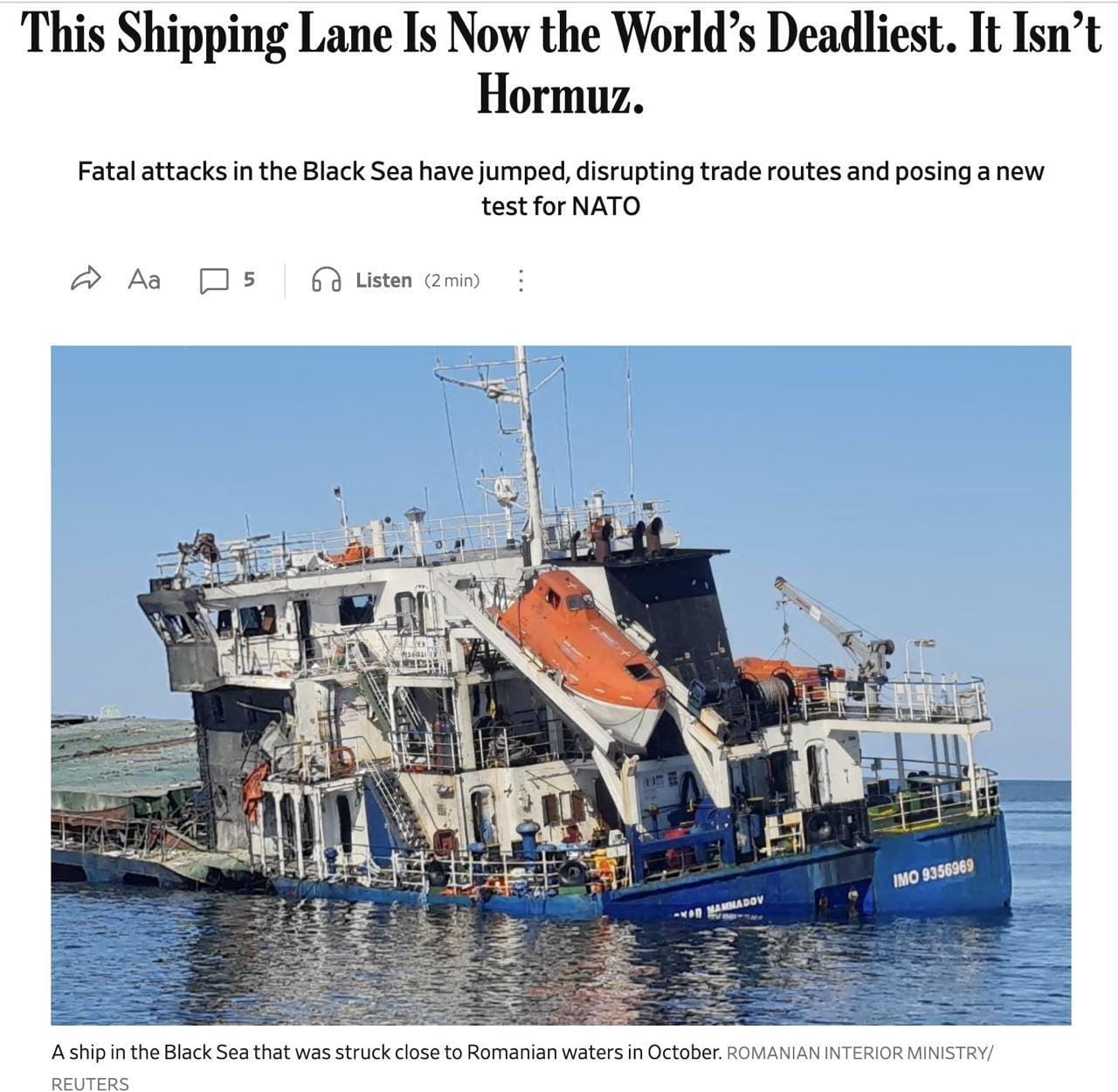
The deadliest body of water this year isn’t the Strait of Hormuz. A series of attacks in the Black Sea has killed more people than strikes on shipping so far in the war between Iran and the U.S., disrupting trade routes and turning up the heat on NATO.
This year, there have been over 300 attacks in the Black Sea, according to figures from maritime security company Ambrey. The strikes have killed more than 30 seafarers and left more than 20 others missing, according to the Turkish Shipowners’ Association, MarineTraffic reports and local authorities.
That compares with around 130 attacks in the Strait of Hormuz and the wider Middle East, in which 25 seafarers have died, since the U.S.-Iran conflict began at the end of February, according to the International Maritime Organization.
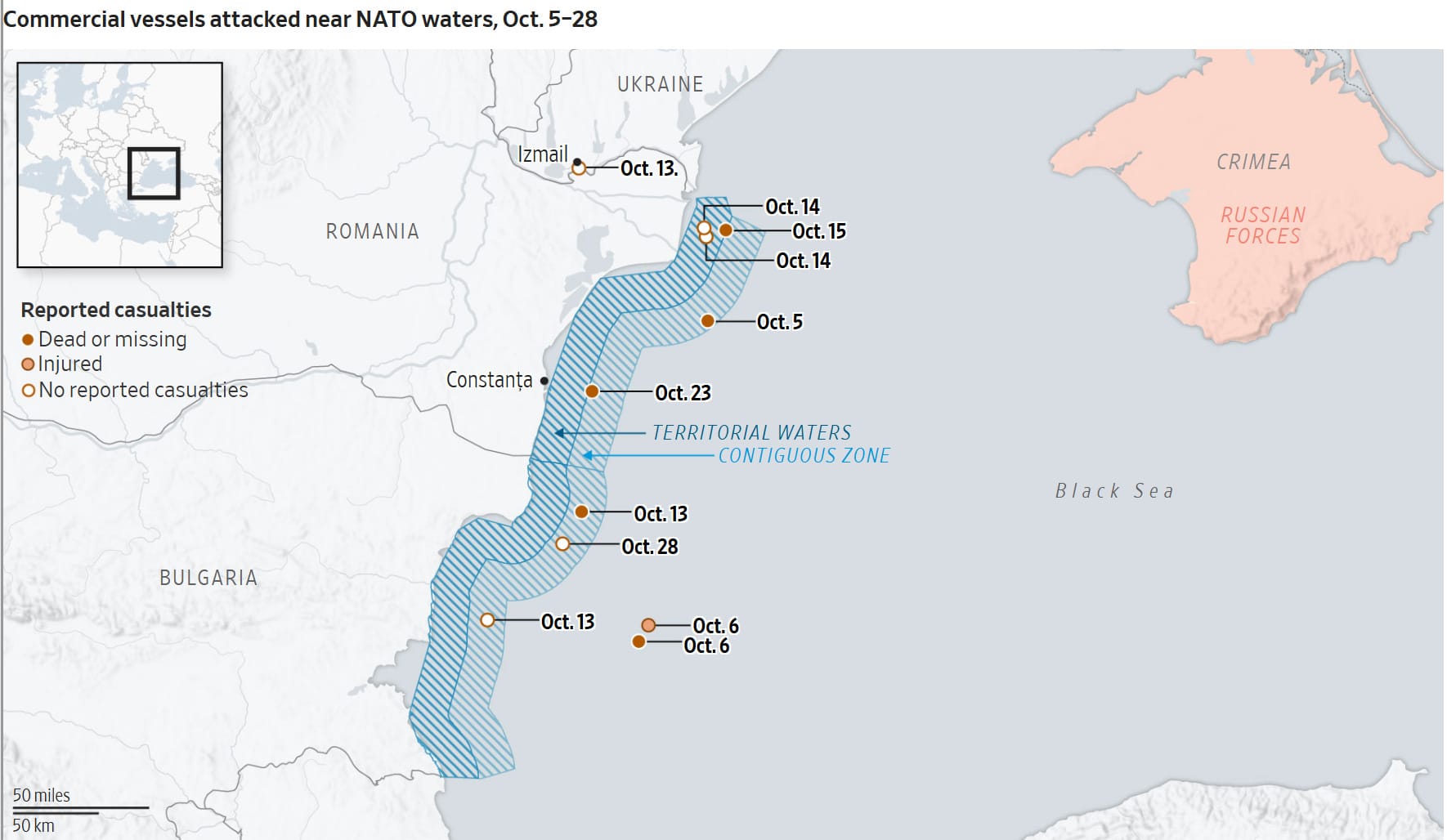
In October, almost half of the attacks on a dozen vessels off Romania and Bulgaria left seafarers either dead, missing or injured.
Russia has become more and more bold recently, even flying Su-34s—at least according to some reports—nearly up to the Odessa border to launch glide-bombs at various energy infrastructure-related targets:
During this attack on the substation in Artsyz, one of the Russian Su-34 aircraft flew dangerously close to the coast of Odesa Oblast, launching its glide-bombs at a distance of approximately 55 km from the coastline.
— AMK Mapping 🇳🇿 (@AMK_Mapping_) November 25, 2026
It seems Russia is either testing if there is any air… https://t.co/6HSfTy5fEw pic.twitter.com/SMJ9oXO1hW
For those wondering whether Russia is afraid of NATO, the article claims many of the ships were already struck inside of NATO members Bulgaria and Romania’s territorial waters:
🇷🇴 Another Ukraine-linked ship sunk off Romania
— DD Geopolitics (@DD_Geopolitics) October 23, 2026
The Comoros-flagged cargo ship Khoriv has sunk 24 km off the Romanian port of Constanța after a drone strike, just a few kilometers outside Romania's territorial waters. It was heading for Ukrainian ports on the Danube.
The ship… pic.twitter.com/7r0ohm3ax5
Just as ships in Hormuz try to evade Iranian strikes by skirting along the Omani coast, here the Ukrainian ships try to sneak along the coasts of Bulgaria and Romania in NATO territorial waters, but to no avail—according to these reports, they are still struck.
The latest on the situation, with annotations from Medvedev:
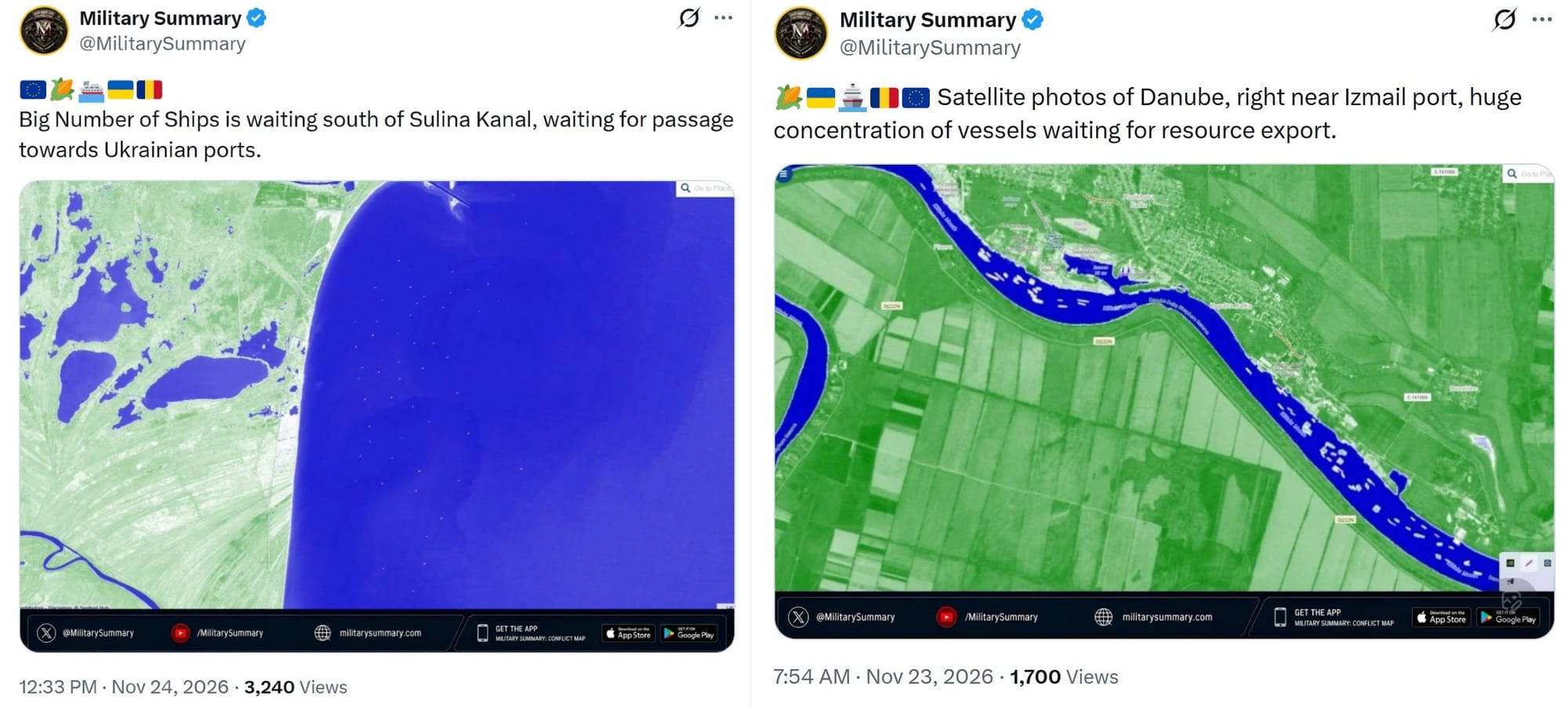
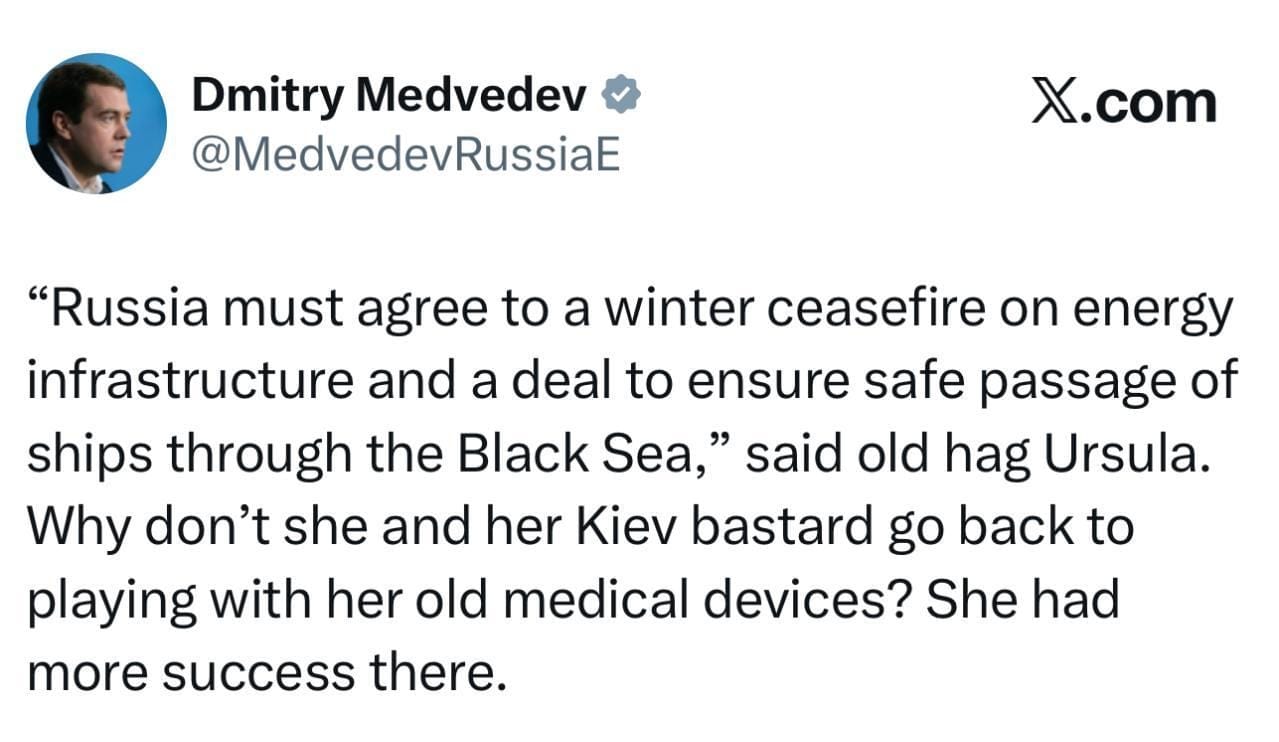
As proof of Alexander Stubb’s urgency to ease tensions, days ago when the Russian ship Sparta II was struck in the Gulf of Finland, it was Finland itself that sent rescue operations to help put out the fire and offer assistance to those on board. This greatly peeved Ukrainian supporters, who believed Finland should have ignored all international maritime norms and regulations and let the ship sink.
Several weeks ago, it was reported that Russia is building a giant new over-the-horizon radar system in Kaliningrad, which again is threateningly described by Western press as being on “NATO’s flank”:
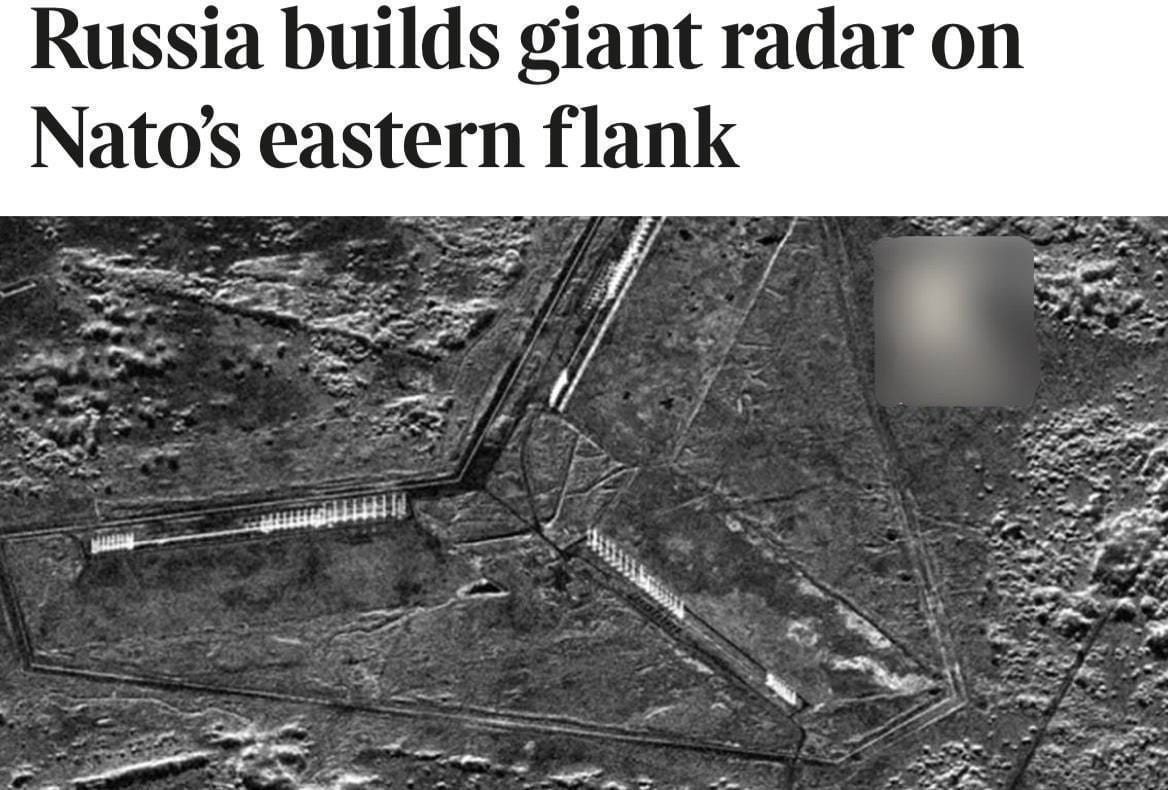
Russia is building a gigantic radar system in the heart of Nato’s eastern flank at Kaliningrad, its semi-exclave on the Baltic Sea, according to satellite images.
The complex at Gvardeysk, about 20 miles from the Polish border and 40 miles from Lithuania, consists of three radiating arms of antenna masts, each roughly 500 metres long.
The purpose includes being able to detect stealth aircraft at great distances:
The structures appear to be part of an over-the-horizon (OTH) radar that could theoretically detect missiles, warships and aircraft at distances of between 550 and 2,000 miles, depending on its specifications — comfortably enough to cover Britain and the rest of Europe’s northern and western periphery.
An OTH radar on the scale seen at Gvardeysk could generate wavelengths of more than 10 metres, tens of times longer than standard long-range air surveillance radar. These are bounced off the upper atmosphere at high frequency to detect objects beyond line-of-sight, including stealth aircraft.
Getting back to the original Baltic Sea piece, it is worth noting as a concluding point that the “journalists” use the tried-and-true tactic of portraying Russia in a negative light as the aggressor in failing to impartially contextualize the situation by explaining why Russia may need to escort its oil tankers to begin with.
That Russian “shadow fleet” tankers are actually doing nothing illegal and are well within their rights to travel international sea routes is an inconvenient and uncomfortable fact for these publications. Just because the ships are kicked out of the Lloyd’s of London insurance crime syndicate does not make them “illegal”, particularly given the fact that they are alternatively insured by Russian companies.
But it would blow the slant of the MSM’s agenda to properly cover the circumstances, and so they intentionally commit deception by leaving things “vague” so that their oblivious and uninformed readership can simply be made to assume that these Russian “shadow fleet” ships are doing something illegal and that the West is justified in trying to stop them. This by extension implies that the Russian warships protecting their state assets are the “bad guys”. If the situation was properly spelled out by the agenda-grinding establishment minions, it would be clear for all to see who the true hostiles really are; but clarity is, as ever, the last thing they want or need.
They will always find a way to churn up the needed fear and panic:
Lastly, on the topic of Russian strikes along the Black Sea corridor, Russia has been increasingly using the new Banderol S8000 missile, with its new successor the Dan-T which can be fired from Mi-28NM helicopters. This marks the first time in history a helicopter from any nation is able to fire long-range turbo-jet cruise missiles, and new Mi-28s are rolling off the production line with this capability, giving Russia a growing ability to launch such strikes against Ukraine’s Odessa region from the Black Sea.
Here is a new video from Solovyov showcasing this in detail for the first time:
This trend has particular importance because many worried that Ukraine was attriting Russian strategic aviation in the form of Tu-95s during the course of this war. They feared this would one day take away Russia’s ability to even launch cruise missiles, but Russia has now developed a whole host of new systems that are able to be launched from both ground modules as well as helicopters and fighter jets. This has vastly expanded not only Russia’s ability to launch cruise missiles at all ranges, but the necessary element of surprise, as well, given that small ground launch systems and helicopters are far less trackable than huge strategic aviation. This gives Russia the ability to launch cruise missile strikes at the spur of the moment with little of the usual forewarning Ukraine has been used to receiving.
Another such new one is called the Filin and is launched from a simple ground launcher:
New Russian cruise missile: Filin
— Dmytro Putiata (@kriegsforscherD) November 1, 2026
Available in two configurations:
- 50 kg warhead, 1,200 km range;
- 100 kg warhead, 700 km range.
Maximum flight speed is 800 km/h, with a maximum flight time of 90 minutes. Maximum flight altitude is 6 km. Accuracy is around +- 10 m.
The… pic.twitter.com/AUU9rkiqSs
Russia is betting heavily on cheap cruise missiles launched from ground platforms, which broadens their possible uses and significantly saves the flight-hour resources of their combat aircraft.
In fact, the West is so worried about this recent spate of Russian cheap cruise missile tech that RUSI wrote an entire piece on how Russia has “leapt ahead” of Ukraine in the race for cheap fast missiles which can’t be shot down:
Experts fear the production of these missiles is exploding at an exponential rate beyond the capability of Ukrainian allies to produce enough air defense systems to stop them:
Russia plans to produce approximately 4,200 of these cheap cruise missiles in 2026 but plans to expand production to 30,000 next year. One of the determinants of how the war will unfold in 2027 is whether Ukraine's supporters can produce or fund production of enough missiles and… https://t.co/2HITPJJGIP
— Rob Lee (@RALee85) November 25, 2026
Russia plans to produce approximately 4,200 of these cheap cruise missiles in 2026 but plans to expand production to 30,000 next year. One of the determinants of how the war will unfold in 2027 is whether Ukraine's supporters can produce or fund production of enough missiles and interceptors to handle the growing quantities of these missiles.
As I theorized before, Russia has been slowed on the battlefield, so it has pivoted to mass production of long-range strike systems to disable Ukraine as a state while it works out solutions for the ground portion of the war. No one knows if the idea will prevail, but one thing is certain: Ukrainian infrastructure will pay a heavy toll next year.


