

Etienne Note: This article is being syndicated as part of a recurring column in our weekly newsletter Five Meme Friday: libertarian Intentional Community Roundup where we cover libertarian and voluntaryist intentional communities and free private cities including Prospera (Honduras), The Free State Project (New Hampshire), Liberstad (Norway), Montelibero (Montenegro), Los Propietarios, (Argentina), Liberland (Croatia/Serbia border), Network States in general and Sea Steading (The Oceans). I am also covering secession movements including Greater Idaho, Please send details of any new happenings, projects or projects I am missing!
How Much Does It Cost to Raise a Child Across the U.S.?
Raising a child to age 18 costs an estimated $303,418 nationwide, but the total can vary by more than $210,000 depending on where a family lives.
Much of that difference comes down to housing, transportation, and childcare expenses, which can significantly affect the cost of raising a child from one state to another.
This visualization uses a 2026 study from LendingTree to compare the projected cost of raising a child across all 50 states and Washington, D.C.
The Most and Least Expensive States to Raise a Child
Hawaii is the most expensive state by a considerable margin, with an estimated 18-year cost of $412,661. That’s nearly $48,000 more than second-place Alaska ($365,047) and over $86,000 more than Maryland ($326,360), which ranks third.
California and New Jersey round out the top five, both at approximately $312,000.
Perhaps the biggest surprise is Kansas, which ranks sixth at $303,250. Despite its reputation for affordability, the state has a higher projected child-rearing cost than New York, Massachusetts, and Washington.
The table below shows the estimated cost of raising a child to age 18 in every state and Washington, D.C.
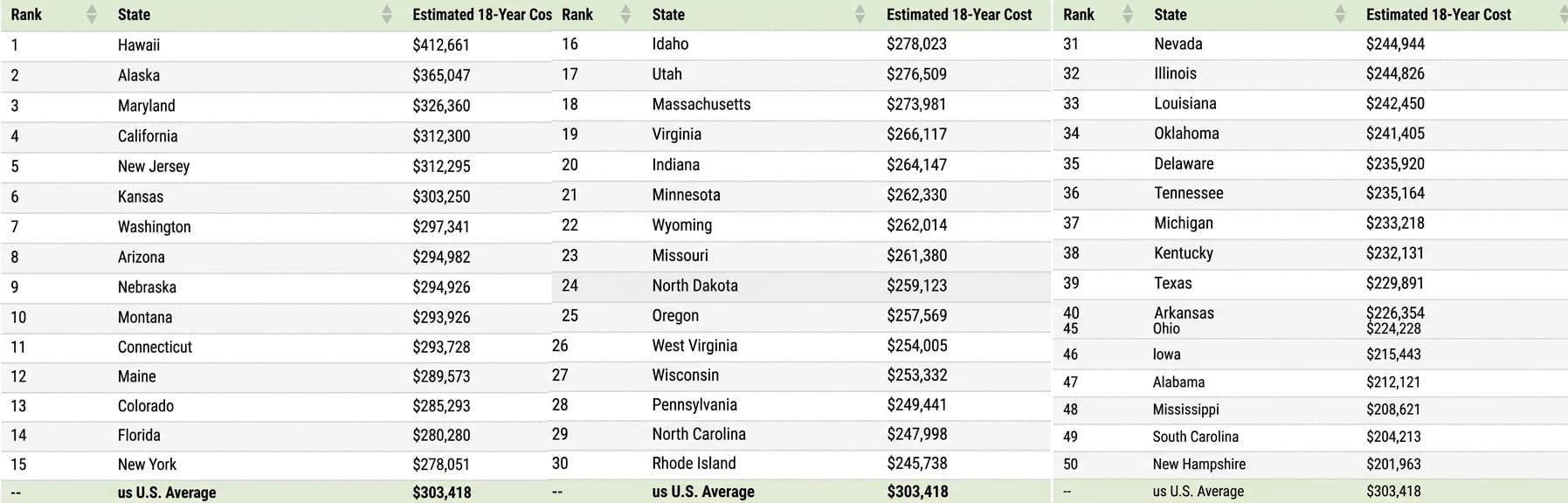
At the other end of the ranking, New Hampshire has the lowest projected cost at $201,963, followed by Washington, D.C. ($202,115) and South Carolina ($204,213).
Costs also vary considerably within states. San Francisco, for example, has an estimated annual child-rearing cost of $43,171, the highest among 48 major metropolitan areas in our ranking of the most expensive U.S. cities to raise a child.
LendingTree’s estimates include additional expenses associated with having a child, such as food, rent, daycare, clothing, transportation, and health insurance premiums. The calculations account for state tax exemptions and credits but exclude the federal child tax credit and college expenses.
Why Is Raising a Child So Expensive in Alaska?
Alaska ranks as the second-most expensive state to raise a child, but childcare isn’t the main reason.
According to LendingTree, Alaska has the highest additional rent and transportation expenses associated with raising a child. These costs help push its projected 18-year total to $365,047.
Interestingly, annual infant daycare costs approximately $12,100 in Alaska, well below the national figure of roughly $17,000.
The First Five Years Are the Most Expensive
The first five years of raising a child can cost more than twice as much per year as the years that follow.
According to LendingTree, families spend an estimated $29,325 annually during a child’s first five years, compared with roughly $12,000 per year during the remaining years through age 18.
Daycare is a major reason for the difference. Infant daycare costs approximately $17,000 annually across the U.S., while childcare expenses generally decline once children enter school.
Although the projected 18-year cost rose 1.9% to $303,418 nationwide, average annual expenses during the first five years fell 0.3% from the previous report, largely due to a slight decline in daycare costs.
The study’s estimates are based on a married, two-earner household with one child earning the national median family income. They primarily use 2024 cost data, and projected expenses are not adjusted for future inflation.
How Do U.S. Childcare Costs Compare Globally?
Childcare costs consume a larger share of earnings in the U.S. than the OECD average.
According to the OECD, childcare for a two-earner family with two young children cost approximately 20% of average earnings in the U.S., compared with 14% across OECD countries, based on 2021 data.
Countries such as Germany, Sweden, and Norway generally have lower out-of-pocket childcare costs, reflecting differences in government subsidies and public funding.


