

Building Freedom in the Cracks of the State A Canadian tax refugee is betting that like-minded neighbors, Bitcoin, and blockchain-voted HOAs can deliver in Latin America, today, much of what free private cities are still fighting for on paper.
Etienne Note: This is an expanded chapter from my upcoming book: Voluntaryism - How the Only “ISM” Fair for Everyone Leads to Harmony, Prosperity and Good Karma for All. The book includes a section that breaks down the most exciting libertarian and voluntaryist enclaves, where freedom-minded individuals vote with their feet by moving to jurisdictions with less government, more freedom, stronger private property protections, and extraordinary liberty-minded individuals. In addition to Veritas Villages, I am covering: Prospera (negotiated sovereignty and governance as a service), The Free State Project in New Hampshire, Cheran (The Mexican town that kicked out the Mexican federal “government” and cartels), Liberstad (Southern Norway), Montelibero (Montenegro, Europe), Liberland (Serbia/Croatia border), Los Propietarios, (Argentina), Network States in general and Seasteading among others.
Patrick Hiebert figures that when he lived in Canada, he worked for the government until about October every year. Add up the income tax, the GST, the PST and the carbon levies, and by his own math roughly 70% of what he earned went to the state. So he left. Two decades and many residential developments later, he runs Autris, a small publicly traded company (OTC: AUTR) headquartered in Panama City, and its flagship product: Veritas Villages, a growing network of freedom-oriented communities in Panama, Costa Rica and Nicaragua.
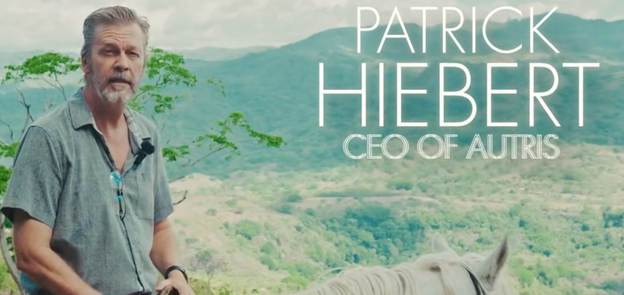
I learned about Hiebert from watching the 2026 Free Private Cities conference and followed up with an interview for my upcoming book, Voluntaryism: How the Only “ISM” Fair for Everyone Leads to Harmony, Prosperity and Good Karma for All and our weekly feature libertarian intentional community roundup in our Five Meme Friday newsletter. Asked whether “libertarian intentional community” describes what he builds, he didn’t hesitate: “I think that’s a pretty good nomenclature for what we do.”
Veritas Villages is not Próspera. It has no charter city, no special legal jurisdiction and no 50-year stability agreement. Its approach is more modest, and more immediately replicable: find countries whose existing governance already gives you most of what you want, buy land, gather people who think alike, and govern the rest by contract.
“Lots of these countries have some pretty good governance. I’d say sometimes 80 to 85% of what we’d want to ask for anyway.” — Patrick Hiebert
Who’s Behind It
Arnold Patrick Hiebert co-founded the Autris Group with his son, Spencer. In 2025 Mikkel Thorup, the well-known expat and offshore consultant, bought a 5% stake in Autris from Hiebert and joined its board. The company is small but growing fast by its own reporting: for the fiscal year ended June 30, 2025, Autris reported revenue of about $1.18 million (up 383%), gross assets of about $44.4 million, and more than $32 million in acquisitions. It says it intends to raise up to $30 million to buy more land and more Bitcoin and to move up to a major exchange.
Those numbers come from company press releases, which are written to sell. Readers who are considering buying a home, or the stock, should do their own due diligence.
The Four Villages
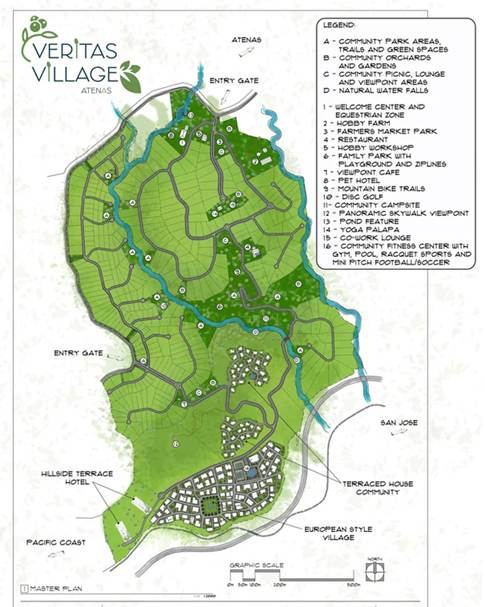
The Master Plan for Atenas
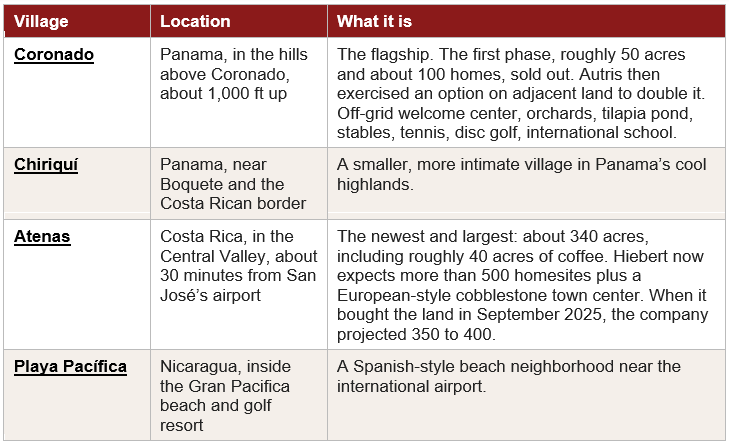



Homes range from a 402-square-foot studio to a 3,400-square-foot, four-bedroom model. Owning a home in any village makes you a member of the Veritas Village Club, which gives you use of the amenities in every other village. Hiebert treats this as a political hedge as much as a perk: “I don’t know what Panama’s gonna be like in 20 years.” If one host country turns hostile, members already have a foothold in the others.
F.I.R.S.T. Principles and the One Rule
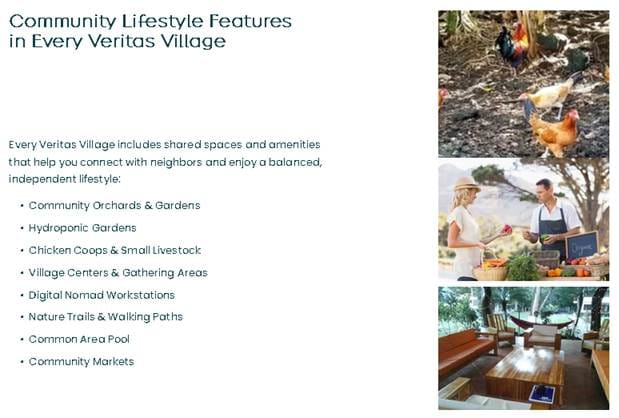
The communities are organized around what Hiebert calls the F.I.R.S.T. philosophy: Freedom, Independence, Resilience, Sustainability and Transparency. In practice, that means off-grid-capable infrastructure (solar, natural water, waste treatment, community food production) and a culture where, in Hiebert’s words, people “can agree to disagree.”
He says the buyers come from everywhere. On one recent day at Coronado, ten prospective couples came from Italy, Germany, France, the Netherlands, the UK, Canada, the US and Australia. What they share is not a party but a diagnosis: the West is sliding toward authoritarianism, while much of Latin America is moving the other way. “People further on either spectrum, far left or far right, are probably not going to find our communities interesting,” he says.
There are very few rules, but one is unusual. Every commercial business inside a Veritas Village must accept Bitcoin, along with whatever other currencies it chooses. “I’m a big believer in financial freedom, and I’m not a big believer in fiat currencies,” Hiebert says. Autris keeps Bitcoin in its own treasury and runs a solar-powered Bitcoin miner at Coronado.
Firing the HOA President
Anyone who has lived in an American subdivision knows the homeowners association is often the closest thing to a petty state most people deal with directly. Hiebert’s fix is the most interesting governance experiment in the project: there is no HOA president and no committee. Residents decide HOA matters through a DAO, a blockchain-based voting system, using quadratic voting.
Each homeowner receives 100 tokens a year. A single vote on an issue costs one token, but the price rises with the square of the number of votes: two votes cost four tokens, three cost nine. That lets residents show how strongly they care, not just which side they’re on, and it stops one passionate faction from dominating every decision.
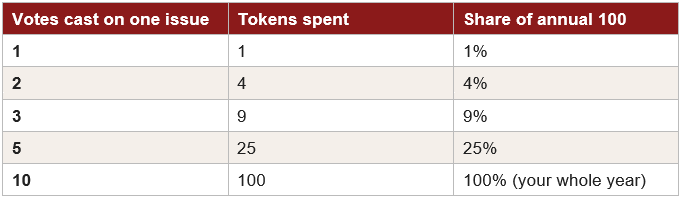
A die-hard tennis player can spend heavily on a third court. A late sleeper can spend a few tokens on banning roosters. Someone who doesn’t care keeps their tokens for something that matters to them. “If you lose the vote, at least you know that your relatively like-minded neighbors feel differently, and you can’t blame it on one person or one committee,” Hiebert says.
From a voluntaryist point of view, this is the part worth studying. It is governance by contract among people who chose to be there, with transparent rules and no permanent ruling class, even a small one.
A Mortgage That Pays You
Autris recently introduced vendor-financed Bitcoin mortgages. According to Hiebert, buyers who pay in Bitcoin don’t pay interest. Instead, the company pays them 1.9%. His reasoning: fiat lenders charge interest partly to cover the lost purchasing power of the currency they’re repaid in. If you believe Bitcoin doesn’t lose purchasing power, you can afford to pay the borrower. “As far as I know, we’re the only residential community developer that offers negative interest rates,” he says.
It’s a clever piece of monetary theory put into practice, and also a bet. In effect, the developer is betting Bitcoin will appreciate. Buyers should understand exactly what their loan is denominated in. If the debt is denominated in Bitcoin and Bitcoin rises, the loan costs more in dollar terms. If it’s denominated in dollars and paid in Bitcoin, the risk is reversed. Read the contract.
The Tax Picture: Territorial, Not Zero
All three host countries use territorial taxation: they tax income earned inside the country and generally leave foreign-source income alone. A Costa Rica resident who designs buildings for US clients may owe nothing locally on that income. A corner store selling to locals pays the normal tiered rates. Hiebert is careful to say he isn’t a tax lawyer.
There is a major exception for American readers. The United States is one of only two countries, with Eritrea, that tax citizens on their worldwide income wherever they live. Moving to Panama does not end your relationship with the IRS. The Foreign Earned Income Exclusion and foreign tax credits soften the blow, but the 0% figure applies to Canadians, Europeans and Australians in a way it doesn't apply to U.S. passport holders.
And territorial taxation is a policy, not a promise. “I hope they don’t change it and get greedy,” Hiebert says. That is the core vulnerability of the whole model: host governments grant the freedom, so they can take it back.
Why Not Próspera?
I asked whether Autris would build inside Próspera, the Honduran ZEDE whose charter-city governance is the gold standard of the free private city movement. Hiebert admires it (“I envy Próspera’s governance”) and works with Tipolis, the free-private-city consultancy that helped design Próspera’s governance, on the governance within his own villages. His objection is economic, not philosophical. Próspera’s early investors need land prices high enough to earn back their money, and those prices are above what Autris could resell homes for. “We’d be losing money on every home.”
He also points to Honduras’s instability. The country repealed the ZEDE law in 2022, and Próspera spent years fighting to survive a hostile government despite its supposedly ironclad 50-year agreement. As Hiebert put it, they “almost found out a couple of years ago that that didn’t matter.”
Proof of Concept as Strategy
The most strategically important thing Hiebert told me may be this. He travels with the Tipolis team to meet heads of government and propose self-governed zones, or free cities. (“I don’t use sovereign because the governments hate that word.”) The answer is always the same: show us where you’ve done one.
Veritas Villages is that proof. At a recent dinner, a Panamanian minister asked him how Coronado had sold out while neighboring developments sold “one home to their sister and one to their dentist.” Hiebert’s answer was the philosophy itself. The people moving in are bringing businesses with them, including a violin maker and a Canadian snowmobile-parts manufacturer potentially relocating their businesses to the land of the canal and no snow. Now, he says, officials are asking what else they can do to help.
That is the incremental path: show results first, then ask for more autonomy. It is slower than a charter and less philosophically satisfying, but it may be more durable because it gives governments evidence that freer arrangements benefit them, too.
The Voluntaryist Scorecard
Veritas Villages is not a stateless society, and it doesn’t claim to be. Here is our assessment of where it advances voluntaryism and where it falls short.
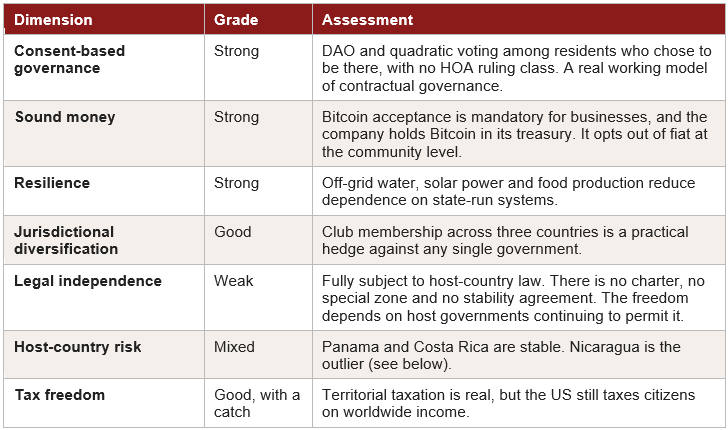
A word on Nicaragua. Hiebert praises Daniel Ortega’s hands-off COVID stance (“I’m not your father, you’re not children”) and calls Nicaragua “the most capitalist socialist country I’ve ever been in.” That may describe daily life for expats. But the Ortega-Murillo government has expelled hundreds of political opponents and stripped them of citizenship, shut down thousands of NGOs, and seized property from critics, including the Jesuit-run Central American University in 2023. A government that confiscates property from people who displease it is the opposite of a safe home for freedom-minded investors. Leaving people alone during a pandemic is one thing. Respecting property rights is another.
The Bottom Line
Free private cities are the cathedral of the movement: ambitious, legally innovative, and slow to build. Veritas Villages is the parish church. It already stands, is already full, and is built from what is available today. It doesn’t abolish the state. It routes around the worst of it, picks the friendliest jurisdictions it can find, and uses contract, cryptography and sound money to govern what the state leaves alone.
For readers who want out of an increasingly authoritarian West now rather than in twenty years, it is one of the more serious options available. For the movement, its greatest value may be as the working example that persuades the next government to sign a charter.
Disclosure: This article is not investment, tax or legal advice. Financial figures are drawn from Autris press releases and have not been independently audited by Voluntaryist.News.
About the Author
Etienne de la Boetie2 is the founder of the Art of Liberty Foundation, and the editor of Voluntaryist.News, our daily survey of the best of the alternative media from a voluntaryist perspective, and Five Meme Friday, which delivers hard-hitting voluntaryist memes and the best of the alternative media. He is an internationally recognized expert and speaker on voluntaryism and government illegitimacy, criminality and corruption. His original writings and research can be found at ArtOfLiberty.Foundation
He is the author of multiple books exposing the illegitimacy and criminality of government, including:
- The Greatest Theft in Human History – How the Banks and “Government” Will Steal at Least $1.40 MILLION from the Typical Worker… “Legally” – which exposes the theft of inflation from fractional reserve banking and the real cost of confiscatory taxation and Social Security underpayment from government CPI manipulation.
- To See the Cage is to Leave It – 25 Techniques the Few Use to Control the Many – An expose of a variety of unethically manipulative techniques the organized crime “government” is using on the population in their mandatory schools, affiliated scouting programs, and through propaganda secretly inserted into films and television shows to trick the population into a system that will steal 58% of their lifetime earnings.
- “Government” – The Biggest Scam in History… Exposed! – How Intergenerational Organized Crime Runs the”Government,” Media and Academia- which breaks down how inter-generational organized crime centered around banking and central banking is robbing and controlling the population using the technique of “government” with puppet politicians and monopoly media/academia.


