

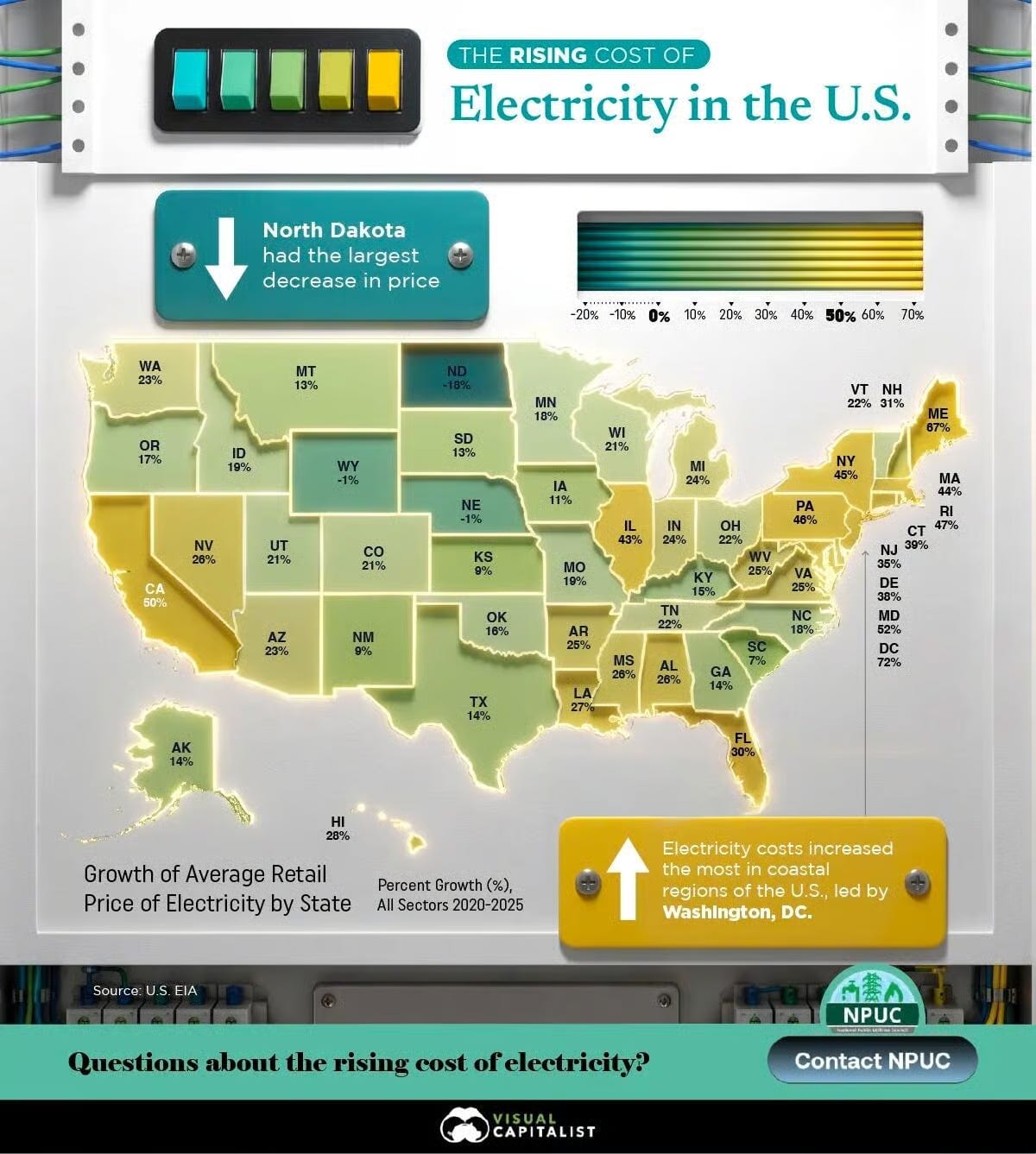
Washington, D.C. had the largest increase in average retail electricity prices, rising 72% across all sectors from 2020 to 2025.
Etienne Note: As the organized crime banks and “government” steal the value out of the money, it takes more dollars to purchase every input of electricity, from labor to coal to wire, that is getting passed on to the consumer. See our expose: THE GREATEST THEFT IN HUMAN HISTORY! How the Banks and “Government” Will Steal At Least $1.40 Million From The Typical American Worker... “Legally” for details. In electricity, the organized crime “government” makes things worse with government-owned monopolies OR where they grant a private company (or co-op) a geographical monopoly for a service area, restricting competition. The overwhelming majority of U.S. utility service is provided through either a government-owned utility or a geographically protected monopoly. For electricity, the numbers are especially clear. In 2024, publicly owned electric utilities were about 59% of all electric utilities by number!
By Cody Good, Visual Capitalist
Across the U.S., Americans are paying roughly 30% more for electricity than in 2020.
This graphic, in partnership with the National Public Utilities Council, uses data from the U.S. Energy Information Administration to show the change in average retail electricity prices by state across all sectors from 2020 to 2025.
Where Electricity Prices Rose the Most
Washington, DC saw the largest increase in the country, with average retail electricity prices rising 72% between 2020 and 2025. Maine followed closely at 67%, while Maryland and California rose 52% and 50%, respectively.
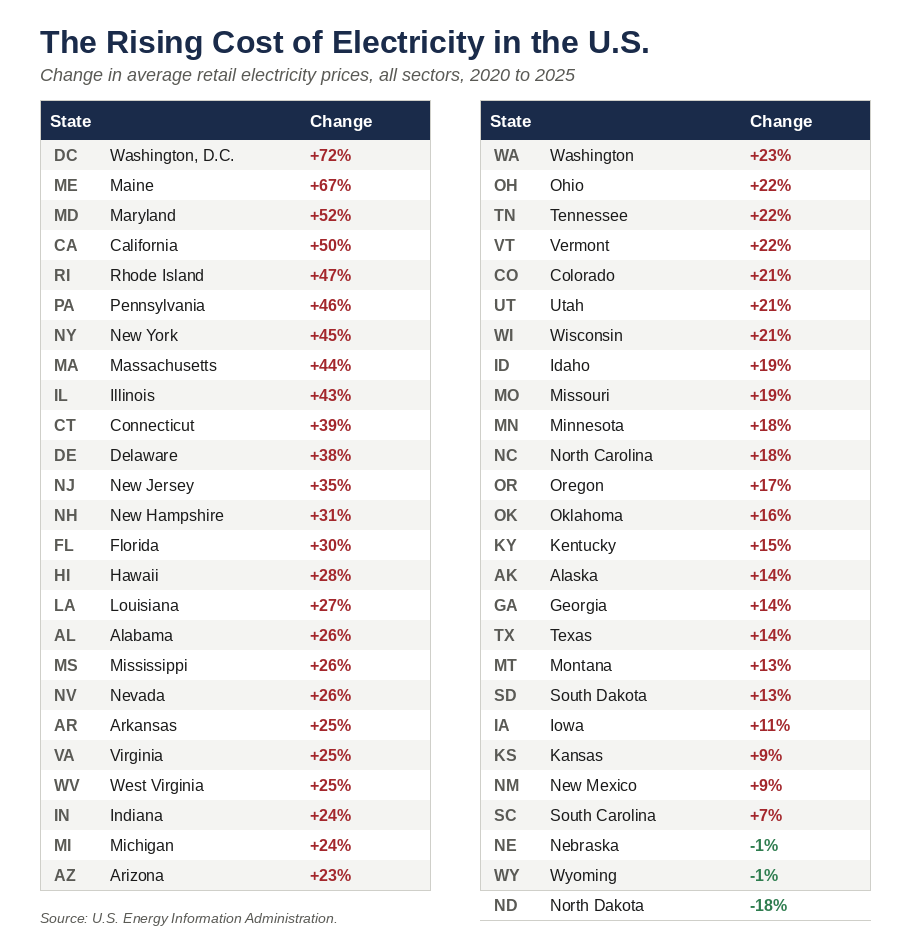
Data shows percent growth in average retail electricity prices across all sectors from 2020 to 2025.
Many of the largest increases were concentrated in coastal and Northeastern markets, where retail electricity prices have climbed sharply since 2020.
The U.S. Interior Tells a Different Story
While most states saw higher electricity prices, a few moved in the opposite direction. North Dakota had the largest decrease, with average retail electricity prices falling 18% from 2020 to 2025.
Nebraska and Wyoming also posted slight declines, each falling 1%.
This contrast shows how electricity costs can vary widely across the country depending on regional generation mixes, fuel costs, grid needs, regulations, and local market conditions.
The Bigger Impact of Rising Electricity Costs
Electricity prices rose across most of the U.S. from 2020 to 2025, but the increases were uneven. This matters because electricity is a core cost for households, businesses, and local economies.
As demand grows from data centers, electrification, and grid upgrades, affordability will remain a key challenge across the U.S.


