

The power grid relies on thousands of aging, hand-built transformers. If enough fail, the blackout could last years.
Etienne Note: The New York Times just explained in detail how to take down the power grid….
By Christopher Cox, The New York Times Magazine
The snipers had been shooting for nearly 10 minutes before someone called 911. A man driving down the highway told the police he thought he heard fireworks as he passed Pacific Gas and Electric’s Metcalf electrical substation, 15 miles southeast of San Jose. An engineer at a nearby power plant said he thought it was gunfire. Maybe more calls would have come in, but the communication link between the substation and PG&E, along with several phone and internet cables, had been severed. It was April 16, 2013.
The shooters — two, maybe more — took up positions 30 to 40 yards outside the substation fence, in the dry scrubland near Coyote Creek. At 1:31 a.m., after a security camera recorded what looked like a signal from a flashlight, they began firing high-powered rifles into the facility. Sparks flew into the air whenever the bullets grazed the chain-link fence, but most of the shots hit their apparent targets: a row of truck-size power transformers, which step down high-voltage electricity to lower voltages so it can be sent to local homes and businesses. Because this was Silicon Valley, those customers included some of the largest tech companies in the world.
After some 120 shots, 17 of Metcalf’s transformers had been disabled. The attackers knew to aim for the units’ cooling systems, oil-filled fins similar to those on a radiator, which draw heat away from the electrified core. That allowed the oil, 52,000 gallons of it, to drain out slowly so that the transformers wouldn’t fail right away, which would have triggered an alarm. The gunmen could take their time.
At 1:50 a.m., there was another flicker from a flashlight, and the shooting stopped. One minute later, the police arrived at the substation, but by then, the shooters were gone. The police looked around and, finding nothing suspicious, left as well. It wasn’t until a utility worker arrived at 3:15 a.m. that the extent of the damage was clear.
The president of PG&E called in the Federal Energy Regulatory Commission (FERC), which is responsible for ensuring the reliability of the bulk power system — that is, the grid. Though the company had avoided a blackout because power was rerouted quickly, the attack seemed intended to put large portions of the Bay Area in the dark.
Jon Wellinghoff, then the chairman of FERC, flew out to Metcalf a few days later. Wellinghoff has close-cropped salt-and-pepper hair and the no-nonsense sternness of a technocrat, softened slightly by the Western cadences of his speech, the product of a childhood spent in California and Nevada. He remembers entering a trailer at the substation where two F.B.I. agents and a handful of security people from the utility had gathered. “We asked them what happened,” Wellinghoff told me, “and they said: ‘Well, we think a couple of guys just came in and kind of shot up these transformers. We think it may be a disgruntled employee, but really we don’t know.’” Investigators found no fingerprints on the shell casings, no tracks in the dust.
Wellinghoff had brought another FERC official and two infrastructure experts from the Joint Warfare Analysis Center in Dahlgren, Va., with him, and the four men decided to explore the site of the attack themselves. They found little pyramids of stones outside the fence, which they took to be the snipers’ positions. “We went back inside the trailer, and I turned to my two guys. I said, ‘What do you think happened?’” Their answer, Wellinghoff recalled, was chilling: “‘Somebody put together a very carefully planned and very precisely executed attack on the substation. We don’t know who they are, but they were very highly trained.’”
They knew which cables to cut. They knew which part of the transformers to hit. And “they knew exactly when the police were coming,” Wellinghoff said. “They knew exactly when to stop, and they got away completely clean.”
Weighing on Wellinghoff’s mind was an analysis he had commissioned just a few months earlier, which identified a potential weak point in our power system, one that looked very much like the crime scene he was now investigating. Electrical engineers had long assumed that the patchwork nature of the grid would protect it from failure. More than a century ago, industrialists replaced a pointillist model of supplying power — coal-fired plants serving individual factories and neighborhoods — with a highly centralized system of massive generators linked by long-distance transmission lines. Customers would now receive electrons rather than coal hoppers in their backyards, a shift that allowed for rapid electrification from coast to coast: In 1908, around 10 percent of American households had electricity; by 1949, 90 percent did.
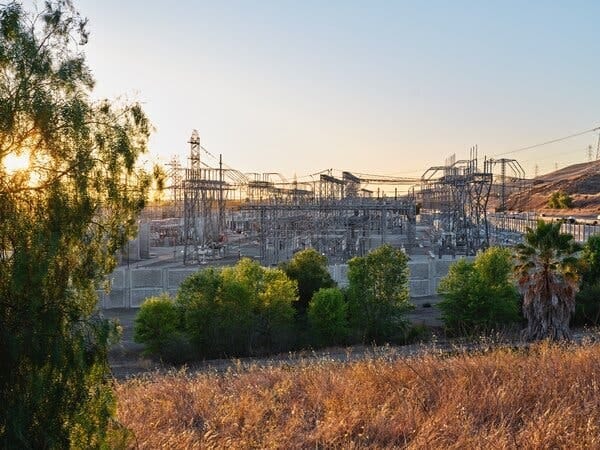
The grid is perhaps the most complex machine ever built, but it was created without a master plan and made subject to the distortions of greed and local orneriness like every other big project in the United States. As a result, we have not one grid but three: the Western, Eastern and Texas Interconnections. Within each area, thousands of utilities generate and distribute power, and the flow is managed by one of 101 regional balancing authorities across the United States.
FERC conducted a power flow analysis, which modeled the cascading effects of knocking out the most critical substations in each interconnection, ones where multiple high-voltage lines came together. “We came up with some very astounding numbers,” Wellinghoff said. “If you knock out nine total substations among those three grids, you can black out the entire United States.”
According to Wellinghoff, which nine substations were taken offline didn’t matter as long as each one was among the 10 most important in its region, and you could black out the three interconnections individually as well: “I mean, it’s not like there are particular substations. You just have to figure out what are the top 10 critical ones in each of those interconnects. Which, to do that, it’s probably something that a bunch of 12-year-olds with the internet could do pretty easily. All you have to do is look at a map of the grid and figure out where most of the wires go into the substations — that’s a critical substation.”
Now, just weeks after Wellinghoff learned about this analysis, the attack at Metcalf showed him how easy it was to take out these nodes: With 20 minutes and enough rifles, a crew could potentially turn the lights out nationwide. He went back to Washington and briefed the White House, Congress and the Department of Energy on what he had learned. “I basically wrote a memo about what happened and gave it to everybody I could to explain to them that we needed to do something immediately, linking what we had done in our analysis with what had been physically done at Metcalf.” A blackout caused by lost transformers, he warned, could last 18 months or longer.
Wellinghoff, who was appointed to FERC in 2006 by President George W. Bush, left the agency a few months after the attack and eventually founded a consultancy called GridPolicy. When parts of the memo were made public, most notably in Rebecca Smith’s reporting on Metcalf in The Wall Street Journal, FERC’s inspector general opened an investigation, which faulted Wellinghoff for sharing the findings with industry and federal officials without having them reviewed to determine whether they should be classified. He said that because the report used open sources, he didn’t think its conclusions needed to be withheld.
Not everyone agrees that FERC’s power flow analysis was accurate; it’s inherently difficult to make definitive predictions about how such an intricate system might respond to a coordinated attack. Mark Lauby, the chief engineer of the North American Electric Reliability Corporation (NERC), an industry-led public-private entity charged with protecting the grid, told me the network’s complexity and built-in redundancies made the kind of cascading blackouts predicted by FERC “unlikely.” Since Metcalf, however, FERC has continued to treat the protection of substations to prevent a cascading blackout as a vital national security issue.
Today, Wellinghoff, 77, is a proponent of green energy, in part because of the resilience that solar power and batteries can add to the grid. During our first conversation, he mentioned that he’d gotten a warning from the power company in Reno, where he lives, that it was expecting outages that day. Before we hung up, I said I was glad the power had not gone out after all. “It went out about a minute ago,” he said, “but my backup battery kicked in immediately. I didn’t even notice it.”
No arrests were made after the Metcalf shooting, and the crime is still unsolved. It took PG&E 27 days to bring the substation back online, using a group of “troublemen” — experts in grid repairs — to replace the cooling systems on the broken transformers. That’s the timeline for one substation, with the power still on. In the midst of the chaos of a nationwide blackout, with many more than 17 units disabled, recovery would take far longer than a month.
It was hard to replace transformers quickly back then; it’s nearly impossible now. Since 2021, the average wait time for a large power transformer — the kind you’d find at a major substation, capable of handling tens or hundreds of thousands of volts — has climbed from less than a year to 128 weeks, with some lead times growing as long as five years. “The transformer shortage is bad,” Ajey Pandey, an energy analyst and a former municipal resource planner, told ChinaTalk, a tech-focused media outlet. “It’s like hair-on-fire, biting-my-nails, losing-sleep levels of bad.”
Tim Holt, who oversees grid technologies for Siemens Energy, one of the world’s biggest transformer producers, says the acute phase of the shortage began during the coronavirus pandemic. Supply chains broke down, at least temporarily, and utilities reacted to longer delivery times by engaging in the industrial version of panic-buying toilet paper. “You see delivery times getting longer,” he told me. “And of course, then people say, Oh, now I have to make sure I secure my supply.” The war in Ukraine strained manufacturers even further; one of Siemens Energy’s vendors was bombed on the third day of the war.
At the same time, overall demand for electricity began to increase for the first time since 2005. Thanks to improvements in energy efficiency in everything from appliances to packaging to lighting, for more than a decade our economy was able to grow without needing new sources of power. That changed when we started electrifying everything — and hyperscalers like Microsoft or Google started building data centers that consumed as much power as a small city. Demand for transformers in 2027 is expected to be more than double that in 2020. “In the next 15 years, we’re going to spend as much on the grid as we have spent in the last 150 years,” Holt says.
One more thing: Huge numbers of the transformers already installed on the grid need to be replaced. According to one manufacturer, some 75 percent of distribution transformers — the smaller units on street corners and atop telephone poles — are past the end of their expected service life, which maxes out at around 50 years. Twelve years ago, the average age of the country’s large power transformers, which often have a shorter lifetime, was estimated to be 38 to 40 years.
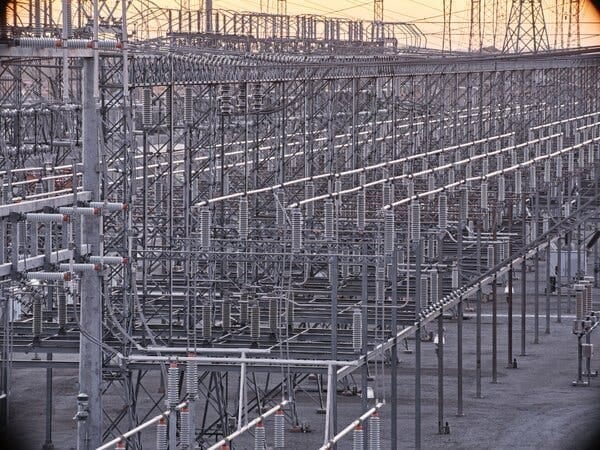
Large power transformers look like shipping containers, basically, with knobby spikes called bushings sticking out of them — those are insulators, often made of ceramic, that allow high-voltage lines to pass into the core without generating giant, arcing sparks. Closer to home you might see squat green boxes plopped down by the sidewalk, little bits of street furniture with “HIGH VOLTAGE” plastered on them. Those are distribution transformers, as are the gray pole-top cylinders that are probably most familiar to you.
Replacing all those aging devices won’t be easy. Robert Crumb, the underground comics artist, once described drawing the various transformers he saw while being driven around Sacramento. “You can’t make up this crap. It’s too complicated,” he told a documentary filmmaker. “This stuff is not created to be visually pleasing. It’s just an accumulation of the modern industrial world that people don’t even notice.”
The crap inside is even more complicated, though the design hasn’t fundamentally changed since William Stanley Jr. developed the first widely used commercial transformer in 1886. (He also founded a company that makes insulated metal drinkware known as Stanley cups; his son was the Stanley in Morgan Stanley.) Two copper wires are wrapped around opposite sides of a ring-shaped steel core. If you increase the number of windings in the first wire, it will reduce the voltage in the second when electricity starts flowing. “I have a very personal affection for a transformer,” Stanley told a meeting of the American Institute of Electrical Engineers in 1912. “It is so reliable, strong and certain. In this mingled steel and copper, extraordinary forces are so nicely balanced as to be almost unsuspected.”
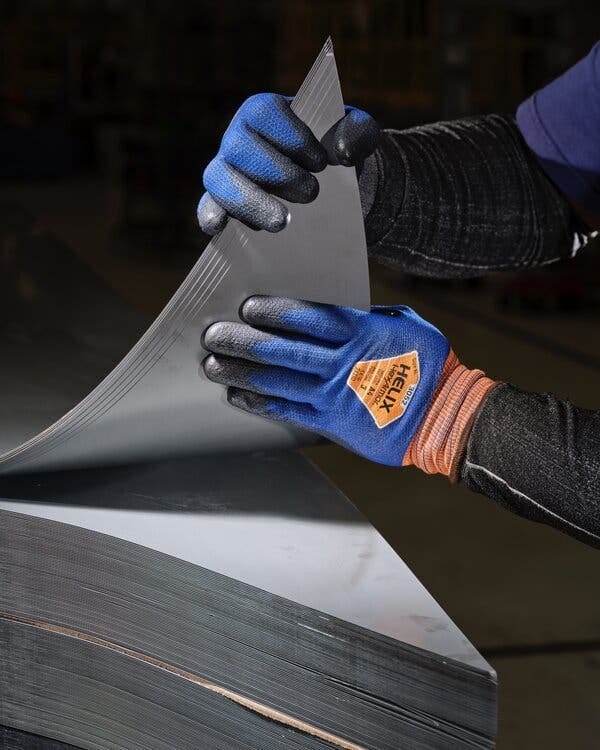
Making that design more efficient, and capable of stepping down today’s ultrahigh voltages (some transmission lines operate at 765,000 volts; your toaster is rated for 120), requires a unique combination of 19th-century craftsmanship and 21st-century materials science. The steel in a transformer is a special kind called grain-oriented electrical steel (known as GOES), a silicon-iron alloy in which the metal’s crystals are all aligned to reduce energy loss. Producers make sheets of GOES as thin as nine-thousandths of an inch, which are stacked to make the transformer core. The process is so delicate and time-consuming that only one mill in the United States can do it.
The other components are assembled by hand. The transformer manufacturers I spoke with used the phrase “art form” to describe the labor that goes into each device. “This is not making a box of Chiclets,” Kevin Lowery, the director of communications for Virginia Transformer Corp, told me. “It is a highly engineered piece of equipment that has very specific needs.” The first time Wellinghoff went to a transformer factory, he watched in amazement as a technician wound the copper coils by hand, a process that can take weeks. Paper insulation and spacers are placed just so. Master welders are required for the oil tanks and the transformer case. Workers bind wiring together by hand, like a store clerk wrapping a Christmas present. “It was clear to me that there was a vulnerability there that we needed to address,” Wellinghoff said.
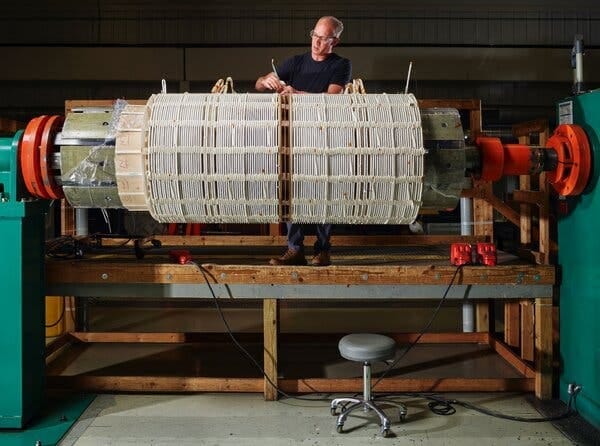
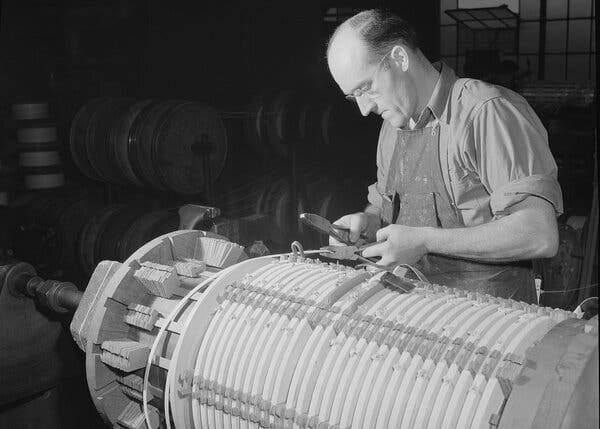
Because each substation has different requirements — different voltages in and out, different loads, different cooling needs — standardization is nearly impossible. Chris Hart, chief executive of the transformer manufacturer Central Moloney, told me his company had over 11,000 different active designs. “Everything we build is built to a spec, and every spec is completely different,” he said. This is especially true for large power transformers, a fully bespoke product with a price tag to match: as much as $14 million each.
Already, domestic manufacturers can produce about only 20 percent of the transformers purchased in the United States; a half-dozen other countries, including Mexico, South Korea and China, supply the rest. The shortage has become bad enough that hyperscalers have begun paying to cut in line, ensuring that their transformers are built next. Even so, data centers, factories and solar farms have all faced delays coming online for want of transformers.
It’s a bottleneck and a choke point for the whole economy, with no relief in sight. Holt, from Siemens Energy, told me that wait times for large power transformers were still increasing. His hope was to one day return to prepandemic delivery times — of two to three years. Somehow, we’ve made the industrial equivalent of a Fabergé egg the linchpin of our civilization. What would happen if someone started breaking them?
It is difficult to overstate how completely the loss of the grid would disrupt life as we know it. In that first hushed moment after the lights went out, we wouldn’t even know that this outage was different from any other. Maybe we would lose power for a few hours. Maybe the ice cream would melt. The mood, at first, might be almost jubilant, as it was after the 2003 blackout in the Eastern Interconnection. At some point, though, the authorities would have to tell the public: The power won’t be restored for a very long time.
During the first phase of a long-term blackout, we’d return, briefly, to the early 20th century, when isolated facilities ran on “private power.” Critical infrastructure like sewage plants, water treatment plants and hospitals could keep running as long as they had diesel or natural gas. Those with emergency radios could listen for updates from one of 73 Primary Entry Point stations, which are outfitted with 60 days of generator fuel. (In New York, that station is WABC, 770 on the AM dial.) But without electricity, even these backups would begin to fail as diesel ran out and the natural-gas pumps shut down.
The second phase would be harder. The hope of restoring the grid would fade as fossil fuel supplies were exhausted, because so many utilities rely on them to “black-start” their generating units. A 2010 report called “High-Impact, Low-Frequency Event Risk to the North American Bulk Power System,” prepared by the Energy Department and NERC, condensed the entire disaster movie that would follow into a single paragraph: “The supply of food, water and fuel would degrade within days. The facile communication of information to the general population would be greatly complicated by the loss of cellphones, internet access and television. The economy would virtually shut down as electronic transactions could no longer be processed. After several days, widespread social unrest and confusion would ensue.” Thirsty, starved, dirty and surrounded by the useless machines we once depended on, we would be lucky if our misery ended at “confusion.”
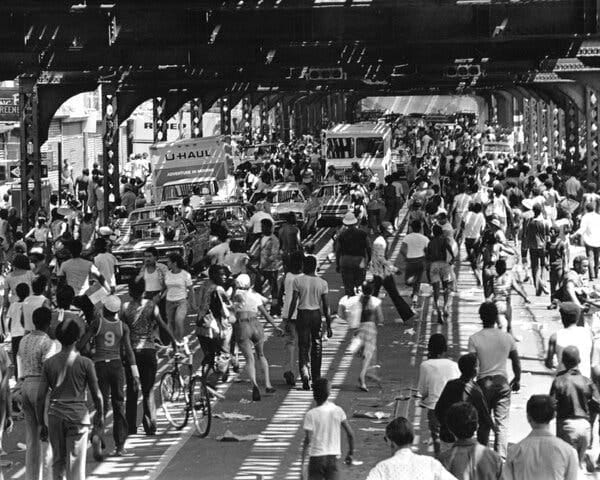
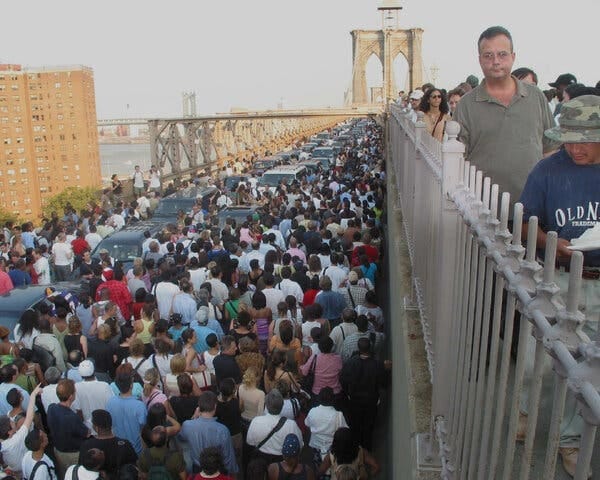
At first, the preppers would be pleased with themselves. “If you want, you can buy a year’s worth of freeze-dried food and maybe some bottled water,” Thomas Popik, chairman of the Foundation for Resilient Societies, told me, “but if we have a long-term grid collapse, it’s only going to take you so far.” Depending on how many transformers were destroyed and how quickly global manufacturers could produce new ones, interconnections could be down for years. Even the ultimate prepper — the U.S. government, which maintains large stores of emergency supplies — wouldn’t be able to outlast a blackout that long.
In an era of frayed alliances, we would rely on the world’s assistance: food, fresh water, diesel. Beyond simple survival, the priority would be to repair or replace the damaged transformers — nine substations with around 20 transformers each suggests that some 180 would be lost. If only the cooling systems were compromised, as at Metcalf, perhaps a united world could make replacements quickly. Everything about the process, from sending the specs abroad to coordinating deliveries, would be made immeasurably harder by the blackout. Lauby, NERC’s chief engineer, pointed out that although energy represents only 7 percent of our economy, “it’s the first 7 percent, because nothing else works after.”
If entire units had to be replaced, the hurdles would begin to seem almost insurmountable. Each one would have to be designed and built from scratch, a process that could take months, followed by the weeks required to send them across the ocean to ports that, one would hope, had figured out a way to operate on no power or limited power. The journey over land would be no easier. Large power transformers weigh as much as 800,000 pounds. “You can’t just slap these son-of-a-guns on a flatbed and drive them across the country,” Lauby said. “The tonnage is huge. They’re hugely fragile and huge.” Often they are sent via rail cars called Schnabels, but there are only a handful of those in North America. Final installation would require specialized cranes and gantries that would also be in short supply — as would the diesel needed to run them.
There is no comprehensive plan for how to respond to a nationwide blackout, though there are government reports calling for one to be created. In 2015, Congress ordered NERC to study the idea of a strategic transformer reserve, but the idea was shelved in favor of a voluntary utility-led equipment-sharing program. Since each large power transformer is unique, it’s questionable how useful such a reserve would be in any case. NERC also holds a biennial war-games exercise called GridEx, simulating how utilities and various local, state and federal governments would respond to a more limited outage, but participation is optional.
Rather than responding to limited outages, we may need to consider a period of years when only a few power plants far from the affected substations are able to restart. A report prepared for President Trump in 2018 suggested creating “community enclaves” around these islands of life, able to provide for critical needs “even in a limited capacity or degraded state.” Another disaster movie scenario, perhaps. Or the start of the long road to renewal.
Somehow, we’ve made the industrial equivalent of a Fabergé egg the linchpin of our civilization.
There are a few ways to solve the problem posed by the transformer shortage: build more of them here, faster; make the grid less reliant on them; or replace traditional transformers with something better. A few months ago, I went to Reno to see whether the last would be possible anytime soon.
Inside a blank building just off Prototype Drive, a company called Amperesand was assembling what it hoped would be the most significant innovation in transformer technology since the days of William Stanley. It’s called a solid-state transformer. Rather than filling a giant steel vault with GOES, hand-wound copper and oil, Amperesand’s transformer is made of small modules that can be easily replaced if damaged, and their input and output voltages can be controlled via “power electronics” — the use of semiconductors to manipulate voltage and current.
The supply chain involved is more robust as well: Ferrite and silicon carbide, the key components, are both easier to produce than GOES and in greater supply thanks to their usefulness to the electric vehicle industry. Lauby called solid-state transformers “the grid of the future,” which could one day be capable of plugging into a substation on the fly: “With a power electronic transformer, you stick it in there and it’ll kind of figure out what it’s supposed to be.”
First, though, Amperesand and its competitors, which include Heron Power in California and DG Matrix in North Carolina, need to build one that works at a smaller scale. “Over time, I think we will start to penetrate into the substation,” Brian Dow, Amperesand’s chief executive, told me. But the immediate market was in serving the hyperscalers.
Dow, dressed in an untucked dark blue polo, khakis and sneakers, led me onto the factory floor. We put on safety glasses and static-discharging smocks. Stretching out toward the far end of the building was the pilot line for a product that still doesn’t have a name; they just call it the S.S.T. It looked less like an assembly line than a series of science fair booths.
Dow came to Amperesand from Tesla, where he worked on power electronics for the Megapack project and batteries for the Model 3. I asked him how many of the people I could see on the line also came from Tesla, and he started pointing: He did, he did, he did. “I worked with Elon a lot in Model 3 ramp-production hell, and he told me a lot of lessons about production scaling,” Dow said. “One example,” he said to me: “Make one T-shirt size fits most. Don’t try to make a bespoke product.” Dow also cited another useful Muskism: Delete everything in the production process that you can delete. Complexity is your enemy.
“We’re at this fulcrum point where a whole bunch of infrastructure needs to be replaced because it’s aging out,” Drew Baglino, the chief executive of Heron Power, told me. Like Dow, Baglino was ex-Tesla; the two had discussed working together before becoming competitors. The field of power electronics is still small enough, Baglino told me, that most of the recent graduates in the field are in a WhatsApp group together.
Dow said that when he started working for Amperesand, he would have meetings with venture capital firms talking about disrupting the transformer business, “and people looked at us like we were crazy.” That all changed last October, when Nvidia released its plan for a “fundamental architectural shift” in the design of the data centers using its chips. On the schematic, instead of a traditional transformer, the company had included an S.S.T. Heron Power recently raised $140 million in a funding round led by Andreessen Horowitz; Amperesand had funding from Siemens and Goldman Sachs and was pursuing a collaboration with Oak Ridge National Laboratory.
For better or worse, data centers are driving a lot of innovation — and turmoil — in the bulk power system. Hyperscalers aren’t just jumping the queue for traditional transformers. They are destabilizing the grids they are connecting to. When a large language model like Google’s Gemini or Anthropic’s Opus is in training mode, it uses huge amounts of electricity, 500 megawatts or more. When the model switches out of training mode, Dow said, “it’s like the city of Cincinnati turning off every single light instantaneously.” The grid is not equipped to handle whipsawing loads like that, but S.S.T.s are.
Popik, of the Foundation for Resilient Societies, said he had gotten more mileage recently from talking about transformers as a problem for A.I. build-out than from talking about, well, the future of civilization. “If you tell people we need more transformer production capacity in the United States because someone might attack us one day,” he said, “a lot of people go: ‘There are a lot of bad things that could happen. I can’t worry about every one.’ But if you tell people, ‘You know, the United States may not be competitive internationally in 10 years in the field of artificial intelligence unless we can build a lot more data centers and they’re going to require electricity, but the bottleneck for those data centers may actually be transformer production,’ then people go, ‘Oh, wait a minute.’”
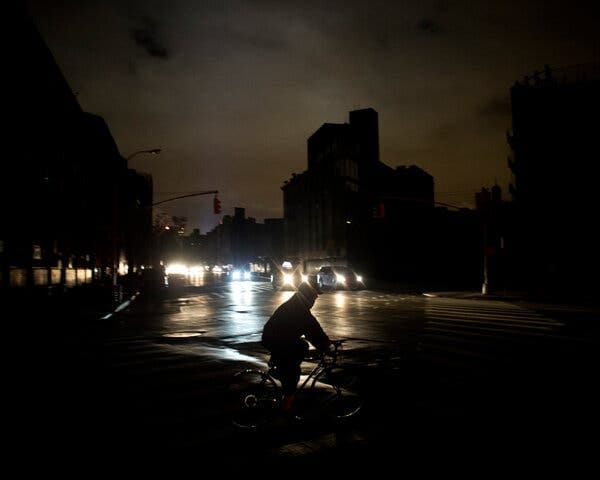
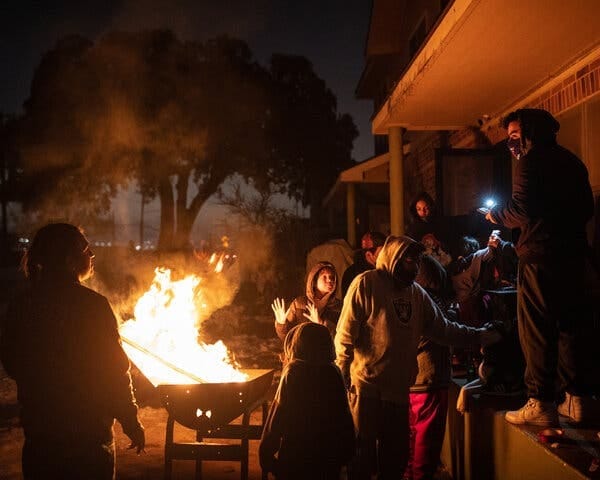
If you squint, you can envision data centers as a vehicle for bringing about all sorts of useful changes to the grid. “This is the story of stories right now,” said David Roberts, who hosts a podcast about clean energy called “Volts.” Everyone is hungry for capacity, he says, “and that need is pulling them in an irresistible fashion toward the solutions that the dirty hippies have been pushing for years.” That includes, most notably, installing batteries just about everywhere. Batteries, in turn, allow us to make better use of the power already available on the grid: If they can kick in at moments of peak demand, we can operate much closer to that peak around the clock. Already, battery storage is expected to double from 2025 to 2027.
“It is the overwhelming tendency of our time to assume that a big problem calls for a big solution,” the poet and environmentalist Wendell Berry once wrote. The best solution to a fragile grid may look like a lot of little interventions, distributed widely. That kind of bulk power system, Roberts said, will become “very boringly resilient and reliable.” Taking a substation or two or four offline might not lead to the cascading failures predicted by FERC if backup power is plentiful enough.
The Trump administration has been a somewhat reluctant partner in this effort. The White House’s “A.I. Action Plan” has a section devoted to building out the grid, but Dean Ball, the primary author of the plan, said he was careful to avoid some language that sounded suspiciously green. “I wanted to include batteries,” he said, “and I also remember making the deliberate choice to say ‘storage’ instead of ‘batteries,’ because I felt like that was a slightly softer word.” Ball has since left the White House but, he said, “I think batteries are the area where they really can soften, and I think their views were softened by the hard reality of physics.”
The administration’s playbook is better suited to the concurrent attempt to rebuild the domestic transformer industry. In April, Trump invoked the Defense Production Act to allow the government to directly support manufacturers of grid equipment, including producers of electrical steel. “This has been a comprehensive effort deriving from the president’s vision from the beginning,” said Peter Lake, who until late July was senior director of power for the White House National Energy Dominance Council. He urged transformer manufacturers to “come talk to us, come to the N.E.D.C., come talk to D.O.E. We have a range of financial tools that are available.” Jared Delello, who directs government activities for Delta Star, a transformer manufacturer with four facilities in North America, said his company was expanding production with the explicit aim to “solidify the U.S.’s position at the forefront of A.I. development.”
This is not the first time the Defense Production Act has been used to encourage transformer manufacturers to increase production. President Joseph R. Biden Jr. did it in 2022, to limited effect. The timeline to open a new factory may simply be too long for executive orders to make a difference. Holt said his company, Siemens Energy, had plans to start building large power transformers at a facility in North Carolina, but the decision was “purely driven by demand.” (It did take advantage of some tax credits available under the Inflation Reduction Act.)
Hart, from Central Moloney, said there was an industrial policy affecting his business: the tariffs on copper and aluminum. “It’s not sustainable,” he said. “Costs are up almost 20 percent. We need relief on all of the metals.” And almost all of the manufacturers I spoke with said finding qualified workers was a persistent problem. The most delicate parts of the transformer require master craftsmen, but Hart said even basic skills were lacking. “We literally, in some of our facilities, begin our training process with lefty loosey, righty tighty,” he said. “If all of the business for transformers across the globe shifted back into the United States, I don’t think we could staff it.” Central Moloney has invested almost a million dollars in the welding programs of local high schools. Holt said Siemens Energy was training some of its workers by sending them to Germany.
Demand is high enough, though, to break through these constraints. In the past four years, Virginia Transformer has grown to 6,000 employees, from 1,800. Hitachi Energy is spending more than $1 billion to expand U.S. production. Siemens Energy has changed its capital expenditures plan three times over the past two years, always revising it up. “The market just overtook us,” Holt says.
Soon, we’ll make a lot more transformers domestically, and faster — and that’s probably as close as we’ll get to fixing the substation problem. A just-in-time economy is efficient, but it’s brittle, subject to crackups when any part of a supply chain is stressed. A perfectly safe grid, or even a pretty safe grid, requires investments such a system can’t fathom: coordination and cooperation across industries; a corps of highly paid and extensively trained blue-collar workers; huge stockpiles of spare materials; and security upgrades that will in all likelihood go unused. High impact, low frequency — it’s a risk that’s incompatible with business as usual.
This May, I went to the Metcalf substation. I had asked PG&E for a tour, but it declined. “We share security information with our regulators and law enforcement,” a spokesman said. “We aren’t going to share specific details about other measures we’ve deployed or plan to implement in the future. We aren’t going to provide a road map for anyone.” I had to explore the site on my own.
I walked along a bike trail that wound around one side of the substation. The chain-link fence that the shooters aimed through had been replaced by a high concrete wall. At regular intervals there were lights, sensors and cameras. Farther down the trail, I arrived at the approximate site where the snipers had set up their positions. The wall blocked the transformers inside from my sightline. The substation, however, is built in the scrubby bottomlands by Coyote Creek, which flows from here through San Jose and into San Francisco Bay. It’s surrounded by grassy hills dotted with cows, with transmission towers soaring above them. I got back in my car and drove to higher ground.
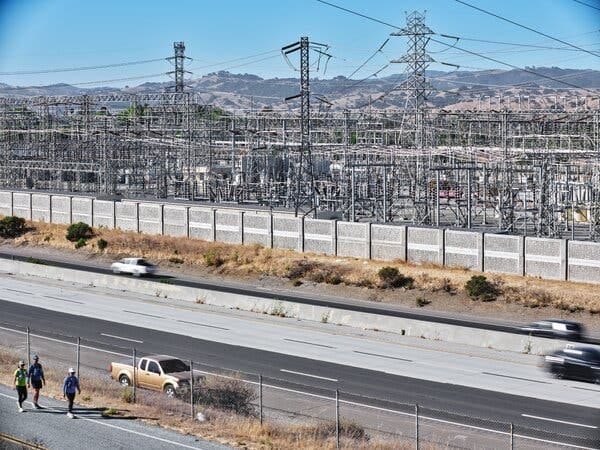
From multiple points to the northeast and northwest of the substation, it was easy to see the transformers lined up inside, about 150 yards away. I parked and climbed a hill, and the only thing slowing me down was thistle. I had brought my binoculars; I trained them on an area inside the wall. I had an unobstructed view of the bushings sticking out of the transformers like lightning-struck hair, the vulnerable cooling fins jutting out of their side bulk.
Incredibly, there are five gun ranges in the hills around the substation, including a 200-yard range meant for high-powered rifles. As I scanned the facility with my binoculars, I could hear them all. From a pistol range I heard an announcement, “OK, shooters, we’re in a safe-fire zone,” followed by a flurry of two-beat reports. It was not difficult to imagine what the valley would have sounded like the night the snipers opened fire.
In 2013, the Department of Homeland Security sent a delegation to utilities around the country, urging them to increase security at their substations. “We did a nationwide tour to alert owners and operators about the vulnerabilities,” Caitlin Durkovich, then the assistant secretary for infrastructure protection, told me, but with more than 200,000 miles of high-voltage transmission lines and roughly 55,000 substations spread across the country, “there is awareness that you can’t protect everything.”
The year after, NERC published a “reliability standard” for utilities, requiring them to assess their substations and prepare a plan to defend them from physical attacks. How the utility would do that, however, was left unspecified. “Identify what are the physical security issues that you need to manage, and then manage them” is how Lauby described the standard to me, though NERC does regularly audit compliance. Whatever upgrades the utilities have done, Wellinghoff told me, they may not have outpaced the development of new threats. “We have a whole new situation,” he said, “and that is the emergence of this very, very sophisticated drone warfare.” He added that the grid had changed in the years since 2013, though, and it was possible that new transmission lines added resilience to the system.
The F.B.I. last commented on the Metcalf attack in 2014, when an official again suggested that it was the work of a disgruntled employee, an idea Wellinghoff calls “ridiculous.” (It would need to have been two disgruntled employees, in any case, because the cover to the vault holding the substation’s communications links was too heavy to lift single-handedly.) One PG&E executive called the shooting a “dress rehearsal” for future attacks, and indeed, in the past decade, dozens of facilities — in Arkansas and Oregon, Florida and Washington — have been targeted, often using the same tactic as the one seen in 2013: puncturing the cooling system and letting the oil drain out.
The most successful of these attacks happened in Moore County, N.C., in December 2022, when someone used a gun to disable multiple transformers in two substations operated by Duke Energy. This time, there was a blackout: 45,000 people lost power, some for as long as five days. No suspects have been named in the investigation, but several foiled substation attacks have involved right-wing extremists. Among neo-Nazi and accelerationist groups, Metcalf has been studied as a model for years. In 2024, five members of a group that one member called “a modern-day SS” were given prison sentences of 21 months to 10 years for plotting to destroy transformers throughout the Mountain West.


