

If there was ever a “canary in the coal mine” moment for the next housing crisis, it’s that mortgage and insurance giant Fannie Mae maintains a secret mortgage blacklist.
The Wall Street Journal broke the news on March 17 that Fannie Mae keeps a blacklist that includes condo associations it believes have too little property insurance or need to make critical building repairs. According to the Journal, it’s a list that every major lender pays attention to.
In other words, if you’re buying a condo in a building on that list, you’re likely not going to get a loan. However, the insurance “canary” isn’t just about condo buildings.
If you think homeowners insurance has already skyrocketed — and it has — hold on because you’re likely about to get screwed even more. First, some background:
The power of Fannie Mae, Freddie Mac, and Ginnie Mae
These three agencies insure against losses on about 90% of all residential mortgage loans. These loans end up as mortgage-backed securities (MBS), which amount to more than $9 trillion.
The liquidity of the MBS market is the main reason getting a home mortgage in the U.S. is relatively easy. Without agencies like Fannie Mae, our housing market would be a fraction of what it is today. When borrowers make the monthly payment on their loans — usually to a loan servicer — the monthly payment goes through the agencies and makes its way to the MBS market.
The agencies guarantee against principal losses and collect a monthly fee called a “Guarantor Fee.” In this case, they’re acting like an insurance company to MBS bond holders by collecting premiums and paying out any losses due to borrower default. MBS are collateralized by the borrower’s home.
Therefore, if the homeowner’s insurance isn’t paid, then the collateral (ie: the home) backing the loan is at risk. If a home that’s collateralizing a mortgage that the agencies guarantee is without insurance, and the home is destroyed, the agencies would take the loss.
A lapsed insurance policy can be considered a default and lead to foreclosure.
Insurance and mortgage rates are connected
Homeowners insurance is going up. A Treasury Department report released in January found that, nationally, insurance rates rose 8.7% faster than the rate of inflation from 2018-2022.
Of course, the agencies can’t guarantee large swaths of homes in securities unless they are insured.
Most people’s mortgage payment includes their insurance premiums and real estate taxes. Those premiums and taxes go into an escrow account from which the loan servicer pays those bills when they are due. So, as your insurance premiums and real estate taxes go up, so does your mortgage payment.
This is where the rubber meets the road. While the average price of insurance went up 8.7% more than inflation from 2018-2022, it went up 14.7% more in the 20 highest-risk zip codes. The consumer price index rose 20% during that period. That means a $1,500 insurance policy in those top 20 zip codes increased an average of $344, raising a monthly $3,000 payment to $3,029. Another study from S&P Global found that premium increased an average of 34% from 2017-2023:
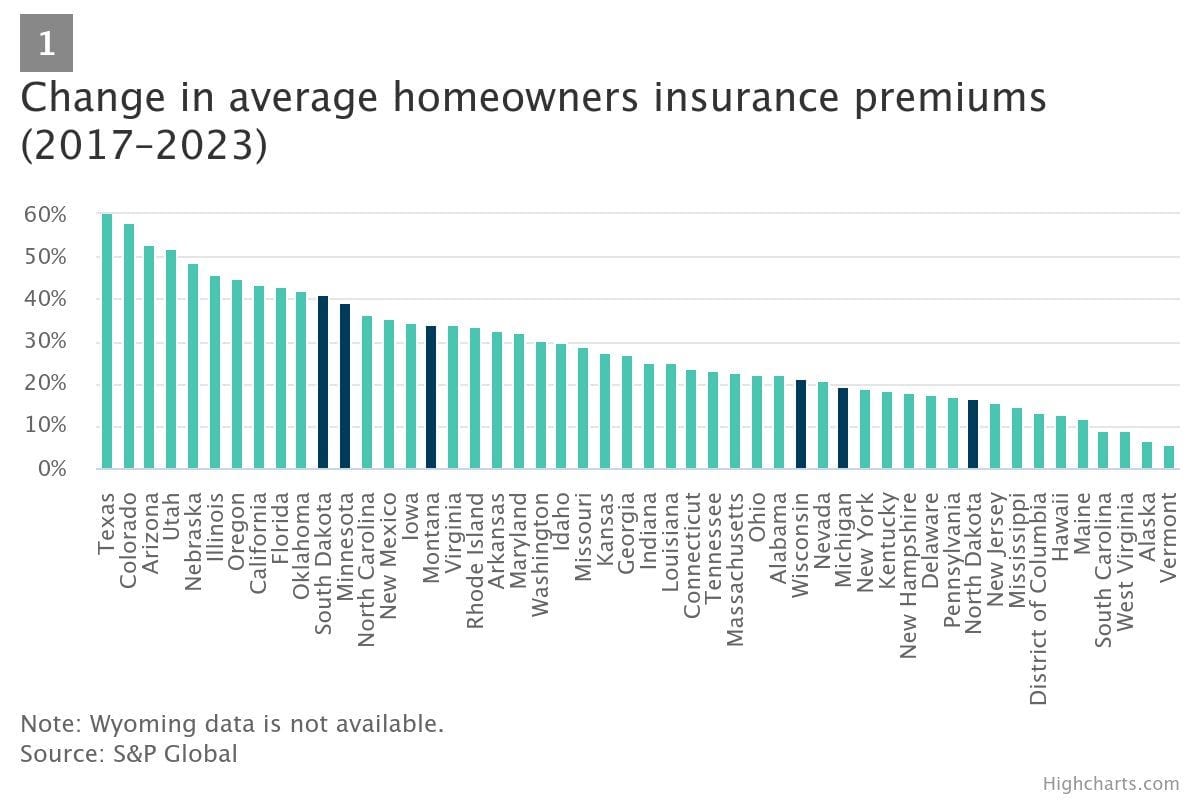
If you can still only pay the $3,000 a month, you’re delinquent even if you covered your principal and interest in your payment. That means you’re on the path to foreclosure.
Often, homeowners in this situation get introduced to a dark corner of the financial world: Forced Place Insurance (FPI). When closing on a home, the borrower signs loan documents agreeing to maintain continuous homeowners insurance coverage. If the insurance policy lapses or gets canceled, the lender or servicer steps in and obtains FPI — also known as lender-placed insurance — to safeguard the property.
FPI premiums are usually four to 10 times more — meaning even higher monthly mortgage payments and an increased likelihood of default. That’s starting to happen in the commercial real estate market.
FPI played a big role in the 2007-2008 mortgage crises, as Rohit Chopra, the former director of the Consumer Financial Protection Bureau, noted in this 2023 speech:
There have been numerous lawsuits against mortgage servicers and insurance companies alleging that these entities, or an allegedly captive reinsurance company, were paid kickbacks. Even if the mortgage servicer doesn’t profit from the force-placed insurance, the mortgage servicer has limited incentives to minimize the cost of the force-placed insurance or avoid the placement. The entire price of the force-placed insurance is then passed on to the borrower.

Go paid at the $5 a month level, and we will send you both the PDF and e-Pub versions of “Government” - The Biggest Scam in History… Exposed! and a coupon code for 10% off anything in the Government-Scam.com/Store.
Go paid at the $50 a year level, and we will send you a free paperback edition of Etienne’s book “Government” - The Biggest Scam in History… Exposed! OR a 64GB Liberator flash drive if you live in the US. If you are international, we will give you a $10 credit towards shipping if you agree to pay the remainder.
Support us at the $250 Founding Member Level and get a signed high-resolution hardcover of “Government” + Liberator flash drive + Larken Rose’s The Most Dangerous Superstition + Art of Liberty Foundation Stickers delivered anywhere in the world. Our only option for signed copies besides catching Etienne @ an event.


