

By Peter Tchir (Academy Securities), via ZeroHedge
Treasuries, Treaties, and Treatises
Let’s start with Treasuries. We laid out the approach we would take if we were Warsh last weekend in Warsh’s Mark Antony Moment (a play on coming to “bury” inflation, yet having quite the opposite effect, at least in terms of interest rate policy).
After Bessent’s “attempt” to drive bond yields lower, we analyzed the possibilities in Treasury, Treasuries, The Fed, and Iran. The primary focus was on bonds, though we had to toss in the “possibility” of Economic Armageddon for Iran.
On Monday we discussed the Fed on Fox Business, but they picked up our theme on Tuesday where Academy was the chyron on Varney & Co. Academy had the pleasure of spending the first half hour on Bloomberg TV on Thursday where we covered rates, Iran, energy, Global ProSec, and maybe even Situational Awareness (it all becomes a bit of a blur).
Please read Thursday’s report, in conjunction with last weekend’s report (or watch the video links) to get a sense of our outlook for Jackson Hole and what the Fed should (or needs to do) to support Bessent’s efforts.
Today, we will add some additional information to reinforce our take on the power of a Federal Reserve Operation Twist.
A Fed “Operation Twist” Is the “Real” Deal
As of today, according to Bloomberg, the U.S. government has $7.5 trillion of T-bills outstanding and $21.7 trillion of coupon debt outstanding.
Bessent is buying “at least $4 billion” per “operation.” These operations are almost weekly, and while the threat of “at least” is interesting, jumping from $2 billion to $4 billion wasn’t enough to move markets for long. This is NOT QE. Gold rose, and the dollar fell, in response to Bessent. Likely overdone as this is more about re-arranging the deck chairs, rather than creating “money,” which is what the “debasement” trade seemed to buy into.
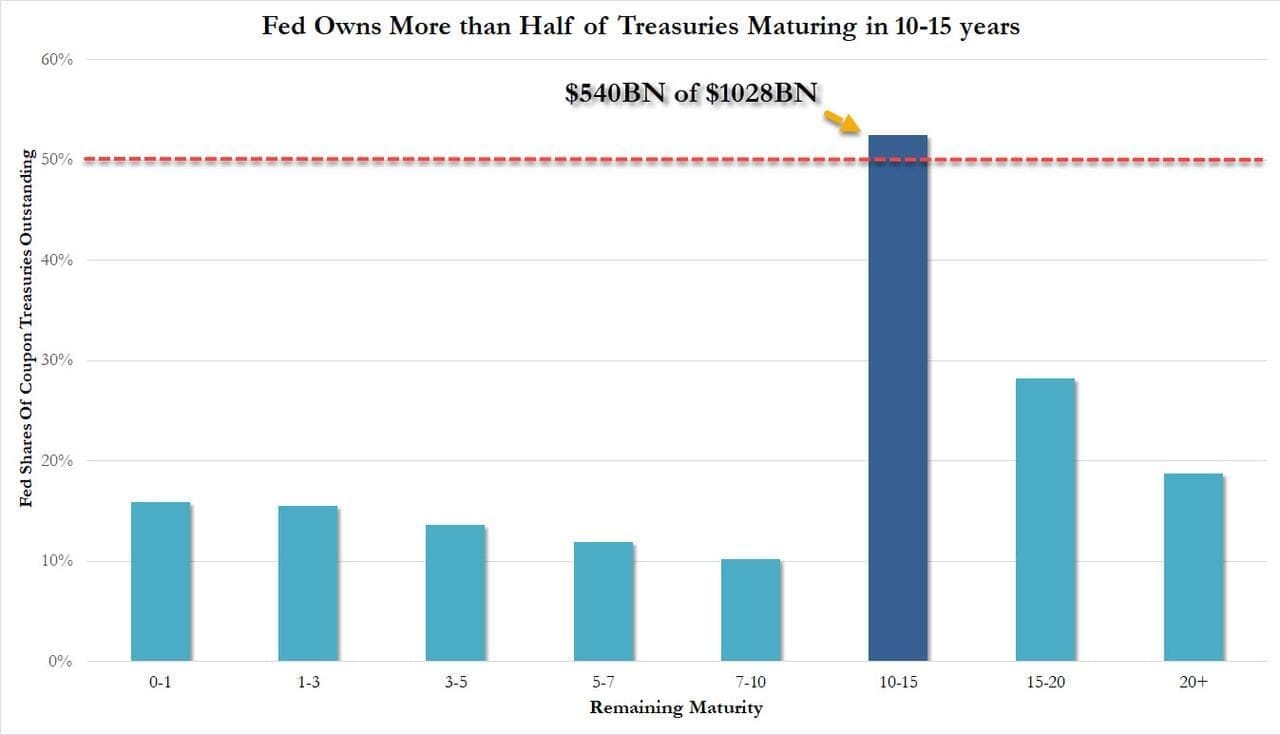
I’m not sure the Treasury Secretary should ever refer to any part of the US yield curve as illiquid. But Bessent did. Maybe he is remembering the “good old days” when nothing happened in August. I don’t think this August was sleepy, nor particularly illiquid.
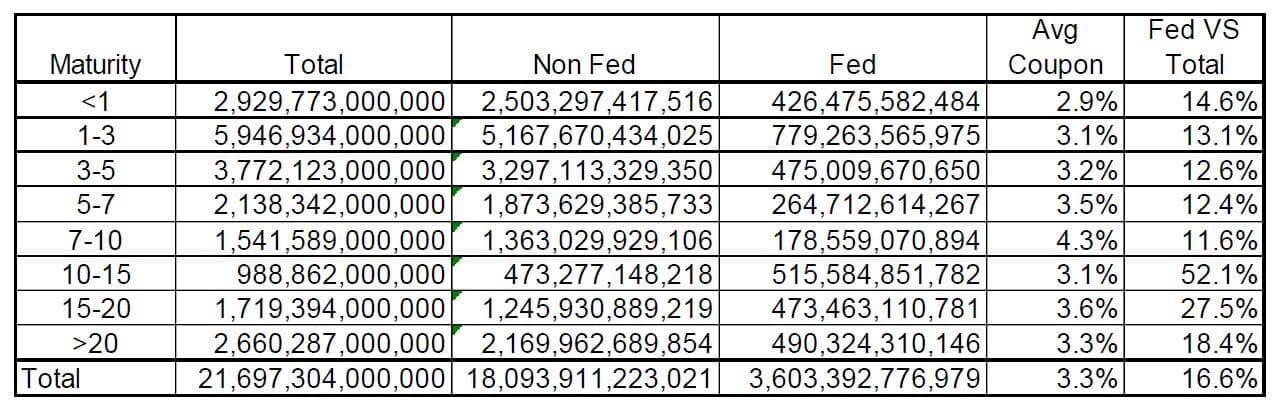
Having said that, the Federal Reserve owns over 50% of all bonds maturing between 10 and 15 years from now. That seems a long way from “free” markets. The Fed’s holdings of longer-dated bonds are quite high (nearing 20%). It might be illiquid and partially “artificial,” but not in the way that Bessent implied.
The Fed owns almost half a trillion of bonds maturing within the next year.
These are coupon bonds (not T-bills).
The average coupon is 2.9%, so the Fed is bleeding money. They own, on an accrual counting basis, these bonds at the yield they purchased them at (probably lower than 2.9%) and fund at Fed Funds Effective (3.63%). It explains why the Fed was helping to “artificially” reduce the deficit with their payments to Congress, and now they are adding to our deficit woes by bleeding carry.
Let’s imagine the Fed selling that $426 billion, and buying the same notional amount of bonds with 20+ years maturity. A small up-front loss (they’d have to monetize the premium they paid for their bonds), but a very big pick-up in carry (5.25% or so on carry vs funding of 3.63%). It would also represent over 15% of the total amount of bonds with a maturity of 20 years or more (and over 20% of the float the Fed doesn’t already own).
If they decided to do the same with their bonds maturing in 1 to 3 years, they’d have a bigger up-front loss, but more carry going forward, and would own over 50% of the debt outstanding.
I don’t know what percentage of ownership constitutes “cornering” a market, but we’d pretty much be there.
From Warsh’s perspective (and that of all Fed members), Operation Twist does NOT count as QE because it keeps notional amounts the same. If the admin wants to see the long end of the yield curve go down, they need to stop “playing” with the amounts Bessent controls and go all in on a Fed-driven Operation Twist.
Can’t say I’m a fan, but why not?
In the coming days we should find out if Bessent is “on his own” or if the Fed is throwing their weight behind his efforts to control the longer end of the bond market.
When Bond Traders Say “Done” – They Mean “Done”
Whatever else you learned in school, or on the trading desk, the most important thing you are taught is “done means done.” You’ve committed your capital (or the firm’s capital) and it might be a good or bad decision, but you are “done.” You are stuck with that trade. Trying to back out, or change the terms, or beg for some accommodation, may work (exactly once), but your reputation is toast.
I haven’t done a deep dive on any of the following (so I could be wrong), but it is difficult not to see a pattern emerging, that seems problematic down the road. There are many factors outside the public domain, and we all know negotiating deals is not easy, especially when the parties involved are very far apart on many of the issues. However, the concern is that the negotiating strategy we sometimes use could be misconstrued by certain countries and work against us in some circumstances.
- Canada getting 50% tariffs (again). But according to Canada they walked away when the U.S. introduced unfavorable terms at the last minute.
- Saudi Arabia getting help to develop non-military nuclear capabilities. But that seemed to derail almost immediately, when there was “confusion” over terms that supposedly required the Saudis to agree to join the Abraham Accords. Again, the goal is for the Saudis to join the Accords one day, and it is unclear if this was a part of the discussions initially.
- The “Board of Peace” (a misnomer if there ever was one, given some of the cast of characters involved) announced a peace deal between Israel and Hamas. Which would be great if even one of the sides had agreed.
- Not sure why we are “both” pulling back on military exercises in South Korea and reaching out to North Korea. Yes, there are reasons (South Korea importing a lot from the Middle East and not helping in the war, etc.) but still seems odd.
- The original MOU with Iran. Within days, the $300 billion of economic relief sounded like it needed to come from other countries, none of whom had agreed. The language about the Strait seemed pretty favorable to Iran, and different than what the President said (hence why we were quickly back to fighting over it). Iran is notorious for changing terms and making any negotiation difficult, which is why it is said that while Iran has never won a war, it has never lost a negotiation. We know it will likely take more time to get Iran to agree on a satisfactory deal, but the devil is always in the details.
- The UK had the first “friendly” trade deal. Who knows what has actually been documented, but it didn’t stop the U.S. from adding some tariffs for sending troops to Greenland while the U.S. talked about annexing Greenland.
Bottom Line
Either the Fed helps Bessent on Treasuries, or this recent intervention will fall flat (and probably do more harm than good, which is often the case when an intervention is attempted but doesn’t succeed).
My gut is there is more to come, but we really need to see something from Warsh and the Fed at or before Jackson Hole.
Whatever negotiating tactics worked well in Trump 1.0 don’t seem to be as effective during Trump 2.0. I could be wrong, and am playing chess in the wrong dimension, but I’m concerned the U.S. is “kicking the hornet’s nest” (which probably needed to be kicked), but the outcome might not be as good for the U.S. economy (and the stock market) as it could be!
On Iran, it seems there is only so much we can do economically without confronting China, and that is a confrontation that is fraught with dangers to our economy (and another reminder of why we need to smelt, process, and refine things here in the U.S. ASAP – or with our close neighbors, but that seems to have taken another step in the wrong direction).
Or maybe I’m just tired and cranky as the dog days of summer have taken a toll on my psyche.
And this report had nothing to do with Treatises, but it seemed to go well with Treaties and Treasuries, and I thought it might attract Spider’s attention as he teaches me a new word almost every time we see clients together!


