

Etienne Note: We have team and friends in Venezuela and understand there are over 40,000+ missing. Many buried under the rubble. They need heavy equipment to move rubble ASAP. We have evaluated multiple charities that are providing support on the ground and have chosen to support: The House Project which already has multiple projects on-going in Venezuela. We will be featuring them as our Voluntaryist Charity Option in Five Meme Friday. You can donate here: https://thehouse-project.org/es/collections/donate
It was just over forty seconds that separated the two earthquakes. The first, magnitude 7.2, was centered about 21 kilometers west of Morón, in the north of the country, around 6:00 p.m. on Wednesday. Before the ground had finished settling, a second quake —magnitude 7.5, the strongest recorded in Venezuela in more than a century— struck almost the same spot.
Experts call this phenomenon a seismic doublet: two earthquakes of very similar magnitude that occur within seconds of each other and very close together. The combination multiplied the damage and left thousands of people no time to react between one blow and the next.
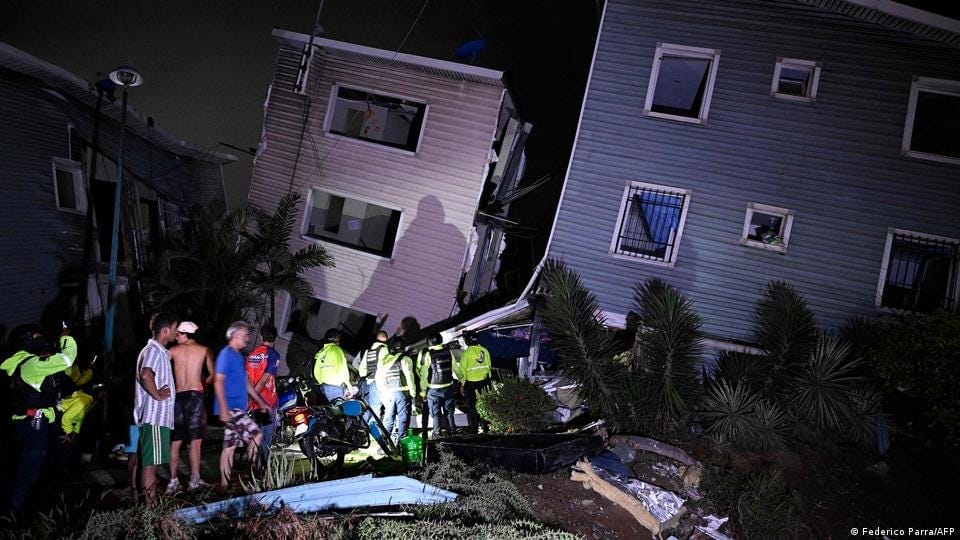
The coastal state of La Guaira is, so far, the hardest-hit region. Dozens of buildings collapsed completely and many others were left with deep cracks and fallen walls. In towns such as Catia La Mar there is no electricity, and hundreds of people are spending the night in the street, unwilling to enter structures that could come down in any aftershock, or searching for their loved ones in the rubble.
In Caracas, the collapse of the Petunia building, in the Chacao municipality, became one of the focal points of the tragedy: local authorities reported several deaths there, along with dozens of people rescued alive. Heavy machinery continues to clear rubble so that specialized rescuers can make their way through in search of more survivors.
+120 buildings reported as totally collapsed
+130 with severe structural damage
+160 with partial damage
They slept in the plazas, and there are areas no one has reached
Last night, thousands of families left homeless had nowhere to go. In downtown Caracas, they spent the night out in the open in plazas, parks and parking lots the few open spaces that feel safe while aftershocks keep shaking the city. Mothers with children and the elderly slept outdoors, cold and not knowing whether their building would still be standing by dawn.
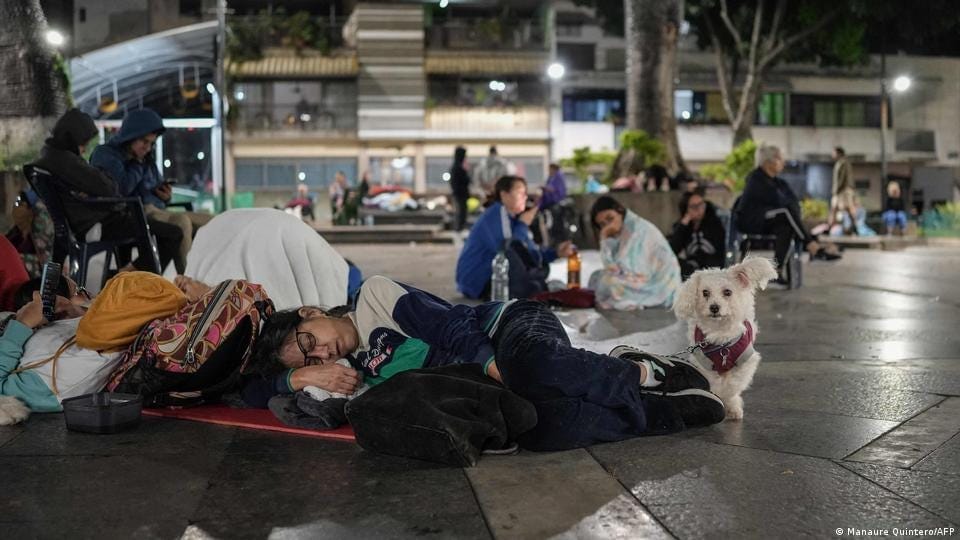
And there is something more serious: at this hour there are still areas where no aid of any kind has arrived. In those places there are no rescuers, no machinery, no authorities. It is the neighbors themselves who are pulling people from the rubble —without helmets, without gloves, without tools, without protection of any kind— digging with their hands while shouting for help for those still trapped.
This is the part of the emergency that the official figures still cannot see: entire communities holding on alone, waiting for aid that has yet to come.
A health system stretched beyond its limit
The most urgent challenge right now is not only the number of victims, but the capacity to respond to them. The emergency infrastructure is at its breaking point. Several health centers were damaged and, in the most compromised cases, had to be evacuated over the risk that the buildings themselves might give way —leaving the injured without the physical space to be treated under safe conditions.
Added to this is the shortage: medical supplies are lacking, resources are lacking, and machinery is lacking. Firefighters are overwhelmed and the tools to lift rubble are insufficient for a disaster of this scale. On the ground, rescue teams insist that what is needed most is specialized technical support —people who know which tools to use and how to enter a collapsed structure without it caving in.
“What we need is help, above all with the technical teams.”
— Operations chief of a rescue group, in La Guaira
The injured are treated in the open outside Jose Maria Vargas Hospital-Guaira
Meanwhile, dozens of Venezuelans have organized on their own: they load motorbikes with water, food and medicine and head down to La Guaira to bring what they can to the hardest-hit area. Citizen solidarity has, in many cases, arrived ahead of the formal aid.
The missing: a number that grows on its own
The interim government, led by acting President Delcy Rodríguez, declared a state of emergency and confirmed 164 dead and 971 injured, warning that the real toll could be much higher as teams reach the areas still cut off. But another count is running in parallel: that of the families. Through the citizen platform desaparecidosterremotovenezuela.com, thousands of people are reporting their loved ones in the hope of locating them. As of this update, 40,729 reports had been filed; 37,815 of those people were still out of contact, and 2,914 had already been found alive.
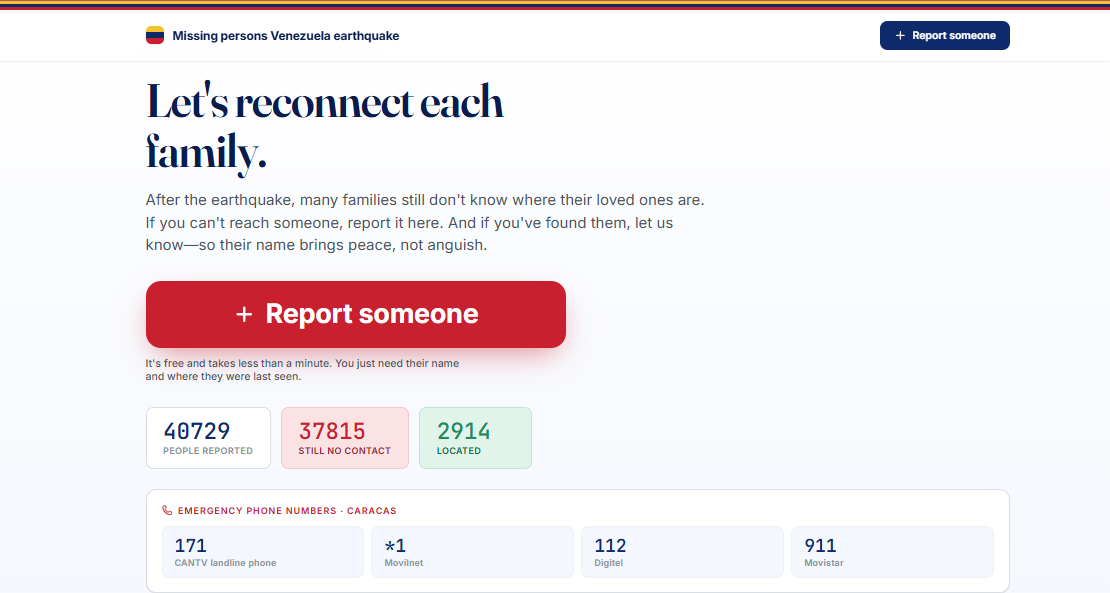
That gap —between the officially confirmed deaths and the tens of thousands of people their relatives still cannot locate— is the real scale of what is at stake. Not all of those people are under the rubble; many may be unreachable because the power and phone networks collapsed across much of the country. But until every name has an answer, no one can say what the true scope of this tragedy is.
Several countries have announced the deployment of search-and-rescue teams, medical personnel and field hospitals. The formal aid will take time to fully deploy, especially with Simón Bolívar International Airport temporarily closed due to damage. For that reason, in the coming hours, the local effort and the resources that reach the affected communities directly will be decisive.
Help Venezuela get back on its feet
HOW TO HELP NOW?
Donate to the House Project in Venezuela
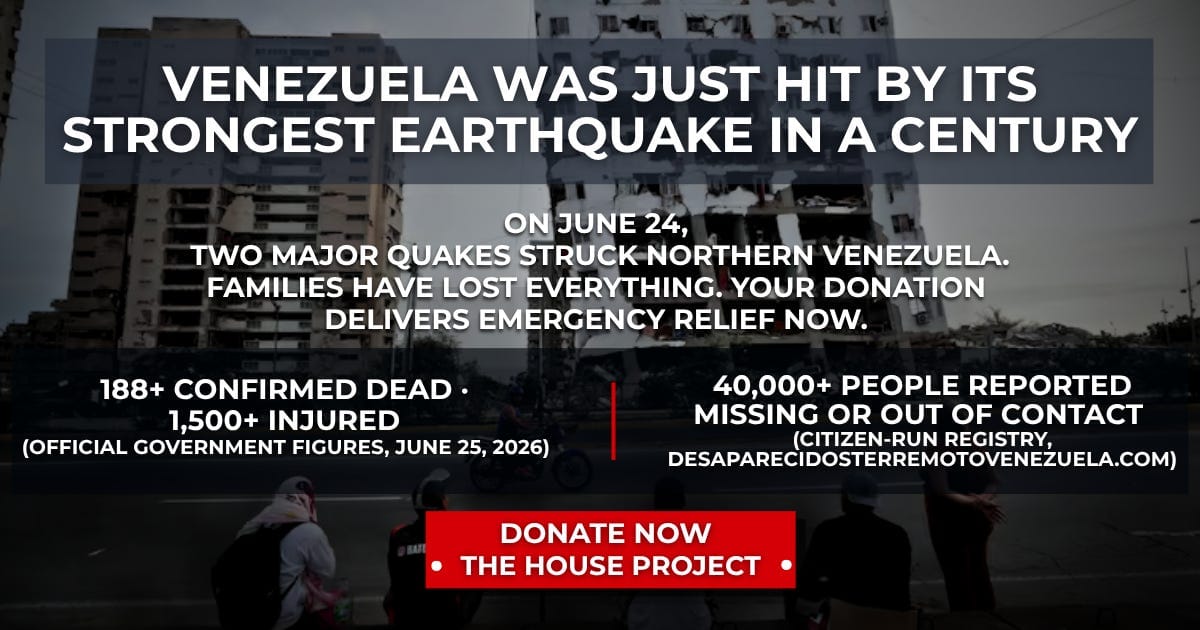
Etienne Note: We have team and friends in Venezuela and understand there are over 40,000+ missing. Many buried under the rubble. They need heavy equipment to move rubble ASAP. We have evaluated multiple charities that are providing support on the ground and have chosen to support: The House Project which already has multiple projects on-going in Venezuela. We will be featuring them as our Voluntaryist Charity Option in Five Meme Friday. You can donate here: https://thehouse-project.org/es/collections/donate


