

by Bryan Lutz, Editor at Dollarcollapse.com
Gold has served as humanity’s most trusted store of value for millennia, but recent enforcement actions have revealed a darker side to modern precious metals markets. Over the past decade, major financial institutions, institutions we are told to trust, have paid billions in fines for systematically manipulating gold prices, proving that market manipulation is not just theoretical. It’s not a conspiracy theory either, it’s a documented reality with real consequences for you and I.
Here are three primary forms of gold market manipulation that have been proven in court:
Spoofing
Benchmark manipulation
Systemic market manipulation schemes
Spoofing: The Digital Age’s Favorite Manipulation Tool
What it is: Spoofing involves placing large orders with the intent to cancel them before execution, creating false signals of supply or demand to influence other traders’ decisions and move prices artificially.
Spoofing has become the most common form of precious metals manipulation in electronic markets. The technique exploits the information content of order flow—when other traders see large buy or sell orders, they assume informed trading is occurring and adjust their own strategies accordingly.
Here’s how it works: A manipulator places a large “spoof” order on one side of the market while simultaneously placing a smaller “resting” order on the opposite side. The large spoof order creates the false impression of significant buying or selling interest, causing other traders to react and move prices toward the manipulator’s smaller order. Once the resting order is filled at the artificially influenced price, the spoof order is quickly canceled.
Example: The JPMorgan Case, America’s Biggest Bank
The most spectacular example of spoofing came to light in the JPMorgan Chase case, which resulted in over $920 million in penalties—the largest precious metals manipulation fine in history. From 2008 to 2016, JPMorgan traders engaged in tens of thousands of spoofing sequences across gold, silver, platinum, and palladium markets.
Michael Nowak, who ran JPMorgan’s global precious metals desk, and Gregg Smith, an executive director and trader, were both convicted and sentenced to prison for their roles in the scheme. Court documents revealed they placed hundreds of thousands of spoof orders designed to inject false information about supply and demand into the markets, directly harming other traders who relied on these false signals.
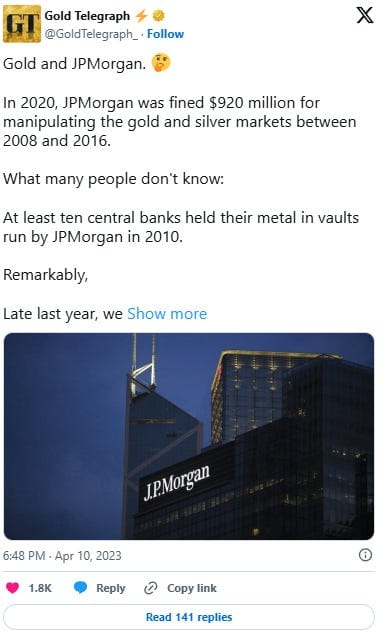
The scheme was so systematic that it operated for eight years across multiple market cycles, demonstrating how sophisticated spoofing techniques could evade detection while generating substantial profits for the manipulators.
Benchmark Manipulation: Gaming the Global Gold Price
What it is: Benchmark manipulation involves abusing price-setting mechanisms that determine official reference prices used globally for settling contracts, valuing portfolios, and pricing derivatives.
The London Gold Fix, established in 1919, served as the world’s primary gold benchmark until 2015. This twice-daily price-setting process involved five major banks meeting to determine the official gold price used worldwide. The opaque nature of this process created perfect conditions for manipulation, as the same banks setting the price were also major gold traders with significant conflicts of interest.
Benchmark manipulation is particularly insidious because it affects not just immediate market participants but anyone whose investments, contracts, or financial products reference the manipulated benchmark price. This includes exchange-traded funds, mining companies, jewelry manufacturers, and institutional investors globally.
Example: The Barclays London Gold Fix Scandal
On June 28, 2012, Barclays trader Daniel James Plunkett deliberately manipulated the 3:00 PM London Gold Fix to avoid a $3.9 million payment to a customer. Plunkett was managing a digital exotic options contract that would require Barclays to pay the customer if gold fixed above $1,558.96.
During the fixing session, Plunkett strategically placed orders designed to keep the gold price below the barrier level. His manipulation succeeded—the price fixed just below $1,558.96, allowing Barclays to avoid the customer payment while generating an additional $1.75 million profit for Plunkett’s trading book.
The timing made this manipulation particularly egregious: it occurred just one day after UK regulators had fined Barclays for LIBOR manipulation, demonstrating a pattern of benchmark abuse. When the customer questioned the suspicious fixing result, Plunkett failed to disclose his manipulation and provided false information to both Barclays management and regulators.
The UK Financial Conduct Authority fined Barclays £26 million and banned Plunkett from the financial industry for life.
Market Manipulation: Coordinated Schemes and Systematic Abuse
What it is: Market manipulation encompasses broader coordinated efforts to artificially influence prices through deceptive trading practices, including wash trading, coordinated schemes between multiple parties, and the exploitation of market structure vulnerabilities.
This category includes more complex manipulation schemes. It sometimes involves multiple techniques, participants, or markets simultaneously. Unlike spoofing or benchmark manipulation, which have specific technical definitions, market manipulation is a broader concept, which distorts natural price discovery through various abusive practices.
Here’s one common way this happens: Market manipulation often involves exploiting the relationship between paper gold markets (futures, ETFs, derivatives) and physical gold markets. With paper gold trading volumes estimated at 200-250 times physical gold availability, relatively small interventions in key market segments can have amplified effects across the entire gold ecosystem.
Example: Deutsche Bank’s Multi-Year Manipulation Scheme
Deutsche Bank’s precious metals manipulation demonstrates how systematic market abuse can operate across multiple techniques and time periods. From 2008 to 2014, Deutsche Bank traders engaged in a comprehensive manipulation scheme involving spoofing, stop-loss triggering, and coordinated trading designed to profit at customers’ expense.
The bank’s traders would deliberately trigger customer stop-loss orders—protective orders designed to limit losses—by moving prices to levels that forced customer liquidations. This practice allowed Deutsche Bank to profit from both the initial price movement and the subsequent forced selling by its own clients, representing a clear violation of fiduciary duties.
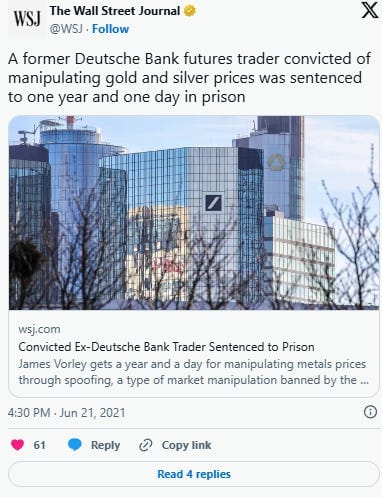
The manipulation extended internationally, with traders in Deutsche Bank’s Singapore office participating in schemes to trigger customer stop-losses from 2009 to 2012. The bank’s surveillance systems actually detected potential misconduct through automated alerts, but supervisors failed to follow up on the majority of these warnings, enabling the manipulation to continue.
Deutsche Bank ultimately paid $60 million to settle civil litigation and $30 million in regulatory penalties. Two of its traders, Cedric Chanu and James Vorley, were criminally convicted for their roles in the manipulation scheme, demonstrating that market manipulation can result in both civil and criminal consequences.
Have You Seen James Corbett’s Interview of Etienne? How to Leave the Cage?
Etienne recently appeared on The Corbett Report with James Corbett to discuss his new book: To See the Cage is to Leave It – 25 Techniques the Few Use to Control the Many.
It is definitely one of Etienne’s best interviews ever! If you have ever wanted to share Etienne’s work with your friends, family or colleagues, this is the interview for you. You can get a copy of To See the Cage is to Leave It (press release) by “Going Paid” on Substack AND get access to all FOUR of the Art of Liberty’s Substacks: Important News from the Art of Liberty Foundation, The Daily News, The Daily News Digest, and Five Meme Friday. By “Going Paid” you can get access to the full transcript, all the slides, memes, and videos mentioned in the interview: How to Leave the Cage - James Corbett & Etienne de la Boetie2
The Best “Go Paid” Deal on Substack! You Get REAL Stuff!!

Go paid at the $5 a month level, and we will send you both the PDF and e-Pub versions of Etienne's new book: To See the Cage Is to Leave It - 25 Techniques the Few Use to Control the Many and a coupon code for 10% off anything in the https://artofliberty.org/store/.
Go paid at the $50 a year level, and we will send you a free paperback edition of Etienne’s new book: To See the Cage Is to Leave It - 25 Techniques the Few Use to Control the Many OR “Government” - The Biggest Scam in History… Exposed! OR a 64GB Liberator flash drive if you live in the US. If you are international, we will give you a $10 credit towards shipping if you agree to pay the remainder.
Support us at the $250 Founding Member Level and get a signed high-resolution hardcover of “Government” - The Biggest Scam in History... Exposed! + Liberator flash drive + a signed high-resolution hardcover of Etienne's new book: To See the Cage Is to Leave It - 25 Techniques the Few Use to Control the Many + everything else in our "Everything Bundle" of the best in voluntaryist thought delivered domestically. International pays shipping. Our only option for signed copies besides catching Etienne @ an event.


