

Etienne Note: We have rebranded our Free State Project Corner section in Five Meme Friday to: libertarian Intentional Community Roundup to cover other projects including Prospera (Honduras), The Free State Project (New Hampshire), Liberstad (Norway), Montelibero (Montenegro), Los Propietarios, (Argentina), Liberland (Croatia/Serbia border), Network States in general and Sea Steading (The Oceans). I am also covering secession movements including Greater Idaho,
Please send details of any new happenings, projects or projects I am missing!
“Research shows this individual Jason Sorens, who founded the free state movement [sic] is behind the proposed legislation to remove local control of zoning and planning. Along with the Log Cabin Republican board members.”
“Sorens is a menace to our state and should be thwarted at every move.”
“This housing agenda IS Bolshevik and they are in numbers enough to have intimidated normal GOPers to voting for this garbage.”
“The attack on zoning and planning did not occur until the Free State’s architect, Jason Sorens of Amherst, wrote a paper laying the blame at the feet of ‘snob zoning.’”
When the Republican-majority New Hampshire legislature took up a couple dozen pro-housing supply bills this year, anti-housing radicals erupted in outrage.
Lies and threats are standard tools in the NIMBY toolbox, so it was no surprise that they thought these tactics - so effective in local government - would work on legislators.
They did not - for the most part.
For some reason, even though I am not a legislator, I became the lightning rod for much of the ire. I didn’t see much of it, but people told me about it - and things even worse than the quotes above. Apparently I was accused of consorting with Jeffrey Epstein and wanting to legalize “rape trailers” around New Hampshire. Seriously. I was content to be the object of these people’s wrath, so long as it sheltered legislators while they did the real work of studying, refining, and advancing these bills.
This is the story of how a Republican-dominated legislature in the Northeast dealt a blow to a massive housing crunch by passing 17 pro-supply bills in 2025.
New Hampshire’s Housing Crunch
New Hampshire is one of the more regulated states for housing and has accordingly higher than average housing costs and rates of homelessness. According to the Wharton Residential Land-Use Regulation Index (WRLURI), based on a survey of municipal officials, New Hampshire was the fourth most-regulated state for new housing in the mid-2000s. The late 2010s survey put New Hampshire at 31st, but the other direct measure of land-use regulation that scholars have used to compare states over time, the Ganong and Shoag measure of appellate court decisions mentioning “land use” per capita, puts New Hampshire at 8th-strictest as of 2022. Since New Hampshire is a small state with only a handful of municipalities contributing to the WRLURI, this measure of New Hampshire’s regulatory stringency has wide confidence intervals. The overall picture is that New Hampshire is probably more regulated than average.
New Hampshire isn’t necessarily more regulated than the rest of New England. Large minimum lot sizes, for example, are typical of the entire region. According to the latest data from the New Hampshire Zoning Atlas, only 13% of the buildable land area of the state is available for single-family development on lots of less than an acre (Figure 1).
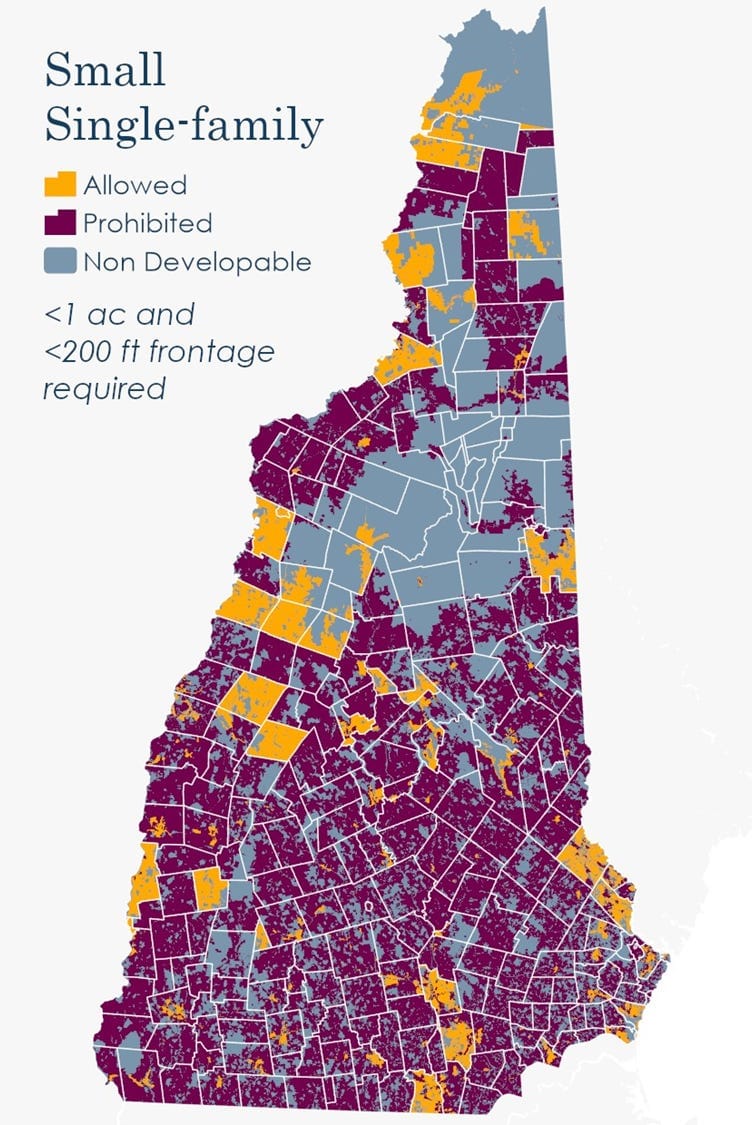
The places that are colored orange here are either: 1) ultra-rural places without zoning where demand for housing and housing costs are extremely low, 2) New Hampshire’s biggest cities, and 3) minuscule village centers scattered around the state. There’s hardly any land for starter-home subdivisions in inner- or outer-ring suburbs.
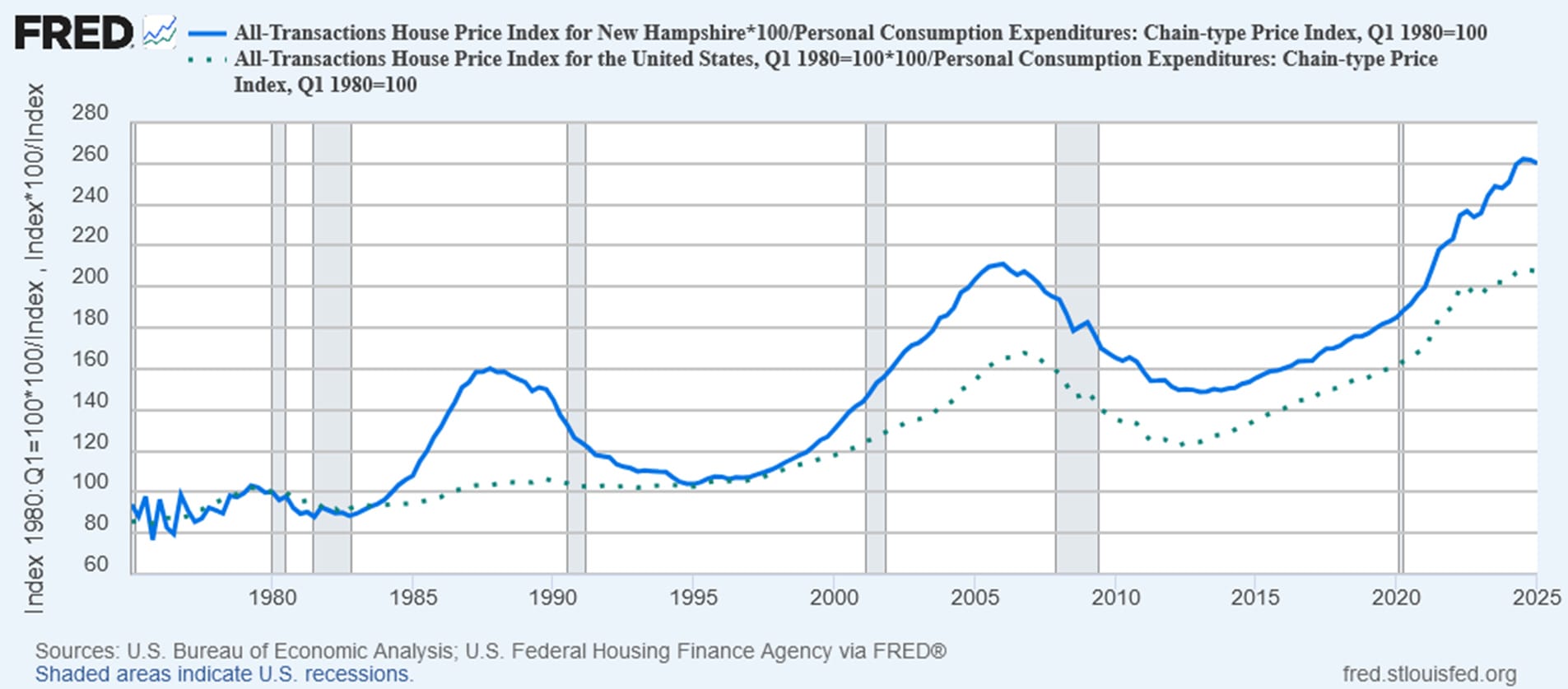
Quality of life is relatively high in most of New Hampshire, and the state has typically been a destination state for interstate migrants, especially before the late 1990s and since about 2015. The migration flows slowed down dramatically after three waves of zoning adoptions and tightenings in the 1970s, 1980s, and 2000s. Since New Hampshire recovered from a particularly sharp recession in the early 1990s, house sale prices have consistently outpaced the national average (Figure 2).
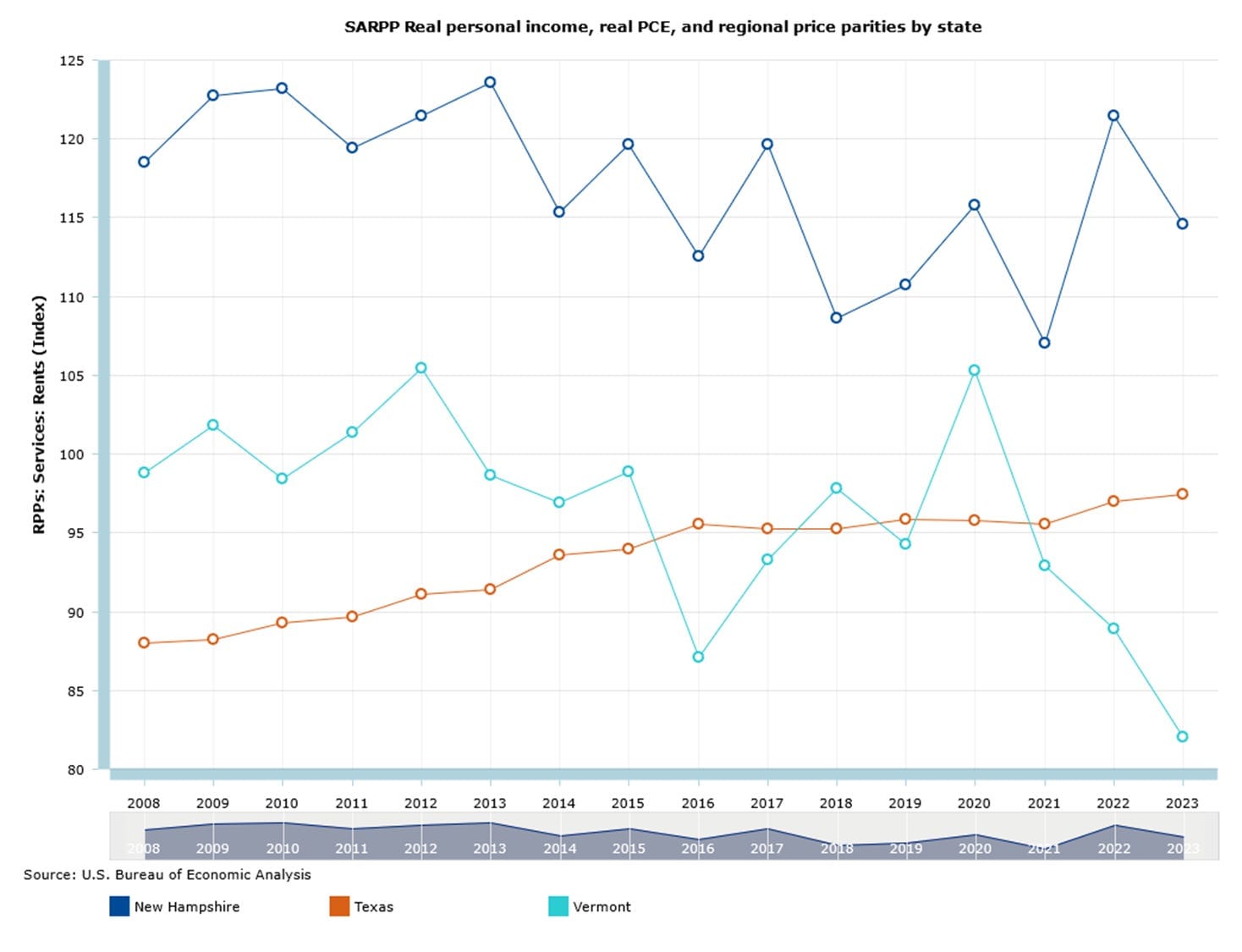
Similarly, rents in New Hampshire are higher than the U.S. average. Figure 3 shows BEA data on rental costs as a percentage of the national average. New Hampshire rents since 2008, the first available date, have been 10-25% above the national average. I’ve included Texas and Vermont here as instructive comparison states. Texas has a lot more net in-migration than New Hampshire but still has much lower housing costs, suggesting greater supply elasticity. Vermont has a lot less net in-migration than New Hampshire and lower housing costs, suggesting that the state probably has lower housing demand than New Hampshire. New Hampshire’s stronger economy probably explains this higher demand.
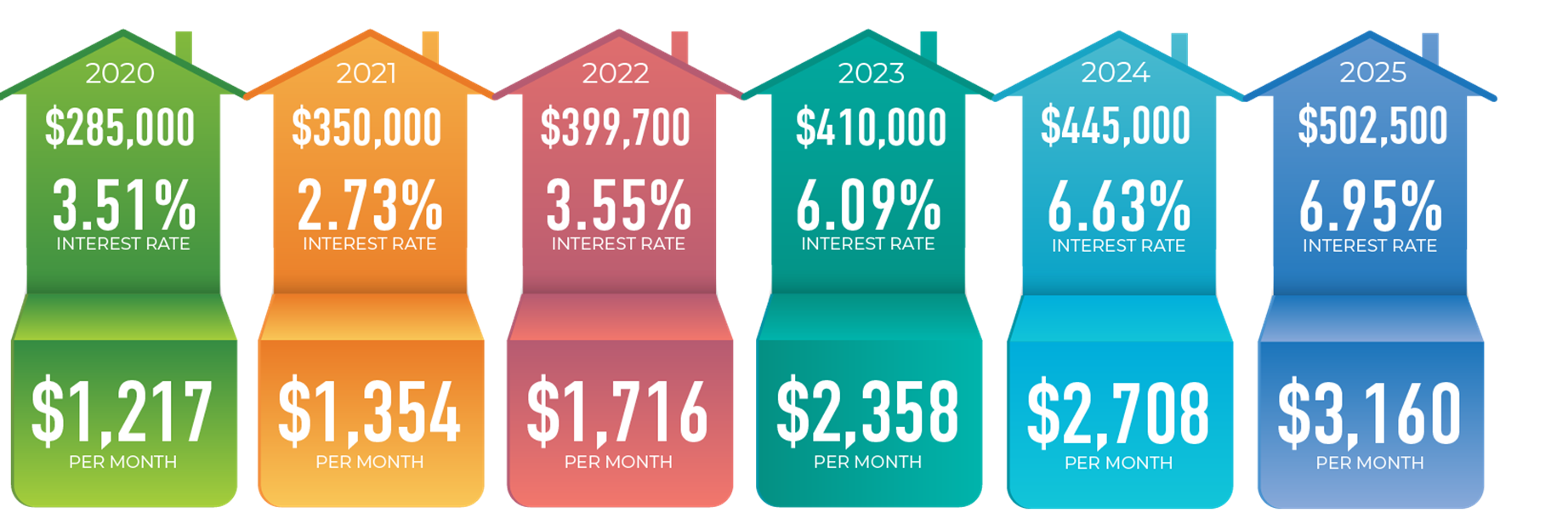
Like many other places, New Hampshire saw housing costs explode over the pandemic, first with a big boost to housing demand, especially for larger houses, as work-from-home and the closure of many entertainment options in big cities drove demand for at-home quality of life in rural areas and small towns, and then later with a general rise in inflation and interest rates. Between 2020 and 2025, the monthly cost of ownership of the median-value house in the state nearly tripled (Figure 4).
The trends in rents and rental vacancies were less dramatic but still marked. According to data from
The Legislation
Legislators responded to popular demand and filed dozens of bills to address housing costs. In
HB633 creates a commission to study charitable housing trusts. I’m excited about the possibility of charitable housing trusts as a device to give residents equity in their home while reducing the transaction costs associated with a traditional sale, such as legal review and title insurance. But this is just a study commission for now.
HB399 establishes a commission to study the entire Zoning Enabling Act. This commission could have huge long-run impact, as they are likely to refer legislation completely rewriting the statute that authorizes zoning. It could be an opportunity to refocus zoning on its legitimate purposes and prevent uncompensated regulatory takings.
SB74 requires all state agencies involved in permitting to make annual reports on their activities. This law could be a starting point for identifying additional pain points in state permitting processes.
HB92 requires members of zoning boards of adjustment to recuse themselves from appeals of decisions of planning boards on which they also serve. It’s a straightforward, good-government, separation-of-powers bill, but it also should help prevent a cabal of naysayers from too easily controlling both the planning board and the zoning board. (In New Hampshire, the planning board does site plan and subdivision reviews, votes on conditional use permits, and recommends zoning amendments. The zoning board deals with variance requests, special exceptions, and building code appeals.)
HB296 creates an alternative pathway for local governing bodies to approve development on private roads and a 30-day shot-clock on appeals to zoning boards, a measure that should largely benefit property owners vis-a-vis complaining abutters.
SB281 legalizes building on Class VI roads, which are public roads not maintained by any government body, so long as the property owner absolves the municipality of all responsibility for the road. Localities had taken inconsistent approaches to development on Class VI roads, which are widespread in rural New Hampshire.
SB283 exempts basements from floor area ratio (FAR) calculations. Only a handful of jurisdictions use FARs at all in New Hampshire, mostly in the larger cities. The new law should open some opportunities for slightly taller or broader buildings in these places.
SB153 expedites driveway permitting from the state Department of Transportation. Developers have mentioned this process as a pain point in breaking ground on larger subdivisions.
HB413 slightly extends subdivision application vesting rights, but its more significant provision is to make building code decisions appealable to superior court and the Housing Appeals Board, a quasi-judicial body for rapid review of housing-related regulatory decisions of local governments.
HB457 stops municipalities from requiring fewer than two occupants per bedroom, a common tactic in college towns. When more college students can split a house, they will free up more housing for families.
HB60 specifies that a property owner may evict a tenant with 60 days’ notice after the expiration of a tenancy or lease agreement lasting longer than one year. While the new law may increase evictions, it is overall a pro-supply bill because it will incentivize property owners to rent out their property. Anti-eviction tenant protection laws often make renters worse off.
HB428 sharply limits municipal technical amendments to the state building and fire codes. In other words, developers can now be confident that a single set of requirements applies to all projects statewide.
SB282 legalizes single-stair buildings up to four stories statewide.
HB631 legalizes residential development in commercially zoned areas and waives all dimensional regulations for residential and mixed-use conversions of commercial buildings that do not increase height or footprint (useful mainly for grandfathered structures). Because it doesn’t preempt density restrictions or other regulations, this law doesn’t go as far as some other states’ RICZ bills.
SB188 allows developers to use municipally approved private agencies to certify documents and inspect buildings, potentially dramatically shortening the process to receive building permits and certificates of occupancy.
HB577 expands the state’s ADU law, now legalizing one attached or detached ADU per single-family lot, by right, statewide, with at most one parking space required under local regulations. The only remaining significant barrier to ADU construction under state law is now the ability of localities to impose an owner-occupancy requirement.
SB284 limits residential parking minimums statewide to no more than one per dwelling unit. It is thus the most significant statewide parking reform in the U.S. (Washington has a further-reaching reform that only applies to cities.)
In addition to these bills, the enacted state budget consolidated state-level permitting in two agencies, the Department of Transportation and the Department of Environmental Services. Developers had long complained of months-long delays at other agencies, especially the Fish and Game Department. The budget also reduced funding for affordable housing programs, so we are about to get a real test of the free-market approach to housing abundance.
The Controversy
Just as the support for housing was bipartisan, so was the opposition. Conspiracy theories ran amok on both the left and the right.
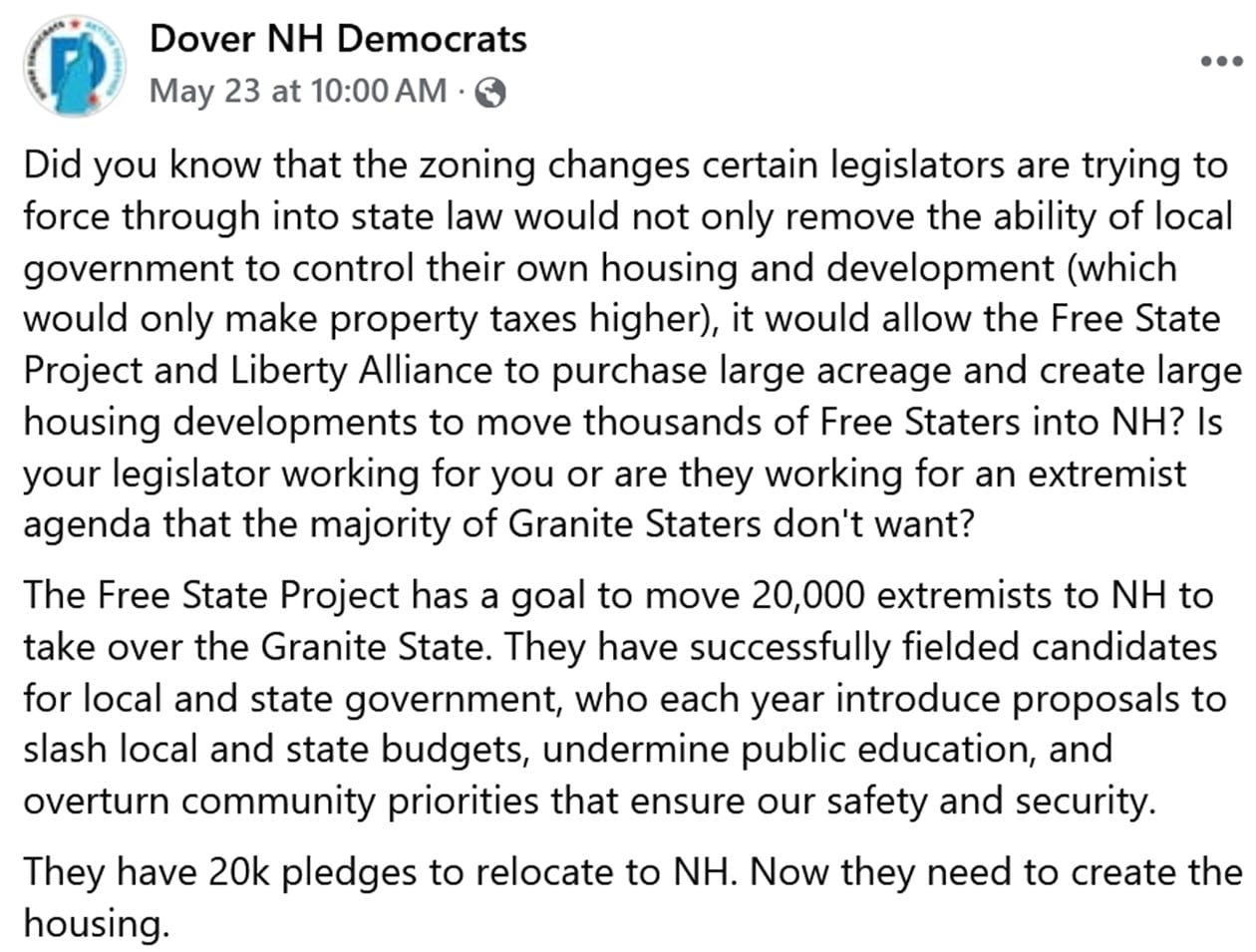

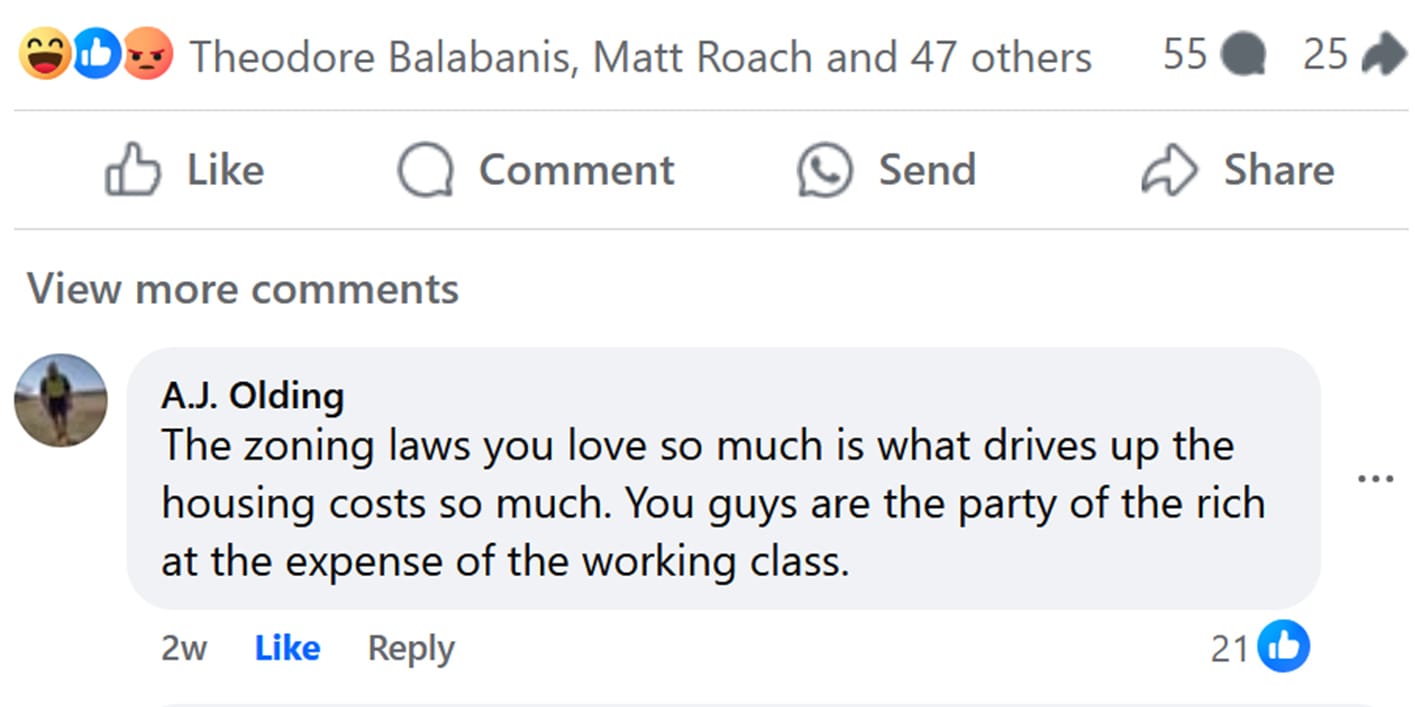
But while left-NIMBYs focused their rage on liberty Republicans, Free Staters, and me personally, right-NIMBYs focused
Reflections
So far New Hampshire is the only northeastern state where Republican legislators have played a big, positive role in pro-housing legislation. Republican governors Phil Scott of Vermont and Charlie Baker of Massachusetts did quite a bit to push housing solutions, but legislators have typically been more reticent.
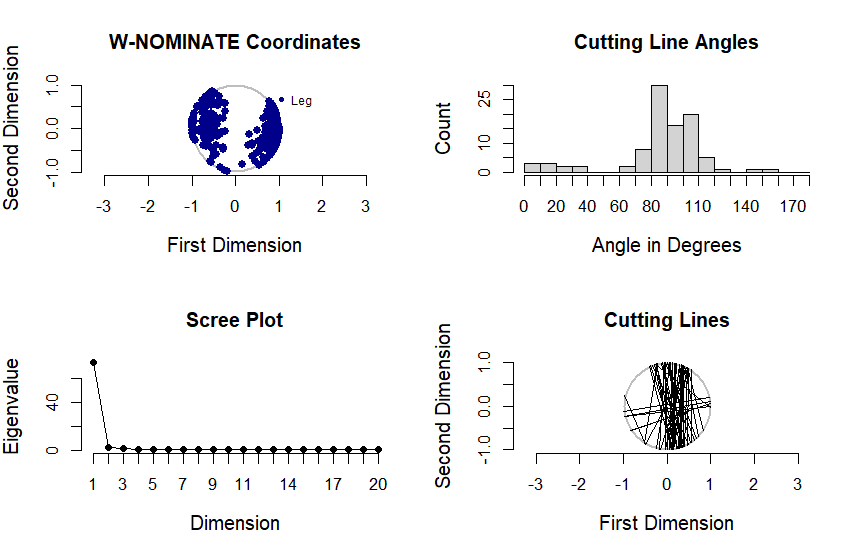
The first dimension has far more explanatory power than the second dimension, as the cutting angles and scree plot demonstrate. In other words, whether you’re right-wing or left-wing has the biggest impact on roll-call voting. Vertical cutting lines indicate votes that tend to divide left and right. Horizontal cutting lines indicate roll-call votes that load onto the second dimension.
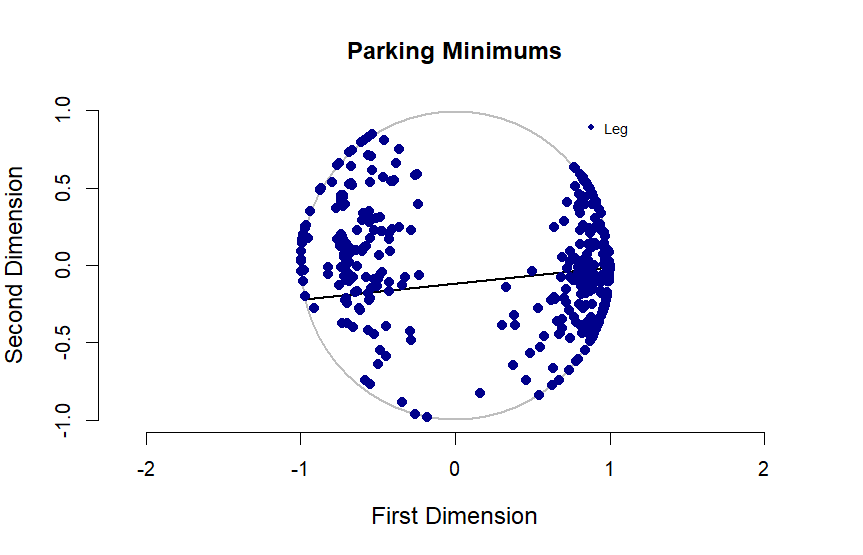
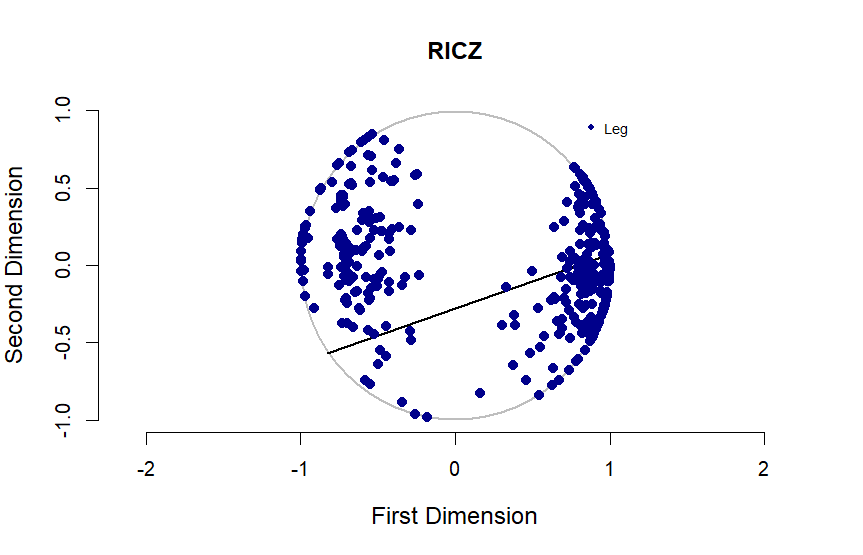
I also investigated other votes with horizontal cutting lines. Does anyone want to guess what other issues may have divided liberty Republicans from… less-liberty Republicans?
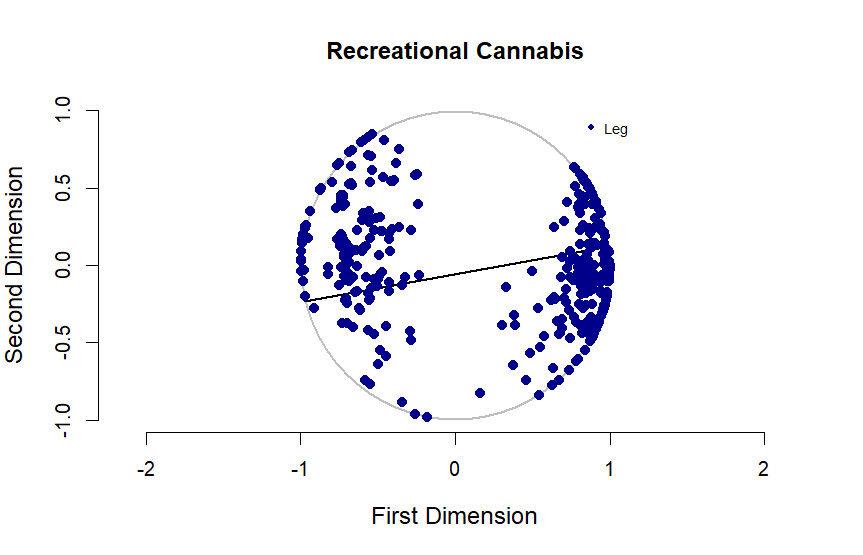
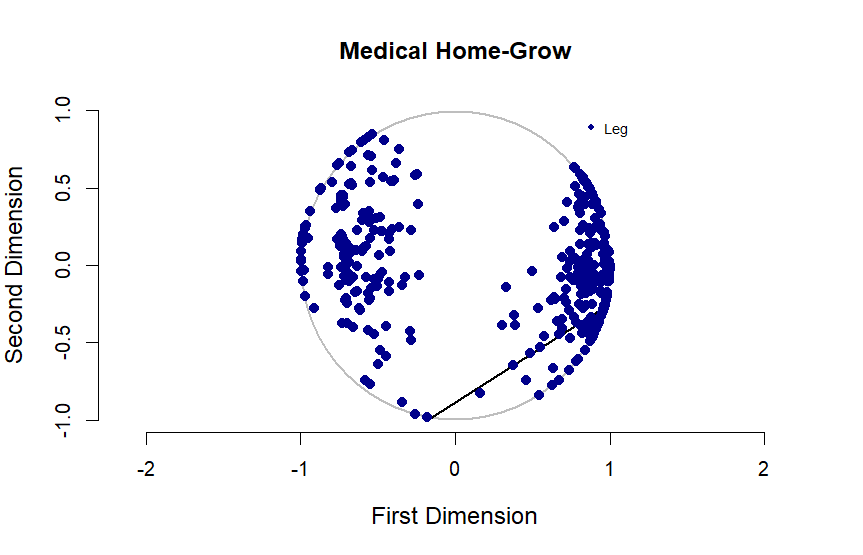
Liberty Republicans and abundance Democrats were more likely to support housing and marijuana legalization. The other interesting conclusion I draw here is that there is no relationship between first-dimension ideology and second-dimension ideology among Democrats, but there appears to be a
I didn’t use Senate roll-calls because there aren’t many. They rely heavily on voice and division votes.
The Best “Go Paid” Deal on Substack! You Get REAL Stuff!!

Go paid at the $5 a month level, and we will send you both the PDF and e-Pub versions of Etienne’s new book: To See the Cage Is to Leave It - 25 Techniques the Few Use to Control the Many and a coupon code for 10% off anything in the https://artofliberty.org/store/.
Go paid at the $50 a year level, and we will send you a free paperback edition of Etienne’s new book: To See the Cage Is to Leave It - 25 Techniques the Few Use to Control the Many OR “Government” - The Biggest Scam in History… Exposed! OR a 64GB Liberator flash drive if you live in the US. If you are international, we will give you a $10 credit towards shipping if you agree to pay the remainder.
Support us at the $250 Founding Member Level and get a signed high-resolution hardcover of “Government” - The Biggest Scam in History... Exposed! + Liberator flash drive + a signed high-resolution hardcover of Etienne’s new book: To See the Cage Is to Leave It - 25 Techniques the Few Use to Control the Many + everything else in our “Everything Bundle” of the best in voluntaryist thought delivered domestically. International pays shipping. Our only option for signed copies besides catching Etienne @ an event.


