By Scott A. Burns, Caleb S. Fuller
Note: This is the eighth article in a multi-part series on teaching economics through today’s ongoing trade war. You can read Part 1 here, Part 2 here, Part 3 here, Part 4 here, Part 5 here, Part 6 here, and Part 7 here.
One of the greatest blessings of teaching economics is that the news cycle never fails to provide us with teachable material.
Today’s headlines are no exception.
Since launching their trade war in April, the Trump administration has provided us with a treasure trove of lessons for our students. Perhaps their greatest contribution to this educational cornucopia has been the masterclass they’ve conducted on how not to win a trade war.
Their first fatal mistake came on April 2 (“Liberation Day”—the D-Day of today’s trade war). On this day, they broke the first (and second) rule of fighting trade wars: do not start a trade war.
Earlier in this series (Part 2), we discussed the multipronged and ever-evolving rationales proffered by today’s mercantilists for the ongoing trade war: that tariffs are necessary for raising tax revenue, economic protection, and as leverage in strategic trade and diplomatic negotiations. Our ensuing articles showed that each of these rationales falls apart under scrutiny.
Tariffs aren’t an effective way to raise tax revenue (Part 3). This is especially true in the 21st century when the federal government’s share of GDP is ten times higher than it was in the 19th century. To the extent we need to raise additional revenue, there are far better tools at our disposal than tariffs.
Tariffs also can’t be justified on economic grounds. From a historical standpoint, tariffs were in no way responsible for America’s economic growth in the first 150 years of the Republic (Part 4). If anything, the U.S. economy grew despite tariffs, not because of them. Tariffs also served as a magnet for cronyism and corruption, which centralized far too much economic power in Washington, D.C. The blatantly corrupt nature of this tariff regime helped prompt the passage of the 16th Amendment.
Nor can tariffs be justified by the administration’s more popular argument today that they protect us from persistent trade deficits. Despite its ominous-sounding language, there is nothing inherently bad or dangerous about running a “trade deficit.” Trade isn’t a zero-sum game. By definition, trade is “win-win”—it makes both sides richer. This is just as true for trade between individuals who live in the same nation as for individuals who live in two different countries. Bilateral trade deficits pose no threat to our economy (Part 5). The same applies to our overall trade deficit with the world (Part 6). Contrary to popular belief, imports do not lower our GDP (thanks to specialization, they actually raise it). When it comes to trade, we’re all on the same team. The more trade, the better.
Lastly, tariffs aren’t particularly effective as a negotiating tool (Part 7). This holds true even if you’re merely using them as a threat in a “strategic trade war” that is intended to bring about free trade. Even if they’re wielded with the best of intentions, tariffs are a blunt instrument. Our policy toolkit has far more surgical tools than the threat of mutually assured economic destruction.
All in all, there’s no good economic case for tariffs and other types of protectionist policies. The only solid arguments are non-economic ones —namely, protecting our national security. However, even this rationale must be vigilantly guarded from abuse. Once the door is opened to these sorts of exceptions, a legion of pleading special interest groups is never far behind.
We hope these articles have taught readers about the biggest follies of today’s trade war and provided some intellectual ammunition for combating the most popular myths about trade. However, the simplest and most persuasive case against today’s trade war boils down to the lesson in our first piece of this series.
Economics of Trade Wars in One Lesson: The Broken Window Fallacy Applied to Trade
We began this series with the fallacy that lies at the heart of all trade wars: Frederic Bastiat’s “Broken Window Fallacy” (Part 1). In Economics in One Lesson, Henry Hazlitt poignantly summarized Bastiat’s seminal insight by observing that the art of economics consists in looking not just at the immediate and “seen” effects of a policy on a particular group, but tracing its “unseen” effects on all groups.
How does this lesson apply to today’s trade war and protectionism, in general?
Mercantilists are always quick to point out protectionism’s visible (“seen”) effects. They love to point to Rust Belt factories reopening and headlines about American firms “bringing back” jobs as evidence that restricting trade creates prosperity.
To the layperson, the results of mercantilism seem like magic. “Look, domestic jobs reappeared!” But to the economists’ well-trained eye, the sleight of hand is obvious. By drawing our attention to the visible benefits that a small group of firms and workers reap from protectionism, mercantilists are able to conceal its even greater “unseen” costs on the rest of the economy. These costs are admittedly much harder to detect—they’re dispersed throughout society in the form of new products and higher-paying jobs that never get created in the first place. But they’re every bit as real.
A real-world example helps bring this abstract point to life. Suppose that, per Commerce Secretary Howard Lutnick’s wishes, the U.S. bans imported iPhones. To meet our domestic iPhone demand, we’d need to redirect millions of Americans to work in newly created iPhone factories.
Considering that we have enough trouble filling our existing manufacturing job openings, redirecting millions of American workers to these jobs won’t be easy. Americans aren’t exactly pining to return to the factory, let alone for something as tedious as making iPhones. We may even have to conscript workers to fill these jobs. Regardless, protectionists like Secretary Lutnick may tout this development as a smashing success: “Look, we created millions of jobs right here in the U.S.!”
But the discerning economists will reply: “At what cost?”
Suppose, for argument’s sake, that a software developer who was slated to start a $200,000 job working for Apple computers is instead conscripted to work in Apple’s iPhone assembly factory, making only $20,000. Protectionists like Lutnick quickly point to what is “seen”— the $20,000 iPhone assembly job created in America. But they conveniently ignore this arrangement’s much larger (opportunity) cost—the $200,000 high-quality job that is destroyed! Trade-offs matter. On net, the U.S. economy is made $180,000 poorer by this arrangement, not $20,000 richer.
Tinker with this example all you want, but the takeaway remains: protectionism makes us poorer. Sure, we could recruit or conscript lower-skilled workers making only $30,000 a year instead of high-skilled software developers or doctors making much more. That would reduce the magnitude of this trade-off, but the net effect on the economy would still be negative. Or we could pay iPhone workers higher salaries— say, $50,000 a year, or higher. But that would raise iPhone prices, leaving consumers with less money to spend on other products and thus destroying jobs in those sectors.
No matter how you slice it, protectionism shrinks our economy and makes Americans poorer. The same is true for our trading partners. When iPhone assembly factories get shut down in Vietnam because of protectionist policies in America, Vietnamese workers are stripped of what for them was their best available job opportunity. They’re then forced into less desirable jobs, reducing their well-being and shrinking their economy as a whole. Americans and foreigners are both made better off when they’re free to work jobs they’re best suited for and trade with whomever they want.
The beauty of trade is that it allows us to enjoy “the best of both worlds.” It frees us to specialize in making the stuff we’re efficient at making (e.g., software) so that we can buy stuff we’re not efficient at making (e.g., iPhones) at much lower prices. Restricting trade, in contrast, forces us to endure the worst of both worlds. The last thing that American policymakers should want is to usher in a dystopian world where U.S. workers are stuck working much worse jobs, earning much lower income, only to buy much more expensive iPhones with less leftover to buy everything else we enjoy.
Why are Tariffs So Popular? The Logic of Concentrated Benefits and Dispersed Costs
If protectionism is such an economic disaster, why is it so politically popular? Libraries have been filled with detailed explanations to this question, but a simple answer can be expressed in five words: concentrated benefits and dispersed costs. The benefits of protectionism are heavily concentrated on a fairly small group of people. Still, its costs are dispersed across everyone else in society.
Again, a real-world example helps make this abstract argument more concrete. U.S. auto companies and their workers would no doubt benefit from a tariff on their foreign competitors. It’s therefore understandable why auto lobbyists and labor unions spend millions of dollars each year to wheedle members of Congress to impose trade restrictions. However, the cost of these policies would be dispersed across the entire economy in the form of marginally higher car prices.
Who has more incentive to vote based on this single issue: the auto worker whose $120,000 a year job is entirely attributable to tariffs, or the consumers who likely won’t even notice they’re paying $1,200 more than they otherwise would for a car? You can see why auto workers who already work closely have no problem organizing themselves to form an effective political coalition. Consumers, on the other hand, face a “collective action problem.” Even if we can get all of them to agree that we’d be better off without tariffs, it’s hard to get millions of strangers from disparate regions to band together to vote on this one issue that likely ranks low on their list of priorities. Besides, suppose these consumers’ time is valuable. In that case, it won’t take long before the costs of their efforts exceed the $1,200 they can expect to receive in the unlikely case that their campaign is successful.
The same logic of concentrated benefits and dispersed costs that we applied to the auto industry in our example applies to virtually every other sector of the economy. This, in a nutshell, is why bad trade policies persist—undeniably, restricting trade benefits some U.S. workers and firms in the short run, particularly if they compete with foreign imports. However, that protection comes at an enormous cost to the rest of us, especially in the long run. When trade is restricted, American consumers are forced to pay higher prices. This leaves them with less disposable income to spend on other items, destroying jobs in those sectors and reducing the size of our economic pie.
Once we’ve traced through all the “unseen” effects of protectionism, it’s clear that trade wars make Americans and the world poorer. Breaking trade deals, like breaking windows, only destroys wealth. The notion that we can bring about prosperity by destroying the global division of labor that created such enormous wealth over the past few centuries is just another example of the broken window fallacy. It’s a myth that is upheld by political cronyism and economic fallacies. Whether the fallacies perpetuated by today’s protectionists are rooted in ignorance or deception is irrelevant. Ignorance of the laws of economics is no excuse for bad policy, especially when the economic laws that govern international trade—Adam Smith’s division of labor, David Ricardo’s law of comparative advantage, etc.—have been so well-established for so many years.
Economists revel in being “mythbusters.” Exposing mercantilist magic tricks might not make us fun party guests. It certainly won’t make us the toast of the town in Washington, D.C. However, helping people “see the unseen” so that they can separate reality from illusion is one of the most rewarding parts of the job. Teaching people how to think like an economist is like giving them LASIK eye surgery so they can see the world in a whole different light. It’s understandable why those who benefit from protectionism want to deny others this treatment. But it’s unfortunate that so many in power either fall prey to these cheap parlor tricks or actively perpetuate them for political gain.
So, beware the protectionists’ sleight of hand. The wealth that is “created” by protectionism may seem real, but it’s an illusion. It all comes at the expense of the far greater wealth that would’ve arisen from free trade. Don’t fall for the trick. As Michael Caine demonstrates in The Prestige, behind every rabbit pulled out of a hat is a hidden litter of discarded bunnies.
The Fatal Conceit of Protectionism: Destroying the Ring of Power over Tariffs
President Trump clearly doesn’t understand Bastiat’s lesson of the “seen” and the “unseen.” His well-documented hostility towards trade dating back to the 1980s makes that abundantly clear. Unfortunately, his ignorance of economics runs far deeper than falling for some mercantilist myths. If his bold efforts to reengineer the global economy over the past few months are any indication, he doesn’t grasp the core ethos of economics.
At its core, economics teaches us humility. It helps us appreciate the marvelous complexity of the market economy. Therefore, it should humble those in power about the limits of their knowledge and the perils of trying to plan an economy in any sort of top-down, command-and-control fashion.
There’s a reason why those in power so often deride economics as the “dismal science.” Economics puts parameters on planners’ utopias and exposes the folly of their best-laid plans. Correctly understanding economics should constrain our technocratic impulses, not unleash them. As F. A. Hayek observed in The Fatal Conceit, “The curious task of economics is to demonstrate to men how little they really know about what they imagine they can design.”
President Trump’s actions over the past few months have been a case study in economic arrogance. Since April 2, his administration has certainly engaged in “bold, persistent experimentation” in its effort to overhaul the global economy. So confident were they in their grandiose plans that they decided to launch the largest trade war since the Great Depression.
Suffice it to say this ambitious project hasn’t exactly gone according to plan. The chaotic, on-again-off-again nature of today’s trade war has roiled markets and generated a dizzying amount of regime uncertainty. Even though the President temporarily put his most impactful tariffs on hold, the fog of the trade war has hardly lifted. Business investment has cooled dramatically, and the economy is performing well below its pre-tariff trend. Given that the President’s 90-day pause is slated to end this month, the relative calm markets have experienced over the past couple of months likely means that we’re in the eye of the storm, not the other side.
It’s always tempting for political leaders to think that they can be the enlightened ones who can use their immense power to bring about a better world. To be fair to President Trump, he’s not alone in this hubris. Almost every leader sees themselves as King Arthur pulling Excalibur from the stone.
Given the enormous power that Congress has granted to our presidents to dictate trade policy unilaterally, a more apt fictional analogy might be to the “Ring of Power” in J.R.R. Tolkien’s The Lord of the Rings. It is hard for presidents to resist the temptation of wielding so much power over the economy. But Gandalf was right. Whether we’re talking about Sauron’s threat to Middle Earth or President Trump’s trade war today, the only way to handle a ring of absolute power is to destroy it. Congress would be wise to heed this advice by casting the Ring of Power they created over trade policy into the fire so President Trump and his successors aren’t tempted to abuse it further.
Conclusion
We started this article by noting the blessing of teaching economics: the news cycle always delivers. The blessing of being an economist is that our knowledge and advice are always in demand.
Alas, this blessing is also our curse. Why? No one in power actually listens to us, much less heeds our advice. F.A. Hayek once mused that no other discipline is called upon for advice so often, only to have that advice so swiftly ignored. This observation is spot on if our current state of affairs is any indication. For economists, every day feels like Groundhog Day. Each new day brings a fresh batch of headlines that cry out for our attention, only to be followed by politicians who refuse our advice.
It’s hardly surprising that politicians are so quick to dismiss us. All too often, economists are bearers of bad news. Every time a politician devises some newfangled plan that promises to deliver voters something for nothing, economists are duty-bound to remind them that “there’s no such thing as a free lunch!” Thomas Sowell put it bleakly in A Conflict of Visions, “There are no solutions, only trade-offs. Politicians have an unconstrained view of the world and what they can accomplish. Economists have a constrained view. The two visions are inexorably in tension.”
This is yet another reason why those in power deride economics as the “dismal science.” Most of the advice we impart and the lessons that we draw from the headlines are prescriptive in nature. They’re cautionary tales about what not to do and what can’t be accomplished with mere good intentions.
Reminding politicians that we live in a world of scarcity and every choice requires trade-offs makes us quite the buzzkill at Washington, D.C., cocktail parties. To be fair, it’s hard to blame them for tuning us out or looking at us like we’re the Grim Reaper. If you’ve talked to any economist for more than five seconds, you know that once you’ve heard the phrase “but on the other hand” a few dozen times you’re bound to join Harry Truman’s search for a one-handed economist.
If economists struggle to get politicians to listen to them, what is our best hope to get them to listen to us in today’s trade war?
Too often, economists make the case for trade by invoking dense concepts like comparative advantage or using a flurry of terms that most people don’t understand and that economists themselves struggle to explain. We admit that we may be guilty of this occasionally (Looking at you, balance of payment accounting). Our students would probably prefer we stick to Frank Knight’s simple observation that “a trade is a trade is a trade” (whether within or across political boundaries).
At the end of the day, however, our best argument for trade is a story.
Imagine an eccentric entrepreneur declares he’s found a new technology for turning corn into cars. Skeptics laugh, labeling him a “crank” and a “shuckster.” But, lo and behold, when their investigative journalists report back from his ocean-front factory, they confirm the impossible: shucks of corn pour in; cars roll out.
This radical technology sends shockwaves through the economy. Domestic car companies lobby politicians to shut down this new low-cost competitor. But the American public fights back, praising her for producing cheap, high-quality cars they previously couldn’t afford. This frees them to spend thousands of dollars each year on other products, thus stimulating those industries. Overall, Americans are made much richer thanks to this bold entrepreneur and her mysterious technology.
One day, an intrepid journalist enters the factory and discovers the secret to the entrepreneur’s success: the factory isn’t a factory at all—it’s a port! There’s no magic machine turning corn into cars. There’s just a port teeming with dock workers who load up crates of corn trucked in from Iowa and then ship them off to Japan in exchange for cheap, high-quality Japanese cars.
As Bryan Caplan eloquently explains, the moral of the story is that the visionary entrepreneur did find a way of converting corn into cars. “What difference does it make what’s in the factory?! For all practical purposes, foreign trade is a kind of technology—a creative way to reduce our cost of living and [thereby] increase our standard of living.”
If Congress doesn’t have the courage to rein in his power, is there any hope that economists can get President Trump to see through this mercantilist mirage and put an end to his disastrous trade war?
On the surface, such an effort seems hopeless. Over his four-decade career in the public eye, President Trump has been crystal clear about one thing: he loves tariffs and thinks foreign trade is bad. He also loves the immense power that Congress has granted presidents to set tariffs, so he can set whatever terms he wants to trade in his fiefdom. In a revealing Time Magazine interview, the President likened himself to a department store owner charging companies whatever price he deems appropriate to sell their products in his store (clearly he doesn’t understand how department stores work. Mistaken as this example may be, it does give us an interesting insight into how he sees the world and how economists may be able to get through to him on trade.
First and foremost, President Trump sees himself as a businessman. Reasonable people can disagree on his success in running his business empire. But as a longtime businessman, he isn’t completely blind to the benefits of markets and trade. In his former life, he had no problem seeing the benefits of trade for his business. The Trump Organization conducted billions of dollars worth of transactions worldwide while he was at its helm, and it still does so today.
The president also has no problem acknowledging the benefits of domestic trade. He supports free trade within our nation’s borders. To date, he’s proposed no restrictions on trade between the 50 states (Greenland and Panama TBD; our prospective 51st state, Canada, not so much).
He also has no problem embracing the logic of specialization when it benefits him personally or politically. He understood it beautifully when he “wrote” his best-selling magnum opus, The Art of the Deal (He effectively traded his time and money for the ghostwriting services of Tony Schwartz). He even implicitly accepted the benefits of foreign trade when he advocated sending U.S. prisoners to El Salvador (evidently, El Salvador has a comparative advantage over the U.S. in detaining prisoners, and Qatar has one in producing Air Force Ones. Who knew?).
For all the ink spilled trying to divine his true motives, his philosophy on trade is quite simple: trade is good when he thinks it serves his needs, and bad when it doesn’t. Understanding this might be the key to unlocking his mind and changing his views on trade.
Only the Almighty knows how the President’s trade war will play out from here. It’s been a turbulent past three months, to say the least. Who knows what changes might occur later this month when the 90-day tariff pause comes to an end.
In the meantime, let’s hope that somewhere near Mar-a-Lago, a Trump-whispering economist can convince him that free trade benefits him directly. Who knows? Maybe all we need to do is rename our ports along the Gulf of Mexico, America, and throughout the United States, the “Ports of Trump,” then convince him that whichever nation’s ports handle the biggest trading volume wins. It’s a long shot, but it’s worth a try.
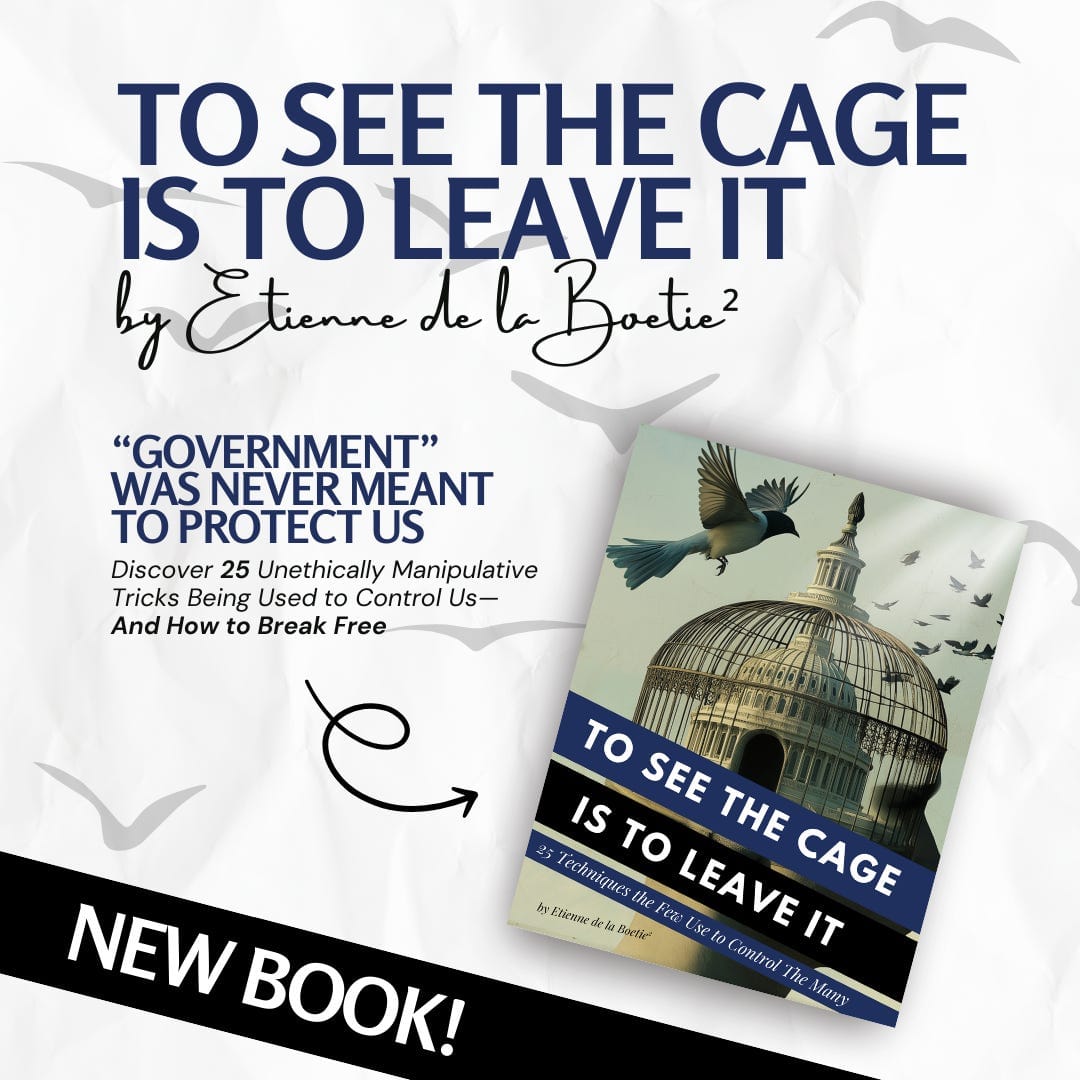
New book by Etienne de la Boetie2 exposes that the government and Hollywood have been running a multi-generational, trillion-dollar psychological operation on the population to indoctrinate them into accepting a ruling class, confiscatory taxation, and inflationary fractional reserve currency issued by private banks.
The book details 25 unethically manipulative techniques the “government” and monopoly media have been secretly using on the population, ranging from a hidden curriculum in their mandatory schools and scouting to the secret placement of propaganda in over 1,000+ movies and 1,000+ television shows. These techniques include subliminal messages and product placement of the American flag “anchored” to moments of high-positive emotion during the “programming”.
See the Press Release with more details HERE.
Buy the book at SeeTheCage.com
Substack readers can get the book for FREE by “Going Paid” to ANY of the Art of Liberty Foundation’s four Substacks AND get access to all four of those Substacks! Simply “Go Paid” and we will reply with details.