

Through most of human history, opium circulated in very small quantities and was used primarily as a medicine. Anatolia was probably the region in which farmers first began to cultivate poppies as an important commercial crop, and the practice is thought to have spread outwards from there. The armies of Alexander the Great are believed to have carried opium into Iran, hence the derivation of the Persian and Arabic words for opium, “afyun,” from the Greek “opion.” The Perso-Arabic terms, in turn, engendered the word “afeem,” widely used across the Indian subcontinent, and Chinese terms “afyon” and “yapian.”
A useful analogy in thinking of the social history of opium is that of an opportunistic pathogen, one that goes through long periods of dormancy, affecting very small numbers of people. But when social processes and historical events provide the pathogen with an opportunity, it bursts out to rapidly expand its circulation. With opium this happened in several phases, over centuries, usually in connection with empires. The Mongol Empire, for instance, along with its successor states, played an important role in propagating opium in many parts of Asia in the 15th and 16th centuries. This came about because opium was adopted as a recreational drug by imperial courts and ruling elites; it was not used as an instrument of state policy. The pioneer in that regard was the Dutch East India Company, which made extensive use of opium in its quest for commercial and territorial expansion in Southeast Asia. Yet while the Dutch led the way in enmeshing opium with European colonialism, it was the British in India who perfected the model of the colonial narco-state, when they began to use opium to pay for their imports of Chinese tea, a commodity that produced enormous revenues for Britain in the colonies as well as the metropolis.
After Britain, the country that benefited the most from the China trade—and, therefore, the global traffic in opium—was none other than the United States. And in the United States, unlike in Britain, it is well-established that the beneficiaries included many of the preeminent families, institutions, and individuals in the land.
This is not to imply that fewer British subjects benefited from opium; quite the contrary. Since Britain was the prime mover behind the global drug traffic, its involvement with opium was obviously on a much larger scale than that of the United States. Not only was the British colonial apparatus in India overseeing the production and distribution of most of the world’s opium, but Britain was also home to the single largest, and richest, group of “private traders” involved in smuggling opium into China. It is possible that the pathways of the fortunes that British traders brought back could be tracked in the same way the circulation of the wealth derived from slavery has been charted in recent years. But the task would not be an easy one, because opium money seeped so deeply into 19th-century Britain that it essentially became invisible through its ubiquity. In any event, this exercise has not been undertaken, possibly because of its inherent difficulties, or because it would threaten cherished myths about Britain’s imperial past, or because there exists no domestic constituency to press for such an investigation, as was done for slavery.
On the other hand, even though the United States’ involvement with the 19th-century opium trade was on a far smaller scale than that of Britain, what became of the money that was brought back by American private traders has been tracked in considerable detail. The principal reason for this is probably that those funds had a much greater impact in the young, newly independent country, because its economy was tiny compared with Britain’s.
Such was the influence of the China trade on the United States that its place in American memory is very different from that in British or Indian memory. One sign of this is that while Britain possesses vast collections of Chinese objects, books, and artworks, it does not, so far as I know, have any museums devoted solely to the China trade: Its Chinese artifacts are mostly housed in institutions that are global in scope, such as the British Museum and the Victoria and Albert Museum. In America, by contrast, there exists a museum dedicated entirely to the China trade. Nor is this the only one; there are several others in which the China trade figures prominently, such as the impressive and well-funded Peabody Essex Museum in Salem, Mass.
Current Issue
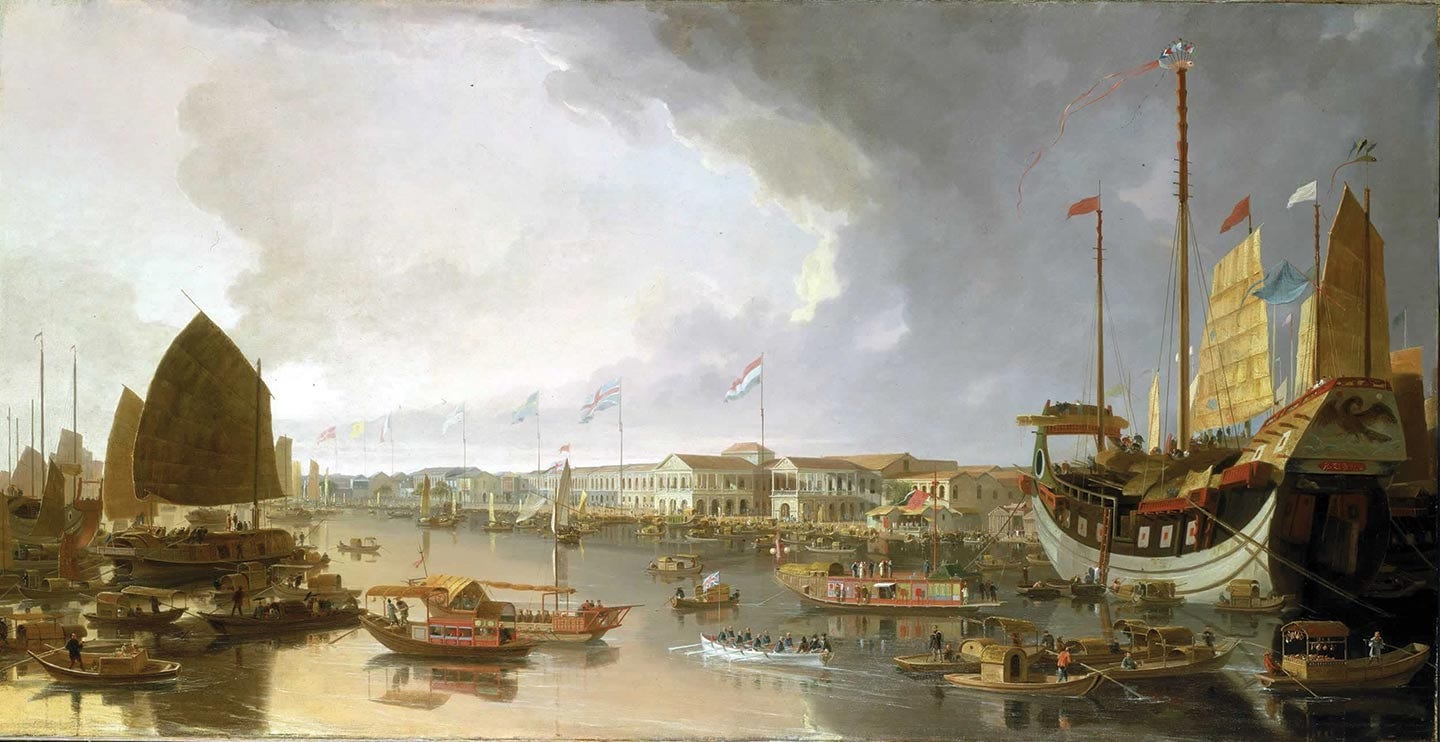
Another measure of the impact of the China trade on the United States is the sheer number of American towns and cities named Canton: There are more than 30, twice as many as are named after London. Yet while there are many American Cantons, there is not a single Guangzhou or even Whampoa: Those names would perhaps have made China’s unseen presence within the country uncomfortably real. The word “Canton” thus served to create a very particular niche within American memory, one in which China was domesticated and anglicized and the disconcerting realities of the opium trade were rendered palatable.
Those realities have been the subject of several excellent studies, including John R. Haddad’s America’s First Adventure in China, Dael A. Norwood’s Trading Freedom, and Jacques M. Downs’s The Golden Ghetto: The American Commercial Community at Canton and the Shaping of American China Policy, 1784–1844. The last of these was the outcome of a lifetime’s work: Downs combed through the records of all the major traders, which together constitute an archive of monumental proportions, having been preserved by “New Englanders and Philadelphians—people who never discard anything, be it documents, clothes, broken furniture, or outworn institutions.” Yet, while massive in size, the archive does not necessarily provide a transparent window on the past: The traders were generally very careful to hide the real nature of their businesses, even warning their families back home not to make anything public of their letters. In some instances, the traders’ descendants selectively destroyed papers that mentioned the buying and selling of opium.
Opium did not, by any means, account for the entirety of the traders’ businesses, but their other ventures were entirely predicated on it. They used their earnings from the drug to fund their purchases of teas, porcelain, silk, artworks, and much else. Thus, for example, in a letter written shortly after Commissioner Lin Zexu shut down the opium trade in 1839, Robert Bennet Forbes, a young Yankee trader, explained that no other part of the foreign merchants’ business with China could function without it: “[T]he Opium trade being cut off there is no money… thus does the Opium Trade affect every one trading here and us too… we cannot get money to buy tea & so we do not get our commissions.”
Traders like Forbes and his brother John understood perfectly well, as Downs notes, that “the entire China trade, was based on the opium traffic.” It is essential to remember, therefore, that America’s China trade, as a legitimate commerce, existed for only about 20 years, from 1784 to 1804. When applied to later forms of the commerce, the expression “China trade” is nothing other than a polite euphemism, much like calling Pablo Escobar’s cocaine business the “Andean trade.”
The coupling of the United States and China is not a new phenomenon, as many American pundits seem to believe. As Norwood explains in Trading Freedom, this link has existed since the earliest days of the republic. In America, as in Britain, it was tea that created the initial connections. Americans too were enthusiastic drinkers of tea, which “had a special place in the new nation’s political imagination for its ties to the performance of gentility,” Norwood writes. But during the colonial period, Americans were expressly forbidden to trade with China, that being the exclusive prerogative of the East India Company. As a result, the tea that Americans drank had to be routed through Britain, which made it more expensive. The resentments generated by this exploded in 1773 with the Boston Tea Party, which helped light the fuse of the American War of Independence.
At the end of the war, in 1783, the new nation found itself independent but hemmed in. With nearby British colonies shut off from trade, China was one of the few worthwhile destinations open to American ships, a potential lifeline for the country’s merchants. “Send ships immediately to China,” John Adams told Congress in 1783. “This trade is as open to us, as to any nation.” Adams got his wish soon enough: The first American vessel to set off for China, a diminutive sloop by the name of the Harriet, hoisted sail the same year, within weeks of the departure of the British from New York. But the Harriet never reached China. Its cargo, which consisted mainly of ginseng roots, was acquired at an unusually high price by the captain of an East India Company ship at the Cape of Good Hope. This was probably done in the hope of dissuading the Americans from entering directly into the China trade—but the race was already on, and there was no stopping it.
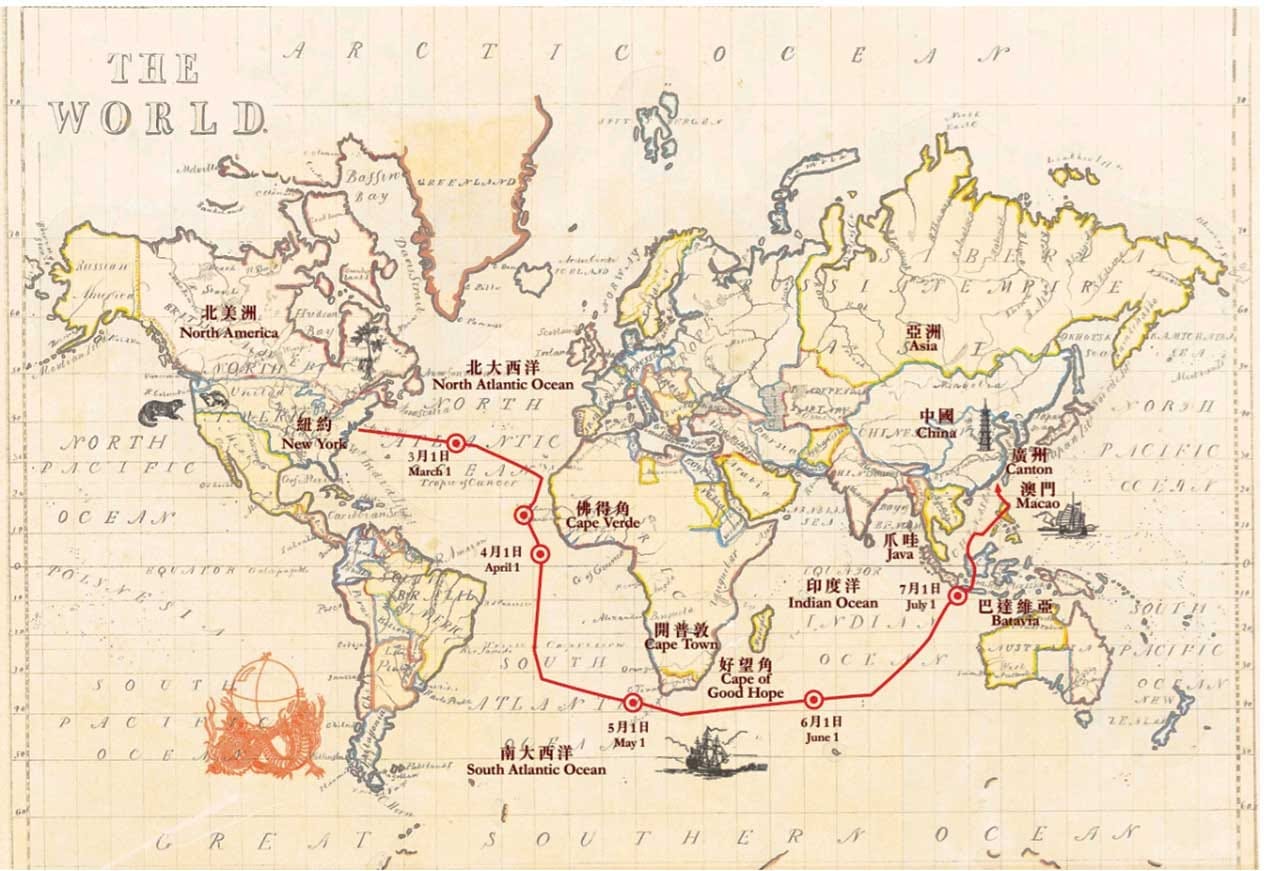
The Harriet was followed, two months later, by a much larger vessel, whose mission was announced by its name: the Empress of China. The supercargo (business agent) was Samuel Shaw, a veteran of the Revolutionary War who would later become an ardent advocate for expanding America’s trade relations with China.
Six months after its departure from New York, the Empress became the first American ship to drop anchor at Whampoa, the last deepwater anchorage on the Pearl River. As Jonathan Goldstein relays in his study of Philadelphia and the China trade, the Americans were warmly welcomed by Chinese merchants, and the Empress’s cargo, which consisted of rum, furs, and “the largest quantity of ginseng ever brought to the Chinese market,” was sold for good prices. On its way back, the ship’s holds were filled with tea, porcelain, and textiles; it also carried some Shanghai roosters, which on being cross-bred with American strains produced a variety—the “Bucks County chicken”—that soon became immensely popular in the United States. These imports earned the Empress’s owners $30,000, a solid 25 percent return on their investment. Word of the ship’s successful voyage spread quickly along the Eastern Seaboard, and soon merchants and shipowners from Boston, Salem, Providence, New York, and Baltimore were also outfitting vessels for the journey to China. Within a few years of the Empress of China’s voyage, dozens of American ships were visiting Guangzhou annually.
But American merchants quickly ran into the same problem as others had before them: They had to pay for Chinese tea with Spanish silver dollars, and there was little the Chinese wanted from them other than bullion. Ginseng was one commodity for which there was some demand in China, but the American product was considered inferior, and there was only so much of it that the market could absorb. What else? For a while the answer was furs and sealskins, and that was how two Massachusetts families—the Delanos and the Perkinses—were drawn into the China trade along with John Jacob Astor, America’s most prominent vendor of furs. However, despite their initial success in selling furs to the Chinese, they soon encountered an insurmountable challenge: There were only so many seals and sea otters that could be killed before their numbers dwindled to a point where it was no longer economical to hunt them. Sandalwood became the next solution, and several Pacific islands were ransacked until they were thoroughly depleted of sandalwood trees; then it was the turn of the humble sea cucumber (bêche-de-mer)—and so on. All the while, there hung before the Americans the solution that had been fashioned by the British in the late 18th century: opium, a commodity that, unlike ginseng, did not obey the dictates of the supposed laws of supply and demand.
Americans were at a disadvantage, however, because in the early years of the opium traffic, they were shut out of the East India Company’s auctions in Calcutta. But the success of the British drug-running operation induced American merchants to look for other sources of opium, and they found a good one in Izmir (Smyrna), which was the outlet for Turkey’s principal opium-growing region in the interior.
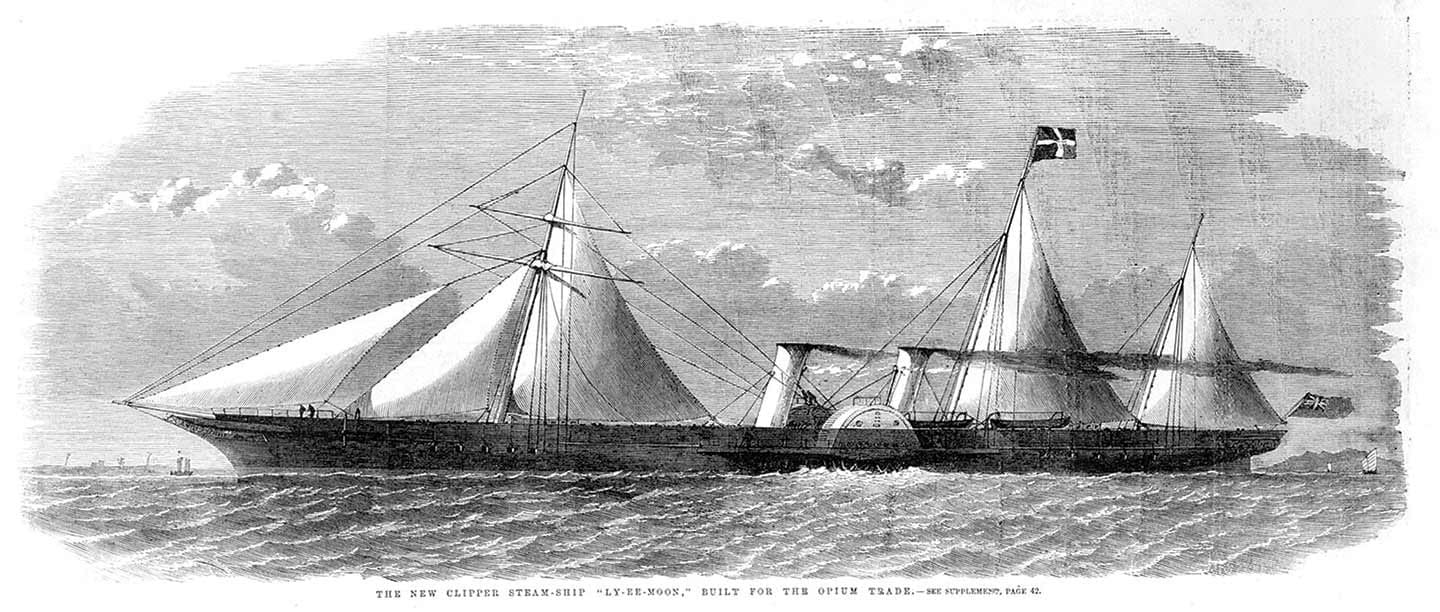
The pioneers in the Turkish drug trade were the brothers James Smith Wilcocks and Benjamin Chew Wilcocks, from a prominent Philadelphia family. The Wilcocks brothers traveled as supercargoes on the first American ship to carry Turkish opium, the Pennsylvania, in 1805. The ship disposed of its 50 chests of Izmir opium even before reaching China; the cargo was sold in Jakarta. The success of this pioneering effort created something of an “opium rush” among leading American merchants like John Jacob Astor of New York, Joseph Peabody of Salem, and Stephen Girard of Philadelphia. Girard was a self-made man who had come to America from France as a cabin boy and had eventually become an immensely wealthy enslaver, banker, and shipping magnate. After learning of the Turkish opium route, he wrote urgently to his agents in the Mediterranean: “I am very much in favor of investing heavily in opium.” When Girard died in 1831, he was the wealthiest man in America, and is still counted among the richest Americans of all time; the same is true of Astor.
Soon there were so many American merchants in Izmir that they were able to monopolize the shipping of Turkish opium to China. But the output of the Turkish industry was not large, and the opportunities in India were simply too great to be missed. So even as they were setting up the traffic in Turkish opium, some Americans also began eyeing the East India Company’s auctions in Bengal. In 1804, Charles Cabot, captain of a Boston-owned ship, declared, “I intend to purchase Opium at the Company’s sales & proceed to the eastward where I have no doubt of being first at market.”
Those early attempts to tap the Indian market foundered initially because of the disruptions caused first by the Napoleonic Wars and then by the British-American War of 1812. But after that war ended in 1815, Americans began to expand their dealings in opium at a rapid rate. John Jacob Astor even sent a ship into the Persian Gulf in an attempt at finding another source to supplement the supplies from Turkey. Astor’s speculations in opium in this period were large enough to send tremors down his rivals’ spines. “We know of no one but Astor we fear,” declared the Boston firm that then dominated the Turkish market.
By 1818, Americans were, by some estimates, smuggling as much as a third of all the opium consumed in China, thereby posing a major challenge to the East India Company’s domination of the market. Indeed, competition from Americans, and their Turkish opium, was one of the reasons that the company ramped up its production in Bihar soon after.
Meanwhile, India continued to be by far the greatest source of profits in the opium trade, and American merchants remained eager to expand their reach into the Indian traffic: The fact that they were shut out of it only whetted their appetites. And it was not as if the Americans did not hold some winning cards of their own. Marketing Turkish opium in China had put them in a good position to act as agents for Indian businessmen; they knew the ins and outs of the trade and had acquired extensive contacts within smuggling networks. They also had their own receiving ships at Lintin Island, on the Pearl River, where they could offer to store their partners’ drug consignments at lower rates than those of the big British smuggling networks. Moreover, their connections with the business worlds of Bombay and Calcutta went back a long way, to the years immediately following the formal recognition of American independence in 1783.
By the late 1780s, several New England merchants had started to work with Parsi and Gujarati brokers in Bombay, because they offered better rates and more reliable service than English agents. Bombay’s major export then was cotton, while the American products that found a market there were gin, rum, iron, and cordage. At that time, British regulations made it difficult for Americans to carry Indian goods to China, but the rules changed after 1815, and that was when New England merchants plunged headlong into the trafficking of Malwa opium.
Soon, several American merchants, mainly from Salem, were residing in Bombay, where their provisions and housing were taken care of by their Parsi partners. While the Americans did find partners among the great Parsi merchant clans like the Wadia, Dadiseth, and Readymoney families, most of the bigger companies were already spoken for by the British behemoths like Jardine Matheson & Co. and Dent & Co. Thus, it was often the smaller Parsi firms that were more eager to work with them. Among the Gujarati firms that partnered with Americans, the most important was Ahmedabad’s Hutheesing Khushalchand, one of the largest Malwa opium brokerages.
The indefatigable Benjamin Chew Wilcocks of Philadelphia was one of the pioneers in establishing American-Indian partnerships in opium. By 1824, Wilcocks was doing business to the tune of 100,000 silver dollars annually with Hormuzjee Dorabjee of Bombay, and this kept growing steadily until his retirement in 1827, when he passed his company to a relative, John R. Latimer, who further developed the firm’s connection with Parsi merchants, most notably the Cowasjee, Framjee, and Hormuzjee families.
Following close on the heels of the Philadelphia merchants were the big opium-trading clans of Boston—the Perkins, Sturgis, Russell, and Forbes families, who were all as intricately interrelated as the Mafia lineages of southern Italy. They called themselves “the Boston Concern,” and the eventual merger of their firms would make them the single biggest opium trading network in China. The wealth they gained from the opium trade would establish them as core members of the elite circle that Oliver Wendell Holmes called “the Boston Brahmins,” America’s closest equivalent to an aristocracy.
The Best “Go Paid” Deal on Substack! You Get REAL Stuff!!
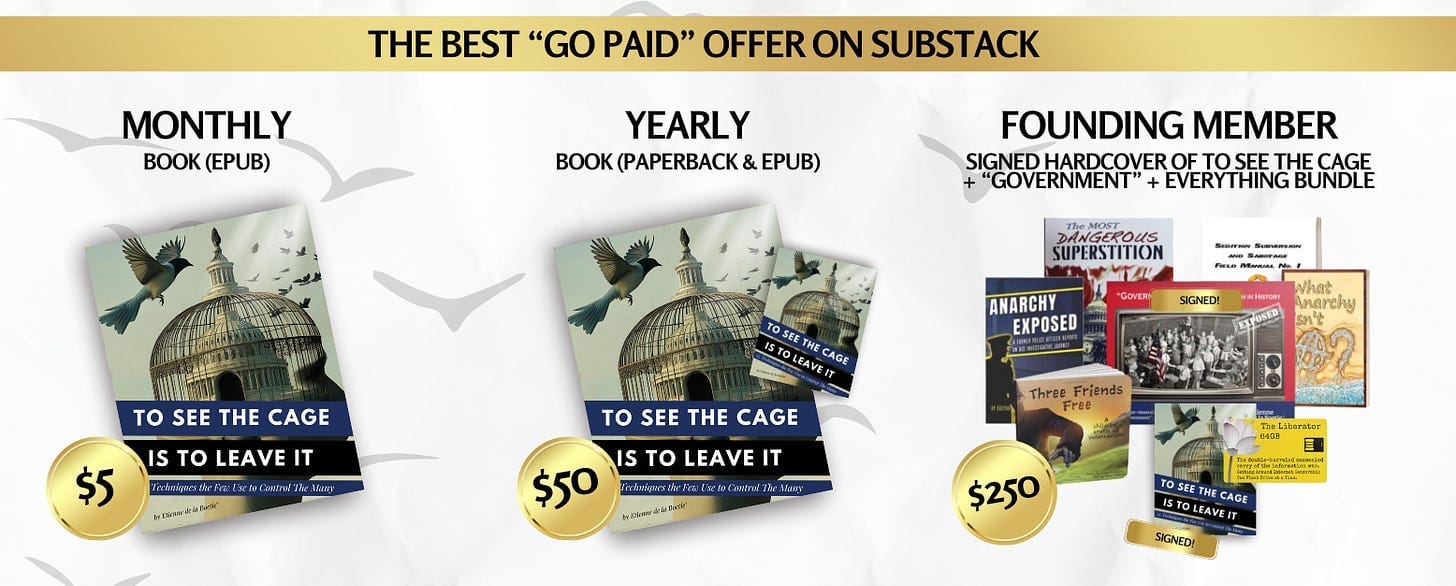
Go paid at the $5 a month level, and we will send you both the PDF and e-Pub versions of Etienne’s new book: To See the Cage Is to Leave It - 25 Techniques the Few Use to Control the Many and a coupon code for 10% off anything in the https://artofliberty.org/store/.
Go paid at the $50 a year level, and we will send you a free paperback edition of Etienne’s new book: To See the Cage Is to Leave It - 25 Techniques the Few Use to Control the Many OR “Government” - The Biggest Scam in History… Exposed! OR a 64GB Liberator flash drive if you live in the US. If you are international, we will give you a $10 credit towards shipping if you agree to pay the remainder.
Support us at the $250 Founding Member Level and get a signed high-resolution hardcover of “Government” - The Biggest Scam in History... Exposed! + Liberator flash drive + a signed high-resolution hardcover of Etienne’s new book: To See the Cage Is to Leave It - 25 Techniques the Few Use to Control the Many + everything else in our “Everything Bundle” of the best in voluntaryist thought delivered domestically. International pays shipping. Our only option for signed copies besides catching Etienne @ an event.


