

AI glasses are enabling harassers to record women stealthily, posing a growing threat to privacy and online safety
Etienne Note: Google smart glasses were called "Google Glass" and they died because the people that were wearing them starting getting called "Glassholes." Also, Ring cameras were out for several years before it became known that there were secretly being wired into 1000+ police departments, Homeland Security Fusion centers and ICE. Don't be surprised when we learn that the organized crime "government" can flip these on remotely.
By Annabel Martin, The Telegraph
In early December last year, Beth Knight, then 17, was waiting in London’s Waterloo station after missing her train home. The next service wasn’t for 40 minutes and she had just found a bench to sit on when a man in his mid-20s approached her.
“He said: ‘I find you attractive so I wanted to say hello,’” Beth explains. She responded with a line many women use when confronted with unwanted attention from men: “I have a boyfriend.”
Beth wasn’t lying, she did have a boyfriend. In fact, she had been in London visiting him to exchange Christmas presents. But, undeterred, the man – who was wearing dark-rimmed glasses – persisted with his intrusive questions, asking her what she was doing, where she lived, what she did for a living and whether he could have her Instagram handle.
Trying to defuse the situation, Beth typed her Instagram account name into the stranger’s phone. “I didn’t want to become a statistic,” she says of the encounter, referring to the increasing levels of violence towards women by men. “I wanted him to walk away rather than me having to leave the situation, because I thought that would be more dangerous.”
He left after he got her details, but the interaction left Beth shaken. When she told her friends and boyfriend about what had happened, she said the penny dropped: “I thought, ‘I bet he filmed me on those glasses.’”

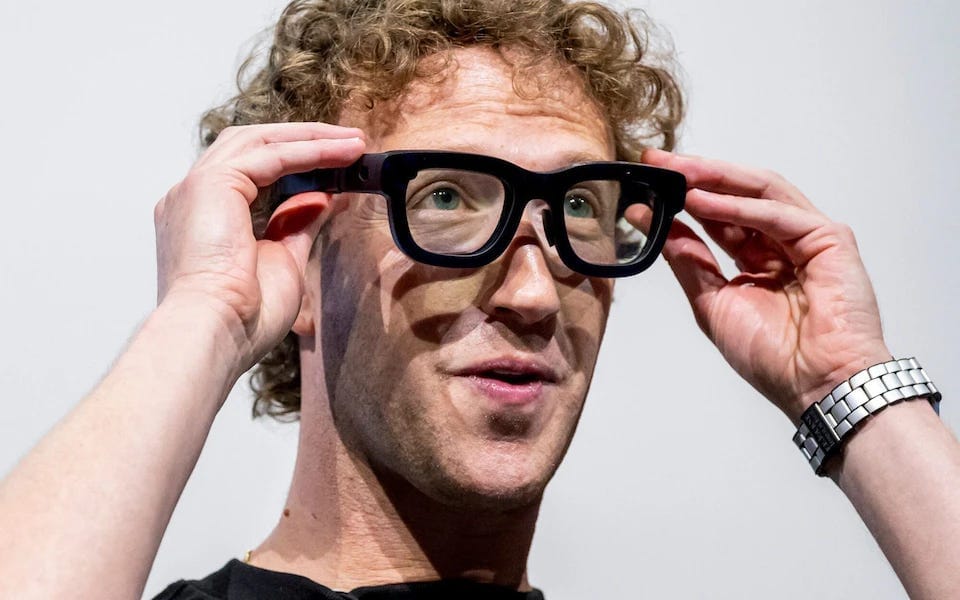
Just a few years ago, the idea that someone could record you imperceptibly using a pair of normal-looking glasses would seem like something from a dystopian drama or a James Bond movie, but Meta glasses – “smart” spectacles or sunglasses with tiny inbuilt cameras to capture images and sound – are becoming ever more popular. The glasses are connected to your smartphone and users save their footage by importing it into the glasses’ accompanying app.
Meta – the technology group founded by Facebook’s Mark Zuckerberg – released smart glasses in 2021, but has seen rapid growth in recent years thanks to partnerships with the eyewear brands Ray-Ban and Oakley, selling seven million pairs in 2025. “They’re some of the fastest-growing consumer electronics in history,” declared Zuckerberg earlier this year.
Meta claims the glasses (which cost between £269-£459) help people “stay in the moment, from listening to music to live translation or hands-free calls”, but their surging popularity has also come with criticism. The ability of wearers to record or take a photo with the small camera in the frame has raised concerns over surveillance and rights to privacy.
Someone could be wearing smart glasses and clandestinely record you at the gym, in a changing room, at a cash machine, in a children’s playground or at a doctor’s appointment. While it is often legal to film people in public spaces in the UK without permission, the stealthy nature of Meta’s glasses has led to them being nicknamed “pervert glasses”.
While the user who records the footage owns it, any time an AI feature is used – for example, should the user say: “Hey, Meta, start recording” – the footage is also sent to Meta. The recordings can be used by the company for AI training, and some go through human review. Earlier this year, two Kenya-based review workers told Swedish newspapers they had witnessed glasses users going to the toilet and having sex.
A couple of days after her strange encounter, Beth stumbled across a video on TikTok of a young woman talking about her experience of being secretly filmed in public by someone wearing smart glasses, and began feverishly searching for footage on TikTok, looking at videos captioned “Picking up girls London”, “picking up girls Waterloo”, “Meta glasses” – and then her stomach sank.
One video showed the same man who had approached her in Waterloo talking to another young woman. While a video of her conversation had not been posted, the prospect of it possibly being published filled her with dread. “I wondered, ‘Will he post a video of me? And if he does, when will he post it?’” she says.
The man’s account – which had 100,000 followers and 261 other videos – featured hundreds of videos of him trying to chat women up, stunts which were used as a ploy to advertise an online course he runs, teaching men how to “improve” their pick-up techniques via strategies that echo those of self-proclaimed misogynist and manosphere influencer Andrew Tate. “I felt completely powerless,” Beth says. “He had taken a video of me without my permission or knowledge and I had no control over the situation.”
Weeks went by, and despite having asked for her details, the man did not make contact with Beth, nor did he post any footage of her. Then, on Christmas Day, Beth’s mother asked what had come of that strange incident in Waterloo station. Beth checked the TikTok account and her chest tightened. He had secretly recorded his conversation with her and posted it on his account as an advertisement for his courses. In his eyes, the encounter had been a “successful” pick-up.
Beth noticed the man had edited out the part of the video where she said she was at college, which would reveal that she was between the ages of 16 and 18. “He knew that I could have been underage. He fully was aware of that and chose to edit it out,” she says. “I was angry. It was like pure rage because he was exploiting my image to sell his courses. I almost felt like I was watching someone else, seeing myself in such a state of discomfort, such a state of panic,” she says.
Beth instantly messaged the account, asking him to remove the video. She says the perpetrator ignored her messages and blocked her when she posted a comment to the same effect on the video. Eventually, the video was taken down, but it is not known whether that was by the account holder or the platform itself due to complaints. Beth’s mother also reported the incident to the British Transport Police, although ultimately she decided not to proceed with the case, asking instead for her report to be kept on file.
“I was under a lot of stress with my A-levels, so we decided we couldn’t go through with that at that time, for my mental health,” Beth says. “His entire Instagram and TikTok were just videos of him doing the same to other women. Sometimes they were drunk. Sometimes they were even more visibly uncomfortable than I was. You could see how scared they were.”
Beth posted a video to her own TikTok, explaining what had happened, and she received messages from other women who had also been secretly filmed by Meta glasses. “It wasn’t an isolated incident,” she says.
Indeed, alarm bells are sounding ever louder about the safety of smart glasses, the threat they pose to an individual’s right to privacy and their role in harassing women. Campaign group Stop Smart Glasses has called for the wearable tech to be banned because of its effect on women’s safety on public transport. These worries come at a time when sexual offences on London’s Tube network reached a five-year high last December.
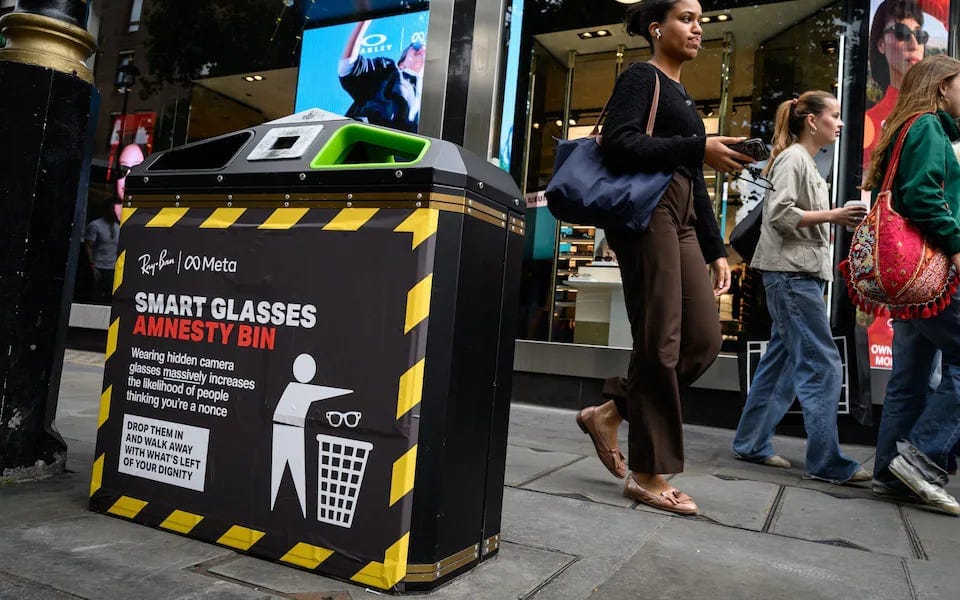
In August, pub chain Wetherspoons banned its customers from using Meta eyewear in all of its 800 pubs, and ATG Theatres, which owns Bristol Hippodrome, Edinburgh Playhouse and theatres across London, forbade theatregoers from wearing Meta glasses to shows.
Yves Jeanrenaud is a sociologist and professor of gender and diversity in engineering and computer science at Osnabrück University of Applied Sciences in Germany. After reading reports of Meta glasses being used secretly to record inside massage parlours and during immigration raids in the US, he designed and launched Nearby Glasses, a free app that alerts users when smart glasses are in use nearby. The app scans for Bluetooth signals compatible with smart glasses technology within a range of 9m to 15m.
Jeanrenaud points out that the colour of the recording light on Meta glasses is white, rather than red, which he says feels purposeful. “When you walk around and look at CCTV, every camera that’s recording has got a red light,” he says. “It’s not a coincidence they chose a colour that’s easily overlooked. They could have gone for any other colour but white, and [the light is also] quite small and perfectly possible to cover.”
Indeed, people online can disable the glasses’ LED recording light for less than £100. Beth saw no recording light when she was secretly filmed in Waterloo. “We’re used to people filming and taking pictures at every occasion, but we are also used to being able to spot that. When I hold up a phone to your face, you’ll recognise it,” says Jeanrenaud. But that’s not the case when smart glasses are used.
Milica Stilinovic is a research associate at the University of Sydney, and her most recent project included analysing 350 videos on Instagram (owned by Meta) of footage secretly recorded by men of women in everyday settings. Stilinovic says that Meta glasses “enhance a pick-up artist’s ability and the ‘manospheric’ ability to harass women”.
On the study, she says: “What I found to be most shocking was the level of vulnerability we were willing to film for the purposes of pick-up artistry, for the purposes of selling male dating coaching, or to benefit from engagement from increasingly volatile situations.”
Beth feels “way more on guard” since she was filmed without consent in the station. “Anyone could be exploiting me at any time, and I can’t tell when I’m in danger.
“But what hasn’t been highlighted enough is that what happened to me was the best of a bad situation. They can film hookups with strangers or children in bathing suits at the beach. That’s what concerns me more.”

Meta glasses didn’t create harassment, surveillance or data breaches, but they are enabling it in unprecedented ways, says Stilinovic. “At the end of the day, we don’t need spy glasses from a James Bond era.”
Next time you’re out in public, try to spot them – it’s easy, they look like every other pair of black-rimmed sunglasses or reading glasses.


