

Click Above or HERE for the YouTube Version
Etienne de la Boetie² | Jason Christoff
I had a great talk with Canadian health guru and political commentator Jason Christoff.
We talk about my new book: The Greatest Theft in Human History - How the Banks and “Government” Will Steal at Least $1.40 MILLION from the Typical Worker… “Legally.” The book breaks down how much the organized crime banks and "government" will steal through inflation (that benefits the banks) + confiscatory taxation + Social Security underpayment for a typical worker ($60K yr) over a 40-year career + 20-year retirement = $1.40 MILLION.
Clarification from the Interview
There is one thing I wanted to clarify from the interview. In our discussion of the difference between Social Security and private retirement accounts, I was explaining that if people were able to put their Social Security tax into a private retirement plan, a $60K worker would build up around $900,000+ and could draw a comfortable 3%, which would give them around $3,000 per month vs. Social Security's $2,000 per month, and your heirs would be able to inherit the principal upon your death.
When Jason asked me if Social Security survivors get anything after they die, I said no, compared to inheriting the entire principal of a private retirement account. They do actually get something. They get a $255 one-time payment that hasn't changed since 1954, and the wife/husband and minor children would continue to receive a percentage of the deceased's Social Security payment ranging from 71.5%-100% BUT it is capped at 150-180% of your benefit, and a two-income household typically loses a third to a half of its Social Security income when the first spouse dies.
Full Transcript
Jason Christoff
Okay, welcome everybody. I have the great honor of speaking to Etienne de la Boetie² today, and we're going to be discussing the scam of government and its many forms. Etienne is a master of this information. He has a great book. Maybe you could just give us the title of the book, where to get it and what it describes to start, before we get into one of your recent articles about how much is stolen from the American taxpayer over their lifetime, which is a very interesting story all on its own. But let's go over the book a little bit before we start.
Etienne de la Boetie²
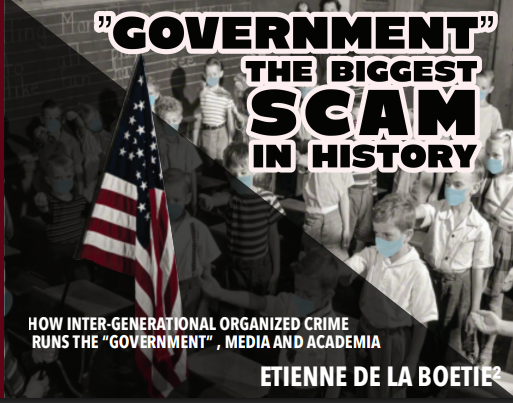
Sure. Well, the book that I'm best known for is “Government” – The Biggest Scam in History… Exposed!. And the subtitle of that is How Inter-Generational Organized Crime Runs the "Government," Media and Academia. And in that book, I make the case that government's always illegitimate. You can never have a legitimate government. It's best thought of as a technique to rob and control populations. It's the banks at the top. The banks create unlimited money out of thin air using a technique called fractional reserve banking. The government does it with quantitative easing and digital dollar creation and a variety of techniques as well. And so that is inflationary, and that steals the value and the purchasing power out of everybody else's money invisibly.
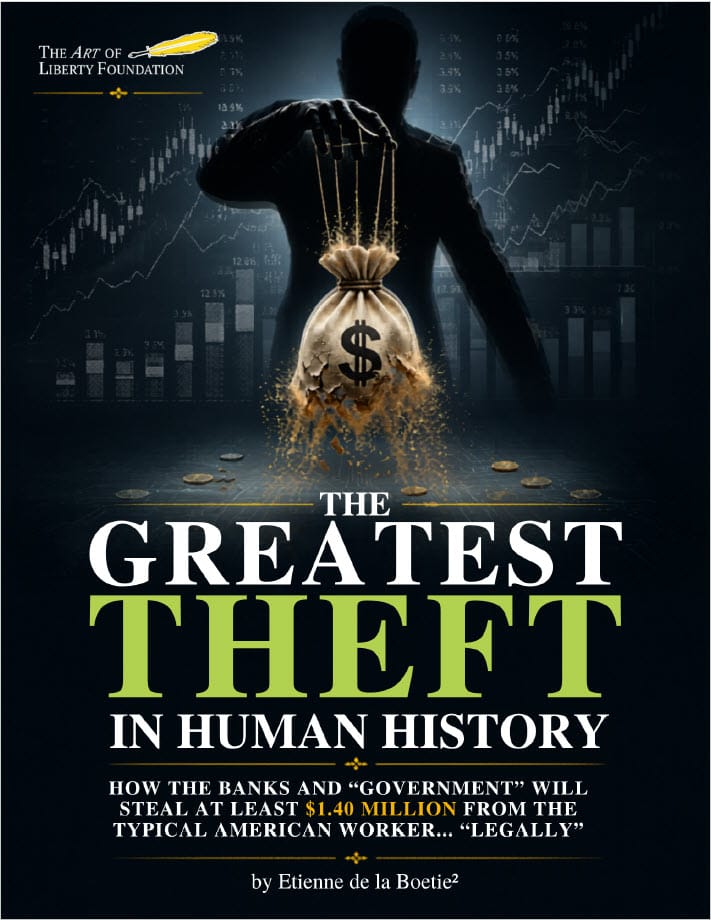
And so my new book, because "Government," The Biggest Scam in History, has produced the greatest theft in human history. And so that's the title of my new book, The Greatest Theft in Human History – How the Banks and “Government” Will Steal at Least $1.40 MILLION from the Typical Worker… “Legally”. So "legally" is the last word in the title, and it's in air quotes, because that's really the biggest scam in all of human history: that government is legitimate at all. But government makes something that is inherently immoral and dishonest, this monetary system, it makes it quote-unquote "legal."
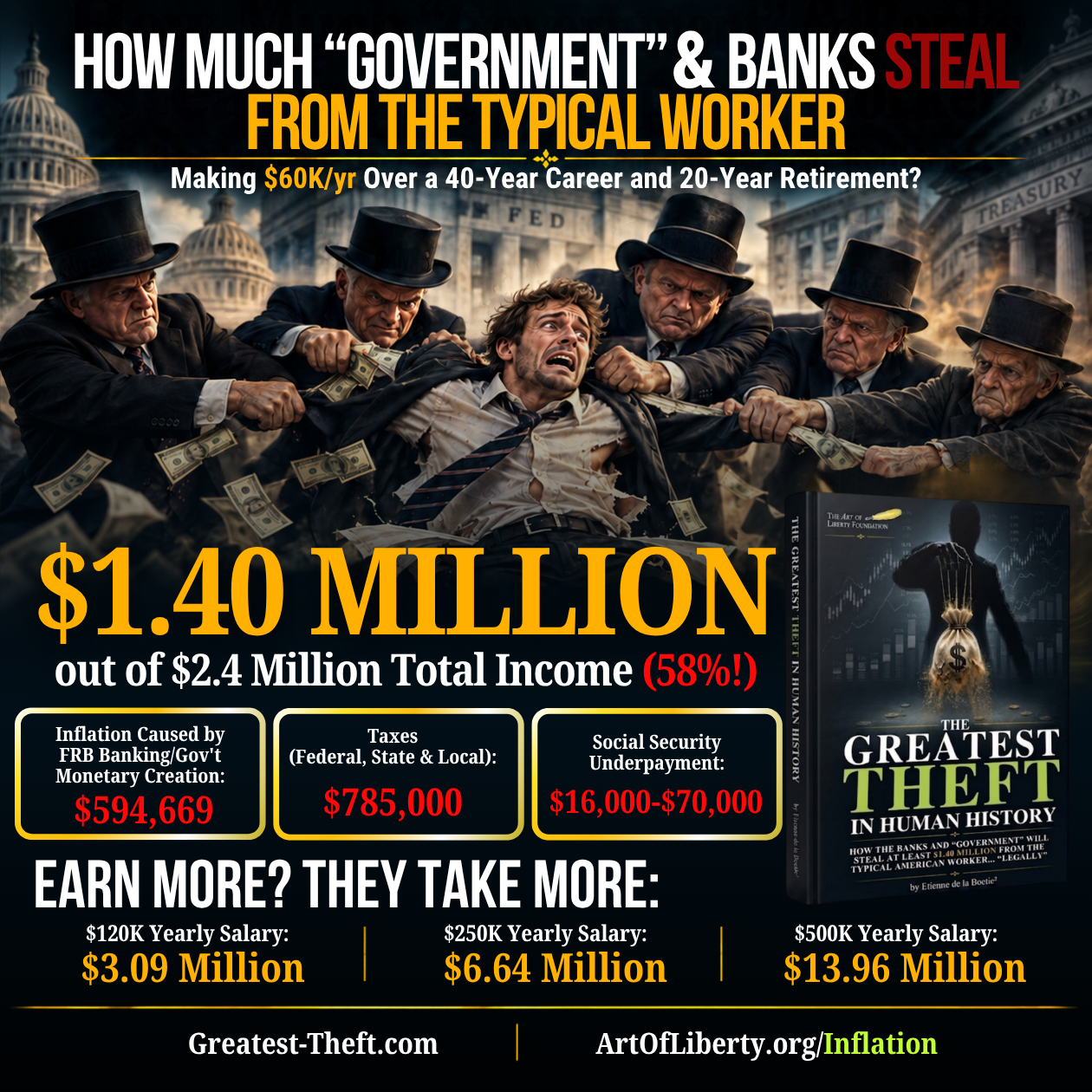
And so what we did in the new book is we've been the first to break down what is the total theft that government extracts from the average person. Part of that is inflation, part of that is confiscatory taxes, and part of that is Social Security underpayment. And so if you're a typical American worker, you make $60,000 a year. If you make $60,000 for 40 years, you're going to make about $2.4 million. And the government is going to steal, at a bare minimum, $1.4 million of that money, some of which you'll never see because it's in purchasing power. So that's 58% of everything that you're going to make.
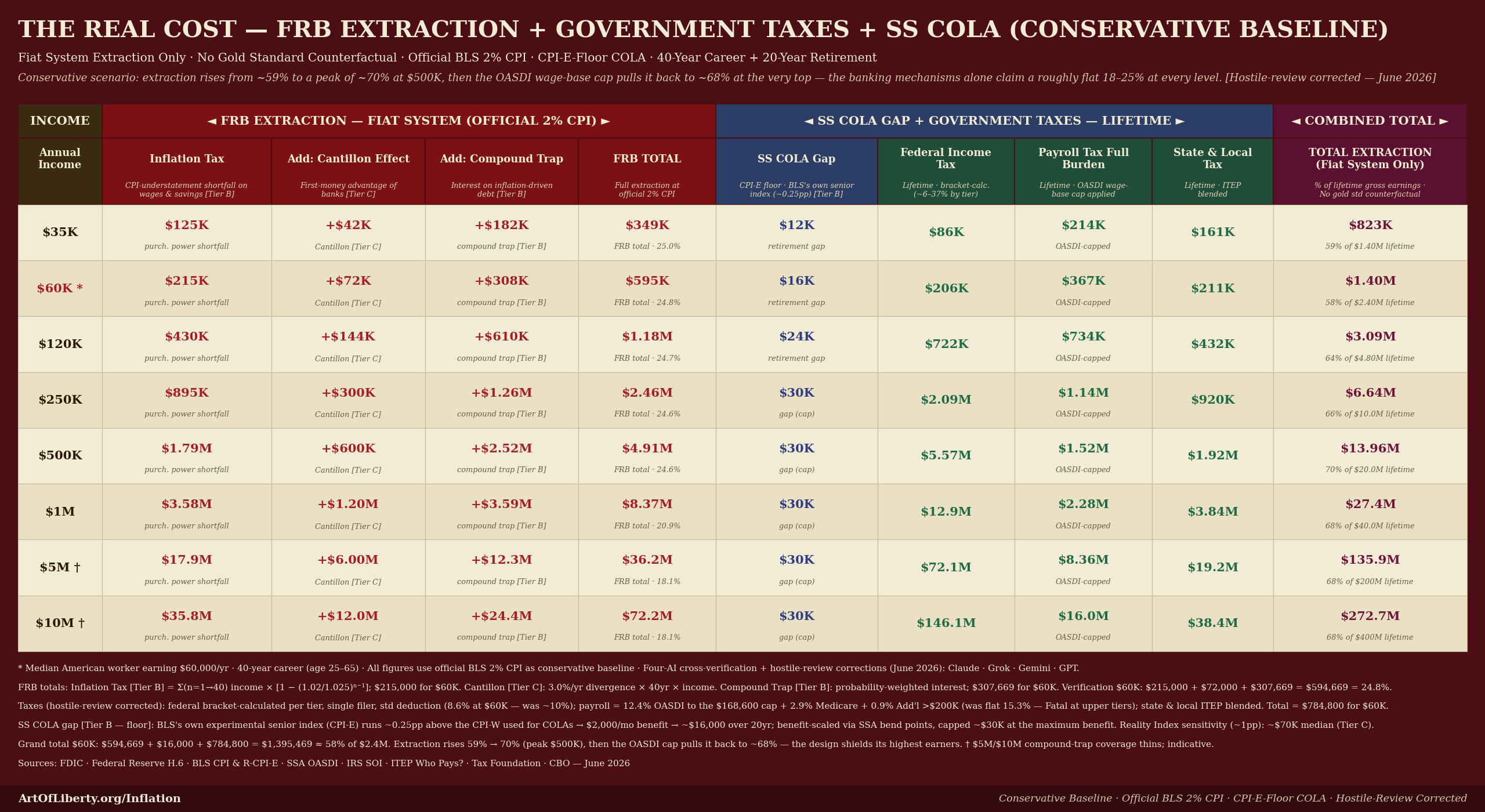
And then they're going to keep robbing you in your Social Security, because the government is lying about what the real inflation rate is so that they don't have to pay Social Security cost-of-living adjustments, known as a COLA.
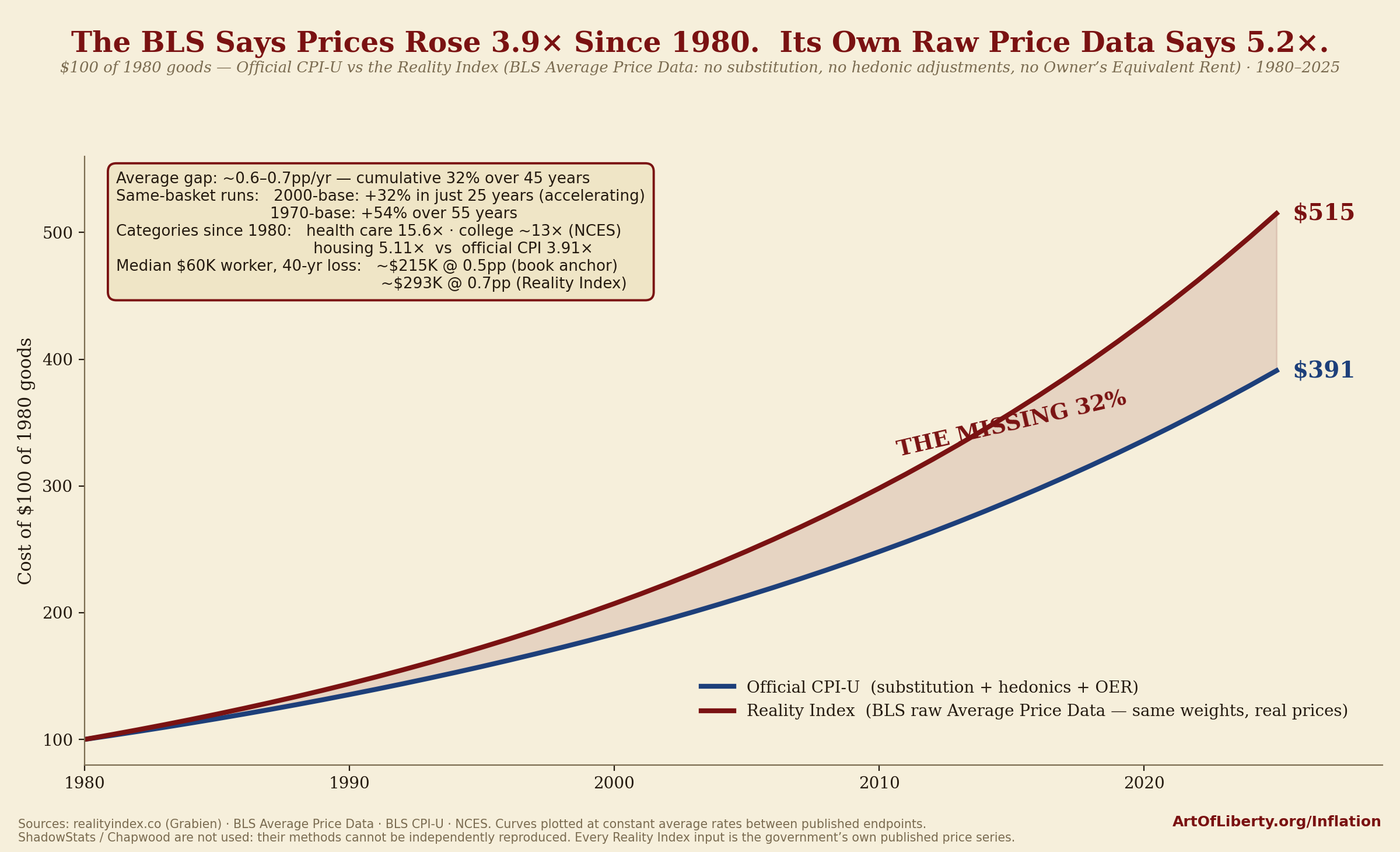
And Social Security says, we're going to index your Social Security benefits to inflation. And so the Bureau of Labor Statistics calculates the inflation rate.
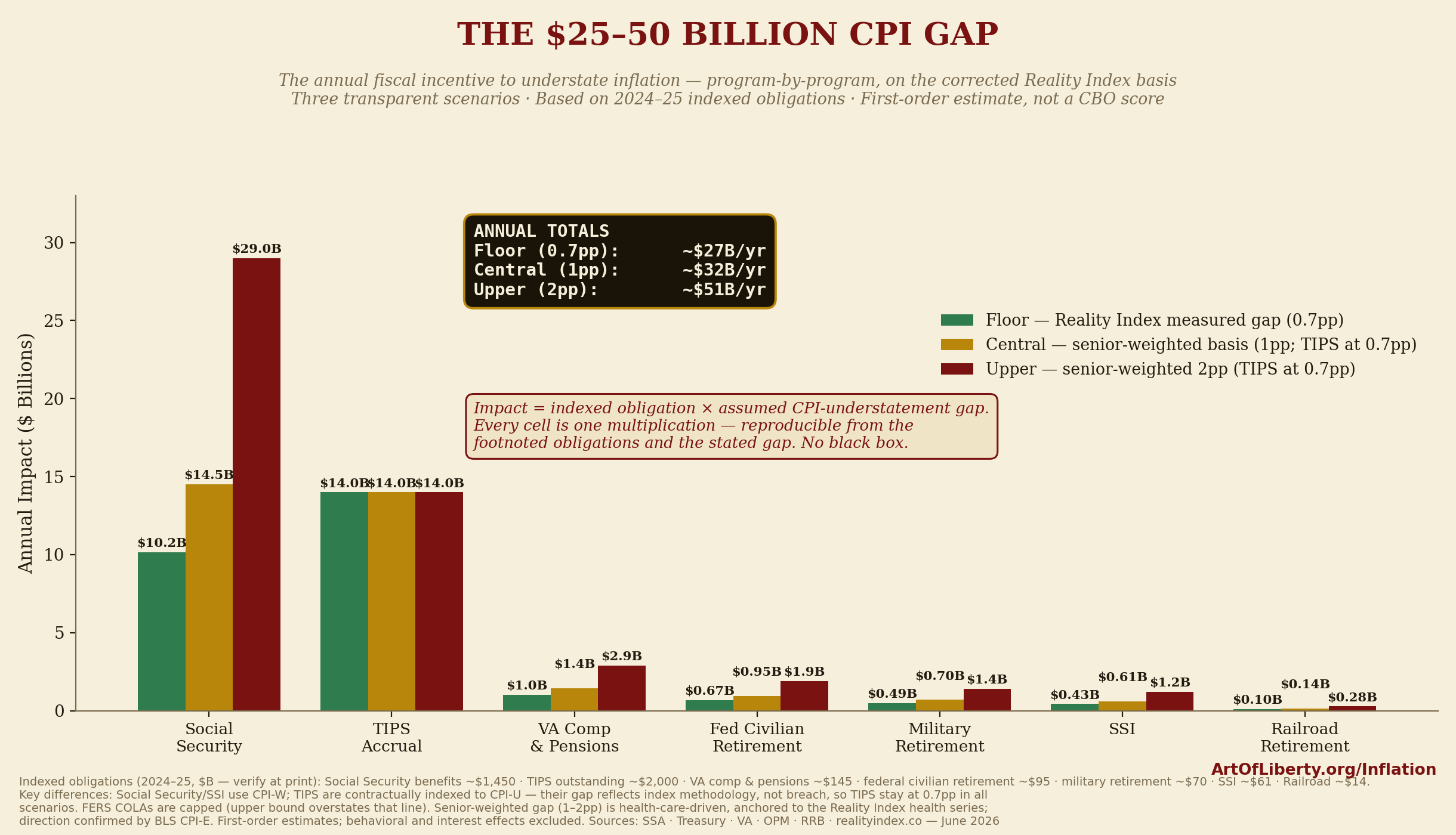
They're notorious, and they've been accused by many, many prominent economists of understating inflation, because if they told you what the real inflation rate is, number one, everybody would be ticked, and number two, they would owe over $50 billion more a year in things that require COLAs. And that's not just Social Security, that's also Treasury Inflation-Protected Securities, which is a form of Treasury securities indexed to the CPI. They provide military and pensions for their workers; those are indexed to the CPI. And they even manage the railroad pensions, and those are indexed to the CPI as well. So if they were honest about that, they'd owe a bunch of money.
And so what we did is, so that's about $16,000. In fact, it's kind of funny, Jason, because the government actually admits that the CPI-W they use to calculate the COLA doesn't really cover the right basket of goods for an elderly person. So they have something called the CPI for the elderly, and they say, okay, this is really what it should be. And then they just don't pay the COLA on that. So if you just use the government's own numbers, the government's going to steal $16,000 from grandma and from your parents, if your parents are drawing Social Security.
Jason Christoff
Is that yearly?
Etienne de la Boetie²
No, that's over a 20-year retirement. But don't forget, even that CPI is still lying about what the real inflation rate is. And so what we did is we used an alternative index called the Reality Index at RealityIndex.co. And what the Reality Index did is it uses the government's same numbers, weights and measures, the same thing that the government uses to calculate theirs, but the Reality Index pulls out the shenanigans that the Bureau of Labor Statistics uses to fudge the numbers. There's something called hedonic adjustment. There's something called substitution, where they say if the price of steak goes up, they're not going to count steak. They're going to assume that you're going to eat chicken, and they're going to count chicken. As crazy as that sounds, that's how the government calculates inflation. And hedonic adjustment is: you buy a car, and the car is $10,000 last year, and this year the car is $12,000, but since the car now has a heads-up display and more features, they're going to say you're going to enjoy it more, and they're going to say that the car is only $10,500. It's crazy.
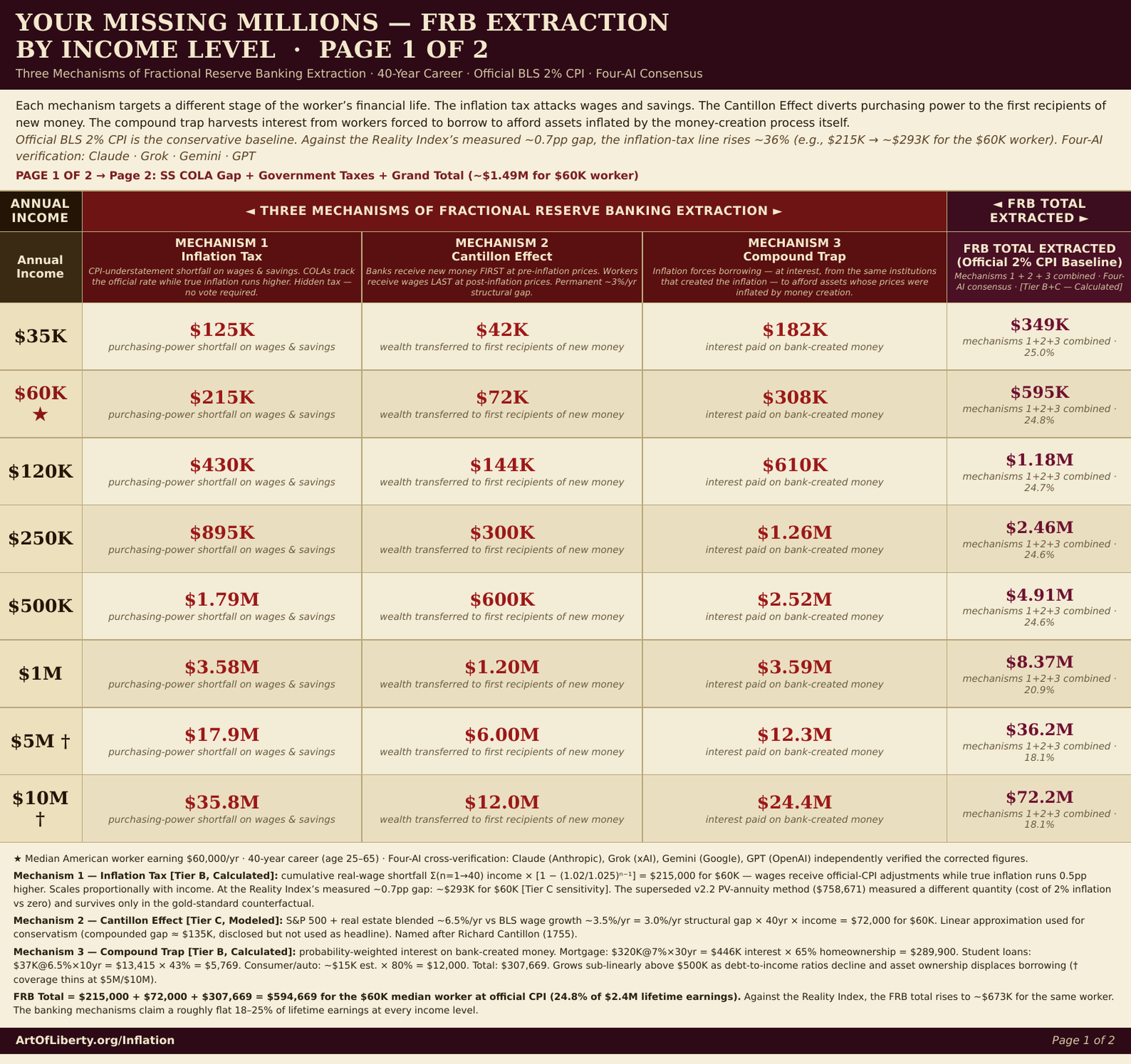
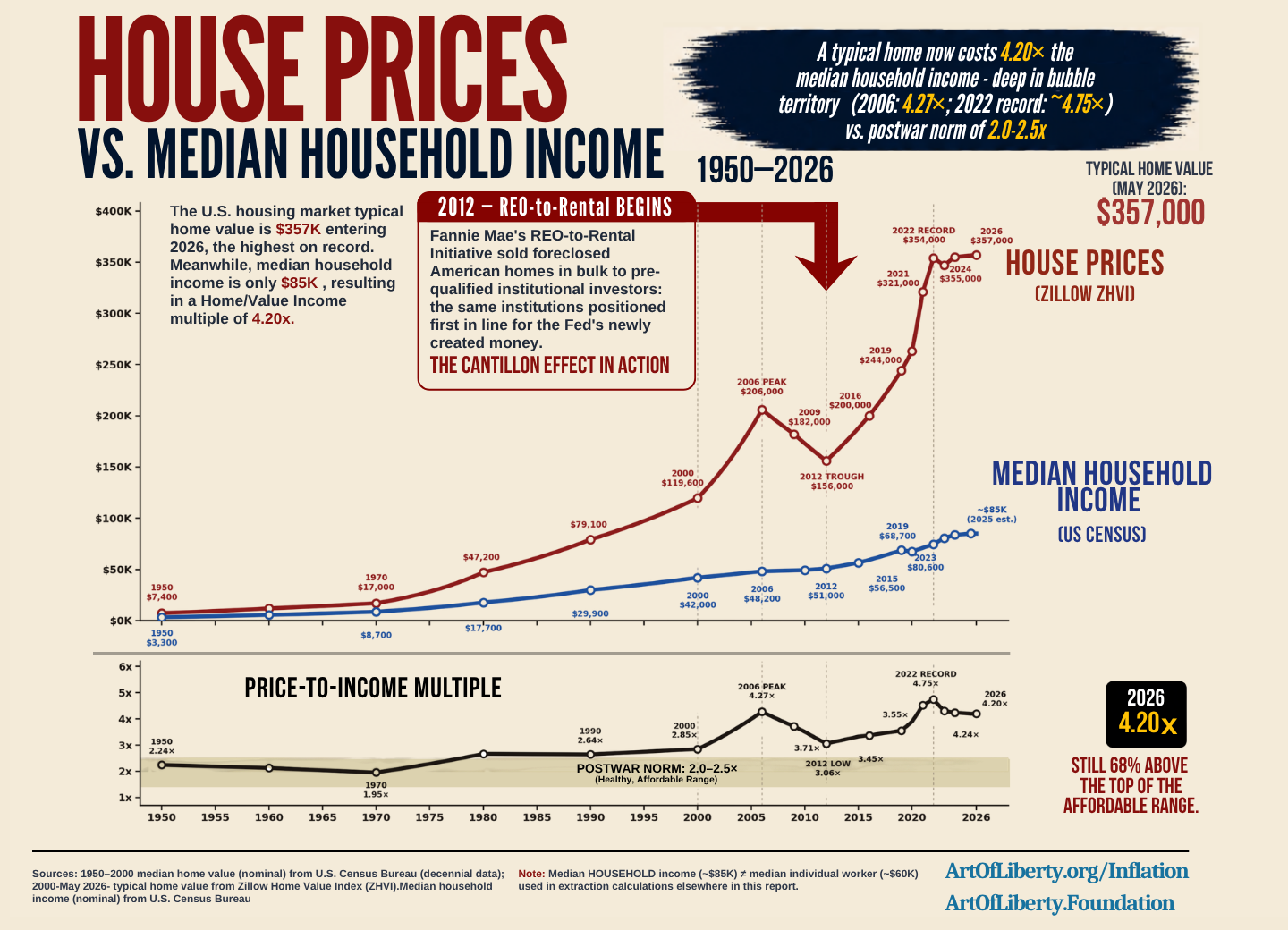
And so when you pull out those shenanigans, it's not $16,000, it's $70,000. And so when you add it all up together, the inflation over 40 years and a 20-year retirement is about $596,000 that they're going to steal from you invisibly. And part of it's visible, because there's a component. We actually coined our own term in economics, and the term is called the "compound trap." And what the compound trap is, is that when the government has this dishonest monetary system and it forces money into housing as a hedge against inflation, it cranks up the price of housing, and then people have to borrow hundreds of thousands of dollars more to buy a house from the same banks that created the inflation. It's very, very insidious. And so part of that calculation is, well, what's the cost of people having to borrow hundreds of thousands of dollars more for assets, not just housing, but medical expenses, student loans, and everything goes up, right? Everything goes up, and it's the things that you can't dodge.
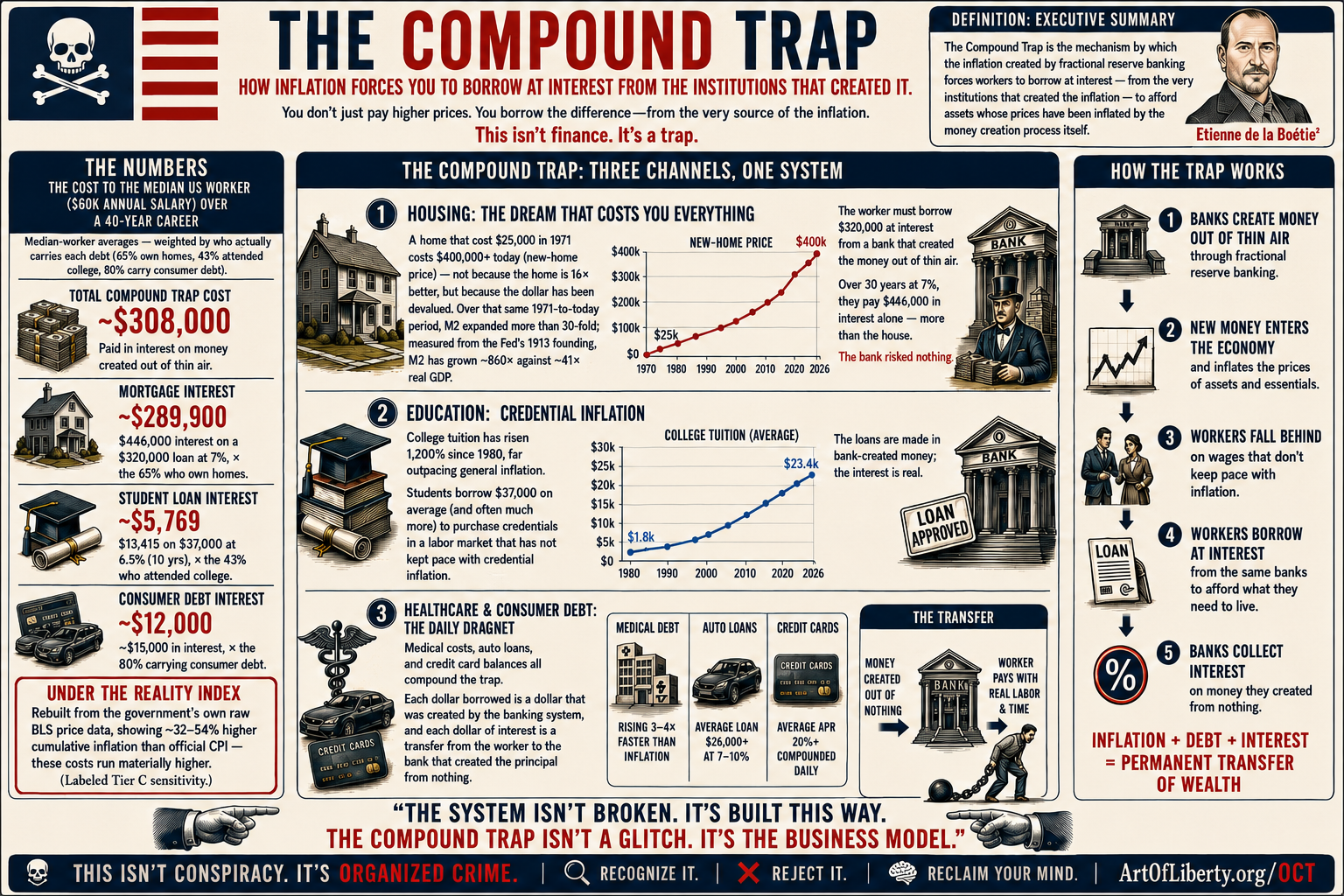
So really, the government's counting the cheap things and they're ignoring housing. They do some shenanigans instead of actually measuring what the housing was, and they could do that quite easily. The company Zillow has a great index on what rents are. And so what the government does is they just call people, and they have a survey called owner's equivalent rent. They call people who aren't even renting their houses out, who own their houses, and they say, "Hey Jason, if you were going to rent your house, what would you rent it for?" And most people have no idea what the market is. They've never really thought about it before. So they give the government a number on the phone, and the government goes, okay, thanks, bye. And then they put that down, and that's notoriously inaccurate. And so all of these shenanigans lead to this tremendous, tremendous fraud where they owe all of this money.
But anyway, we calculate it in this book. And so that $1.4 million, first of all, that's the floor, not the ceiling. There are a lot of things that we didn't count. We tried to make it as conservative as possible. We had some earlier editions that had a higher number.
Jason Christoff
You had to make it fair, right? So people wouldn't have easy shots at the book. So you really underestimate what they're stealing.
Etienne de la Boetie²
Without a doubt, we made it as conservative as possible. And there are two major things that we took out, because there was an earlier version that had a higher headline number. What we're calculating that inflation number against is a zero-inflation environment: if the government actually maintained price stability, which is supposed to be what the Fed is doing, and which it fails at miserably every single year. If you just had no inflation at all, if they weren't stealing the value out of the money, if the banks couldn't create this money out of thin air, then it would be $1.4 million. But in the United States, we had a gold standard, and under a gold standard, prices are benignly deflationary. So your dollar would buy more and more and more under a gold standard. It was 1 to 1.5, as much as 2%, but let's say 1 to 1.5% a year, and that's a tremendous number. And so that $1.4 million, if you did it against the gold standard, they really stole $1.96 million from the typical worker. We didn't include that in the headline number of $1.4 million, but we do have what that number is, and we break it out and explain the math behind it and all the calculations.
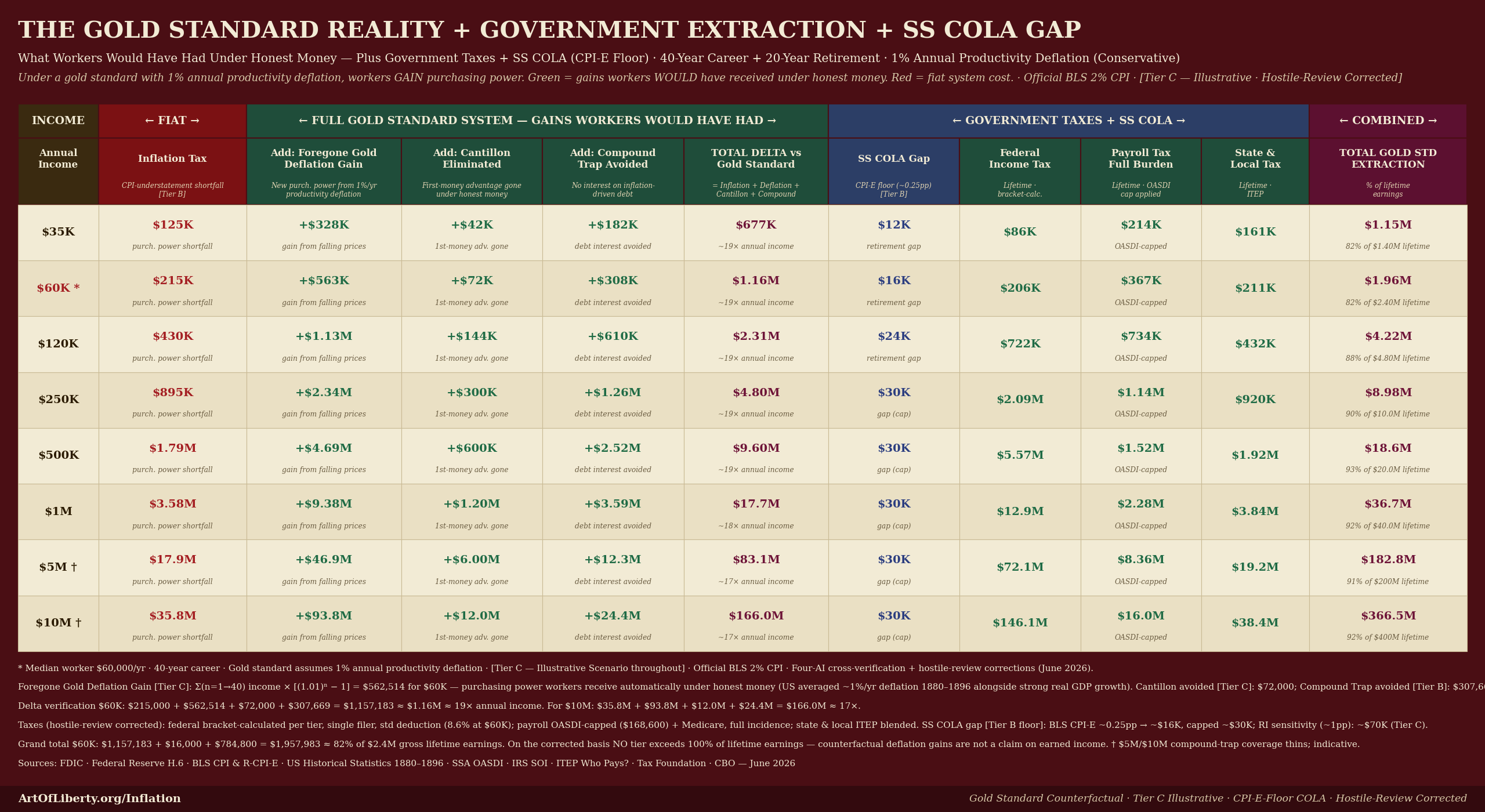
But the other major thing that we didn't count is if you got to take your Social Security and put it into a private account. If that average person put it in and just earned a 5% rate of return, which is less than the historical rate of return of private retirement accounts, they would have somewhere around $900,000 in that account. And if they took it out at a safe 3% a year, that would be around $3,000 a month. Social Security is going to pay them around $2,000 a month. So number one, they would get $1,000 more a month.
Jason Christoff
Okay. 50% more.
Etienne de la Boetie²
Yes, 50% more, but it gets worse. When they die, the principal goes to their heirs. That $900,000 goes to their children, and it becomes their estate, and it becomes inheritable. And so the actual cost is much higher than $1.4 million.
Now, are you ready for this? It gets worse, okay? So $1.4 million is if you're typical. Now, I know your audience is definitely above average, as is mine. And so if you're above average and you make $120,000 a year, the total over your 40-year career and 20-year retirement is going to be $3.09 million. If you make a quarter of a million dollars a year, it's going to be over $6.5 million, and it keeps going up.
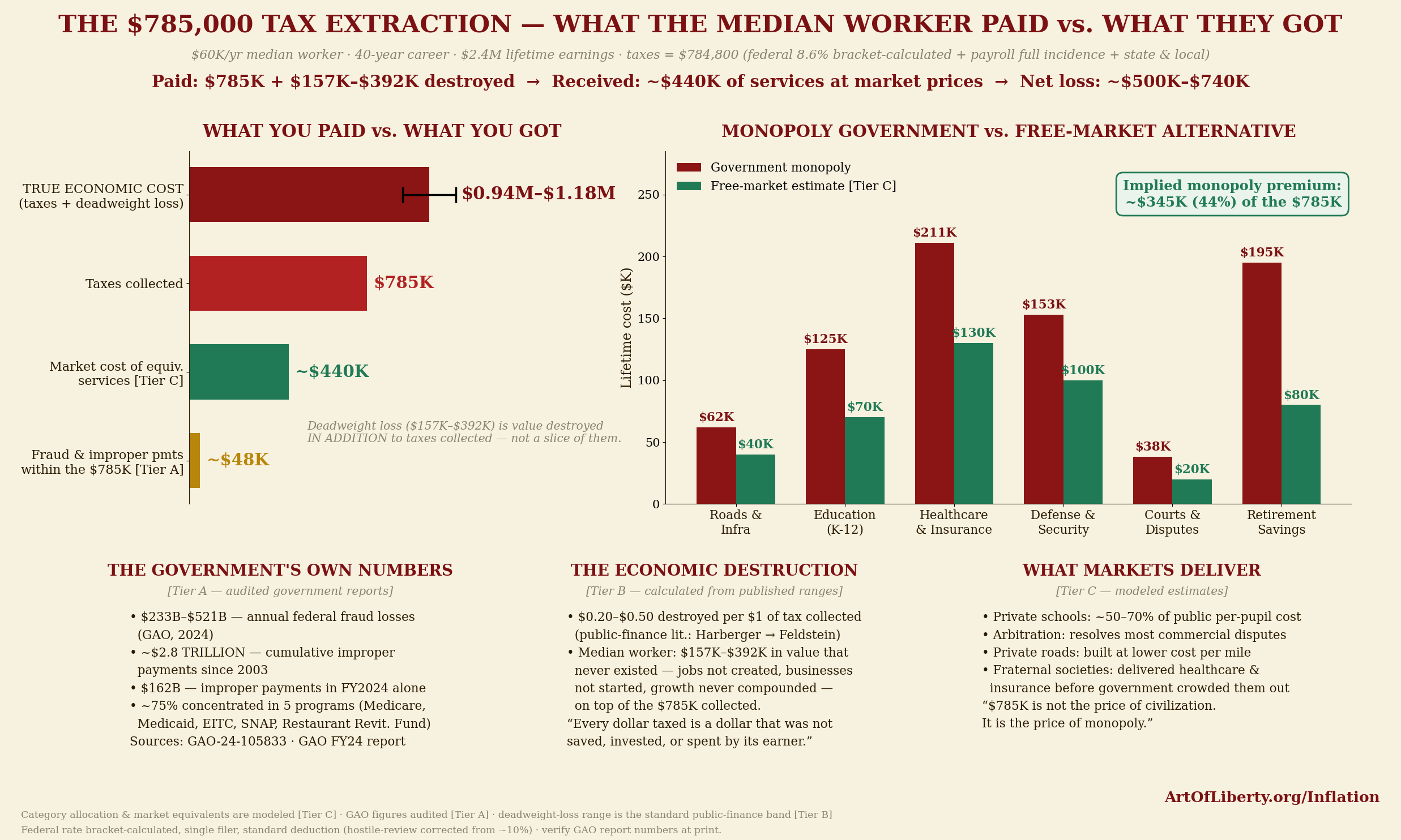
Now, part of the reason that number is so high is because a lot of that is the confiscatory taxes. And so we actually break down that for the typical American worker, that's about $785,000 in federal, state, and local taxes over that 40-year career and 20-year retirement. And so in the book, we acknowledge that, oh yeah, you're going to get some services. But then we break down some things that the average person's never really thought about, and the government isn't going to tell you, and the monopoly media isn't going to tell you, and the government school isn't going to tell you. Number one, the government itself says that somewhere close to 15 or 20% of that just gets set on fire. The government admits there's huge waste, fraud and abuse; that's the Office of Management and Budget. And so let's just say 15% of that $785,000, you might as well just make a big pile of money in the front yard and set it on fire.
Jason Christoff
The money pit.
Etienne de la Boetie²
The money pit. And then the taxes that you're going to pay for quote-unquote "the services," whether it's armed protective services that the government calls the police, or dispute resolution that they call the courts, or air traffic control or whatever it is, they're going to charge you two to three times what you could have gotten it for if it was a free market, because you're dealing with a monopoly provider. The government's literally the equivalent of somebody that comes over to your house, mows your lawn, knocks on your door and goes, hey, I mowed your lawn, you owe me $500. And you're like, I didn't ask you to mow my lawn. Yeah, but I did. So you owe me this money. And so we break down what that cost is.
And then the final thing, and we didn't even include this, there are so many things that we didn't include, economists call it the deadweight cost of taxation. Because you're not spending that money in the laser-like way that people spend their own money (everybody's very careful with the way they spend their money, and it goes into productive businesses or productive charities or whatever), there's all this waste, fraud and abuse. There's all this economic misallocation. And all this economic misallocation destroys the economic benefit that would have occurred if you'd spent your own money and bought your own schooling. And so then that's going to have a negative economic effect that we didn't even include, but it's just another example.
And so the final thing I'll say about all this is: now imagine what the world would look like if the average person had an additional $1.4 million. You could get whatever kind of school you want for your kids. You could get them Montessori, Waldorf, self-directed learning, vocational education. You could give to charities. The world would be very, very different if the government wasn't setting this money on fire and stealing it from you. And so that is what we believe is the most important information on the planet: the fact that the government's illegitimate, it's being run as a criminal enterprise, and it's stealing $1.4 million from the average person. That's the thing that impacts the average person the most. And if you look at the monopoly media, what do they do? They'll acknowledge that inflation is happening. They'll report whatever the government says the number is. But nobody is ever going to say, well, what causes the inflation? We don't know, fairies come at night and sprinkle pixie dust on price tags and gas pumps, and it just magically happens.
Jason Christoff
Well, I'm sure the average person doesn't know that. But going back to something that you just taught me about unpaid Social Security: if someone passes away, it's passed on to their heirs. I would imagine if there were no heirs, the government keeps the money. Am I wrong?
Etienne de la Boetie²
No, you misunderstood. In the Social Security system, there is no account. They say you have a Social Security account and the government's putting money into it. There is a tiny little survivor payment [$255], but you don't get to keep the $900,000, and your heirs don't get to inherit that. That's what they would get in a private system. They would have ownership of that retirement account, and the heirs would get everything. Right now the government steals that and they keep it. They force you into a Ponzi scheme.
Jason Christoff
Just let me get this straight, okay? I retire at whatever age, and this goes for Canada too, but I think it's an important discussion to have. So let's say I get $2,000 a month, and I'm only two years into my retirement and I die suddenly. So I could have been collecting that $2,000 a month for maybe another 25 years, but because I died and only got two years of a potential multi-decade payout, although I paid in, no one else is going to get that.
Etienne de la Boetie²
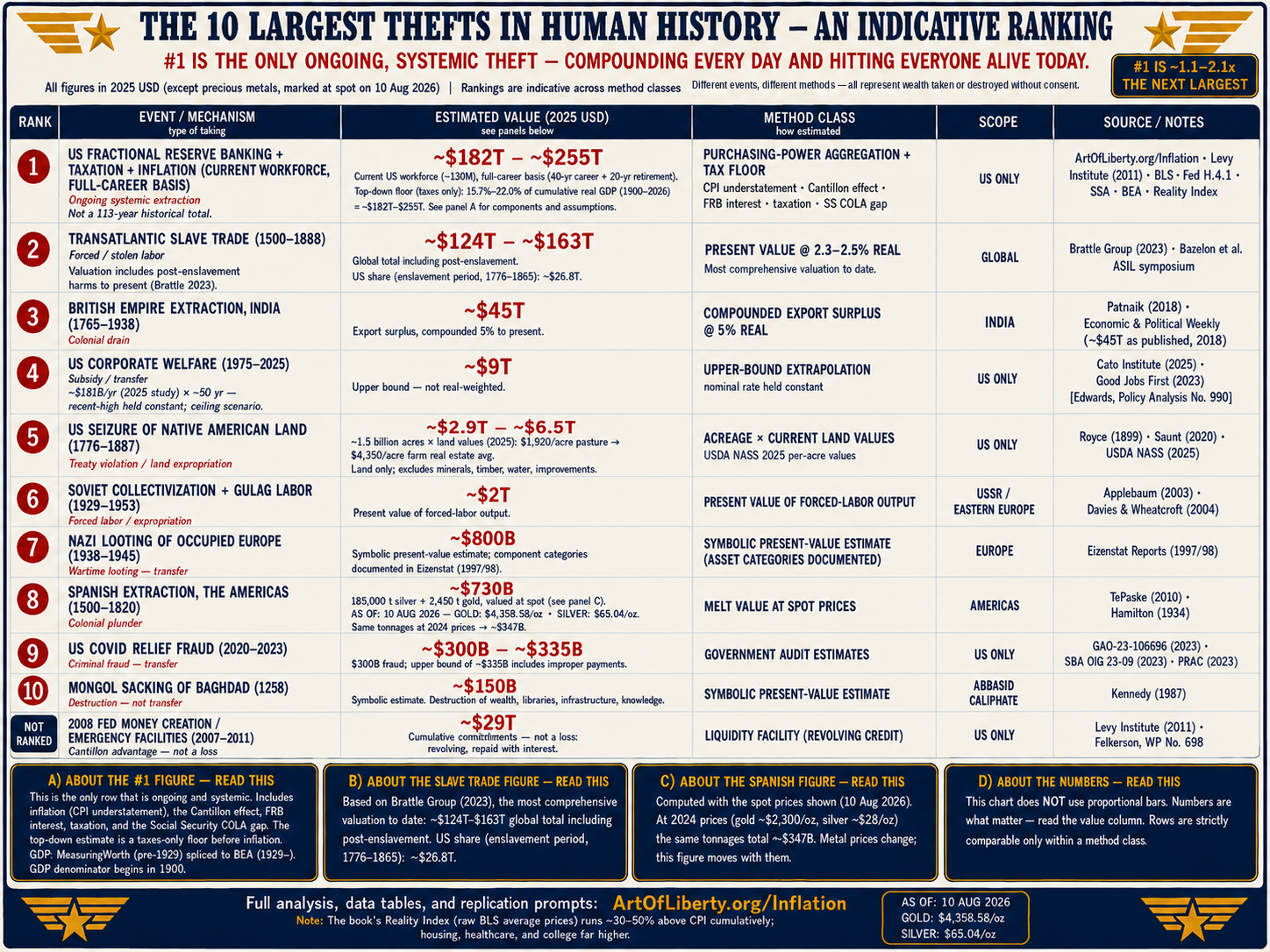
You got it. You got it. So it has been the biggest theft in human history. The title of the book is The Greatest Theft in Human History. And so if you add it all up together, we start in 1913, and we add up what the total theft has been, and on the lower end it's about $182 trillion. It dwarfs the transatlantic slave trade. It dwarfs the British extraction of India.
Jason Christoff
Okay, that $182 trillion. Is that just the Social Security take?
Etienne de la Boetie²
No, no, that's the whole thing. That's inflation plus taxation, and we throw that into the bucket of what I like to call confiscatory taxation, and Social Security underpayment. All of that put together has been $182 trillion. And don't forget, a huge component of that is the banks. I can't prove it, but like you said, who's at the top of the pyramid? I think it's the banks, because the banks are receiving the lion's share. They're the most identifiable entity that's receiving the lion's share. And one of the things that we break down in the book is that the FIRE industry, the finance, insurance and real estate industry, is the largest contributor to politics. So they're buying the politicians, they're installing the politicians, and the politicians keep the system going. They're never ever going to have hearings on the fact that the government's stealing $1.4 million from the average person.
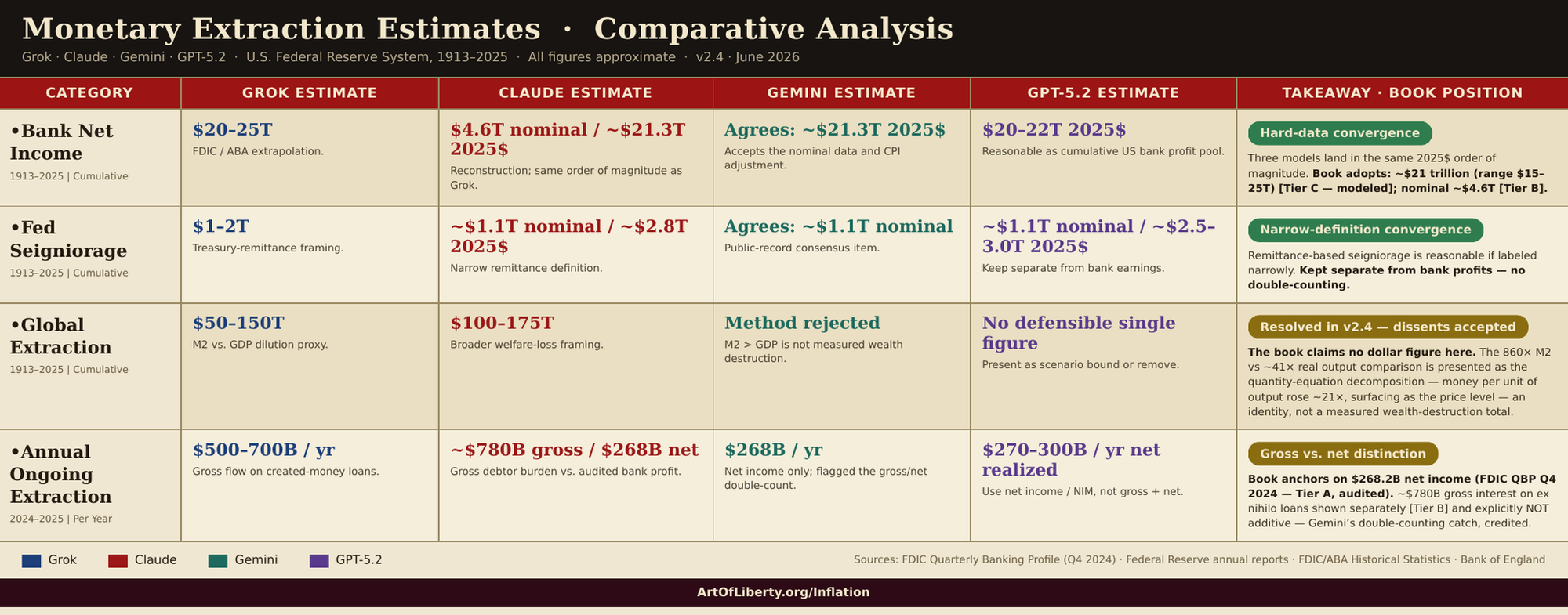
And so the banks, over that same time period from 1913 to now, have made between 15 and 25 trillion dollars, with a T, in profits. And if you think about it, in every city on the planet, what is the largest building? Typically there might be three or four bank buildings that are the largest skyscrapers in every city on the planet. Where did they make these fabulous profits? They stole it. They're stealing the value out of your money, the same as if they stuck their hand in your pocket and stole it. They're just doing it in a tricky way, and then they bought up the media, so the media is never going to explain to you why the money is losing value. They'll tell you how much it's losing, and they'll pretend like it's normal, and oh yeah, this just happens. But that's not the way it was historically. Historically, under a gold standard, you couldn't create money out of thin air with loans and digital shenanigans and digital dollars and fractional reserve banking and quantitative easing, so both the government and the banks were prohibited from doing this. Money was benignly deflationary. Your dollar would buy more and more every year. And it's hard for people to wrap their heads around how wealthy they would be if their dollar bought more and more every single year.
Jason Christoff
Yeah. So before, when we were on the gold standard, if people saved anything, it would at least hold its value and go up one and a half to two percent a year in purchasing power, correct?
Etienne de la Boetie²
Yeah. Yeah. Oh, you froze a little bit. So, correct. And so the other thing to understand, and a lot of people don't realize this...
Jason Christoff
We were rudely interrupted. I'm sure that never happens to you whatsoever.
Etienne de la Boetie²
And it never happened to me, of course.
Jason Christoff
So we'll continue on. And I think maybe the best place to start up is: we were discussing that if someone dies prematurely, and I've put this together myself, if someone dies prematurely and is owed Social Security, obviously they don't get it because they're dead, and their heirs don't get it. So doesn't that create a large incentive for the organization paying out to potentially end the lives of Social Security recipients?
Etienne de la Boetie²
Without a doubt. And that's what you're seeing in Canada, right, where euthanasia is policy. And it appears to be what happened in COVID as well. The government has all these incentives, because it's organized crime. And so that's really the case that we're making.
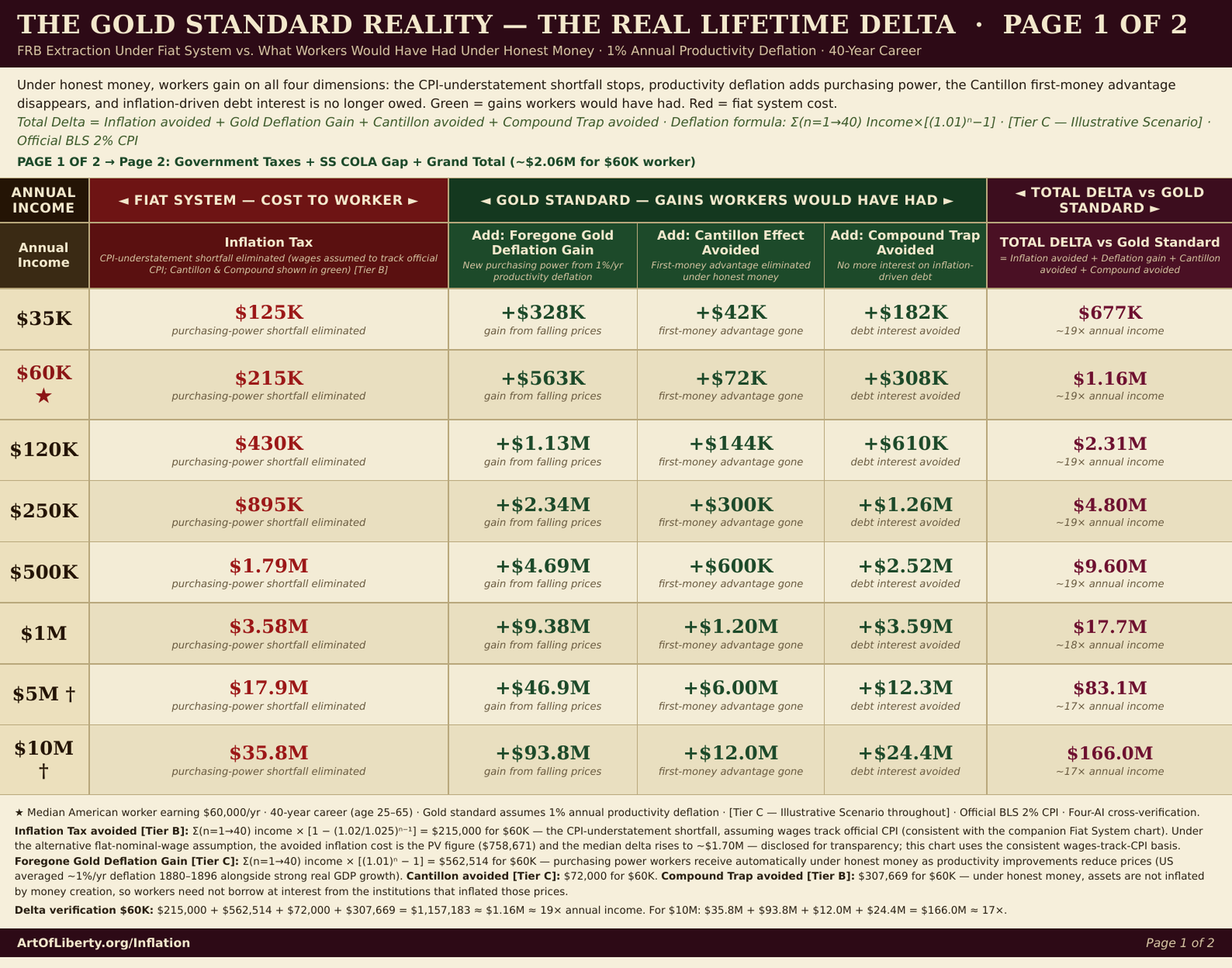
The other thing we were talking about when we got so rudely interrupted was the gold standard. We were talking about the fact that gold is benignly deflationary in a gold standard, where you can't just create money out of thin air with digital dollar creation or quantitative easing or all of these ways that the government steals the value out of everybody's money by counterfeiting money for themselves so they can spend it and pass it out the back door to their friends and supporters and make these obscene profits for the banks. Not only does it buy 1.5 to 2% more some years, but it's not just paper money that you have.
Back in the days of the gold standard, a $20 bill was a warehouse receipt for a $20 gold piece that was on deposit at the bank. You could go to the bank and put down your $20 bill, and they would put a $20 gold piece on the teller window, and you would take the $20 gold piece. The bank note was a way of not having to haul all this gold around, but there was supposed to be one $20 bill for every single gold piece that was on deposit.
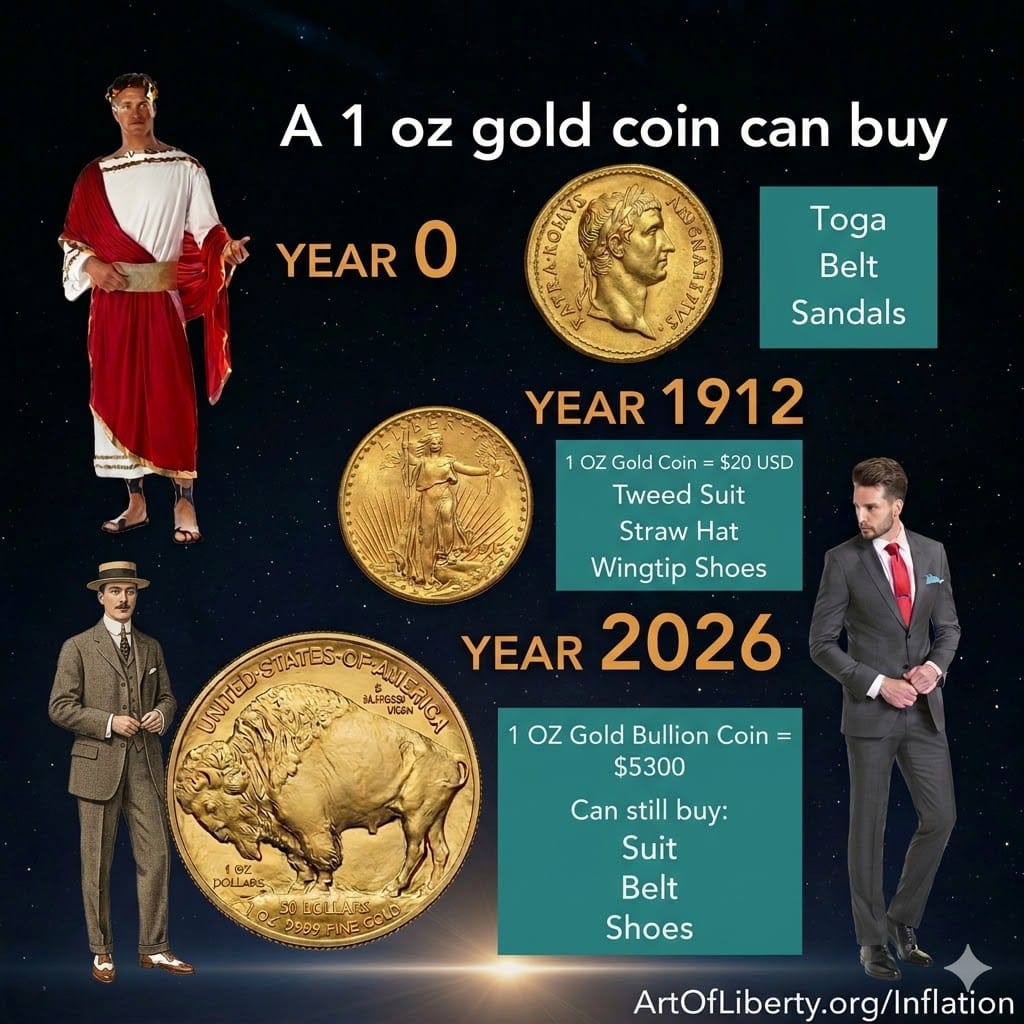
Now, gold has a 5,000-year history of holding its value. In the year zero, a little bit less than an ounce of gold, a Roman aureus, would buy a fine toga, a pair of sandals and a belt. If you flash forward to 1913, before the Federal Reserve came on the scene, a $20 Saint-Gaudens gold piece would buy a finely tailored man's suit, a fancy straw hat, a really nice belt and a really nice pair of shoes. If you took the $20 bill and the $20 gold piece and you buried them and dug them up today, you can't buy anything with a $20 bill, but that gold piece is worth $4,500 plus. And for $4,500, you can still get a finely tailored suit, a really nice belt, a really nice pair of shoes, and if a hat's your thing, you can get one of those too. So that illustrates the theft that this paper money has sucked out of society.
And that's really where we find ourselves. I believe it's a form of economic warfare against the population. I think they're trying to make the population poor as more and more people are realizing that government has been a scam, that the whole financial system has been a scam, that they're being robbed in a variety of ways by the government, that the money's going out the back door. Trump's doing crypto scams; Trump's sons are investing in companies that magically get billions and billions of dollars of government contracts. It is being run as a criminal enterprise in Washington, D.C. And so I think they're trying to bankrupt the population and bring in masked goons on the street as more and more people figure out that, hey, we've been robbed, they've stolen the money, it's the government and the media working together. The media's putting out deception and distraction to try and distract the population away from the most important information in the world, which is that the average person is going to lose $1.4 million to the thieving, stealing, organized crime "government."
Jason Christoff
So let's say we have a corrupt government official. I'm sure you're aware that Donald Trump, I think it was three months ago, wrote an executive order, and of course all executive orders bypass the spirit of democracy in the first place. And this is how this group works, right? Death by a thousand cuts, inch by inch. They erode or normalize anything that's not democratic. I don't like the word democracy, but basically, there shouldn't be one person anywhere who can change any law with the signature of a pen without getting the public's input. But three months ago, he signs an executive order that makes himself immune from IRS audit, for him personally and all his family members, for life. So for the rest of time, basically, it can't be challenged, and no president goes back on another president's executive order. I don't know if that's ever happened. So if this group is up to financial shenanigans, which we know they are, and they're getting boatloads of cash, how do they make sure that their cash is not devalued like this? What is the appropriate gangster plan if you steal a tractor-trailer load's worth of cash? How do you guarantee you don't get caught in the same scam that the public gets caught in, with the devalued purchasing power of the cash they have in their bank or their wallet or under the mattress?
Etienne de la Boetie²
You turn your rapidly depreciating fiat paper tickets into plant, property, equipment, stocks, company ownership, gold, silver, crypto, you name it. And I think that's what the banks have been doing the entire time. Our thesis is that a lot of the monopolization that you see in society would not exist in an honest monetary system.
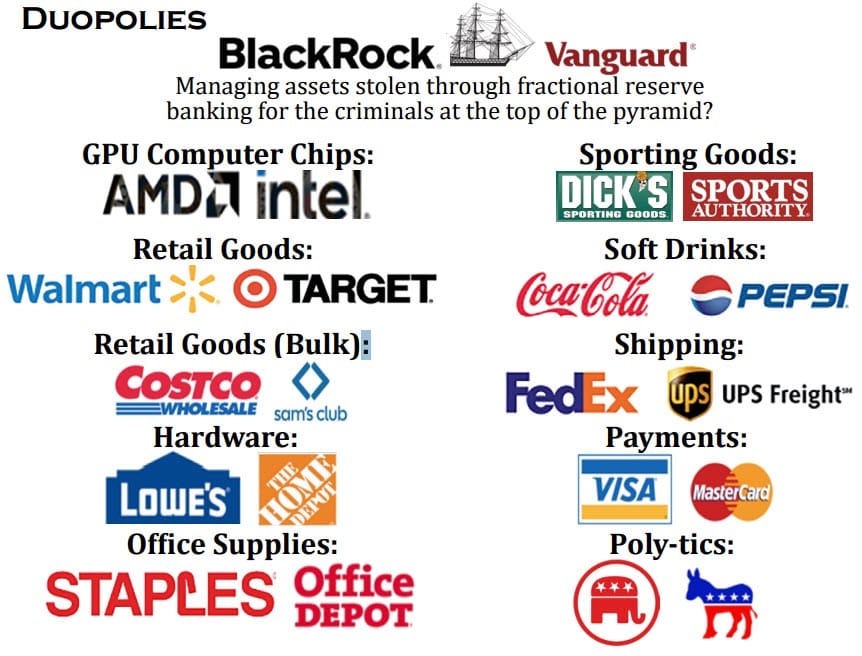
There wouldn't be two hardware stores, Home Depot and Lowe's. There wouldn't be two package delivery companies, FedEx and UPS. There wouldn't be two consumer goods outlets in Target and Walmart. There wouldn't be Coke and Pepsi. There would be a crazy variety of different companies competing for customers, and the companies that win wouldn't be the ones that get unlimited fractional reserve dollars. They'd be the ones that satisfy the customer the best. A meritocracy would be on top instead of a kleptocracy. But instead of a meritocracy, we have a kleptocracy, where the banks are providing this unlimited capital, and I think that they're buying everything up through asset managers like BlackRock, Vanguard, State Street and others, where all of the ownership is obscured.
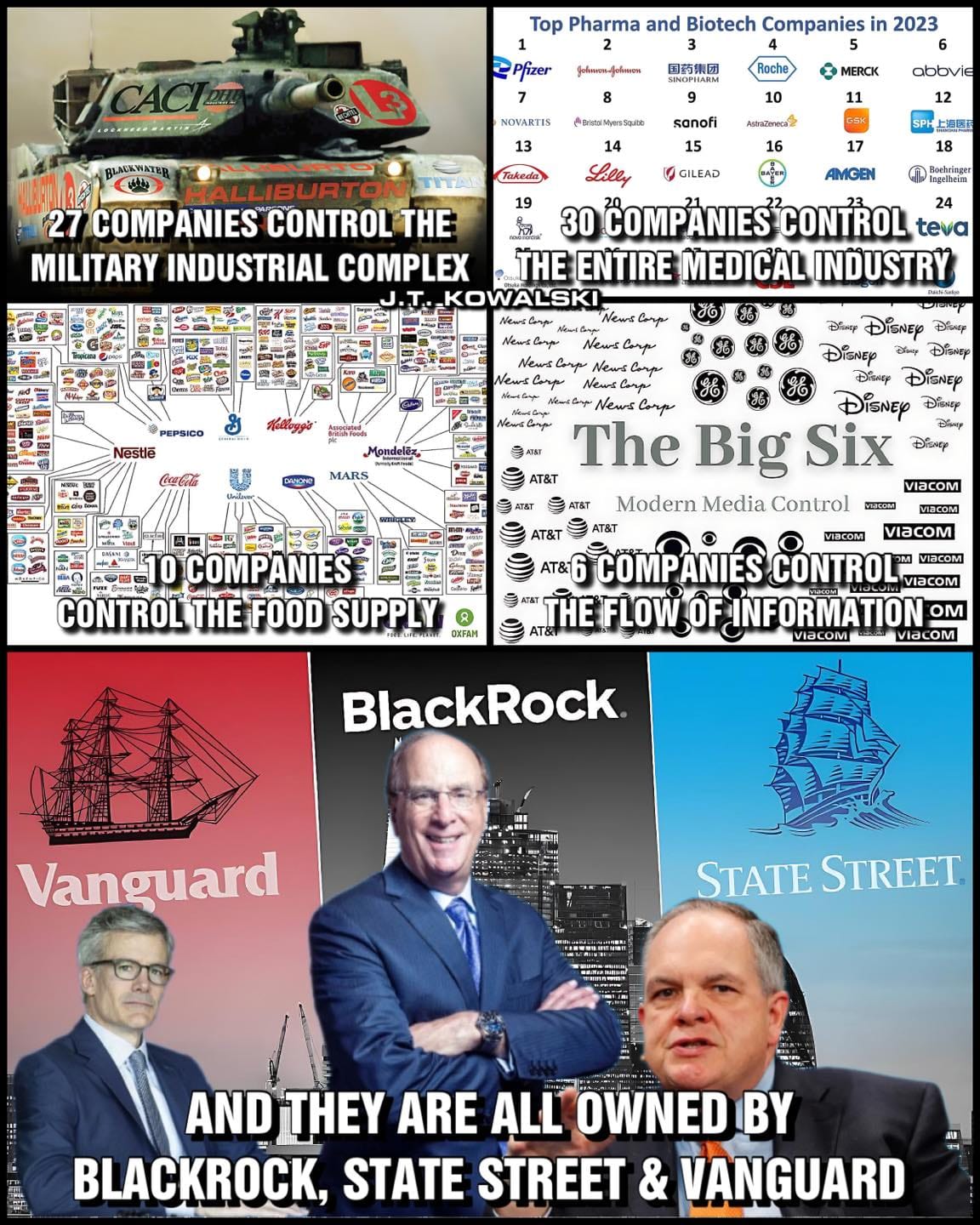
The number one thing you could do if you wanted to get to the bottom of this is to figure out who owns Vanguard and BlackRock and State Street and how that ownership rolls up to the specific people involved, and, oh, look, it's the banking industry and it's the banks. And people have done that kind of research. Years ago there was an analysis, I forget the name, that looked at tens of thousands of companies globally, and they figured out that 40% was owned by the financial industry. I want to say that was 2009 or something like that. There's even more consolidation today. And so the banks are buying it up. And the crooked politicians are doing the exact same thing that the banks are doing. They're taking the rapidly depreciating dollars and turning them into real assets. And I think in the end it's going to be kind of like musical chairs. Once the dollar dies because they've stolen all the value out of it, they're going to try and hold on to the plant, property, equipment and companies that they've stolen through fractional reserve banking, the gold and the silver and everything, and then they're going to leave us to fight over the scraps. That's what I think it looks like for the politicians and for the people that have been stealing the value out of your money.
Jason Christoff
When you go to the grocery store here in Europe, they will scan every bill. It doesn't matter if it's a five-year-old bill or a ten-year-old bill or a twenty-year-old bill, they scan it for counterfeit. Now, given what you're saying, how bizarre does that seem to you? I think you know that every dollar they're scanning has already been counterfeited by the banks.
Etienne de la Boetie²
No, you're absolutely right. And it's kind of funny, because I mentioned that in the old days, a $20 bill was a warehouse receipt for a $20 gold piece. And even before you had custodial banks, the goldsmith was the bank in many towns and villages, because the goldsmith had a safe. You could break into the average person's house quite easily: thatch roof, little wooden door, not a lot of building quality, very few places to hide your valuables. And so people would go to the goldsmith and let him put their gold in his safe, and he would write out a note that says you have $20 on deposit. And so really the first inflation was that the goldsmiths would write out more notes and begin spending them, because the notes began circulating as money, and nobody ever came and got their gold, because it was much easier to just have the notes, and the gold was safe. So the crooked goldsmiths would make these extra dollars, and over time, as more and more dollars circulated in the town, it began to bid up prices. And that was the first inflation, a bidding up of prices because there's all this extra quote-unquote "money" circulating around the town.
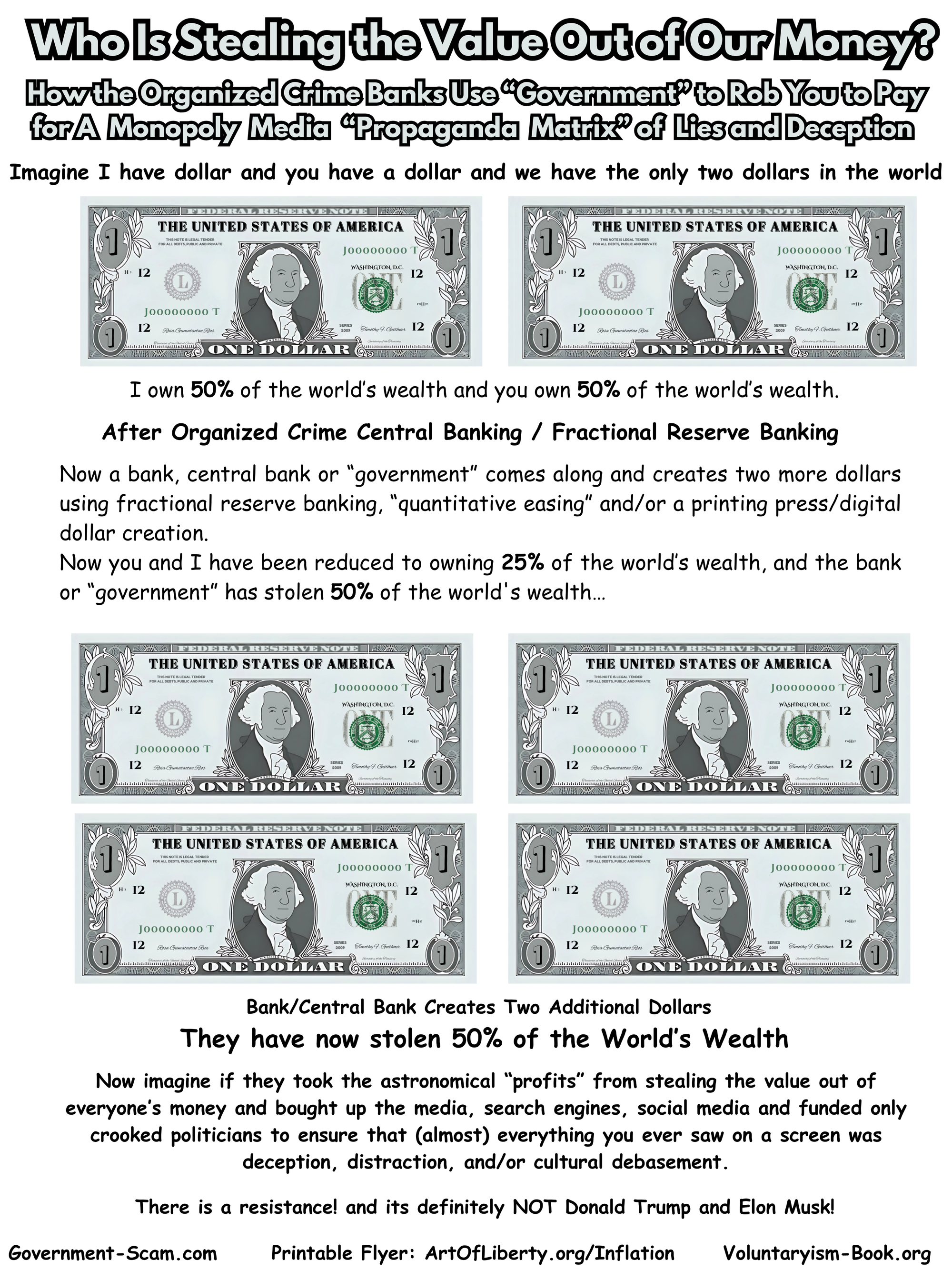
And so what the Federal Reserve did is they institutionalized that practice. The first thing they did is they printed more dollars than were out there. These banks began to make gazillions of dollars' worth of loans, and you had the Roaring Twenties. So the Fed came along in 1913, and there was so much money in circulation that it became the Roaring Twenties. And then when they removed the punch bowl, it became the Great Depression. But they printed so many dollars that now people were going to come, and you were going to see what's known as a bank run. Everybody that's seen the Christmas movie It's a Wonderful Life knows what a bank run is. If you're at the beginning of the line, you get your gold back, and if you're at the end of the line, sorry, we printed up a bunch of extra dollars and you don't get anything; you're now completely bankrupt.
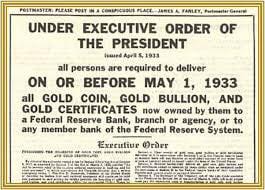
And so that was about to happen to the Federal Reserve. So what did they do? Again, to your point about executive orders: Franklin Delano Roosevelt, by executive order, steals everybody's gold. Everybody in the United States in 1933 had to turn in their gold or face criminal penalties. There would be marshals at the major banks, and when you went to your safety deposit box, they would go with you to make sure that you didn't have any gold in it. They had some carve-outs for numismatics and for dentistry and things like that, but they stole everybody's gold.
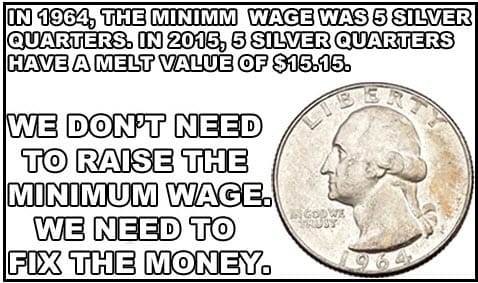
In 1964, they stole everybody's silver. Up until 1964, our coins were 90% silver. The government just kept the silver coins and replaced them with what are technically not even coins; technically, it's a token. And so they stole all of our gold in 1933, they stole all of our silver in 1964, and they've left the country in this very precarious position of having money that's not backed by anything.
That's very, very dangerous, because even back in the time of Voltaire, Voltaire famously said that paper money eventually returns to its intrinsic value of zero. Even our quote-unquote "founding fathers," if you believe in the fables of the Constitution, knew you didn't want to have paper money. So they actually put only gold and silver in the Constitution, but we've got an organized crime government. They don't do anything that the Constitution says.
Back to your point about them legitimizing the ability to write executive orders for crazy things and give themselves immunity for all the crimes they're committing and never audit their taxes: it's a one-sided contract that everybody's forced into, that applies to you but doesn't apply to the government. They've broken almost every single one of the Bill of Rights except the quartering of troops. I don't think they've actually quartered any troops in anybody's house. But if you think you have a Second Amendment right to own firearms, well, if you live in Maryland and other states, they've passed something called a red flag law, and a police officer or judge can write down that they think you're a danger to society, and they can come and get your guns. And the first person that they did this red flag law to thought he had a Second Amendment, and he put up a little bit of a scuffle, and they shot him dead.
And so it's a complete scam. Government was either a scam from the beginning, or it was the dumbest idea in all of human history: to give a single group a monopoly, create a ruling class that has rights that you don't, that is exempt from the basic morality of everybody else, and think that it could be disciplined by a piece of paper. It's just a dumb idea. It didn't work, and I don't understand how anybody can say that it worked. It didn't limit government at all. We don't have a limited government; we've got the greatest monstrosity of an empire that the world has ever seen. It didn't restrain the government at all, and it didn't protect individual rights. What it's supposed to do is protect your natural law rights, but it violates them at every single turn, and it's stealing $1.4 million from the average person. Like I said, it was either a scam from the beginning, which I believe, or it was the dumbest idea in the history of the planet.
Jason Christoff
Yeah. And when I think back to the teller, the lady scanning my euro at the grocery store, I understand the premise is that if someone had a printing press and their money wasn't legitimate, they could literally print as much money as they wanted and buy a whole apartment complex and Mercedes and Lamborghinis and Gulfstream jets, which is exactly what's going on. But we're not the ones printing all this fake money. They are. I'm correct on that, right?
Etienne de la Boetie²
You are correct. It's a 100% organized crime system that has bought the media. If you're creating money out of thin air, the first thing you do is buy up the media, so the media isn't going to tell the population what's going on. You buy up the politicians. You have unlimited money to work with, so even if it costs you hundreds of billions of dollars a year to buy up the media, it doesn't matter; it might as well be free. I used to work on Wall Street. We called it mice nuts. It might as well be free. You can think of it a little bit like the marketing budget, right? And so that's why there's nothing on the mainstream media but distraction and deception. It's a brilliant plan. You almost have to admire it, if it wasn't hurting so many people, if it wasn't destroying families, if it wasn't impoverishing the average person.
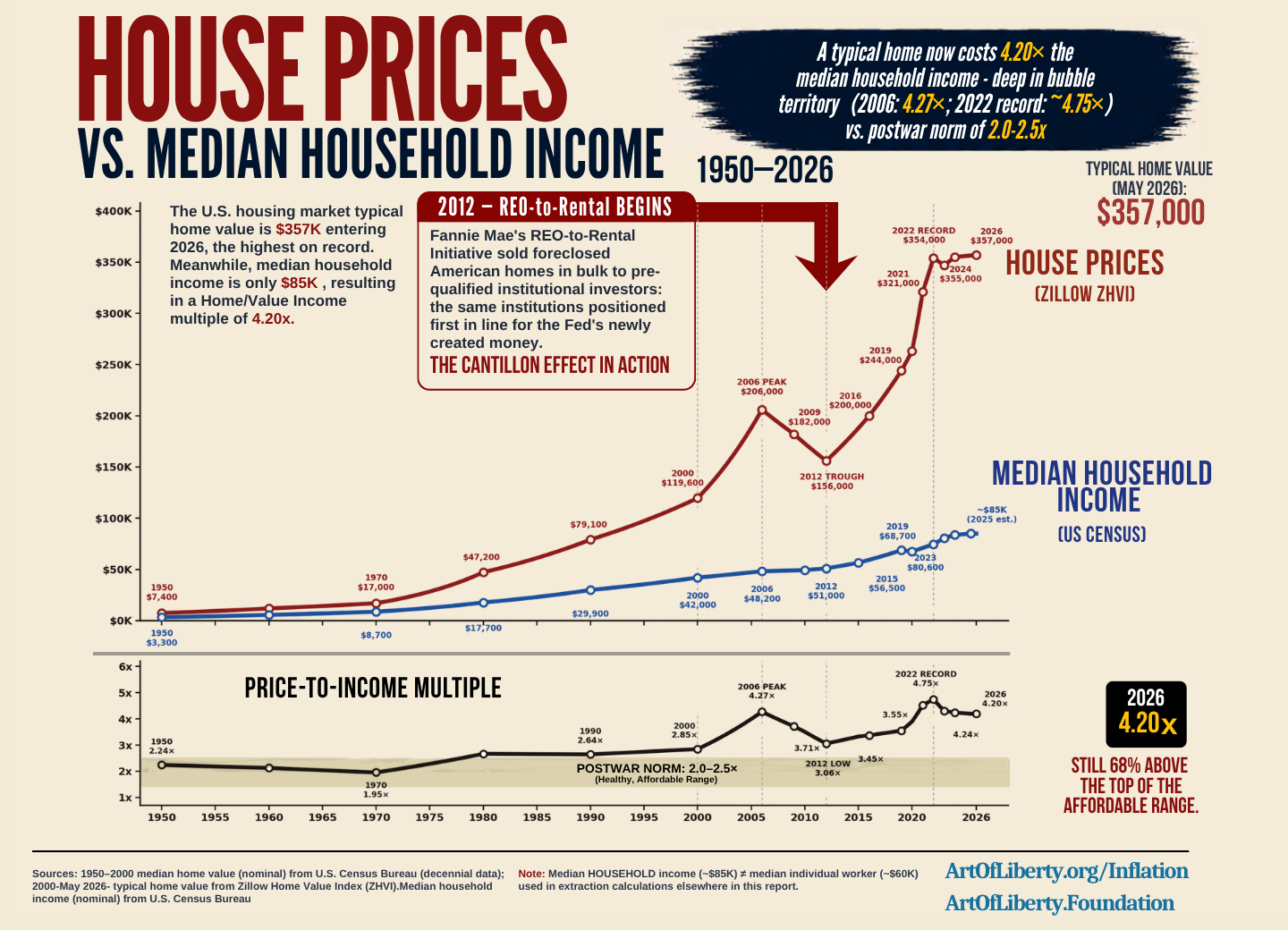
Now 20-somethings can't afford houses, because the crooked monetary system has pushed the average cost of a house in many cities to $300,000 or $400,000. They can't afford the down payment. All of their purchasing power has been stolen. The productivity is there. If you're working a job at a factory or in retail or whatever, contributing to society, you should be dramatically wealthier than you are right now. The productivity is there. They're stealing the purchasing power in this tricky, tricky way.
Jason Christoff
Now, when you were doing your research, did you look at the work of Catherine Austin Fitts at Solari? She has her own URL address, missingmoney.solari.com. Catherine Austin Fitts was in charge at HUD, I think, which is Housing and Urban Development. She was a big-time federal financial expert hired by the government, and she researched and did some basic auditing of only a couple of the departments. I believe there are over 20 departments, and I think she audited a very small few, including her own, Housing and Urban Development. And she and another expert discovered that there was $21 trillion missing. So that's $21,000,000,000,000. Just so people know, a trillion is a thousand billion. So $21 trillion is quite a bit of money. I think they said it was $65,000 per person, not per adult, but per person in the United States. Did you factor in the money stolen from the Pentagon that Donald Rumsfeld announced on September 10th, 2001? It was $2.3 trillion, and the offices investigating the $2.3 trillion missing at the Pentagon were blown up, or hit by a missile, obviously on 9/11. Did you include this stolen tally?
Etienne de la Boetie²
So we mentioned the waste, fraud and abuse, but we were essentially measuring two different things. What we're measuring is how the money is stolen from the average person and what the total is that's stolen. Out of that, $785,000 goes to federal, state, and local taxes, so the money goes to the government. What Catherine's measuring is how the government is stealing out of that general revenue and how that money is missing. It's missing from the Pentagon. It's being spent on $400,000 helmets for the F-35 and $10,000 toilet seats. At the local level, San Francisco got caught spending $1.7 million for a single toilet in a park, if you can believe that.

When we were in Sedona doing our conference, Liberty on the Rocks, in 2024, they'd put up eight pickleball courts for $1.6 million. I called somebody I know who owns a comparable private pickleball facility in Memphis, Tennessee, called Willow Grove Pickleball Paradise, and I told him that Sedona just spent $1.6 million on eight courts, and he starts laughing. He'd put up six courts, with the same chain-link fence and lights and everything like that, for less than $100,000. He had two bathrooms; they didn't. He was building five more indoor, climate-controlled courts with bathrooms and a party room and things like that, and he was going to spend about $335,000 for those five additional courts. So where did the money go? There's a tremendous amount of waste, fraud and abuse at every level of government: federal, state and local. To a degree, it's almost like they're all in on it. They're all living on money stolen from others at the point of a gun. And what they don't get in taxes, it's called the pirate state: they're stealing from motorists in road piracy, and they're stealing it in... what's the phrase when they just take your money and give you a receipt?
Jason Christoff
Extortion.
Etienne de la Boetie²
Extortion. I'm having a brain lock on what the thing is, but the government is stealing at every single level, and they get away with it because they're controlling the information that the average person receives. They force you to go to either the mandatory government school or the accredited private school. Even if you go to a private school, they're going to teach you that government is legitimate, desirable and necessary before you're old enough to question the logic and the morality of that claim. And then the monopoly media is going to come along and reinforce that on every channel. Not only is government legitimate, government's the hero; government's saving the day. If it wasn't for the government, there would be nuclear weapons cooking off in every single American city. There would be biological warfare. There would be Muslim terrorists. It's just ridiculous that they get away with this, and it's an insult to our intelligence. I find it personally insulting, the cartoonish level of propaganda that we're subjected to by this monopoly media system.
Jason Christoff
Yes. So whatever they're stealing, so that people know, the theft is occurring and it's going into their pockets. Anybody associated with the top levels would be rushing out buying houses, investing in companies, so that their cash at least maintains or accelerates its spending power. And of course, as they're going out with trillions and trillions of stolen money and trying to buy houses, because they know if they keep it in cash they're going to lose extreme value on the money they stole, that rapid-fire purchasing bids up the cost of everything, which in essence is inflation: you are losing out to these mass up-bidders.
Etienne de la Boetie²
It's funny that you just said that, because one of the other things that we cover in the book The Greatest Theft in Human History is something called the Cantillon effect.
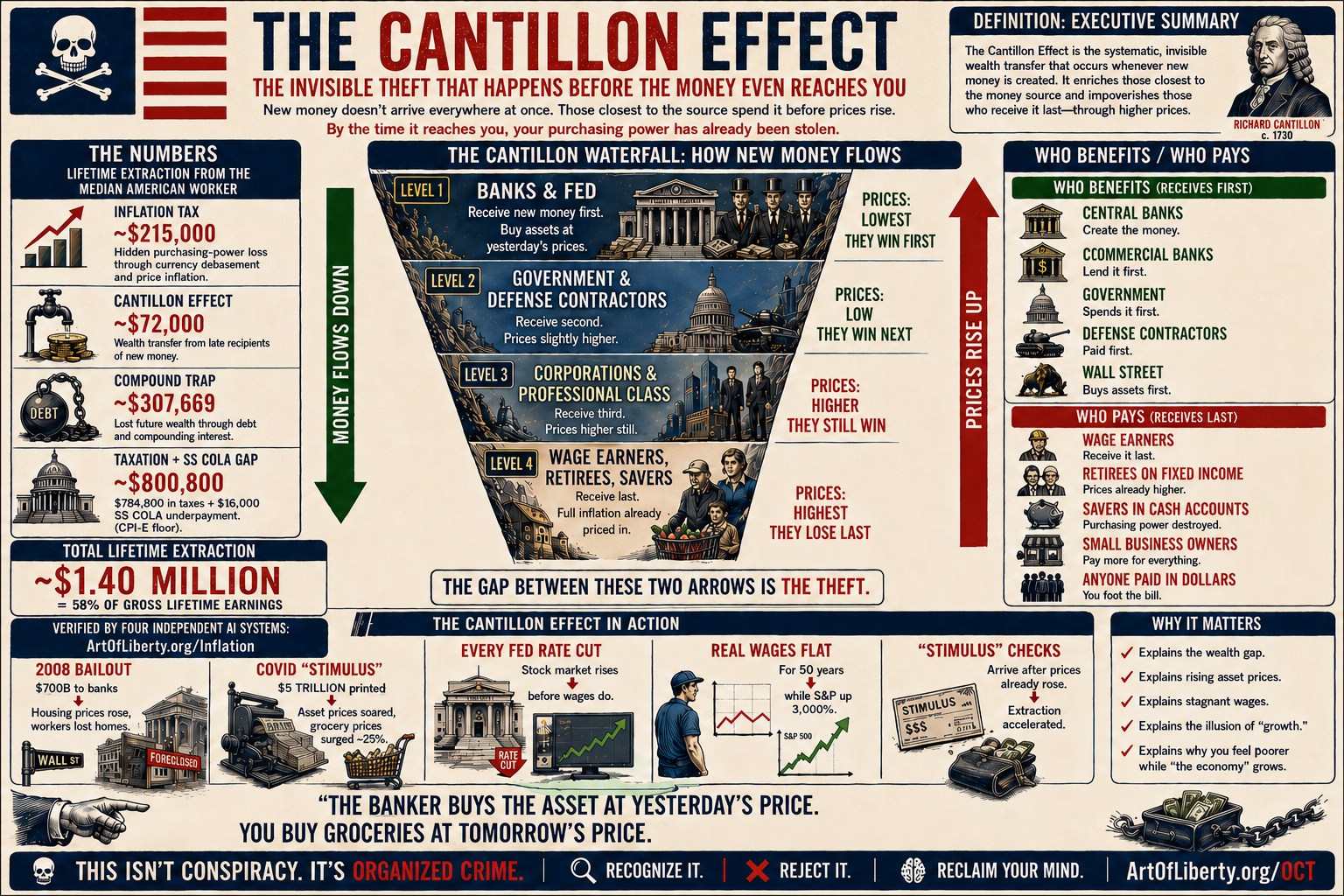
The Cantillon effect is a 300-year-old, well-understood economic mechanism. Part of that $595,000 that you're going to lose to inflation, one component is the pure inflation. So if it's 2% a year, you're losing 2%; if it's 8% a year, like it was during the COVID era, you're losing 8% of the purchasing power of the money that you earn and save. Part of it is the compound trap that we discussed, of having to borrow money from the banks that you wouldn't have to borrow absent the crooked monetary system. But the final third leg of where that $595,000 goes is called the Cantillon effect. When this money comes into existence, it hits the government or the banks and the financial industry first, and they spend it at the maximum purchasing power. So they're buying at today's prices, and then the money does kind of trickle through the economy, but by the time it gets to the average worker, they're going to spend that money at tomorrow's prices, and they're going to have to pay more. And so the people that get the money first are the defense contractors and the Beltway bandits.
And in some cases, in 2012, right after the 2008 financial crisis, when the housing market went into the crapper, the government allowed financial firms to buy houses in bulk at auction, and they bought north of 450,000 houses in the United States in a one-to-two-year period.
Jason Christoff
You mean 450,000 homes they bought?
Etienne de la Boetie²
They bought 450,000 homes in the United States. The financial industry did. The program was called REO-to-Rental.
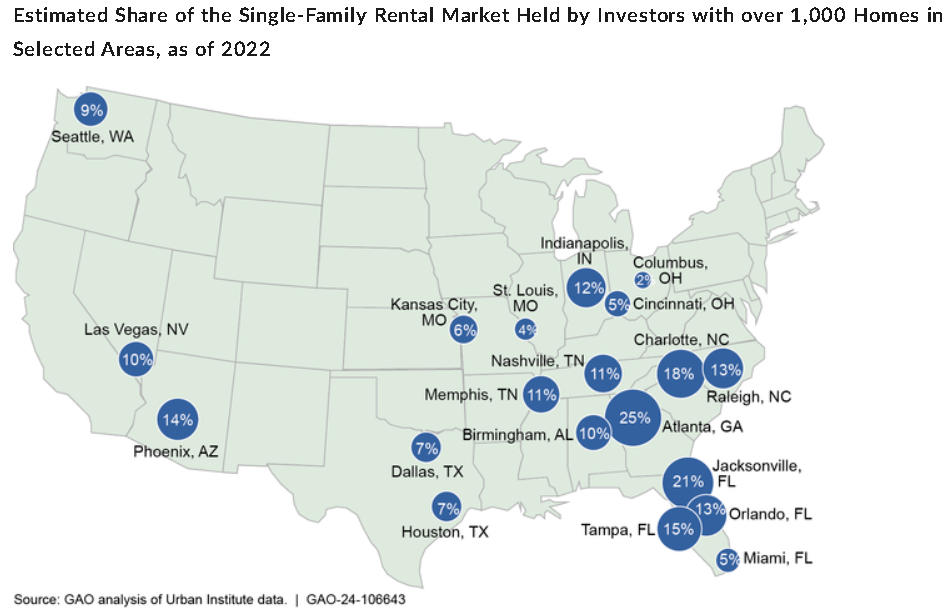
I forget the agency that put the program together, but they sold 450,000. So then that cranked up the price of housing. A lot of people lost their houses to foreclosure. The government comes in and lets the financial industry, which is now flush with this new cash that they probably got in bailouts, or stimulus, or from zero-interest-rate-policy dollar creation, or in loans from the banks that created it out of thin air, buy all the houses. They crank it up, and then they raise the rents, and now you have to borrow way more. The market was adjusting, okay? But instead of letting the market adjust, they give the financial industry a lot of money, and then they sell them everybody's houses. And now people that once owned houses, that might have lost them in a foreclosure, have to rent at twice what they were probably paying in their mortgage payment before 2009.
Jason Christoff
And just so people understand: when Etienne talks about the market readjusting, if someone loses their house in foreclosure, hopefully the average Joe next door can pick up a half-a-million-dollar house for $225,000. That's the adjustment of an overheated economy. Things are supposed to go on sale, and someone's going to benefit. Average people did not benefit, is what Etienne is saying. These groups who stole all this money made sure they had a receptacle for that money that they know is going to be inflated away in value. They just dump all that stolen cash into 450,000 homes. Their stolen money is secure, their booty is secure, their piracy is secure. And then the average person is left holding the bag on both sides of the argument. They're the ones funding the government with their stolen taxation money, and now they're paying double the rent to stay in the home that they could have probably bought if it was a real free-market system and average people were allowed to benefit from the mechanics of the boom and bust.
I've got a question for you, because we're going to wrap up here. What is the average person supposed to do about this? There's going to have to be some action, I would say, like making sure other people understand that government is illegitimate. It's a multi-generational crime syndicate. There is no legitimacy. There isn't anybody on the planet that has the right to steal your money or force any sort of... I mean, enslave is the word. If you have conditions by which you can travel, conditions on how much you can spend, conditions on how you can transfer your money or how long you can spend in a country... Prison is the condition: you get up at this time, you go to the toilet at this time, you get outside time one hour a day. You're a slave. So what do people have to know here? How do they navigate this system? Right now they should have assets; they should have housing if they can; they should buy other assets, at least some food assets, because even if you buy a $10 bag of rice and food doubles in three years and you eat the rice, you're making $10, because you bought the bag of rice at $10 and it went to $20, and you saved yourself $10 from buying it two years down the road. What else can people do to protect themselves in the here and now, and to spread the word that all humans are equal, and no other human in the world has the right to force conditions on the way you live, and steal your money, and also poison you, like in COVID, where the public was poisoned en masse, probably to shave down how much Social Security was paid out, and also to make the public too brain-damaged and physically incapable of any sort of rebellion or rational thought toward the crime syndicate and removing them from power?
Etienne de la Boetie²
Well, I'd say the number one thing that you can do is get your money out of the dollar. My running joke is, I don't know why anybody has a nickel in the dollar. So whether it's gold or silver or beans, bullets and Band-Aids, anything that you would buy over the next couple of years, you probably want to get it now if it's non-perishable. You want to have a deep larder. You always want to have a stocked pantry. You want to have emergency food, just in case the whole thing goes south, because the history of paper money is, as Voltaire said, it always goes to zero. And so we're in a very precarious position.
You want to use cash as much as you can, because I think that they're setting it up. What I believe is that every central bank in the world has pilot programs going on for central bank digital currencies and various forms of digital programmable money. You don't want digital programmable money, and the only way you're going to be able to resist that is if everybody has a lot of cash on hand. And cash is really good because, number one, you're saving the local merchant 1.5 to 3% that he's going to have to pay the bank or the credit card company, which is generally the same entity. At the same time, you're starving the organized crime bank and credit card company of 1.5 to 3%. And also, especially with mom-and-pop local businesses, which you should be doing as much business with as you can, they're going to be able to not report some of that to the lying, thieving, stealing, organized crime "government." And so maybe they can afford a piano lesson for their child or something like that, which would be good for the local economy. So you want to use cash.
The other thing is, you've got to understand that we're in an information war. The number one weapon that is being waged against you is that they're controlling the information that society receives, so that you don't understand what's really going on. So when you find authentic voices like Jason or Etienne or whoever it is, you've got to support them.
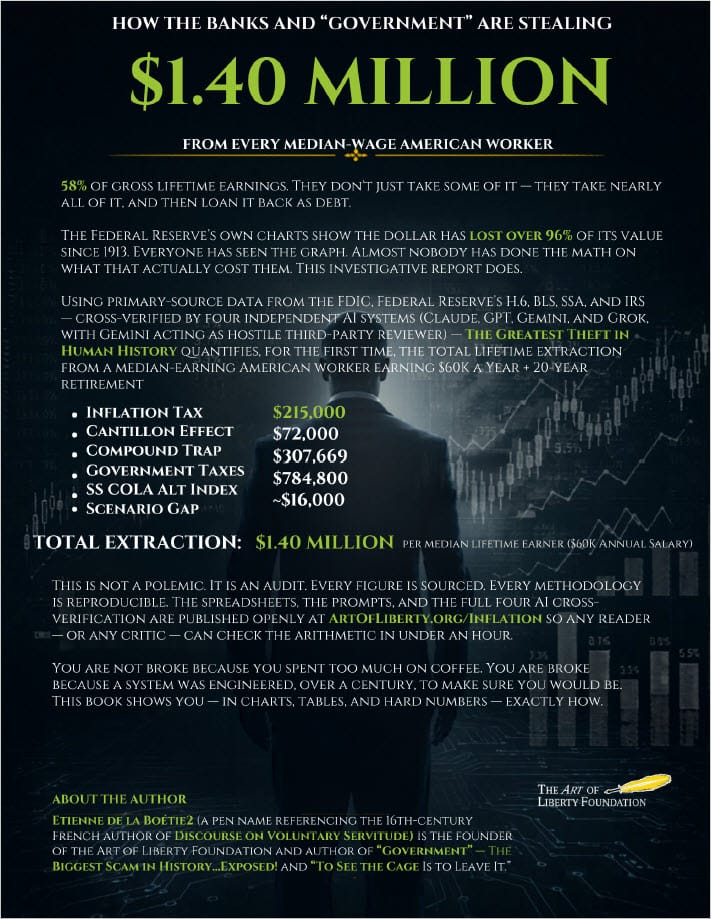
Buy the book. You've got to share it with your friends and your family and your colleagues. You've got to keep the alternative media alive so that we grow and we have strength. I think we have the ability to outperform the monopoly media, in the sense that they're dying and we're growing, but it's only going to happen if you keep us alive.
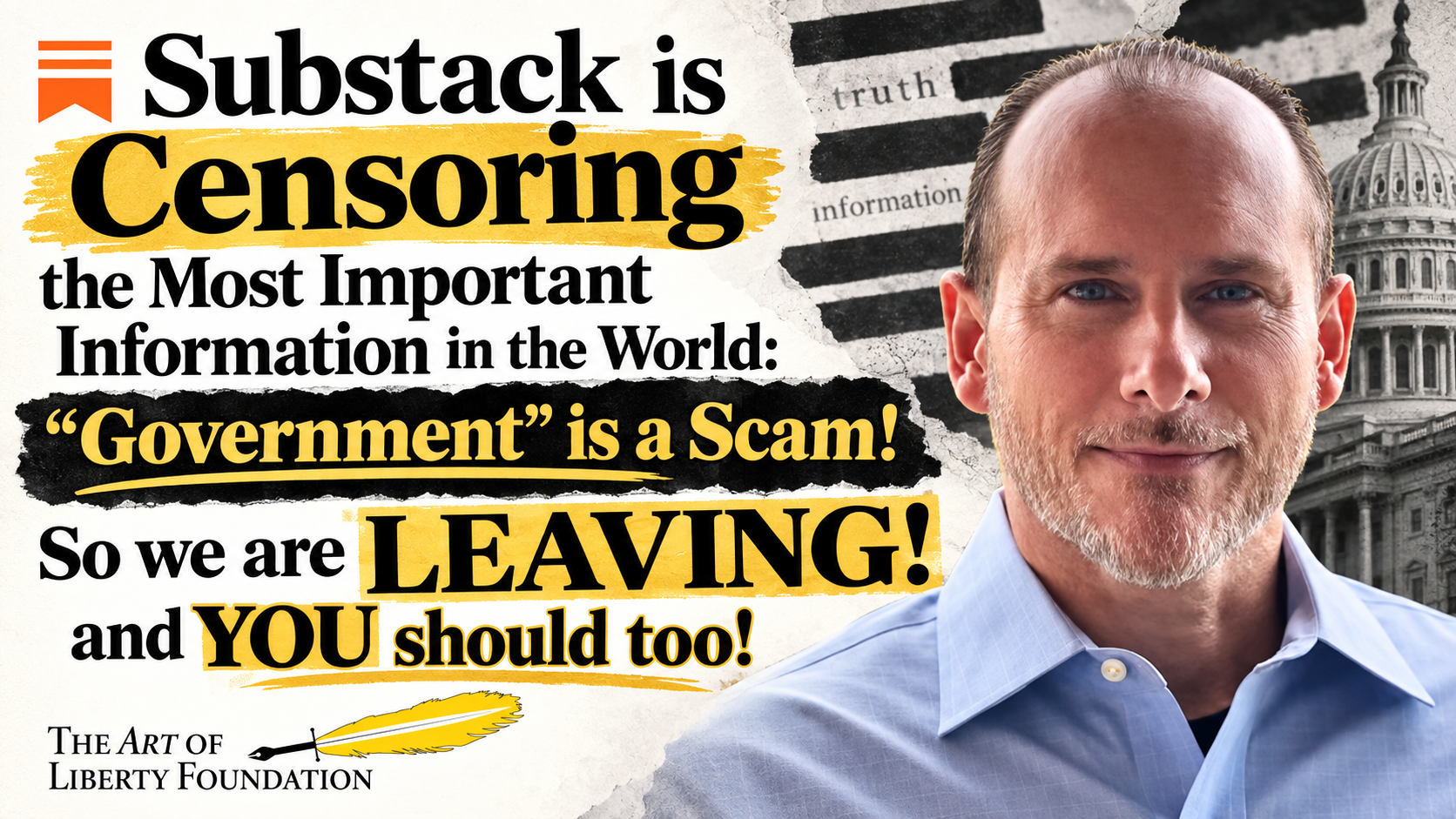
And as an example of that, we were on Substack. If you don't know the basics about the alternative media, it's been censored off of every platform that was out there except for Substack. It was censored off of Facebook in 2018, when Facebook kicked off 200-plus people, 500-plus pages. They took down pages that had millions and millions of followers. The Free Thought Project lost three million followers on Facebook. The Anti-Media, the early alternative media, was kicked off of Facebook. In many cases, they were kicked off of multiple platforms simultaneously. The Free Thought Project lost their Facebook page, got a strike on their YouTube channel and lost their Twitter account in the same week. So it's a coordinated effort across multiple platforms. They made Alex Jones the poster boy for this, knowing he was a divisive figure and a controlled opposition voice that wasn't going to point the finger where it really needed to go, but they took him off almost 10 platforms simultaneously.
So you have to understand that almost every platform that you see out there is corrupt. They let us make money on Substack for a while, and then they began censoring us. They got $100 million from some shady In-Q-Tel and Defense Department-connected investors in July of 2025, and they turned everybody down. The Art of Liberty Foundation was doubling and tripling our audience on Substack until they got this $100 million in July of 2025. They turned us down, and they turned down many, many other members, and our growth just absolutely cratered. So we left Substack and built our own censorship-resistant platform at ArtOfLiberty.Foundation, Voluntaryist.News and Five Meme Friday at FiveMemeFri.org. We built our own platform so we couldn't be silenced.
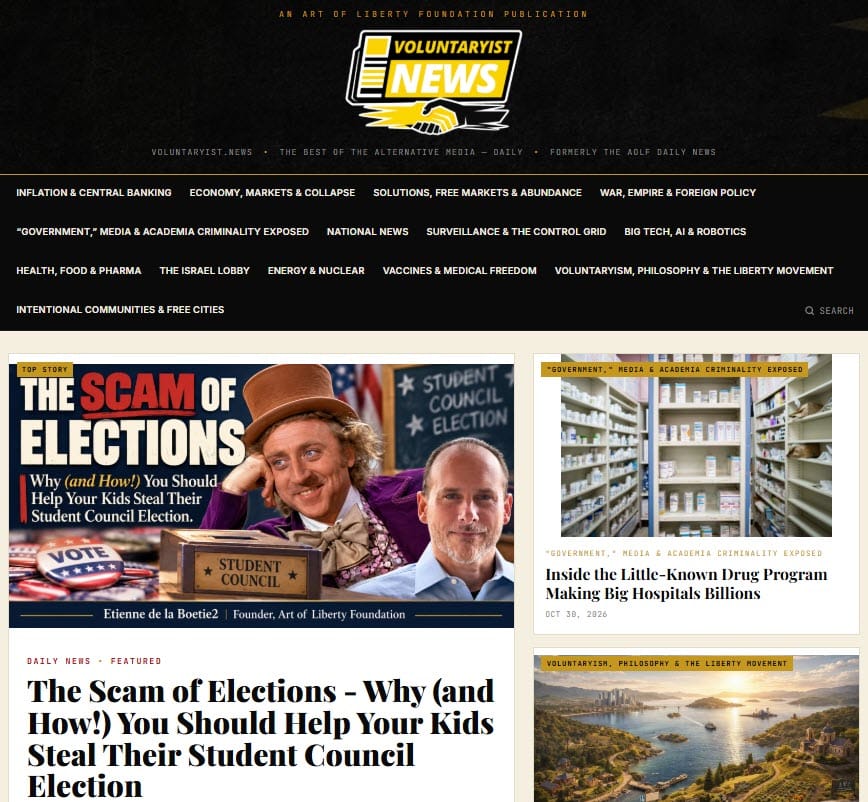
If you're getting your news from social media, you're being algorithmically manipulated. You're having authentic voices turned down, shadow-banned, demonetized and de-indexed at the same time that controlled opposition voices are being turned up. You can't let yourself get caught in that game. You've got to find authentic voices, and you've got to support them. Those are some of the things you can do to fight back, but it is an information war. Can we get the people that haven't been hit by these chemical weapons, like the vaccines and the fluoride and the glyphosate and the atrazine and the BPA, BPS, aspartame, you name it? Can we get the people that still have their faculties pointed in the right direction? Can we educate them on what's going on? Can we get them organized? Can we get them on platforms where they can get authentic voices that aren't being algorithmically manipulated? That's where we are right now, and that's what the average person can do.
Jason Christoff
I think that gives people a lot to think about. You have two books, I believe. Where would someone get either or both?
Etienne de la Boetie²
The new book is The Greatest Theft in Human History. It's at Greatest-Theft.com. But I mentioned that we started our own platform at the Art of Liberty Foundation. If you join there as a Liberty Member, we'll give you a free copy of any book that we have, and you can get my other book, “Government” – The Biggest Scam in History… Exposed!, for an additional $15 with no additional shipping charges. That's really the best deal that we have: become a Liberty Member at ArtOfLiberty.Foundation or Voluntaryist.News. That gives you access to all of the original reporting and investigative journalism that we do, and you can get physical copies of the books in addition to getting access to all of our original reporting.
Jason Christoff
Well, Etienne, thank you for educating the public. It's well needed, and we'll talk to you another time.
Etienne de la Boetie²
It has been a pleasure, and good to catch up with you, and I look forward to our next conversation.
Jason Christoff
Absolutely. Thank you, Etienne.
About Etienne de la Boetie²

Etienne de la Boetie² is the founder of the Art of Liberty Foundation, and the editor of Voluntaryist.News, our daily survey of the best of the alternative media from a voluntaryist perspective, and Five Meme Friday, which delivers hard-hitting voluntaryist memes and the best of the alternative media. He is an internationally recognized expert and speaker on voluntaryism and government illegitimacy, criminality and corruption. His original writings and research can be found at ArtOfLiberty.Foundation.
He is the author of multiple books exposing the illegitimacy and criminality of government, including:
● The Greatest Theft in Human History – How the Banks and “Government” Will Steal at Least $1.40 MILLION from the Typical Worker… “Legally” – which exposes the theft of inflation from fractional reserve banking and the real cost of confiscatory taxation and Social Security underpayment from government CPI manipulation.
● To See the Cage Is to Leave It – 25 Techniques the Few Use to Control the Many – an exposé of a variety of unethically manipulative techniques the organized crime “government” is using on the population in their mandatory schools, affiliated scouting programs, and through propaganda secretly inserted into films and television shows to trick the population into a system that will steal 58% of their lifetime earnings.
● “Government” – The Biggest Scam in History… Exposed! – How Intergenerational Organized Crime Runs the “Government,” Media and Academia – which breaks down how inter-generational organized crime centered around banking and central banking is robbing and controlling the population using the technique of “government” with puppet politicians and monopoly media/academia.
Links: About Etienne · ArtOfLiberty.org · ArtOfLiberty.Foundation · Voluntaryist.News · Five Meme Friday · Store · YouTube · Rumble · X · Telegram


