

Ansar Allah have been ravaging Riyadh with a series of ballistic missile attacks in a step up of the regional war.
Riyadh’s King Khalid International Airport was amongst the targets yesterday, with images of people killed and mass destruction, which included two terminals having their entire roofs “caved in”.
It is now officially the deadliest attack on US’s Gulf allies in the entire Iran conflict, according to WSJ:
On Saturday, at least one Houthi missile slammed into the Saudi capital’s international airport, killing at least 12 people and injuring hundreds more, many seriously. It was the single deadliest attack on the U.S. or its Gulf allies in the conflicts related to the Iran war. A 28-year-old Egyptian flight attendant bled to death after her arm was blown off, one of several victims to lose limbs, officials briefed on the attack said.
WSJ writes that Iran is putting the Crown Prince’s future in jeopardy:
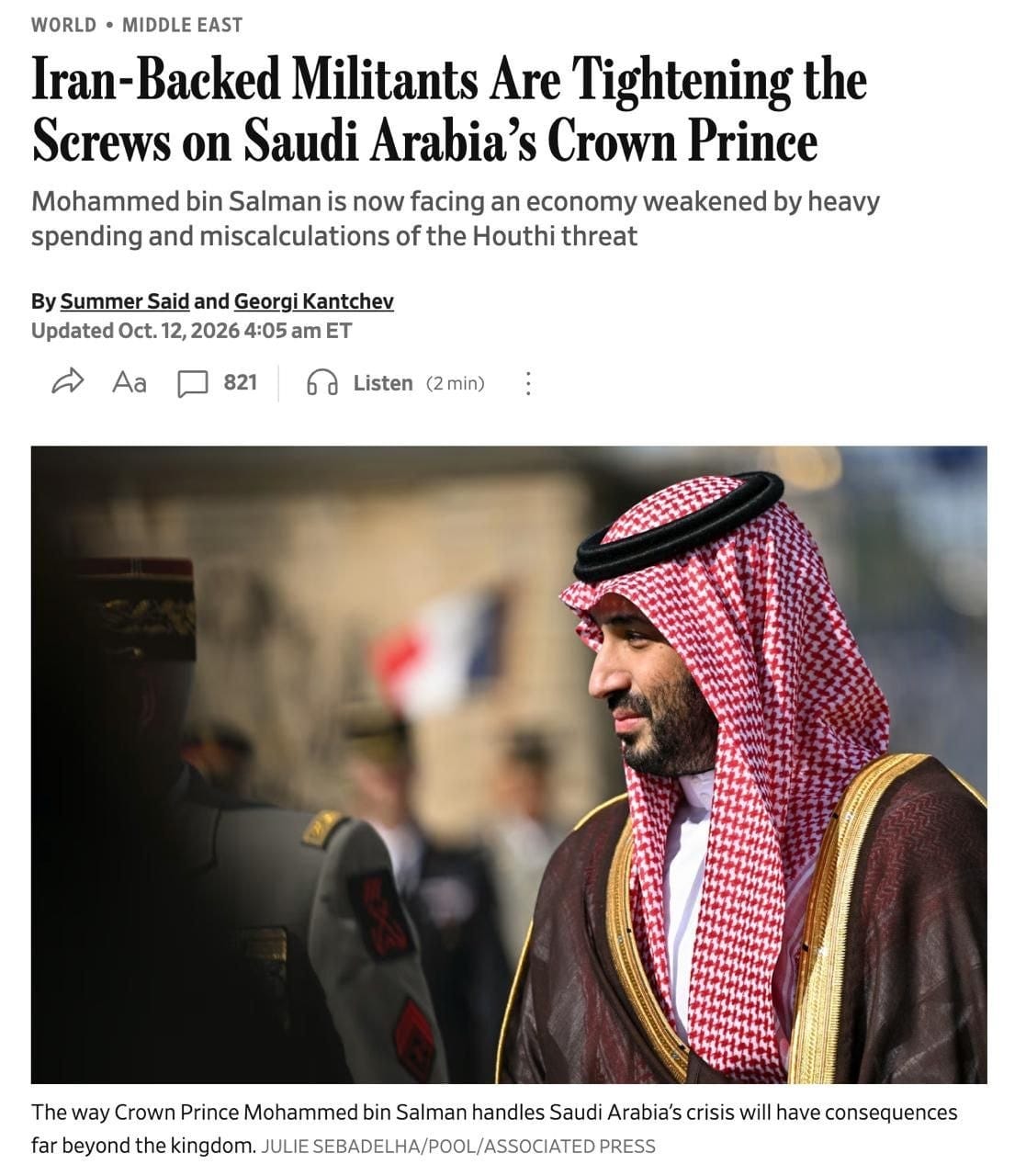
DUBAI—Saudi Crown Prince Mohammed bin Salman started the year on a high note. He had just visited the White House where he was embraced by President Trump. Even after the war with Iran kicked off, Saudi Arabia looked relatively well positioned. It could export oil through a pipeline that bypassed the blocked Strait of Hormuz.
But the Saudis’ escalating fight with Iran-backed Houthi militants in neighboring Yemen now poses new challenges to the kingdom’s security and the crown prince’s ambitious but already struggling plans to transform the country’s oil-dependent economy.
The report reveals that the Prince has been reduced to scurrying possum-like from bunker to bunker in an attempt to outlast the relentless Yemeni attacks, which continue even as of this writing:
The 41-year-old crown prince is shuttling between heavily guarded palaces equipped with bunkers and is guarded by a handpicked security team, officials familiar with his movements said. His last public appearance was Tuesday, when he gave blood to support a national donation drive.
The problem for Saudi Arabia, as WSJ correctly notes, is that the kingdom has no good options on the table. The slow ascendance of the Ansar Allah movement into asymmetrical dominance has taken place with Iran’s—and indirectly, Russia’s—help:
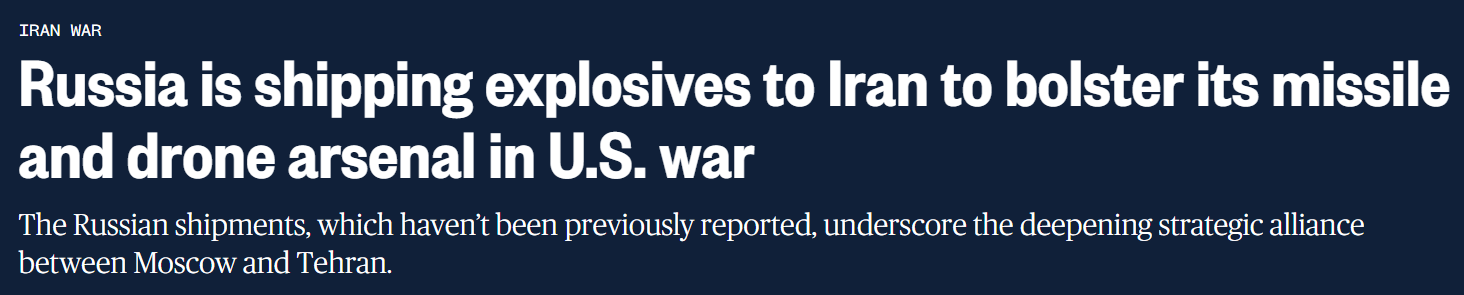
Not to mention a rather unexpected bit of help:
Anthropic admits Houthis used Claude AI instead of weapons engineers to make rockets and ballistic missiles that correct themselves after missing targets https://t.co/KkMXULCSX8
— Daily Mail (@DailyMail) October 12, 2026
Now the Houthis are capable of both making mincemeat of Saudi forces on the battlefield, thanks to drones and increased ISR capabilities, and bypassing KSA’s air defense shield with cheap ballistic missiles.
The Saudi leader has few good options, said Kristian Coates Ulrichsen, a Persian Gulf expert and fellow with Rice University’s Baker Institute. “Any military response risks getting drawn in deeper to an asymmetric conflict in which the Houthis have shown they have the ability to inflict significant and symbolic damage.”
In the above case, Iran has played a particular role by reducing air defense stocks in all of US’s allies over the course of this past year. Russia too has done so by forcing Ukraine to eat up a vast amount of the same needed missiles. This goes to show how interconnected the growing global war has become, and how countries of Iran’s axis have surged ahead to field asymmetric advantages that are now paying massive dividends against their woefully unprepared foes.
Security Alert: U.S. Mission Saudi Arabia (October 12, 2026)
— U.S. Embassy Riyadh (@USAinKSA) October 12, 2026
U.S. government employees working in Saudi Arabia require special authorization to use any airport in Saudi Arabia.
U.S. citizens should be aware of potential flight cancellations, airspace closures, and travel… pic.twitter.com/87Ax8LBdU9
Ansar Allah forces have also been capturing more and more territory from the PLC government forces, with the city of Taiz in southern Yemen currently being surrounded and placed under total siege:
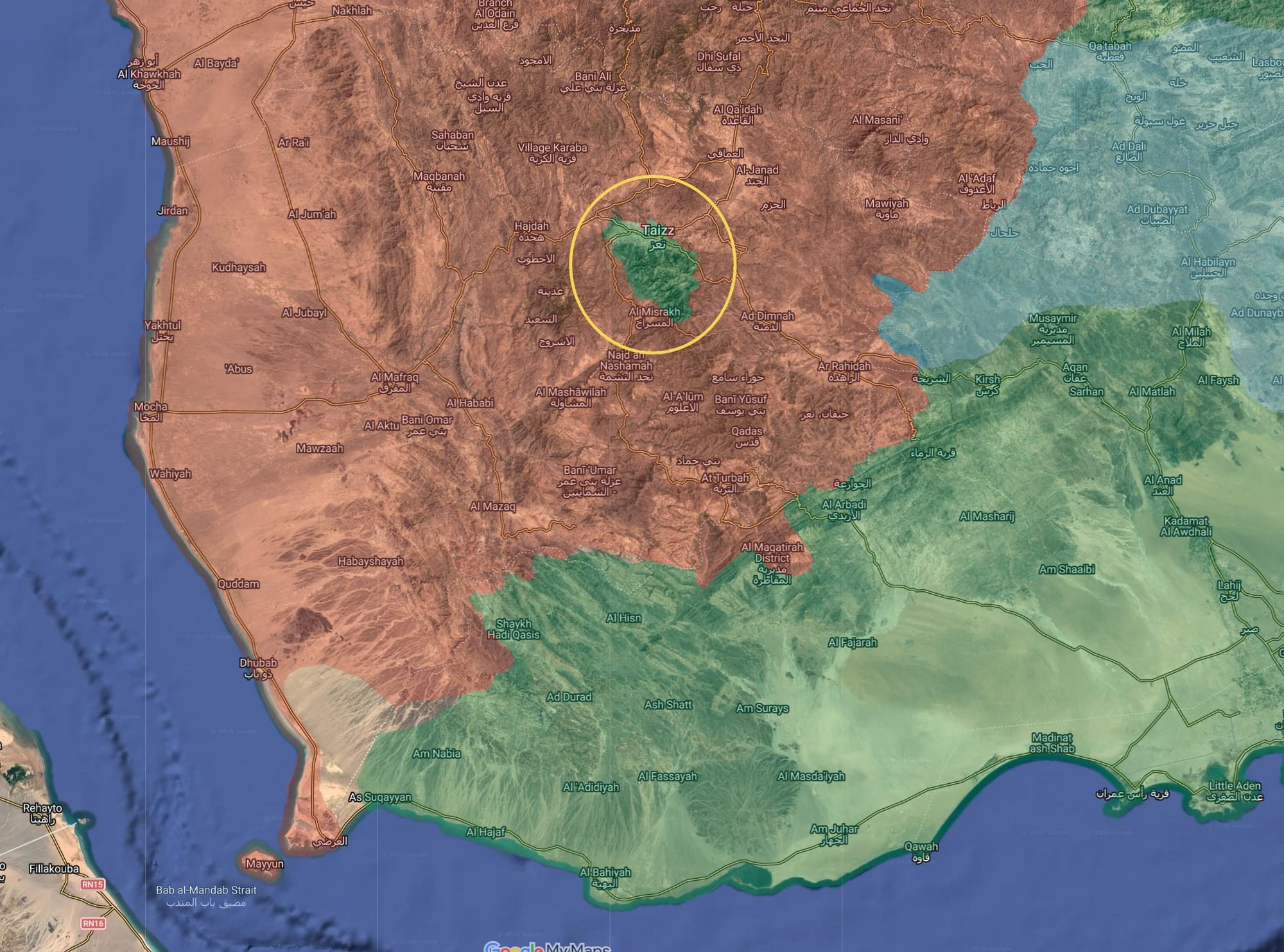
Rough map of what's left of merceneries in Taiz, once the mountain falls, so will the city. https://t.co/Uv7YkWHjOZ pic.twitter.com/t9TGgNlOyA
— Vatnik observer (@Aleksandar88338) October 12, 2026
Taiz is the country’s third largest city, after Sanaa and Aden, so its capture will mark an important milestone in the ongoing conflict.
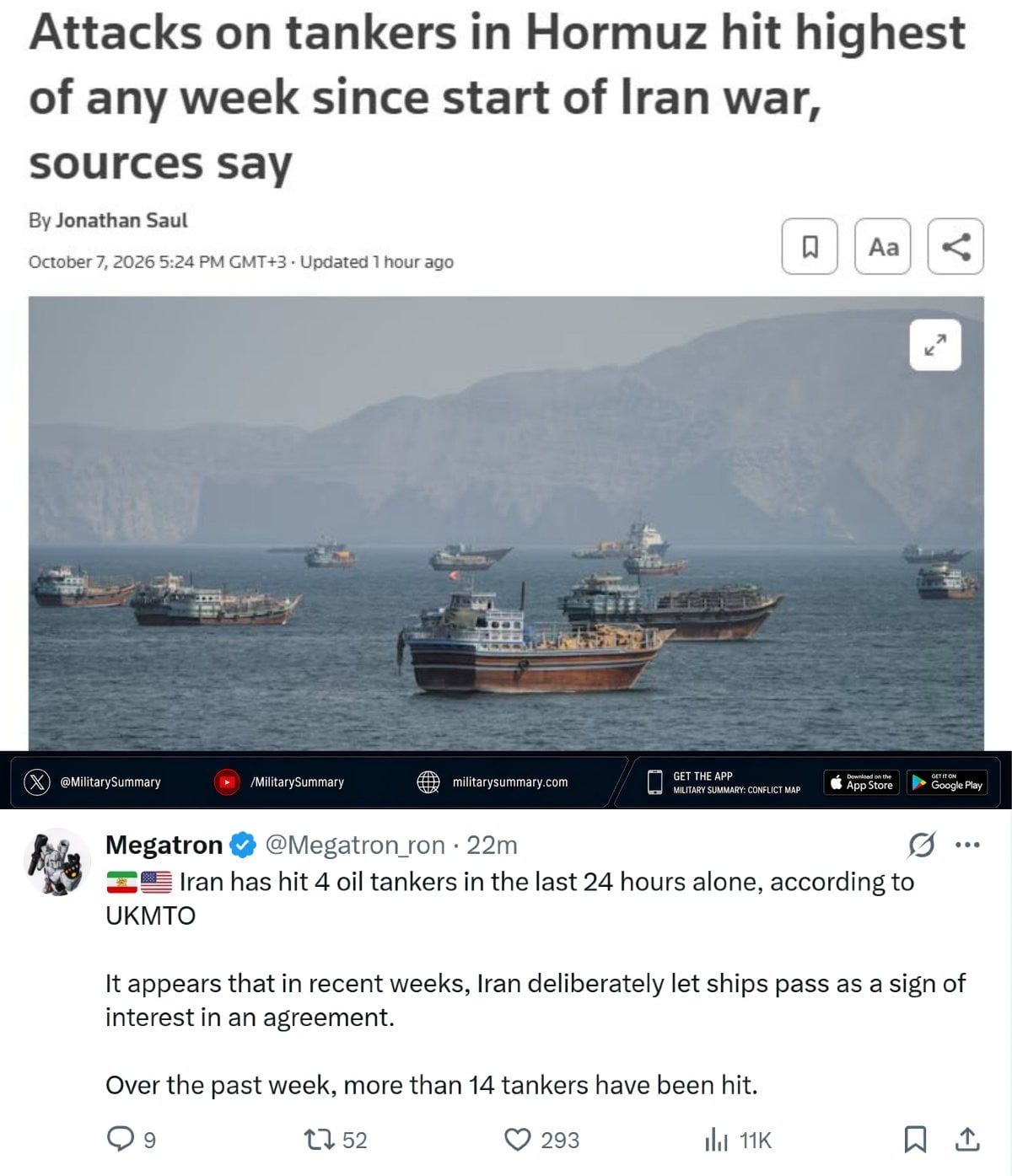
At the same time, Iran has now again widened its blockade of Hormuz and begun hitting more ships outside of strictly the strait itself:
Three additional tankers have been targeted by Iranian strikes in the strait of Hormuz over the past 24 hours. https://t.co/YfQKksD3tS pic.twitter.com/45xrmSosQV
— ayden (@squatsons) October 12, 2026
Reuters writes:
Attacks on tankers sailing through the Strait of Hormuz hit their highest last week of any week since the Iran war began, according to maritime security sources tracking incidents, amid a bigger export push by Gulf producers.
Attacks, attempted attacks and harassment activity including drone overflights, surveillance and hailing using VHF radio by Iran’s Revolutionary Guards have persisted in the strait, the US Navy-led Joint Maritime Information Center (JMIC) said in a note on Sunday.
Recall in the last Hormuz update we had written that there are likely secret handshake agreements in place which have facilitated the transfer of oil through Hormuz while giving Trump the ability to claim dominance. In reality, more and more evidence continues to pour out indicating that the only reason oil was passing was due to these agreements, and now Iran has begun to revoke them:
Kpler's Michelle Brohard suspects some Gulf producers are quietly paying Iran tolls for safe Hormuz passage, possibly 10-20% of cargo. The claim is unverified, but it may help explain why Brent sits near $100. #Hormuz #OilPrices #Iran #Brenthttps://t.co/NlX0ugXr2L
— OilPrice.com (@OilandEnergy) October 8, 2026
Read the highlighted below from Trita Parsi:
Michelle Brohard, head of policy and geopolitical risk at Kpler, speculated in a recent interview with energy analyst Rory Johnston (@commoditycontext) that the reason why more crude is getting through the Strait of Hormuz may be because some countries are paying Iran a toll, possibly up to 20% of the value of each cargo.
I cannot verify whether this is true or not, but I have heard directly from the Iranian side that certain countries in the GCC have struck deals with Iran to allow their oil to get out, and that this is the main reason why more traffic is flowing rather than the Trump administration’s military efforts. “Whatever flows through the Strait, it’s because we are allowing it to flow,” I have been told.
One can dismiss the Iranian account as a desperate effort to claim control over a situation that, on the surface, is moving against Iranian interests.
The situation has gotten so bad that chartering a VLCC tanker now costs more than sending heavy freight to outer space via Space X rocket:
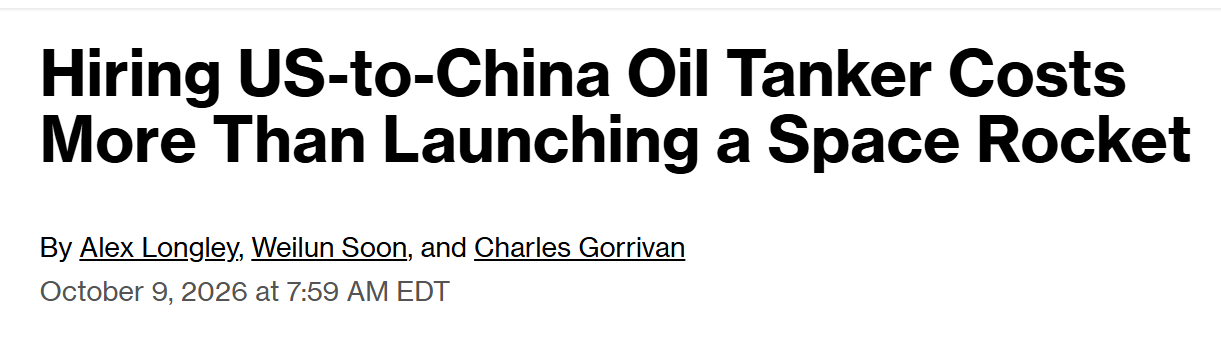
Bloomberg writes:
For a sign of just how extraordinary oil shipping costs have become, consider this: It’s now more expensive to hire a tanker from the US to China than to launch a rocket into space.
That journey costs about $80 million, compared with $74 million for a standard SpaceX Falcon 9 launch, shipbroker Gibson said this week. The same amount of money could have bought a near-identical tanker outright earlier this year.
The eye-watering prices are the result of a global tanker shortage that is getting worse with every additional barrel of oil flowing through the Strait of Hormuz.
They state that the rates now even dwarf the tanker wars of the ‘80s, and are the highest in the history of supertanker spanning the oceans:
Brokerage SSY says that, even after adjusting for inflation, rates are now the highest since the first supertankers hit the world’s oceans in the 1960s — surpassing the tanker wars of the 1980s, when Iran and Iraq attacked commercial shipping in the Persian Gulf.
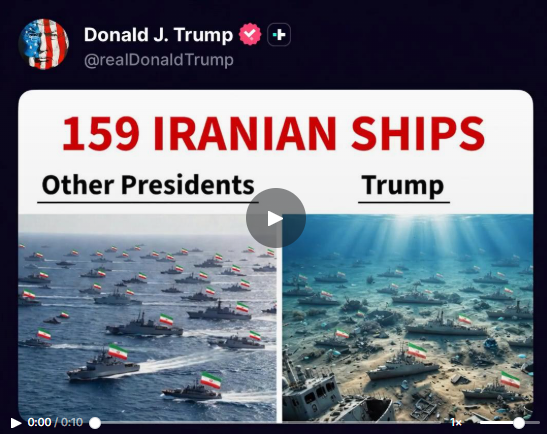
All the while, Trump has continued claiming the war is won and US controls everything, as per usual, all because he sunk a few Iranian ships sitting in harbor, which has zero effect on Iran’s ability to assert itself over the strait via drones and missiles:
But some experts believe the West is now abandoning Saudi Arabia, at least to an extent, because no one wants to be dragged into another Hormuz-like quagmire against the Houthis. Trump himself appeared to decline in joining a Saudi-led strike campaign against Yemen, with some speculative reports even claiming that the US is not using its air defense installations in Saudi Arabia to protect the country against the latest Houthi attacks:
BREAKING: The Saudi government is angry that the U.S. military is not using its air defense systems and fighter jets stationed in Saudi Arabia to protect the country, particularly the airports in Riyadh and Dammam.
The U.S. Army’s Patriot PAC-3 battery in Saudi Arabia protects only Prince Sultan Air Base against Iranian threats—not Riyadh or other Saudi cities against Houthi attacks.
Unlike in previous years, U.S. Air Force and Air National Guard fighter jets stationed at Prince Sultan Air Base are no longer conducting combat air patrols to intercept Houthi drones and cruise missiles over Saudi Arabia. Instead, they are patrolling the Persian Gulf, the Strait of Hormuz, and the Sea of Oman.
This has angered Saudi Arabia, which is itself unable to use its own Patriot PAC-3 and THAAD air defense systems to protect its air bases.
Speculative, but quite damning. If true, it would mean that Trump is either wary of crossing the line and supporting another regional conflict, or is simply being urged to preserve dwindling missile stocks by his desperate generals.
🚨🇸🇦🇬🇧🇺🇸 Saudi is reportedly frustrated with the limited military assistance its received from Western allies...
— Mario Nawfal (@MarioNawfal) October 12, 2026
The UK has provided an air-refueling aircraft, but Saudi's requests for additional defensive support in recent weeks have yet to come to fruition.
Saudi Patriot and… pic.twitter.com/BwFFSuOEzM
Yesterday, however, Trump did remark that the Pentagon was “looking at” possible participation in the wake of the blistering new strikes against Riyadh, althought his could be simple lip service to appear “strong” to his allies.
Little does Trump realize that he is being lured into a masterfully planned Iranian campaign to bog the US down across multiple theaters, stretching its naval forces, air defense stocks, and political capital in a war of attrition the US has already squandered any chance of winning.
In the absence of Trump’s help, however, it seems Bibi may be willing to bail out his confrere:
BREAKING: Israel is preparing to join the campaign against Yemen's Houthis, with Netanyahu seeking Saudi Arabia's approval through US mediation, per Haaretz.
— The Hormuz Letter (@HormuzLetter) October 12, 2026
But according to Haaretz the Crown Prince has already opposed the idea, fearing public backlash at such a direct partnership with Israel. Either way, we all know how such Israeli aggression would end: with more missiles raining down on a defenseless Tel Aviv.
Now, as Trump reportedly “considers” entering the war a Houthi official has already sent a strong response:
An Iran-backed Houthi official warned Monday of a “swift and painful response” targeting the United States and its interests in the region if Washington enters the war in Yemen, AFP reported.
— Iran International English (@IranIntl_En) October 13, 2026
“If the US becomes involved in the aggression against Yemen, we will not deliberate…
“If the US becomes involved in the aggression against Yemen, we will not deliberate over the decision to respond, rather, there will be a swift and painful response targeting the US and all its interests in the region,” Houthi political bureau member Mohammed Al Bukhaiti told AFP.
Bukhaiti also warned employees at Saudi oil facilities and airports to stay away, saying the sites had become “legitimate targets.”
Recall that after taking the region bordering Bab al Mandab Strait, Ansar Allah declared that only Saudi vessels would be barred from crossing. Trump likely knows that should he join in on the strikes, then US vessels too would be targeted, stretching his navy and incurring even more economic costs on the eve of the all-important midterms.
As such, both Trump and the humiliated Clown Prince have their hands similarly tied, and are unable to do much of anything.


