

Prior to the disruptions of the current Iran War, the Kingdom of Saudi Arabia (KSA) had spent more than a half-century as the world’s leading oil exporter. That crucial economic role and the vast gusher of wealth thus generated had established KSA as one of the most important countries in the world.
The Middle East is a dangerous neighborhood, and the Saudis had long recognized that fact. In recent years, their annual defense budget had been the eighth largest on earth, far ahead of what was spent by France or Japan and approaching that of India.
Over the last dozen years their military expenditures totaled around a trillion dollars, and much of that had been invested in some of America’s most advanced and expensive weapons systems. The Saudis deployed hundreds of advanced combat aircraft, so that on paper they possessed nearly twice the striking power of Israel’s very formidable air force.
They had also taken many other steps to ensure their safety.
America had long regarded them as our most important Arab ally, and we had provided security guarantees stretching back to President Franklin Roosevelt’s famous meeting with King Ibn Saud in 1945. The Saudis hosted some of our own local military forces, and their country was ringed by several of our largest regional bases in Bahrain, Qatar, Kuwait, and the UAE.
Although the Saudis were seen as close American allies, they also maintained excellent relations with Russia, with which they shared leadership of OPEC+, and with China, the top buyer of their oil.
The Saudis also carefully cultivated friends and influenced people by spreading portions of their vast wealth across the Muslim world and beyond. Egypt’s huge and impoverished population was partially dependent upon such Saudi largess, while the government of nuclear-armed Pakistan was in a similar situation.
This towering international role for the Kingdom contrasted very sharply with the status of Yemen, their obscure neighbor situated at the bottom of the same Arabian peninsula. That latter country fell at the exact opposite end of the global spectrum, barely known for anything other than khat, the mildly stimulative drug that its impoverished population constantly chewed, often injuring their gum tissue as a consequence.
Political division and civil war had long been endemic to Yemen. For more than twenty years the internationally recognized government of that country has been locked in a bitter conflict with the rebellious Houthis, a northern militia of fierce mountain tribesmen who gave it a great deal of trouble despite its strong military support from both the Saudis and the UAE.
I doubt that too many people around the world had ever paid much attention over the years to the khat-chewing Houthis or their simmering resentment at what they regarded as Saudi interference in their own country’s internal political conflict.
But in recent weeks and especially in recent days, this situation has been drastically transformed. Our news headlines have been filled with reports of the terrible destruction that Houthi missiles and Houthi drones have inflicted upon Saudi Arabia, a country with a per capita GDP that was roughly one hundred times higher.
Many of the most important Saudi oil facilities have been severely damaged, reducing their exports of crude to almost nothing. Attacks on the Kingdom’s major airports have shut down most of the flights, effectively imposing a substantial air blockade against a country long considered a central pillar of the global economy.
As an example of the dramatic impact of these Houthi attacks, some 300 of the world’s leading CEOs and senior executives had been scheduled to attend the important five day WPC Energy Congress held in Riyadh. But with most flights to the country cancelled and the looming threat of additional Houthi missile strikes, many of those top business leaders had cancelled, including the chief executives of Exxon, Shell, Chevron, and BP, with others only participating via video calls.
Top energy CEOs pull out of Riyadh conference after Ansarallah airport strikes
— The Cradle (@TheCradleMedia) October 12, 2026
——
Several of the world's top energy executives were removed from the schedule of the WPC Energy Congress in Riyadh following Ansarallah's strikes on the Saudi capital, Reuters reported on 12 October.… pic.twitter.com/eDMWoBo0uh
Over the last generation or two, the Saudis have invested enormous effort and vast sums of money in raising their global standing by attracting many high-profile international events to their country. But on Friday, another New York Times article emphasized that many of these would now be severely diminished or even cancelled.
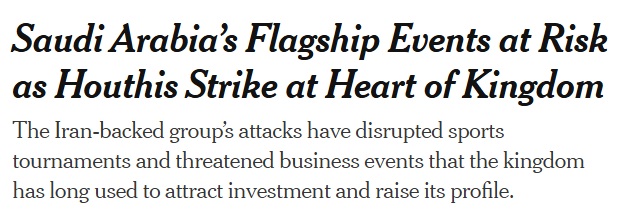
One of the Kingdom’s proudest achievements over the past decade had been the privatization of Saudi Aramco, the state oil company. In 2019 that corporation went public in what was then the largest IPO in history, and since that time it has sometimes ranked as the most valuable company in the world, with its current market value being over $1.6 trillion. But a few days ago, Houthi missiles seriously damaged the Aramco headquarters, representing a terrible national humiliation.
The Saudis have an annual military budget of well over $80 billion while that of the Houthis is so small that the Gemini AI will not even hazard a guess as to its size. But the former seem totally helpless at defending themselves against the attacks of the latter, or even merely deterring those constant strikes.
A few days ago, the editor of the Wall Street Journal published a special note highlighting the front-page story the newspaper was running that same day on the terrible Saudi predicament:
A deadly attack on Saudi Arabia’s main airport over the weekend exposed a deepening crisis for Crown Prince Mohammed bin Salman. The strikes by Iran-backed Houthi militants killed at least 12 people and injured hundreds more.
With threats mounting, the crown prince is shuttling between heavily guarded palaces equipped with bunkers. The violence threatens his ambitions to turn Saudi Arabia into a global tourism and investment hub. Summer Said and Georgi Kantchev examine how Mohammed’s own decisions have contributed to his predicament, with rising defense and infrastructure costs threatening to siphon away funds needed for the economic diversification push.
The attacks are also wreaking havoc on global air travel. Airlines canceled more than 1,000 flights, as threats to Saudi airspace jeopardize one of the last two major air corridors connecting Europe and Asia.
For nearly a decade, Crown Prince Mohammed bin Salman (MbS) has been the imperious de facto ruler of the Kingdom, but according to the Journal he had gone into hiding, secretly moving from bunker to bunker, surrounded by his handpicked personal security force. Meanwhile, the sudden loss of nearly all his country’s oil revenues might be producing a major financial crisis for his regime.
These are dramatic developments. The Kingdom is now nearly a century old, but last week many knowledgeable experts in the history and politics of the region began suggesting that the long reign of its royal family and perhaps even its national existence might be tottering.
For decades Chas Freeman has ranked as one of our most distinguished diplomats, serving as our ambassador to Saudi Arabia during the crucial period of the 1991 Gulf War, and then spending time as an assistant secretary of defense. He obviously knows the Persian Gulf region extremely well, and in his interviews last week, he raised the possibility that Saudi Arabia might collapse.
Alastair Crooke has also spent decades involved in the Middle East, first as a senior MI6 officer and then as a British diplomat and influential peace negotiator. He came to many of the same conclusions.
A crucial point heavily emphasized by Crooke was that the fearful, furtive movements of the Saudi leader were not due to any concerns that he might become the victim of some missile strike by the Houthis, who had no record of undertaking such assassination attempts.
Instead, he surely dreaded his multitude of internal Saudi enemies, all of whom might regard his recent failures and his current weakness as an invitation to eliminate him or perhaps even overthrow his entire ruling dynasty.
The Saudis have long been deeply hostile to Shia Iran, which they regarded as the great regional rival to their own Sunni Muslims of the Persian Gulf. But the Iranians constituted an ancient civilizational-state whose political existence stretched back thousands of years, while with some justice they regularly referred to Saudi Arabia and the other wealthy Gulf Arab states as merely family dictatorships.


