

The past week Western analysts were shocked to discover that Russian armor storage facilities, which were long thought to have emptied out due to the Ukraine war, have been quietly refilling with freshly produced and refurbished armor.
New satellite photos have shown various bases which were totally emptied out during the long years of the war during which the West’s top analysts told us that Russia was not only running out of armor each day, but would run out of heavy tanks, IFVs, and artillery systems in the near future. We repeatedly wrote this was impossible, as Russian doctrine would always dictate that armor losses would end up equalizing with production and shifts in tactics which would incrementally arrest losses until a balance was reached.
This past year we have reported here several times on how vehicular and equipment losses between Russia and Ukraine were slowly flipping. Incidentally, the latest figures from one source:
Vehicle losses have been released for the month of September.
— Hudson War Mapping 🇺🇦 (@hudsonwarmap) October 5, 2026
Primary credit: @HeyHey_Hayden TG
In total, Russia lost 32 vehicles whilst Ukraine lost 175. A ratio of 1:5.5
Excluding Armoured cars/MRAPs, which skew the ratio as Russia hardly utilises them at all whilst Ukraine… pic.twitter.com/g1w8sKS9t6
This came by way of several factors, including the reduction in heavy armor use due to the proliferation of drones, but also increased reliance on small-unit infiltration tactics.
One notable omission in people’s understanding of the latter point: Most assume Russian small-unit infiltration tactics were exclusively a result of increased drone pervasiveness—but this is not the case. In fact, if Ukraine had retained the same defensive capabilities as before, nothing short of large armored columns would currently work in pushing territory. One of the real reasons small unit infiltration began to work was due to the sheer depletion of the AFU’s manpower, which thinned the frontline to such a degree that it allowed small Russian two-man teams to penetrate the scattered pickets of the AFU’s remnants on any given line. If the AFU still possessed adequate manpower, no amount of two-man team infiltration would be possible, as such units would be quickly outmanned, outgunned, and picked off.
As such, it’s important to acknowledge that one of—if not the—most important factors leading to this tactical evolution was in fact Russia’s decimation of Ukrainian manpower, rather than the simplistic “drone evolution” explanation.
On that note, to digress and contextualize the main topic, the latest research on the matter from an academic paper presented at the National Defence University in Helsinki, Finland has some major findings on the estimated casualties of the Ukraine war:
Confirmed data indicates Ukraine is losing far more troops to death or injury than Russia, at least ten times more, probably higher.
— Ian Proud (@proud_diplomat) October 24, 2026
I discuss an academic paper by Alexander Grable @GAWL7014 presented at the Finnish Defence University @mpkkfi https://t.co/4NzxVPdGf4 pic.twitter.com/AixWc32URd
Read the full paper below (download PDF on the lower left of the page):
Skip to page 149 of the PDF for the chapter called “IRRETRIEVABLE LOSSES: ESTIMATING CASUALTIES ON THE RUSSO-UKRAINE WAR”.
Or you can watch the in-person presentation of this chapter by the author himself, Alexander Grable, at the 2 hour 45 minute timestamp here:
The fascinating piece sheds some skepticism on Mediazona’s infamous casualty tallies for Russia, noting several examples of officers listed as KIA by Mediazona, but whose deaths could not be independently verified by the author. When the author queried Mediazona to address this, they replied to him that they have utilized another more obscure government resource which they “do not mention publicly”. In short, their results are not replicable and they hide this fact behind the cop-out of obscure “secret sources” they refuse to list openly.
He further notes that Mediazona has found only ~6,000 Russian officers as being KIA. This is problematic because as per the researcher’s own estimates, the proportion of officers in the Russian Army should have been closer to 20% than to 5%, and more likely, he believes, around 14%. He concludes ~6,000 KIA officers should yield a total casualty ceiling of around 86,000 rather than the nearly 300,000 Mediazona now claims for Russian losses. These are just small examples out of many more given, which you can read for yourself in the piece.
Using official amputee data from Ukraine’s own National Institute for Strategic Studies, the author finds the following casualty estimate disparity using 2024 figures:
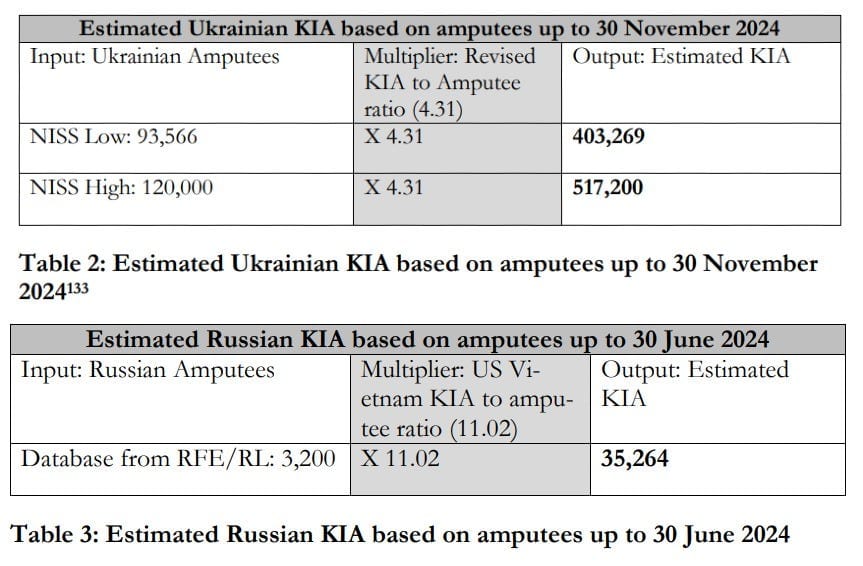
The author correctly notes that the above estimate ratio is roughly 10:1, which corresponds to the body exchange ratios seen between Ukraine and Russia over the past two years:
It is worth highlighting here as well that the ratio in the exchange of the bodies of fallen soldiers between Russia and Ukraine, is 12.46 Ukrainian fallen for every Russian, and also meshes with the amputee information.
A new exchange of bodies happened to be conducted just days ago, with 252 Ukrainian bodies exchanged for 25 Russian ones—an exact 10:1 ratio:
Russia and Ukraine conducted another exchange of fallen soldiers today.
— AMK Mapping 🇳🇿 (@AMK_Mapping_) October 22, 2026
The bodies of 25 Russian soldiers were exchanged for the bodies of 252 Ukrainian soldiers. https://t.co/9iMs776QDe pic.twitter.com/asCbN4uL9e
As a reminder of the exchange history—ignore the incorrect AI translation of “SMO” into “Second World War”:
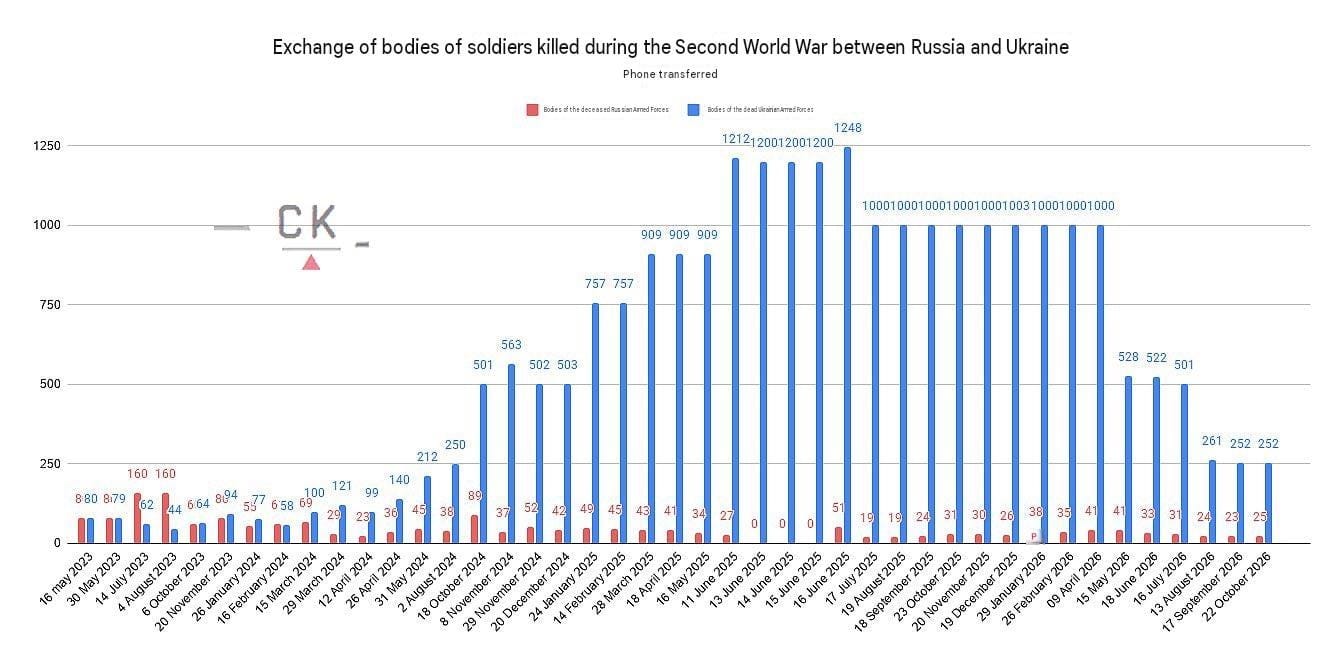
Remember: Ukraine claims the disparity is because Russia was advancing. Yet it is Ukraine that has been advancing for the past several months, according to the AFU, recapturing large swaths of territory. So, which is it? Either Ukraine’s advances were a lie, or the casualty disparity has nothing to do with who’s advancing.
Getting back to the report, the conclusion on casualties reached is as follows:
Conclusion
What then is the balance? The evidence presented demonstrates that Russian KIA/MIA are very probably less than heretofore estimated by most sources, and Ukrainian losses are very probably higher than heretofore estimated by most sources. Moreover, the evidence presented in this article very strongly suggests that Ukrainian losses in KIA/MIA are higher than Russian losses, both relatively and absolutely. Ukraine, with a much smaller population, is quite probably on the wrong side of the attritional gradient, and is losing the war. This puts the sustainability of its combat effectiveness over the current broad front at risk. On this trajectory, Ukraine is unlikely to prevail, and Russia may achieve the upper hand. As Vershinin has argued, Ukraine is running out of room in negotiations as it loses its manpower. Given the critical support provided by NATO, this also means NATO militaries might need to re-evaluate their thinking about the conduct of the war.
Russian Armor Reserves Mysteriously Begin to Grow
With that groundwork out of the way, let us now get to the main portion regarding the “shocking” findings that Russia has been replenishing its armor reserves all across the country, as if in preparation for a future conflict, and what this means about the future of the SMO.
There were several accounts documenting this, most notably the Radio Free Europe editor below, as well as Jompy, who is the leading pro-Ukrainian researcher of Russian armor storage bases. It is Jompy’s research, which consisted of satellite imagery comparisons, that formed the backbone of the theories from 2022 onward that Russia was running out of tanks:
1/4 The 22nd Tank Storage Base, 500 km from the NATO border, is being replenished with new T-90M tanks, as seen in a comparison of @planet satellite images from October 2025 and October 2026. https://t.co/PxXHI8ju5z pic.twitter.com/e84Oj8zoNA
— Mark Krutov (@kromark) October 16, 2026
This concerns some of the following storage bases, which have seen huge influxes of stored armor over the past year.
The 22nd tank storage base near Kostroma, Russia—at 58°27’51.0”N 41°30’25.0”E geolocation:
The 22nd Tank Storage Base, 500 km from the NATO border, is being replenished with new T-90M tanks, as seen in a comparison of @planet satellite images from October 2025 and October 2026.
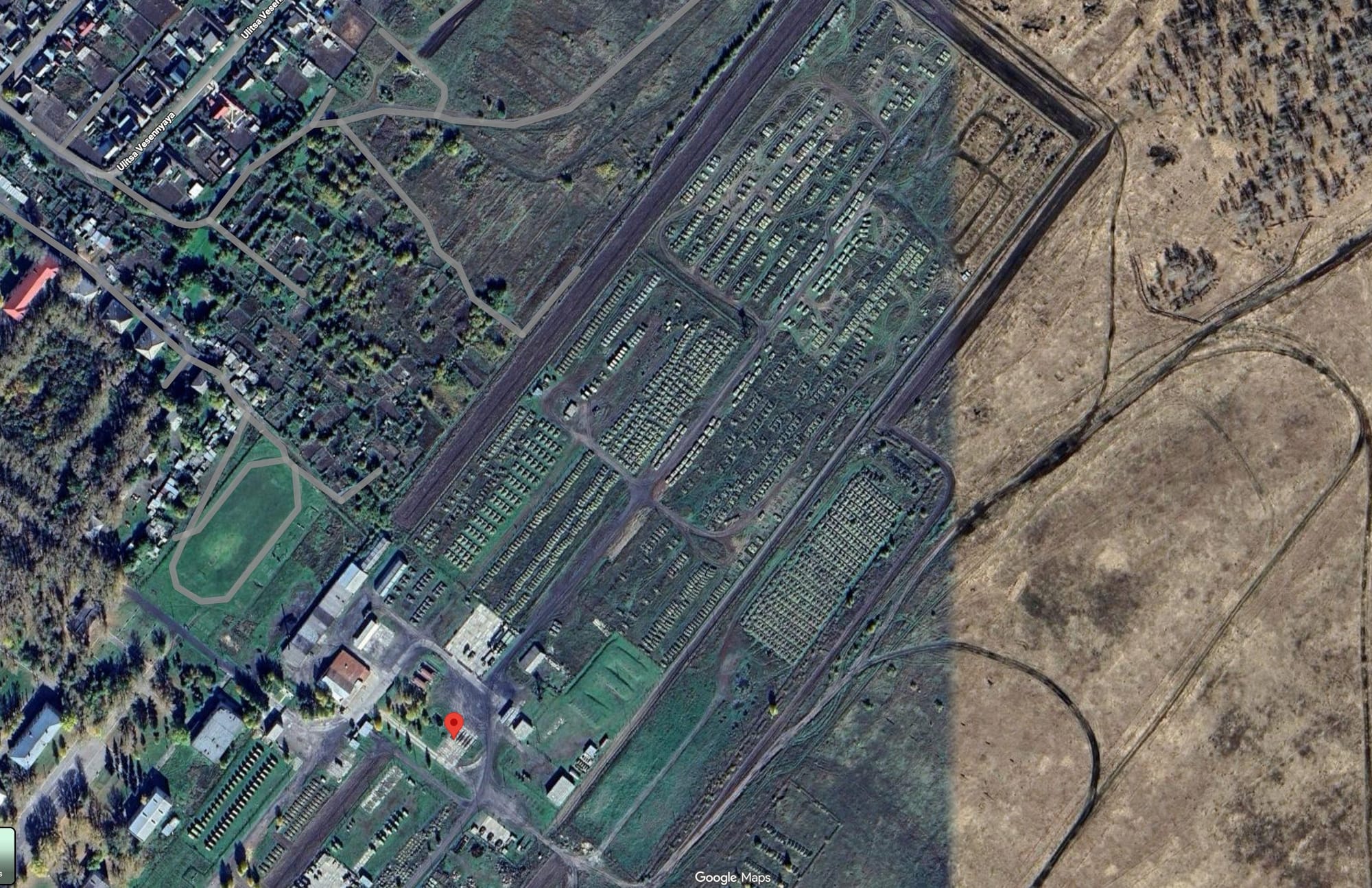
The 349th in Altai Krai, Russia at 52.8115° N, 83.1363° E:
The 349th storage base, Altai Krai. @planet image taken yesterday, Oct. 15, vs Oct. 2025. Southern part fully packed.
The larger northern part of the base had a significant increase in the past year:
The 349th storage base, northern part, significant increase of vehicles. Oct. 15 2026 vs Oct. 2025.
The current Google satellite map appears to show even more armor there, though it’s difficult to tell the exact date of the image despite it being marked as 2026:
One of the shocks is that much of the equipment being replenished consists of the newest produced stuff: T-90Ms, BMD-4Ms, BMP-3Ms, etc.
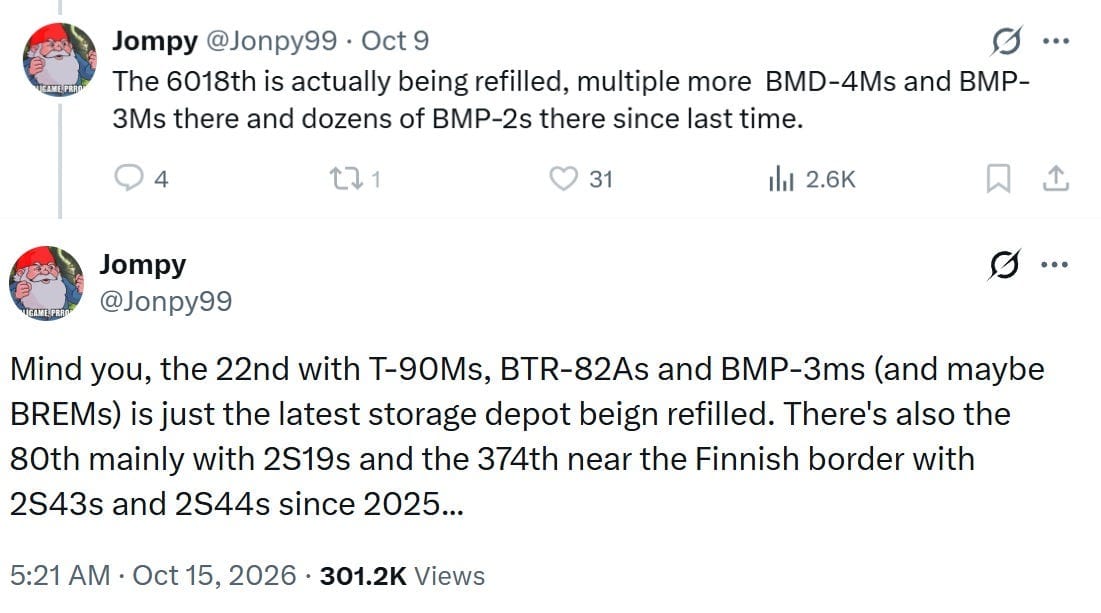
The famed Covert Cabal has purchased further satellite imagery confirming the T-90M replenishment into the 22nd base:
There has also been replenishment at other bases like the 6018th and 80th bases in Sverdlovsk Oblast, which have reportedly seen the latest artillery pieces like the 2S19 Mstas, 2S43 Malvas, and 2S44 Giatsint-Ks increasingly stored there.
Most of these mentioned equipment is the serially produced, latest and most advanced that Russia is now manufacturing: T-90Ms, BMD-4Ms, 2S43 Malvas, etc. Rather than being sent to the front, they are being stored in rear bases, though presumably the front is getting some as well.
In short: Russia appears to be rebuilding its stocks and reserves of every kind of armor and artillery. What can we conclude from that?
The most immediately obvious fact is that Russia is clearly not using all of its power and capabilities against Ukraine. It is continuing to build up reserves of a larger force, both because this is simply doctrinal and in case of a larger future conflict against the European aggressors.
From this simple fact alone, we can deduce many things, one of which is that the Russian approach to the Ukrainian war continues to be a measured one, where the purely kinetic battlefield aspect of the broader hybrid conflict is balanced against other necessities. This has clear correlations to the economic approach as well, where Russia has chosen to prosecute the war in a more “slow boil” fashion in order to husband its economic development in a sustainable way, where the status quo can be preserved for the average citizen without subjecting the country to a “total war”-style scenario.

It must be said that by far the most effective defense against NATO aggression is implied deterrence. When Russia first began to be putatively “bogged down” in Ukraine, we saw many figures in the West openly salivating at the mouth, with Mitt Romney once famously saying if the US wanted to go into Ukraine, it would catch Russia “with its pants down”.
By building up a credible deterrent in the form of large-scale modernized and serially-produced reserve forces, Russia is sending the message that it is more than ready for any two-front war that NATO may covertly be planning. This is particularly the case given that some of the armored storage bases listed earlier are near the European border, and are being filled with the newest and most advanced artillery pieces:
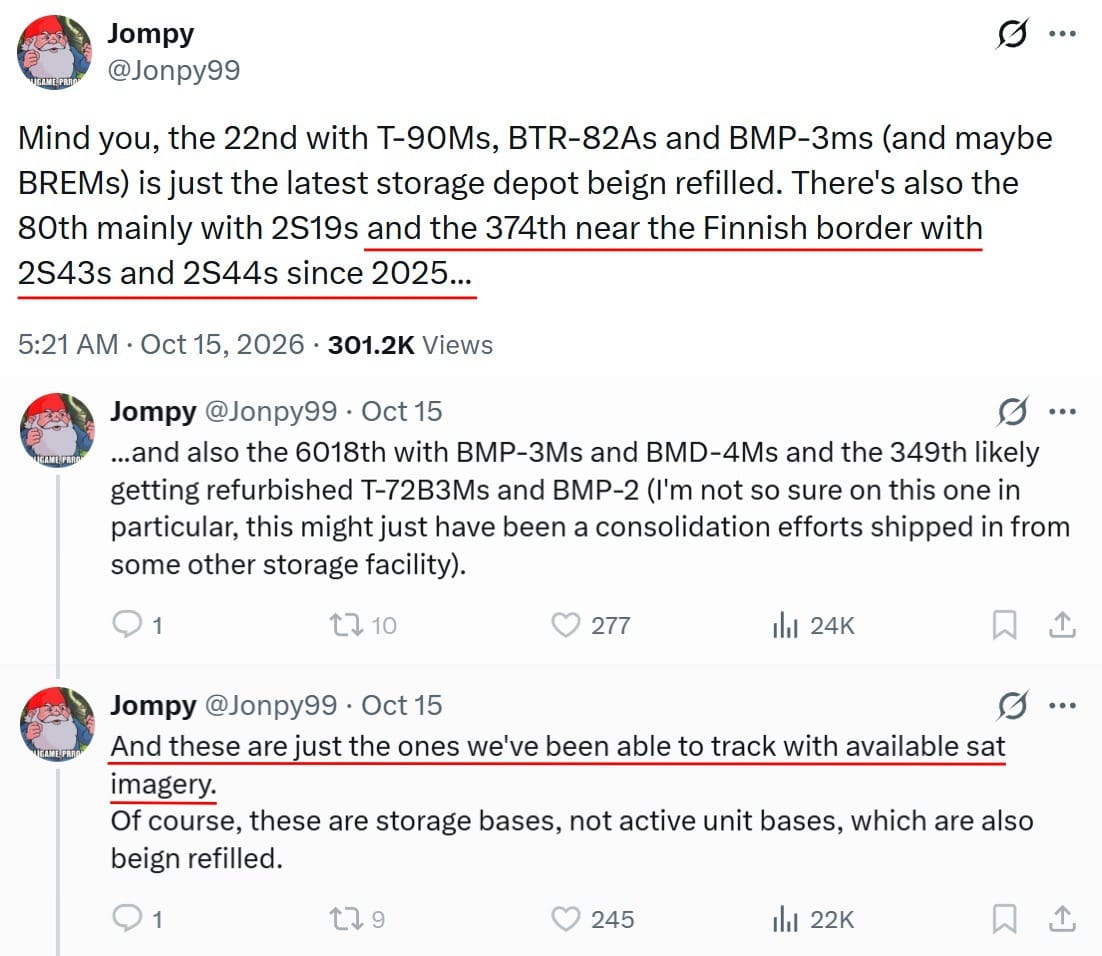
Jompy notes above that these are just the bases his team has been able to track with available satellite imagery, implying there are even more out there which are being refilled, including active unit bases rather than just excess storage bases.
We can extrapolate even further from this: An argument can be made that Russia is also preparing for a much longer-term and drawn out conflict, and will not be “baited” into rashly throwing all its armor and equipment into the grinder for quick gains, simply to appease PR-hungry press cycles, as Zelensky is so eager to do. Russia is not functioning on any particular timeline, and has apparently committed to taking however long necessary to achieve its objectives in the war.
This last point segues into something important we’ve been noting about the current battlefield dynamics and future development of the war:
Since the start of this blog in early 2023, I have made several “controversial” predictions which have flown in the face of the standard accepted orthodoxy regarding the war, but which have proven true over time. The most notable being the earliest understanding of Russia’s future strategic evolution as revolving around the “thousand cuts” mosaic strategy, which we predicted would be the long-term method the Russian forces would utilize even long before drones had come to dominate the front. Now, we see that this “dispersion” and scattered infiltration tactic of continual simultaneous pressure on all fronts is precisely where things have evolved to.
For example, though we outlined the future strategy in several different articles, from way back in February 6, 2023 and February 16, 2023, as well as many others:
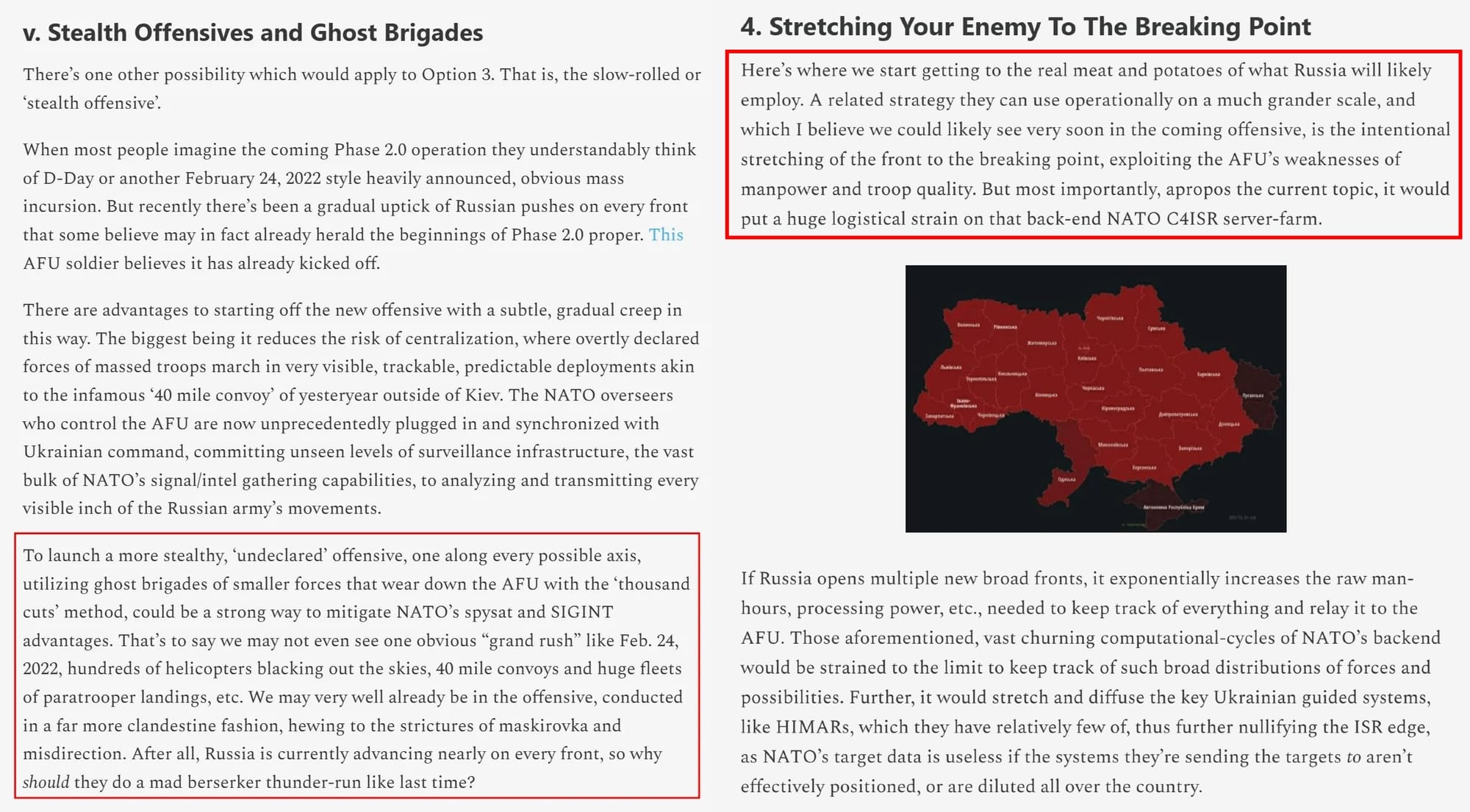
I give this past contextualization in order to preface the fact that we are now again marking a pivotal departure from contemporary analysis on the war.
Our latest predictive analysis is that Russia has initiated a kind of ‘strategic dormancy’ on the frontline, which I have mentioned before. What is this, exactly? It is a form of deliberate ‘slowing down’ of the wasteful offensive potential in favor of broader hybrid operations for a given duration until such time that favorable conditions for larger operational pushes return.
I’ve already written before that these “favorable conditions” are not some obscure “hoped-for” castles in the sky, but are distinctly imminent developments that are already taking shape for the next year. The most notable being the Rassvet or “Dawn” satellite constellation, as well as developments in the field of C-UAS (counter unmanned aerial systems), hard-kill systems like Arena-M, greater EW, etc.
One example of the above—a Ukrainian helicopter armed with a plethora of cheap anti-drone interceptors:
Such interceptors like the Russian Yolka are already becoming widespread, and it’s soon such systems could be fitted onto everything including armored vehicles.
Better drone and ISR technology will further limit the dominance of drones because it will enable the identification and targeting of enemy drone units, which are typically forced to operate ~5km behind the front. Directly eliminating the actual drone unit HQs impacts the pervasiveness and success of drones along the front in a major way.
But getting back to the idea of strategic dormancy. It is a realist approach to war, which simply acknowledges the ebbs and flows of conflict, going with the tides of the dynamics, rather than attempting to “swim upstream”. Russia understands that right now is a pointless time to put an inordinate amount of energy and effort into vast territorial captures and “breakthrough” pushes because the losses incurred are not worth it, particularly when the other hybrid aspects of the war can be leveraged to produce greater effects for the time being. In this case, Russia has privileged the rear strikes campaign which has loosened previous ROEs (Rules of Engagement) and allowed Russian forces to weaken Ukraine in ways that pure territorial captures cannot do.
That’s not to say Russia is stopping all advances, but is simply redistributing the balance of priorities and where it leverages the most resources. This again redounds to the long term outlook discussed earlier: Russia is not in any particular hurry; it sees Europe and Ukraine becoming increasingly strained both politically and economically, while Russia’s own development continues apace.
A brief update on the status of Russian oil refineries. As expected, production is up and now above Russian domestic historical demand.
— Michael Bohnert (@mbohnert) October 24, 2026
I used the past 2-3 weeks to review and update my methodology. I found a few new reliable sources. I also included NASA FIRMS data directly… pic.twitter.com/9Ee3gUbIBk
According to Reuters, Russian oil refineries have increased diesel production to a recent high. In October, diesel output rose to nearly 180,000 tons per day, up from 160,000 previously. This comes against the backdrop of agreements between the Kremlin and the US. Meanwhile,… pic.twitter.com/DB8Tc4JkTq
— WarTranslated (@wartranslated) October 26, 2026
Is this article an endorsement of the strategy? No. Would I personally have utilized the same strategy if I were in Putin’s shoes? Not necessarily. This is a simple acknowledgment of reality on the ground and statement of fact in one.
Russia will continue to deplete Ukraine’s manpower, degrade Ukraine’s infrastructure and political capital, while slowly choking out the front in a way that is favorable to Russia from a resource standpoint, privileging a focus on casualty mitigation and long term sustainability, particularly with regard to a second front potentially being opened up by the European aggressors.
When the time comes, and technology has ripened to the point of resuming more active offensive operations, then Russia will return to a more aggressive approach. A workable universalized form of the Rassvet system alone can appreciably contribute to this, which we could see next year if things go as planned.
Until then, the predominant small-unit infiltration tactics will continue being favored while the MOD leans on its hybrid drone and bombing campaign to deal the majority of the crippling damage. This campaign’s intent is not merely to destroy Ukraine’s rear and cripple the AFU, but it can be argued that its greater goal is to create an infinite resource funnel and abyss in one for the EU, in order to collapse European support of Ukraine. This will effectively be a finishing blow if achieved, and will do more for the defeat of the AFU than anything the Russian ground forces could currently do on their own.
However, given European election cycles, that moment is likely still far away.


