

By Chris Neurath, Fluoride Action Network
A new reanalysis of a widely cited 2021 Swedish study (Aggeborn & Öhman) challenges previous claims that low-level fluoride exposure has no adverse effect on cognitive function.
Presented by Chris Neurath, Research Director of the Fluoride Action Network (FAN), at the International Society for Environmental Epidemiology (ISEE) 2026 Conference in Munich, Germany (August 30 – September 2, 2026), the findings demonstrate that when the study's data and 90 relevant statistical models are closely examined, they present consistent evidence linking low-level water fluoridation to reduced IQ and academic achievement.
Click below to read Neurath's ISEE abstract:
Key Limitations in the Original Study
The original Swedish study evaluated nationwide records for over 500,000 young adults aged 16 to 20, exposed to a mean lifetime water fluoride concentration of 0.35 mg/L — approximately half the concentration used in artificially fluoridated water in the United States.
According to Neurath’s analysis, several major methodological limitations introduced substantial random measurement errors, biasing the original study toward finding “no effect”:
- Ecological Design and Extrapolation: Direct water fluoride measurements were available for only 16% of the population. Exposure for the remaining 84% was extrapolated from neighboring areas, despite sharp local variations in fluoride levels over short distances.
- Late-Age Testing Constraints: Cognitive outcomes were evaluated in late adolescence and early adulthood (ages 16–20). Testing at older ages attenuates observed IQ loss compared to early childhood testing. Prior research presented by Neurath at ISEE 2023 indicates that testing at older ages significantly reduces the ability to detect early neurodevelopmental damage.
- Omission of Non-Water Sources: The study examined lifetime average water fluoride levels while omitting primary non-water fluoride sources, including diet, tea, and dental products.
- Dilution of Early Critical Exposure Windows: Averaging fluoride exposure over 16 to 20 years dilutes the impact during critical early developmental stages. Studies show the greatest IQ reductions occur from exposure before age 5 and during prenatal development—neither of which were accounted for in the original Swedish exposure estimates.
Click below to read a preprint of Neurath's full analysis:
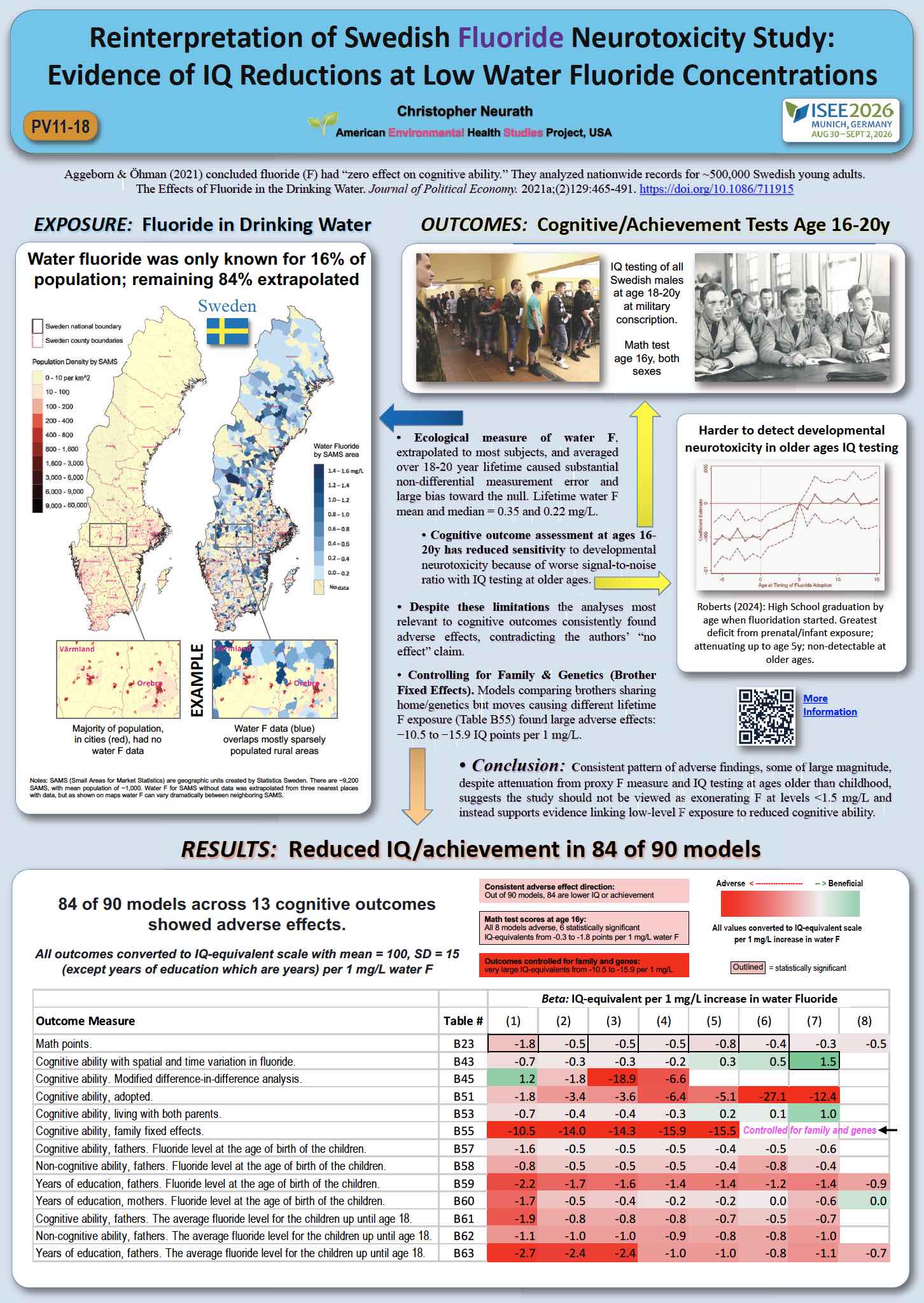
What the Data Actually Show: 84 of 90 Models Indicate Harm
Despite severe attenuation biases, a detailed examination of the paper’s supplementary tables revealed a clear, consistent trend:
- 84 out of 90 statistical models evaluating cognition and educational achievement showed negative/adverse associations with water fluoride exposure.
- 9 models reached statistical significance.
- 8 models estimated severe IQ-equivalent reductions exceeding 10 points per 1 mg/L increase in water fluoride.
Brother Fixed-Effects Models: Controlling for Genetics and Environment
The strongest evidence emerged from family fixed-effects models (Table B55 in the paper's Appendix). These models strictly controlled for genetic factors and home environment by comparing brothers raised in the same family who had different lifetime fluoride exposure due to family moves between areas with differing water fluoride levels.
For example, if an older brother was born in a municipality with 1.0 mg/L water fluoride and the family subsequently relocated to an area with 0.1 mg/L before the younger brother was born, the younger brother had significantly lower lifetime fluoride exposure. Because brothers share 50% of their genes and the same home environment, these analyses controlled for the most significant confounders of adolescent and adult IQ.
In these tightly controlled models, a 1 mg/L increase in drinking water fluoride was associated with a reduction of 10.5 to 15.9 IQ-equivalent points.


