

The U.S. government's fiscal outlook has become markedly worse in the last couple of months — not because of anything happening on Capitol Hill, but because of shifts in global bond markets.
Why it matters: An upward shift in long-term interest rates is putting the government on track to spend much more on interest payments in the coming years than was anticipated just a few months ago.
If current rates stay high and fiscal policy matches current forecasts, the cost of servicing those debts will surpass defense spending in 2025 and top Medicare spending in 2026.
In the current fiscal year, interest spending is on track to surpass $800 billion, more than double 2021's $352 billion figure. In 2026, the government's net interest expense would reach 3.3% of GDP, the highest on record.
Those numbers are from the Committee for a Responsible Federal Budget, on the assumption that rates remain 1 percentage point higher than in the Congressional Budget Office's forecasts, based on the CBO's rules of thumb.
By the numbers: In July, the CBO fiscal projections assumed that the 10-year U.S. treasury bond would yield 3.8%, which was about where the securities were trading at the time.
Not anymore. Since then, the 10-year yield set new modern highs, surpassing 4.8% on Oct. 6 (it was 4.71% on Monday morning).
How it works: Higher rates increase the burden of old debt — but not all at once. As the longer-term Treasury securities that were issued during the low-rate era (roughly 2008 to 2021) gradually mature, rolling over that debt will be more expensive.
Some $207 billion in Treasury notes matured this month alone, originally issued in 2021, 2020, 2018, 2016 and 2013. Their weighted average interest rate was 1.2%, according to Axios calculations.
They will be replaced by newly issued debt in the ballpark of 5%. The same thing is on track to happen every month for years to come.
Yes, but: Markets can shift abruptly, as the last few months show, so it's possible rates could return to something closer to their pre-pandemic norms in the years ahead, easing the pressure.
What they're saying: "Interest rates are higher than anyone anticipated, and if they remain high, interest costs will explode," Marc Goldwein, senior policy director for CRFB, tells Axios.
"With interest rates well above expected economic growth rates, we also risk a debt spiral — especially if further borrowing pushes rates up more," he added.
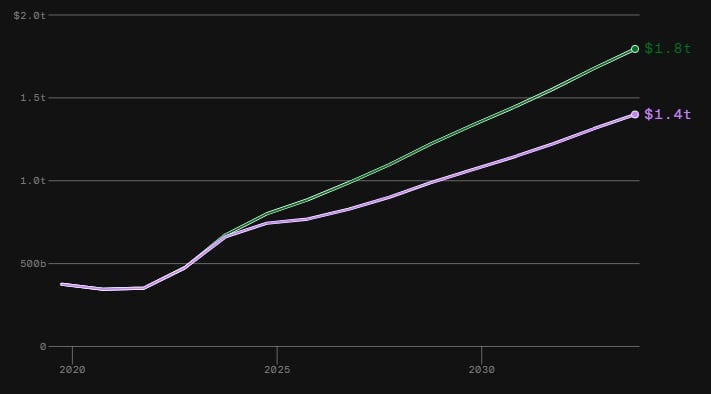
One open question is how the onset of higher interest costs — and the squeeze that will put on everything else the government does — may affect the political landscape.
Between the lines: For the last 15 years, low rates made for something of a fiscal policy free lunch for elected officials. Debt service costs were persistently low as a share of the economy, so there was little apparent cost.
Even as deficits soared — with the recession and Obama stimulus in 2009, Trump tax cuts in 2018, and pandemic rescue spending in 2020 and 2021 — there were, at first glance, few tradeoffs.
In 2020 and 2021, for example, even as nearly $5 trillion in pandemic spending went out the door, the government spent only 1.6% of GDP on interest.
Compare that to 2000, when the economy was booming and the budget was in surplus — and debt service costs were 2.2% of GDP.
The question now is whether high-interest expenses change the politics and focus the attention of fiscal policymakers. That's what happened the last time interest costs occupied as large a share of the economy as they are now poised to.
Flashback: Interest expenses reached high levels relative to the economy in the late 1980s, peaking in 1991 at 3.2% of GDP. This environment set the stage for deficit reduction by Presidents George H.W. Bush and Bill Clinton.
The bottom line: The political conversation in Washington has not yet adjusted to a world in which high-interest costs are a binding factor for both Republicans who want to cut taxes

he Art of Liberty Foundation will be co-sponsoring a conference in Sedona, Arizona on November 3rd, 4th and 5th entitled: Liberty on the Rocks!
The conference brings together some of the leading lights in Liberty to discuss our current political situation and SOLUTIONS, including how to create local Liberty groups and Freedom Cells and how to move yourself out of organized crime’s crooked admiralty law system by correcting your status and standing. Friday night, there will be a VIP Dinner and concert Featuring Grant Prezence. Saturday we are at the Global Center for Christ Consciousness in Sedona for talks, workshops and a panel. There will be a Liberty expo with the ability to table. It is free for all on Saturday after 3:00 PM. Sunday we are taking folks for yoga and hiking in the most beautiful place on the planet. Get the details at


